Published: 07 October 2026. The English Chronicle Desk. The English Chronicle Online
Conservative leader Kemi Badenoch has warned that Britain is heading towards a major political confrontation over public spending, arguing that the country faces difficult economic choices as she seeks to redefine her party’s position ahead of a future general election.
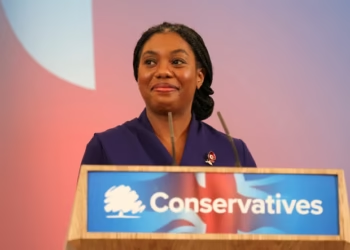
Opening her keynote address at the Conservative Party conference in Birmingham on Wednesday, Badenoch said there was a “fight coming in British politics” over the size and role of the state. She described the coming debate as a struggle over the direction of the country and presented fiscal discipline as central to the Conservatives’ political strategy.
Her speech came on the final day of the party’s 2026 conference, where the Conservatives have sought to set out a longer-term programme under Badenoch’s leadership. The conference has focused heavily on taxation, public spending, welfare, energy, immigration, housing and the role of government.

Badenoch argued that the economic environment had become increasingly difficult and warned that governments could not continue spending money without demonstrating how that spending would be funded. She said Western economies were becoming more fragile and that Britain was facing both financial and political pressures.
“We are running out of money and running out of time to put it right,” she told delegates, arguing that spending beyond what the country could afford was ultimately unsustainable.
Her remarks placed public finances at the centre of the Conservative argument against Labour. Badenoch used her speech to contrast her party’s approach with what she described as Labour’s willingness to expand government spending and borrowing.
The Conservative leader also used the address to highlight the party’s recent success in the Aberdeen South by-election. Douglas Lumsden’s victory, which saw the Conservatives secure 50% of the vote, was presented by Badenoch as evidence that the party could regain support by concentrating on voters’ concerns and offering specific policy proposals.
The result was particularly significant for the Conservatives because, according to Badenoch, the party had not won a Scottish by-election for almost six decades. She said the result demonstrated that the Conservatives could make electoral gains even while in opposition.
Lumsden himself used the conference platform to attack the government over decisions concerning North Sea energy projects. He accused Andy Burnham of delaying a decision on the Jackdaw gas field, claiming that the timing was connected to Labour’s electoral interests in London.
That allegation has been disputed and forms part of a wider political argument over the future of North Sea oil and gas. The Conservatives have increasingly presented domestic energy production as a question of economic security, jobs and energy affordability.
Badenoch reinforced that position in her speech, arguing that Britain should continue developing domestic oil and gas resources while also investing in nuclear power. She criticised what she described as the contradiction of restricting domestic extraction while importing energy from abroad.
The energy argument forms part of the Conservatives’ wider economic programme. Badenoch said her party would seek to reduce energy costs by changing policies that it believes place additional costs on households and businesses.
She also outlined a proposed “Golden Economic Rule”, under which at least half of any savings identified by a future Conservative government would be directed towards reducing the deficit. The remaining funds, she said, could be used to support economic growth and reduce taxes.
Badenoch said the Conservatives had already identified £47 billion in potential savings. Among the measures she discussed were reductions in overseas aid and civil service spending, alongside changes to energy policy.
She argued that every proposed tax reduction or increase in spending should be accompanied by an explanation of how it would be financed. That principle, she said, was intended to distinguish the Conservatives’ approach from what she portrayed as unfunded political promises.
Taxation and spending have become increasingly important areas of debate in British politics as governments face pressure to finance public services, defence, welfare and infrastructure while also managing borrowing costs.
Badenoch’s economic argument was also linked to her broader philosophy of government. She said Conservatives should favour personal responsibility, free enterprise and a smaller state, while maintaining strong government functions in areas such as national security and policing.
She presented the argument as a choice between greater government intervention and a more limited state focused on essential responsibilities. The Conservatives have branded this wider programme “The Right Way”, describing it as an attempt to establish the principles that would underpin a future Conservative government.
Housing was another major element of Badenoch’s address. Drawing on her own experience of buying her first home, she said home ownership remained an important aspiration and argued that the housing market was being hindered by taxation.
She renewed the Conservative commitment to abolishing stamp duty on primary residences. Badenoch argued that the tax creates an additional barrier for people seeking to buy homes, move for work or downsize later in life.
She also argued that removing stamp duty could stimulate wider economic activity because property transactions generate spending on moving services, building work, furnishings and home improvements.
The policy was presented as part of the Conservatives’ broader attempt to combine tax reductions with their proposed fiscal rules. Badenoch said the party would seek to demonstrate that any tax cuts were financially sustainable rather than simply announcing measures without identifying savings.
The Conservative leader also used her speech to attack Labour’s record and to mock the political decline of former prime minister Keir Starmer. She reminded delegates that Starmer had previously spoken about remaining in power for a decade but was no longer an MP, a reference to the dramatic changes in Britain’s political landscape.
Badenoch said she had herself been written off politically and insisted that neither she nor the Conservative Party should be considered finished. Her remarks were designed to reinforce a message of resilience after the Conservatives’ heavy defeat and subsequent period of political uncertainty.
The party is attempting to rebuild its identity while also facing competition from other opposition forces. Badenoch’s speech therefore sought to draw clear distinctions not only between the Conservatives and Labour but also between the Conservatives and other parties offering higher spending commitments.
The question of welfare was particularly prominent in the Conservative programme. Badenoch argued that welfare spending should be concentrated on people who genuinely need support and linked welfare reform to her wider ambition to increase employment and reduce reliance on government benefits.
She said the Conservatives’ approach would involve stricter conditions and a greater emphasis on getting people into work. The proposals have already generated debate over the balance between reducing public expenditure and protecting people who are unable to work.
Badenoch also connected welfare reform with immigration, arguing that reducing dependence on migration would require Britain to increase employment among people already living in the country.
Her wider political message was that government should intervene where it is necessary but should not attempt to manage every aspect of economic and social life. She said people should retain greater control over their money and personal decisions.
The speech also touched on crime, free speech, national security and social issues, reflecting the Conservatives’ attempt to combine an economic programme with a broader statement of political values.
Badenoch argued that the Conservatives should defend free enterprise and personal responsibility while maintaining support for vulnerable people. She also said that crime should be punished and that victims should remain central to the justice system.
Her comments came after several days of increasingly combative rhetoric at the conference. Conservative politicians have attacked Labour over public spending, taxation, policing, diversity policy and economic management, while Labour figures have challenged the Conservatives’ record in government.
The conference has also exposed the continuing political arguments surrounding energy policy. Conservatives have called for greater domestic production of oil and gas, while critics have raised concerns about climate commitments and the long-term transition towards cleaner energy.
The debate over spending is likely to remain one of the most important dividing lines in British politics. Public finances face competing demands from healthcare, pensions, defence, infrastructure and social security, while voters remain sensitive to taxation and the cost of living.
Badenoch’s speech was therefore designed not simply as an attack on the current government but as an attempt to establish a governing philosophy for the Conservatives. She argued that economic growth should be driven by businesses and individuals rather than primarily by expanding the state.
The challenge for the party will be to translate those principles into policies that can withstand scrutiny over their costs, economic consequences and practical implementation. The Conservatives’ promise of lower taxes and reduced spending places considerable emphasis on identifying credible savings while maintaining essential public services.
Badenoch ended her speech by presenting her vision as one of stronger economic growth, greater personal responsibility and increased opportunities for people to own homes, establish businesses and raise families.

Her address marked a significant moment in the Conservatives’ attempt to redefine themselves in opposition. By placing fiscal responsibility, spending restraint and economic growth at the centre of her message, Badenoch sought to make the coming political debate about not only which policies Britain should adopt, but also what role government should play in people’s lives.
The Conservatives’ argument will now face scrutiny beyond the conference hall as voters, economists and political opponents assess whether the party’s proposed savings, tax changes and spending commitments can operate together within a credible fiscal framework.
For Badenoch, however, the message was deliberately direct. She told delegates that Britain was entering a new political contest over public spending and that the Conservatives intended to make fiscal responsibility one of the defining issues of that debate.
Related News:
 UK Doubles Steel Tariffs to 50% to Protect Domestic Plants
 Unions Raise Concerns Over Doctors’ Pay Dispute
 BBC News Faces Deep Cuts in 2,000 Job Plan
 UK Pushes for New EU Goods Trade Deal
 Reeves Fights to Keep Treasury Role Amid Labour Turmoil
 Labour MPs Urge Burnham to Revive UK Aid Target
 Burnham Faces Mounting Budget Challenges
 Burnham Leaves Door Open to Future Brexit Reversal
 Thinktank Calls for Abolition of UK State Pension
 MPs Defend UK Economic Watchdog Against Critics
 Tony Blair Calls for Britain to Rejoin EU Within a Decade
 Burnham Opens Debate on Pension Triple Lock for Care
 Burnham Opens Door to Possible UK Return to EU
 Badenoch Raises Prospect of 2027 UK Election
 London Council Warns of 150% Council Tax Rise
 Informa Agrees £2.24bn Deal to Buy Clarion
 Badenoch to unveil Conservative inheritance tax cut
 Trump’s UK Ambassador Urges North Sea Drilling to Strengthen US Ties
 French Taxi Driver Cleared in David Lammy Theft Case After Fare Dispute
 Millionaires group urge Reeves to introduce wealth tax to ‘lift kids out of poverty’
 Reeves rejects £1bn plea for NHS redundancy payouts
 PM Condemns Leaks, Vows Loyalty to Ministers and Stability
 Major Rent Reform Ends No-Fault Evictions in England
 Most Tories Expect to Support a Farage-Led Government
 Starmer Says Labour’s Economic Plan Needs Years to Deliver
 Labour Blocks Burnham as Party Rift Deepens Ahead of Polls
 Huge mistake: Labour blocks Burnham from byelection bid
 Artificial intelligence will cost jobs, admits Liz Kendall
 Labour targets Greens on drugs in Gorton Denton byelection
 Greens nominate Hannah Spencer for Gorton and Denton byelection
 Mandelson Faces Police Inquiry Over Epstein Leak
 Labour Thinktank Row Deepens Over Journalist Probe Claims
 Morgan McSweeney downfall shocks Labour leadership
 Farage Unveils Reform UK Frontbench Team
 Wales Approves Assisted Dying Bill Consent
 UK EU Trade Reset Gains Public Backing
 Corbyn Leads Your Party in Coordinated Left-Flank Strategy
 Asylum Seekers to Work After Year-Long Wait
 Starmer Row as Greens Demand Apology
 Proposed Law Leaves Gap for Children of Convicted Paedophiles
 Gordon Brown urges court for crimes against children
 Inquiry into HMRC child benefit errors launched by NAO
 Farage Faces Backlash Over Crypto Cameo Endorsements
 Relationship with Trump may be beyond repair, Starmer warned
 UK Government Poised to Revive Stalled Hillsborough Law
 UK Stands Firm on Falklands Amid US Rift
 Welsh Labour Faces Potential Historic Election Defeat
 Silent Tracks: Rail Line Without Passengers
 Major test for Labour as polls open in Great Britain
 Reform UK Faces Crisis as Newly Elected Councillors Resign
 Keir Starmer Struggles to Secure His Grip on Downing Street
 Farage Faces Standards Probe Over Cash Property Purchase
 Kevin Warsh sworn in as Fed chair amid economic backlash
 Secret Role of UK Security Services in Troubles Amnesty Law
 Farage and Reform UK Reshape British Politics
 Minister Criticises Police Guidance Amid Southampton Protests
 Makerfield Voters Demand Real Change as Election Looms
 The Hidden Crisis Eroding Trust in British Communities
 Labour MP Revives Blocked Assisted Dying Bill in Commons
 Starmer Set to Announce Exit Plan as Burnham Eyes No 10
 Burnham Pledges New Era of Open Debate for Labour MPs
 Ann Widdecombe, Formidable Political Figure, Dies at 78
 Security Row Erupts Following Tragic Death
 Burnham unveils £65m drought aid for farmers
 Unions Warn Labour Over Zero-Hours Contract Reforms
 Bayeux Tapestry Revives Franco-British Ties
 North Sea Firms Urge Early End to Windfall Tax
 Mayors Could Gain Greater Powers Over Water Firms
 Trump Threatens EU With Tariffs Over Canada Proposal
 Tom Watson Takes Senior Role at Palantir
 UK Rent Gap Puts Low-Income Families Under Pressure
 Calls Grow to Expand UK National Wealth Fund
 AO Acquires Jessops in Camera Retail Expansion
 The Tests Awaiting Andy Burnham After Labour Conference
 Madrid Tent Camp Grows as Spain Housing Crisis Deepens
 Healey urged to act as UK energy bills rise 4%
 Tories Plan Major Overhaul of UK Environmental Rules
 Gosport Protesters Clash With Police Over Migrant Rescue
 Palace Rejects Funding Andrew’s Police Legal Challenge
 UK house prices stall as mortgage costs rise