Published: 29 May 2026. The English Chronicle Desk. The English Chronicle Online
Keir Starmer’s leadership of the Labour Party continues to face sustained scrutiny following a series of political pressures and recent electoral setbacks that have reignited debate over the party’s direction, strategy, and long-term viability as a governing force. While Labour remains a central contender in British politics, the momentum that once carried the party through periods of Conservative instability has shown signs of strain, prompting renewed internal reflection and external criticism from both supporters and opponents.
The latest wave of discussion began after disappointing electoral performances in several local and regional contests, where Labour failed to make expected gains in key battleground areas. These results, while not catastrophic in isolation, have been interpreted by analysts as a warning signal about voter confidence in Labour’s current messaging and leadership approach. In particular, concerns have emerged that Labour is struggling to maintain enthusiasm among traditional working-class supporters while also attempting to appeal to centrist and moderate voters.
Starmer’s leadership style, defined by caution and an emphasis on fiscal responsibility, has been both praised and criticised. Supporters argue that his approach has helped rebrand Labour as a credible governing alternative after years of internal instability. However, critics claim that this same caution has limited the party’s ability to inspire voters during a period of economic uncertainty and political fragmentation across the United Kingdom. The tension between credibility and enthusiasm has become a defining challenge of his leadership.
Within the Labour Party itself, debate has intensified over strategic direction. Some senior figures believe the party must adopt bolder policy positions on issues such as cost of living, public services, housing, and wage reform to regain momentum among disillusioned voters. Others argue that maintaining fiscal discipline is essential to avoid undermining confidence among business communities and middle-income voters who could prove decisive in a general election. This internal balancing act has become increasingly delicate as pressure mounts from all sides.
Recent political developments have further complicated Labour’s position. The rise of smaller parties and alternative movements has fragmented the traditional two-party dynamic in British politics, creating new electoral challenges for Labour in both urban and rural constituencies. In several regions, voters who previously supported Labour have shifted their allegiance to parties offering more direct or populist messaging, particularly around immigration, taxation, and public service delivery.
Starmer’s attempts to position Labour as a stable and responsible government-in-waiting have also faced criticism for lacking emotional connection. Political commentators suggest that while the party has succeeded in rebuilding institutional credibility, it has struggled to generate the kind of public enthusiasm necessary to mobilise voters at scale. This perceived gap between competence and inspiration has become a recurring theme in political analysis of Labour’s current trajectory.
At the same time, economic pressures across the country have intensified the political stakes. Rising living costs, continued pressure on housing availability, and ongoing concerns about public sector performance have created an environment in which voters are increasingly sensitive to policy detail and leadership messaging. Labour’s challenge lies in translating broad policy proposals into clear, relatable narratives that resonate with households experiencing financial strain.
Opposition parties have been quick to capitalise on Labour’s difficulties. Conservative figures have accused Starmer of inconsistency and policy ambiguity, arguing that Labour’s messaging shifts depending on political pressure rather than firm ideological conviction. Meanwhile, smaller right-leaning parties have framed Labour as disconnected from everyday concerns, particularly on issues relating to immigration control and economic management. These criticisms have contributed to a more competitive and fragmented political environment.
Despite these challenges, Labour continues to maintain a significant presence in national polling, reflecting ongoing dissatisfaction with the current government rather than full endorsement of alternative parties. However, the margin of support appears more volatile than in previous election cycles, suggesting that voter loyalty is increasingly conditional and sensitive to short-term political developments.
Starmer himself has sought to reinforce a message of stability and long-term planning. His public statements have emphasised rebuilding trust in government institutions, improving public services, and ensuring economic stability. Yet political observers note that such messaging, while reassuring to some voters, may lack the urgency required to energise those facing immediate financial and social pressures.
Inside Westminster, speculation continues regarding Labour’s preparedness for a general election campaign. Party insiders reportedly acknowledge that while organisational structures have improved significantly, messaging discipline and voter engagement strategies remain areas of concern. The ability to convert favourable polling into actual votes will be a crucial test of Starmer’s leadership in the coming period.
Another layer of complexity comes from shifting generational attitudes. Younger voters, in particular, have shown fluctuating engagement with traditional party politics, often prioritising climate action, housing affordability, and social justice issues. Labour’s success in capturing this demographic may depend on how effectively it communicates concrete policy outcomes rather than abstract commitments. Failure to do so could risk further fragmentation of its support base.
Media scrutiny has also played a role in shaping perceptions of Starmer’s leadership. Coverage of internal disagreements, policy adjustments, and electoral setbacks has contributed to an ongoing narrative of uncertainty. While such scrutiny is a standard feature of political life, its cumulative effect can influence public perception, particularly when reinforced by opposition messaging and social media amplification.
Looking ahead, Labour faces a critical period of strategic decision-making. The party must balance the need to maintain fiscal credibility with the demand for bold policy interventions that address immediate public concerns. It must also navigate internal ideological differences while presenting a unified message to voters. These challenges are compounded by a rapidly evolving political landscape in which traditional assumptions about voter behaviour no longer fully apply.
Starmer’s leadership will likely be judged not only on electoral outcomes but also on his ability to maintain party cohesion during a period of heightened political volatility. Success will depend on whether Labour can transform its current position of cautious advantage into a decisive and energised campaign capable of securing public trust.
As the next general election approaches, the stakes for Labour continue to rise. Voter expectations remain high, economic pressures persist, and political competition continues to intensify. Within this environment, Keir Starmer’s leadership stands at a pivotal point, with both opportunities and risks shaping the party’s future direction.
Ultimately, the coming months will determine whether Labour’s current challenges represent a temporary phase of adjustment or a deeper structural issue in its political strategy. For Starmer, the task remains clear but difficult: to unify his party, sharpen its message, and convince the British public that Labour is not only prepared to govern but ready to lead with confidence in an uncertain national moment.
Related News:
 Farage and Reform UK Reshape British Politics
 British Woman in Iran ‘Losing Hope’ Amid Ongoing Detention
 BBC Journalist Held and Interrogated in Vietnam
 Zohran Mamdani becomes New York City’s first Muslim mayor
Zohran Mamdani names all-female transition team for NYC mayoralty
Zohran Mamdani becomes New York City’s first Muslim mayor
Zohran Mamdani names all-female transition team for NYC mayoralty
 Second world war veterans honoured as King leads Remembrance Sunday
 BBC director-general and news chief resign amid bias row
 Rama Rebukes Mahmood for Targeting Albanian Families
 Russian Vessel Used Lasers on RAF Pilots, UK Claims
 Ireland Boosts Ukraine Aid as Zelensky Visits Dublin
 US Africa aid remarks spark anger after leaked State email
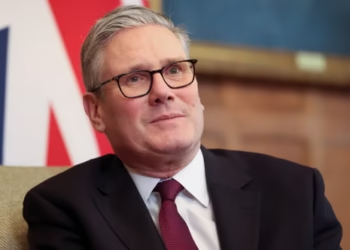 Starmer China visit raises human rights pressure on Beijing
 UK and EU Signal Fresh Push for Defence Cooperation Talks
 Cory Bernardi joins One Nation for SA election
 Starmer Condemns ‘Depraved’ Russian Strikes on Ukraine
 Trump Warns Over Chagos Islands Deal
 Trump and Chagos Deal Rift Over Iran Strikes
 Andrew Mountbatten-Windsor Arrest After FBI Radar
 Farage Chagos Islands Row Sparks Fury
 Trump Tariffs Threat Spark UK and EU Alarm
 UK Allows US Base Use Amid Iran Tensions
 Trump Rebukes Starmer Over Iran Strikes Row
 UK Prepares Aircraft Carrier for Middle East Crisis
 Gordon Brown urges court for crimes against children
 Yvette Cooper: UK Must Follow Principles, Not US Pressure
 UK Minister Denies Iran Missile Threat to Britain
 Army Probes Apache Flyover at Kid Rock’s Nashville Estate
 Relationship with Trump may be beyond repair, Starmer warned
 Kezia Dugdale Warns of Possible Reversal of Equal Rights Gains
 Canadian astronaut French words ease language row
 NHS Safety Fears as Nurses Cover Doctor Gaps
 Charles Faces Trump Test in High-Stakes US Visit
 Athens Mayor Moves to Tackle Overtourism Crisis
 UK Stands Firm on Falklands Amid US Rift
 Reform UK funding: mystery billionaire revealed
 RAF Typhoons scrambled amid Russian drone threat near Nato
 John Terry Faces Backlash Over Political Posts
 UK may ban protests amid rising antisemitism fears
 Ceasefire Standoff Deepens in Ukraine War
 Koh-i-noor Diamond Row Reignites Colonial Debate
 France Faces Record Presidential Crowded Race Amid Far-Right Surge
 Labour Members Turn Against Starmer Leadership
 Starmer Faces Revolt After Crushing Election Losses
 UK Pushes for New EU Goods Trade Deal
 Reeves Fights to Keep Treasury Role Amid Labour Turmoil
 Trump’s Revenge Drive Deepens GOP Divide
 Deadly Russian Air Raids Strike Across Ukraine
 UK Nations Brace for Potential Breakup Amid Reform Surge
 UK Government Cancels Higher Education Programme for Women and Girls
 New South Wales Premier Chris Minns Signals Tough Road Ahead for Labor
 Le Pen’s Popularity Holds Despite Conviction
 Labour MPs Urge Burnham to Revive UK Aid Target
 Dreyfus Statue Finally Gets Permanent Paris Home
 Three-Quarters of England’s Riverbanks Still Off Limits
 Is America Ready for an AOC Presidential Run?
 Five Years of Taliban Rule Leave Afghanistan in Crisis
 Burnham unveils £65m drought aid for farmers
 UK Must Act with Courage and Clarity on Israel-Palestine Conflict, Says Foreign Affairs Committee Report
 Trump’s UK Ambassador Urges North Sea Drilling to Strengthen US Ties
BBC to Apologise Over Edited Trump Speech Amid Backlash
Trump’s UK Ambassador Urges North Sea Drilling to Strengthen US Ties
BBC to Apologise Over Edited Trump Speech Amid Backlash
 Millionaires group urge Reeves to introduce wealth tax to ‘lift kids out of poverty’
 Reeves rejects £1bn plea for NHS redundancy payouts
 PM Condemns Leaks, Vows Loyalty to Ministers and Stability
 Greene Pushes Epstein Files Amid Trump Fallout
 Shadow Fleet at Sea: Europe’s Battle Against Illicit Oil Shipping
 Starmer Says Labour’s Economic Plan Needs Years to Deliver
 Artificial intelligence will cost jobs, admits Liz Kendall
 UK and US Drop in Global Corruption Index Rankings
 Canberra Poster Seizure Sparks Free Speech Row
 UK Government Poised to Revive Stalled Hillsborough Law
 Silent Tracks: Rail Line Without Passengers
 RFU Backs Borthwick Despite England’s Poor Six Nations
 Major test for Labour as polls open in Great Britain
 Keir Starmer Struggles to Secure His Grip on Downing Street
 Farage Faces Standards Probe Over Cash Property Purchase
 The Hidden Crisis Eroding Trust in British Communities
 Trump’s Mount Rushmore Speech: A Divisive Anniversary
 Ann Widdecombe, Formidable Political Figure, Dies at 78
 UK Schools Struggle as Classrooms Top 40C
 Houthis Strike Saudi Arabia as Middle East Tensions Rise