Published: 15 June 2026. The English Chronicle Desk. The English Chronicle Online.
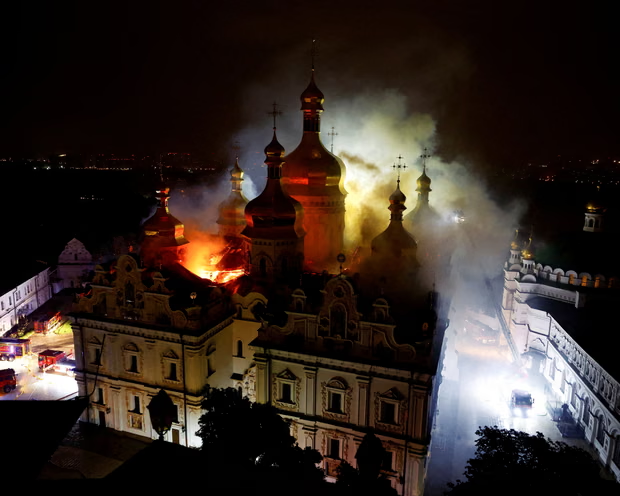
A devastating wave of overnight attacks has left a trail of destruction across Ukraine. The historic capital city of Kyiv suffered immense damage during these coordinated military strikes. A major landmark of global cultural significance caught fire during the intense bombardment on Monday. The Dormition Cathedral inside the Pechersk Lavra monastery complex sustained severe structural damage. This ancient site is recognized globally as an official Unesco world heritage destination. It remains one of the most vital religious symbols for the Ukrainian people.
The extensive assault resulted in tragic loss of life in several different regions. Nine people were confirmed killed across the country during the relentless night of violence. Four of those fatalities occurred within the capital city as explosions rocked residential areas. Countless residents were forced to flee into underground shelters to escape the danger. The sound of heavy explosions echoed continuously through the streets until the morning hours. The scale of the destruction has caused widespread grief and anger among local citizens.
The Russian military command issued an official statement regarding the morning bombardment. Moscow claimed the operation successfully targeted specific military and industrial facilities across Ukraine. However, independent observers noted that the strike on the monastery appeared entirely deliberate. The historic complex sits far from any obvious military installations or strategic industrial centers. The targeting of such a revered site has sparked intense international condemnation and outrage. Many view the action as a direct assault on Ukrainian identity and culture.
The damage in the capital was not limited to religious architecture that evening. Kyiv’s famous Oleksandr Dovzhenko National Film Studio was also struck by incoming ordnance. This facility proudly houses the largest and oldest historical costume collection in the nation. The cultural loss from this specific hit is still being evaluated by experts. It represents another severe blow to the artistic heritage of the vibrant nation. Air raid sirens continued to wail as emergency crews rushed to the scene.
President Volodymyr Zelenskyy addressed the nation and the international community following the tragic events. He described the cathedral attack as an unprecedented crime against global Christian culture. The Ukrainian leader urged immediate action from global powers to halt the ongoing violence. He specifically directed his appeal to the G7 leaders meeting currently in France. Zelenskyy requested a decisive response to counter the escalating campaign of Russian aggression. The president emphasized the urgent need for enhanced defensive capabilities for his nation.
The Ukrainian government is actively seeking concrete international intervention following the latest cultural destruction. Foreign Minister Andrii Sybiha announced urgent diplomatic steps through official social media channels. Ukraine will initiate formal procedures within Unesco to address this act of state barbarism. The minister emphasized that international mechanisms must respond adequately to protect endangered heritage sites. Diplomatic pressure is mounting as more details of the destruction come to light. The global community is facing renewed pressure to enforce stricter protective measures.
International allies quickly expressed solidarity with Ukraine and condemned the latest round of strikes. The French foreign ministry compared the monastery attack to a strike on Notre Dame. Foreign Minister Jean-Noël Barrot stated the incident clearly demonstrated the extent of Russian cruelty. This comparison underscored the deep cultural resonance of the targeted Ukrainian monastery complex. European leaders are discussing potential political consequences for the actions taken by Moscow. The rhetoric from Western capitals suggests a hardening stance against the ongoing campaign.
As the sun rose over the capital, the monastery complex was still burning. Dedicated staff members climbed the remaining towers to ring the bells in defiance. This symbolic gesture provided a moment of hope amid the surrounding ruin and smoke. Local volunteers joined firefighters in a desperate bid to salvage precious religious artifacts. The sound of the bells resonated deeply through the battered streets of Kyiv. It signaled a refusal to break under the pressure of continuous military bombardment.
The escalation comes immediately after significant diplomatic discussions were reported by the Ukrainian leadership. On Sunday, President Zelenskyy held talks with Donald Trump regarding potential peace frameworks. Those discussions focused heavily on finding pathways to end the four-year-old conflict permanently. However, the subsequent military reality on the ground has complicated these diplomatic efforts significantly. The massive scale of Monday’s attack suggests a resolution remains difficult to achieve. The contrast between political talks and battlefield reality remains stark and troubling.
The Ukrainian military released detailed statistics regarding the sheer volume of the assault. Russian forces launched seventy missiles and over six hundred drones during the night. Ukrainian air defense systems successfully intercepted fifty missiles and nearly six hundred aerial drones. This high interception rate undoubtedly prevented an even greater loss of human life. However, the sheer volume of weapons managed to overwhelm defenses in several locations. The statistics highlight the intense pressure currently facing Ukraine’s domestic air defense network.
The geopolitical backdrop to these events contains several distracting international developments. Global attention has recently focused on American diplomatic efforts to sign treaties with Iran. Additionally, media coverage has centered on unconventional birthday celebrations on the White House lawn. These distant events have distracted global audiences from the worsening humanitarian situation in Eastern Europe. Ukrainian officials are working hard to keep international focus on their current security crisis. The timing of the strike suggests a calculation to exploit these global distractions.
Visual evidence from the Pechersk Lavra showed bright flames rising toward the sky. Thick black smoke enveloped the iconic golden domes of the ancient cathedral structure. Six individuals were officially reported injured during this specific strike on the monastery. Metropolitan Epiphanius, head of the Orthodox Church of Ukraine, expressed his profound grief online. He questioned how much more destruction must occur before the world takes decisive action. His words reflected a deep frustration shared by many religious leaders in the region.
Government officials also used social media to share graphic images of the burning shrine. Prime Minister Yulia Svyrydenko labeled the event a brutal assault on national heritage. She openly challenged Moscow’s claims of upholding traditional religious and Orthodox Christian values. The prime minister requested urgent prayers for the preservation of the historic structure. She categorized the incident as a clear crime against history and human decency. Her statement resonated widely with a population seeking comfort in a time of crisis.
The overall impact on the capital city was widespread and highly disruptive. Authorities reported significant physical damage at sixteen distinct locations across the urban area. Continuous interceptor missile launches created a terrifying soundtrack for residents throughout the night. Strong explosions shook windows and rattled structures deep within the central business district. City officials worked tirelessly to coordinate emergency responses under extremely hazardous operational conditions. The physical landscape of the city bears fresh scars from the intensive bombardment. Tymur Tkachenko, head of the military administration, provided frequent updates during the crisis. He confirmed new missile launches were consistently recorded well into the morning hours. Tkachenko repeatedly urged citizens to remain safely inside their designated underground shelters. His department confirmed four deaths and twenty-three injuries within the capital city limits. Meanwhile, a separate deadly strike in Kharkiv tragically targeted arriving emergency first responders. This tactic increased the casualty count and drew further condemnation from humanitarian groups.
Prior to this escalation, Vladimir Putin had issued specific warnings to Ukraine. The Russian president indicated Moscow would initiate systemic strikes following recent Russian battlefield setbacks. The subsequent quiet period in Kyiv suggested that military forces were preparing for action. That temporary silence was brutally broken by the coordinated weekend drone and missile operations. The predictable pattern of threats followed by massive bombardment has occurred regularly before. This latest action demonstrates a continued reliance on heavy aerial attacks against infrastructure.
Neighboring nations have responded to the increased military activity near their own borders. Poland quickly scrambled fighter jets to protect its sovereign airspace during the bombardment. The Polish armed forces placed ground-based air defenses on high alert on Monday. Radar reconnaissance systems were also activated to monitor potential incoming threats from the east. These precautionary measures highlight the growing fear of the conflict spilling into Nato territory. The region remains on high alert as military movements continue to fluctuate wildly.
Ukraine has simultaneously targeted industrial and energy facilities deep inside Russian territory recently. These strategic operations aim to disrupt economic revenues used to fund the ongoing war. A recent Ukrainian drone strike targeted the industrial city of Tula, south of Moscow. That specific operation resulted in three civilian casualties, according to local regional governors. Additionally, Ukrainian forces successfully damaged two key bridges leading toward the Crimean peninsula. These tactical moves aim to sever critical supply lines and isolate Russian military groupings.
Related News:
 EU Weakens as Trump Targets Venezuela and Greenland
 Venezuela Oil Deal Opens Tensions with US Control
 US Citizens Warned to Venezuela Flee Amid Paramilitary Threats
 Gulf states warn Trump Iran strikes risk wider Middle East war
 Machado Trump medal gesture reshapes Venezuela power struggle
 Greenland defence seen as shared Nato duty amid troop arrivals
 Gulf states warn Trump Iran strikes risk wider Middle East war
 Trump Receives Machado’s Nobel Medal in White House Meeting
 Iran unrest slows under brutal crackdown and global tensions
 Syria President Declares Victory as Ceasefire Reached with SDF
 US Considers Asylum for British Jews Amid Rising Antisemitism
 Thousands Protest ICE Operations in Nationwide US Day of Action
 Epstein Files Reveal Trump Officials’ Emails with Financier
 Thousands Protest ICE in New York Against Trump Deportation Campaign
 Sydney Protest Pepper Spray Clash During Herzog Visit
 Cuba Kills Exiles in Speedboat Attack from US Waters
 Yvette Cooper: UK Must Follow Principles, Not US Pressure
 Saudi Arabia Urging US to Keep Up Iran Attacks
 Washington Enlists Musk to Battle Global Hostility Online
 Teen Girl Charged After Alleged Melbourne Hate Crime Spree
 Macron Urges Stability as Trump Jolts Nato and Iran
 Trump Address Sparks Global Backlash Over Iran War Tactics
 Macron Rebukes Trump Following Mockery of His Marriage
 Trump Sets Tuesday Deadline for Iran to Reopen Vital Strait
 Tragic End to Outback Search as Floods Claim a Life
 Ben Roberts-Smith Arrested Over Alleged War Crimes
 Trump and Tehran Find Common Ground in Landmark Ceasefire
 Netanyahu Vows Continued Lebanon Strikes Amid Peace Talks
 Trump Predicts Rapid Return to Peace Talks in Pakistan
 Reeves Slams Trump Over Iran War Lack Of Exit Plan
 US and Iran Pursue Extension of Ceasefire via Pakistan
 Pope Leo Calls for Global Unity Following Trump Criticism
 Mexico, Spain and Brazil call for Cuba dialogue amid crisis
 Ukraine Urges UK to Seize Russian Oil Tankers
 US Calls Australia Media Law “Foreign Extortion”
 Oil Prices Surge Above $120 Amid Iran Blockade Fears
 Tragic End to Search for Missing Girl in Alice Springs
 Questions Remain Over The Tragic Bondi Massacre
 Trump orders US troop pullout from Germany
 Activists allege abuse after Gaza flotilla seizure
 Ukraine strikes Tuapse as oil disaster worsens
 Japan Protests Erupt Over Plans to Revise Constitution
 Australia pushes Pacific security pact amid China tension
 Indiana Republicans Defy Trump in Key Vote Test
 Middle East Crisis Escalates as Oil Routes Shake Markets
 FIFA Confirms Global Ban for Benfica Star Prestianni
 New South Wales Wetland Rescue Legislation Passes
 Tensions Emerge in Netanyahu-Trump Alliance
 US and Mexico Face Heatwave as Floods Batter South Africa
 The Long Way Home: Australia’s High-Stakes Virus Mission
 Trump Warns Iran Ceasefire Is Now on Life Support
 Putin Signals War End as Russian Momentum Stalls
 Fear and Betrayal: The Chilling Case of Kouri Richins
 Scepticism and tight security as Beijing braces for Trump
 UN Faces Crucial Vote on Landmark ICJ Climate Ruling
 US-Mexico Crisis: Cartel Allegations Push Ties to Brink
 Philippine Senator Flees After Days Under Senate Siege
 Solomon Islands Elects China Critic Matthew Wale as Leader
 Tragedy in the Maldives: Inside the Deep Sea Rescue
 US Ebola Case Sparks Urgent Global Screening Measures
 Xi Hosts Putin in Beijing Days After Landmark Trump Summit
 Fragile Truce Shattered as Violence Escapes Diplomatic Control
 The Hunt for Bato: Inside the Hunt for the Fugitive Senator
 Israeli Strikes in Lebanon Kill 10 Amid Ceasefire Strain
 Zelenskyy warns over Oreshnik threat as Kyiv hit
 Hunger increasingly weaponised in global conflicts
 Discontent grows around Putin amid war strain
 Former ICC prosecutor condemns US sanctions
 Bondi Tragedy Survivors Face Online Abuse After Inquiries
 Japan Suffers Plastic Shortage Due to Middle East Crisis
 Venezuela Opposition Steers Uncharted Path Forward
 Aukus Deal Facing Fierce Backing and Historic Criticism
 Thai Princess Bajrakitiyabha Passes Away at 47
 Sentenced to 30 Years: Former Leader’s Secret Drone Plot
 Iran To Propose New Shipping Fees In Strait Of Hormuz
 Trump’s Iran Legacy Hangs on Tehran Deal
 High Drama in Tehran Over Secret Nuclear Letters
 Houthis Strike Saudi Arabia as Middle East Tensions Rise
 Taliban global ties grow as rights fears mount
 Seoul proposes historic peace talks to replace Korean War armistice