Published: 27 August 2026 | The English Chronicle Desk | The English Chronicle Online
More than 300 people have died in Nepal after a catastrophic flash flood swept through the country’s Himalayan border region, while rescue teams continue searching for more than 900 missing people and experts warn that another surge of water could threaten communities downstream.
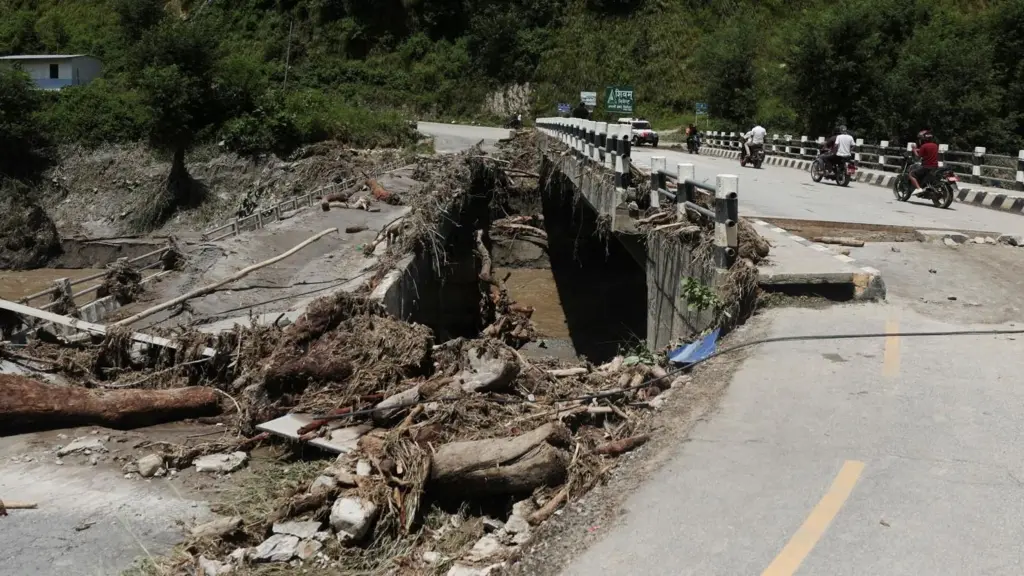
The disaster struck along the Nepal-Tibet border on Wednesday after a massive collapse of ice, rock and debris sent an enormous volume of water into mountain valleys. Entire settlements were damaged or destroyed, roads and bridges were swept away and major infrastructure was left buried under mud.
Nepalese authorities have now recovered 332 bodies, according to the latest reports, while more than 900 people remain unaccounted for. China has separately reported three deaths and more than 500 people missing on the Tibetan side of the border. Because authorities on both sides are working with incomplete information, the overall number of victims and missing people remains subject to change.
The scale of the destruction has made the search exceptionally difficult. Rescue teams are operating in steep valleys where roads have disappeared and bridges have collapsed. Telecommunications networks have also been disrupted, leaving families and authorities struggling to determine whether people reported missing are trapped, have moved to safety or remain unreachable because of the loss of communications.

The latest emergency has also raised a new concern: the possibility of a second flood.
Experts and officials have warned that debris left upstream could obstruct river channels and create temporary dams. If those blockages fail suddenly, another large volume of water could rush downstream, potentially threatening communities that have already been devastated by the first flood.
The concern is particularly serious because the initial disaster altered river channels and left enormous quantities of mud, rock, ice and other debris across the landscape. Continued rainfall could add further water to already unstable areas, increasing the danger of additional landslides and flooding.
Authorities have therefore been forced to balance two urgent priorities: searching for survivors and missing people while monitoring the possibility of further flooding.
A disaster triggered by a glacial collapse
Initial reports suggested that an earthquake may have triggered the disaster. However, subsequent scientific analysis has indicated that the seismic event was generated by a massive collapse of glacial ice and rock rather than by an earthquake.
The US Geological Survey determined that the seismic signal initially interpreted as an earthquake was associated with a glacial collapse and debris flow. Satellite imagery showed that a large section of glacier had broken away at high altitude before falling roughly 1,200 metres towards the valley floor.
The collapse sent ice, rock, sediment and water into the Lhende River system. The resulting surge moved rapidly downstream and fed into major waterways including the Bhote Koshi and Trishuli river systems.
The speed and force of the flood left residents and visitors with little time to react.
The affected region is also an important tourism and pilgrimage corridor. It is used by trekkers and travellers heading towards high-altitude destinations, while thousands of pilgrims travel through the wider Himalayan region for religious reasons.
Consequently, a significant number of foreign nationals are among those missing.
Reports have identified missing people from India, the United States, Britain, Australia, Canada and several other countries. Earlier figures indicated that hundreds of foreigners were among those unaccounted for in Nepal, while Chinese authorities have also reported hundreds of foreign nationals missing in Tibet.
The international dimension of the disaster has prompted governments to begin emergency consular operations.
Australia, for example, has been working to establish the welfare of dozens of citizens believed to have been in the affected region. Other governments have also been attempting to determine whether their nationals were travelling in the disaster zone.
Villages and infrastructure swept away
The physical destruction has been enormous.
Homes have been submerged or buried, vehicles have been carried away and sections of major roads have vanished. Bridges connecting communities have been destroyed, cutting off settlements and making it difficult for rescue teams to reach people who may still be alive.
Hydropower infrastructure has also been badly damaged. This is particularly significant for Nepal because mountain valleys along the affected rivers contain major energy facilities.
The destruction of electricity infrastructure has left some communities without power while rescue operations continue. In some areas, residents searching for missing relatives have gathered near military facilities where helicopters are being used to reach isolated locations.
Nepalese army helicopters have played an important role in evacuating survivors and transporting injured people to medical facilities.
But helicopters cannot replace the roads and bridges that have been destroyed. Rescue workers still face the challenge of reaching communities cut off by mud, unstable slopes and swollen rivers.
Families wait for news
For relatives of the missing, the disaster has created an agonising period of uncertainty.
People have travelled to emergency centres and military bases seeking information about family members. Authorities have been collecting names of missing people while trying to cross-check information from residents, tourists, hotels and tour operators.
In some cases, the lack of telecommunications means that a person can remain officially unaccounted for even if they have survived.
That uncertainty is particularly difficult for families of foreign tourists who have no direct contact with people in the affected region.
Survivors have described being caught in walls of water and mud that arrived with almost no warning.
One survivor, Bibek Kumal, said he was swept downstream by the torrent and survived only after managing to cling to a tree. Others have described seeing family members disappear beneath mud and debris.
Such accounts have reinforced fears that the eventual death toll could rise further as rescuers gain access to isolated areas.
Climate concerns grow
The disaster has also intensified debate over the growing risks faced by the Himalayan region as temperatures rise.
Scientists have cautioned against attributing any individual glacial collapse solely to climate change without detailed investigation. However, warming temperatures are contributing to glacier retreat and destabilising high-altitude environments across the Himalayas.
The region has experienced increasingly rapid changes in glaciers, snow cover and permafrost. These changes can increase the potential for landslides, rockfalls, ice avalanches and other hazards capable of generating sudden floods.
Reuters reported that Nepal has lost a substantial proportion of its glacial ice over recent decades, while the rate of melting has accelerated. Scientists are continuing to examine how warming conditions may have contributed to the latest collapse.
The possibility of secondary flooding demonstrates another consequence of these changing conditions. Once a major landslide or glacial collapse occurs, the danger does not necessarily end when the initial flood passes.
Debris can block rivers, unstable slopes can collapse again and additional rainfall can destabilise already damaged terrain.
Authorities monitor the risk of another surge
Experts are therefore urging authorities to monitor rivers and upstream debris blockages closely.
A second flood could be particularly dangerous because communities downstream may already have suffered severe losses and may have limited access to warning systems, transport or safe shelter.
Emergency workers are also operating under difficult conditions, with damaged infrastructure and the possibility of further landslides complicating their movements.
The priority remains finding survivors, but authorities must simultaneously identify areas that could be exposed to another sudden rise in river levels.
The international community has begun providing assistance. The United States has pledged emergency aid, while United Nations agencies have said they are mobilising personnel and supplies to support affected communities.
Neighbouring countries are also monitoring developments and offering assistance as Nepal attempts to manage the scale of the catastrophe.
A long recovery ahead
Even after the immediate search operation ends, Nepal faces a prolonged recovery.
Rebuilding roads and bridges will be essential to reconnect isolated communities. Damaged power facilities will need to be repaired, homes reconstructed and affected families provided with food, water, shelter and medical support.

The tourism sector is also likely to face significant disruption. The affected region is a major route for trekkers and pilgrims, and damage to roads and border infrastructure could make travel difficult for an extended period.
For Nepal, which relies heavily on tourism and remittances, the economic consequences could extend well beyond the immediate disaster zone.
But the first priority remains human life.
With more than 300 people already confirmed dead and hundreds more still missing, rescue teams face a race against time. At the same time, the warning of a possible second flood means emergency planners cannot assume that the worst has passed.
The disaster has exposed the vulnerability of Himalayan communities to sudden environmental hazards and highlighted the growing challenge of preparing for extreme events in a rapidly changing climate.
For families waiting for news, however, the immediate concern is much more personal: finding their loved ones.
As rescuers move deeper into the devastated valleys and authorities monitor rivers for signs of another surge, Nepal remains in the grip of one of its most devastating recent natural disasters.
Related News:
 Australia Races to Find Tourists Missing in Nepal
 Venezuela Quake Death Toll Surpasses 4,000
 Olympus Awaits Unesco Heritage Recognition
 Powerful 7.7-Magnitude Earthquake Hits Eastern Indonesia
 Wildfires rage across Europe as hundreds arrested in France
 Heavy Casualties Feared as Flash Flood Sweeps Nepal-Tibet Border
 France Eases Cheese Rules as Drought Hits Farms
 South Africa’s Garden Route Gem Faces Looming Water Crisis
 Storm Dave Disrupts Travel but Conditions Set to Ease
 Moldova River Crisis Exposes War’s Hidden Cost
 Cyclone Vaianu Forces Mass Evacuations in New Zealand
 Chornobyl Still at Risk 40 Years After Disaster
 Escobar’s Hippos May Be Moved to India Zoo
 Two Dead in Adelaide Airport Plane Crash Fire
 China Fireworks Factory Blast Kills 21 in Hunan
 Pope Meets Families in Italy Toxic Waste Zone
 Thailand Tightens Visa Rules to Curb Tourist Misbehavior
 England and Norway Fans Turn Miami Into World Cup Carnival
 London Tube Heat Reaches Dangerous Levels
 Wildfires Force Mass Evacuations in France And Spain
 Five Years of Taliban Rule Leave Afghanistan in Crisis
 France Faces Calls to Ban Alpine Marmot Hunting
 Nepal-Tibet Flood Leaves 270 Dead and 1,400 Missing
 Storm Leonardo Triggers Election Delay Calls in Iberia
 Hindu Man’s Stand Sparks Hope in India
 Middle East Airspace Crisis Strands Thousands
 North Korea Fires Missiles Amid US-South Korea Drills
 Anti-Regime Iranians Turn Anger Toward Trump
 Teen Admits Filming Westfield Chair Prank
 Glasgow Central Set for Full Reopening After Fire
 Evacuations Ordered as California Wildfires Spread Fast
 Peretz Targets FA Cup Upset Amid War Concerns
 Queensland Braces for Potential Second Severe Cyclone Hit
 Canadian astronaut French words ease language row
 Black Forest Tragedy Remembered 90 Years On
 Exploring Italy’s Forgotten Dolomites Beyond Crowds
 Southeast Asia Turns to Russia Amid Energy Crisis
 Ukraine Urges UK to Seize Russian Oil Tankers
 Older Than Dinosaurs: Secrets of Mayfly Dance Revealed
 Capitalism ‘Suicidal’, Warns Petro at Climate Summit
 Coalition pushes fossil fuel phaseout plan
 Australia pushes Pacific security pact amid China tension
 France Faces Record Presidential Crowded Race Amid Far-Right Surge
 Norway Doubles Down on Oil and Gas for Europe Energy Security
 Bad Weather Threatens Hantavirus Cruise Ship Evacuation
 Search Intensifies for Missing Hiker on WA Bibbulmun Track
 US Awaits Iran Reply on New Ceasefire Proposal
 Tractor Breakdown Tests Lincolnshire Farmers
 Britons Build Emergency Supplies Amid Rising Fears
 Australia Welcomes the Iconic Michelin Guide
 France Quarantines Cruise Ship After Suspected Virus Death
 Hormuz Talks Near Critical Stage
 Sycamore Gap Artwork Chosen After Public Vote
 China mine blast death toll rises to 90
 Maldives Cave Diving Tragedy Raises Safety Alarm
 Discontent grows around Putin amid war strain
 Man killed in shark attack on Great Barrier Reef
 Farage and Reform UK Reshape British Politics
 Starmer Leadership Under Pressure After Setbacks
 Germany Summons Chinese Envoy Over Russian Troop Training
 Sydney Records Hottest June Since 1859 as Expert Warns New High a ‘Signature’ of Global Warming
 Millions Gather for Khamenei’s Six-Day State Funeral
 Le Pen’s Popularity Holds Despite Conviction
 Bryne Backs Haaland Before England World Cup Clash
 Dreyfus Statue Finally Gets Permanent Paris Home
 UK Schools Struggle as Classrooms Top 40C
 Italy’s Beach Lunch Ban Sparks Holiday Backlash
 Houthis Strike Saudi Arabia as Middle East Tensions Rise
 Three-Quarters of England’s Riverbanks Still Off Limits
 Israeli Strike in Southern Lebanon Kills Seven
 Is America Ready for an AOC Presidential Run?
 London’s 2026 ‘Great Stink’ Raises Sewer Concerns
 Burnham unveils £65m drought aid for farmers
 Gen Z turns to BirdTok for a gentler digital escape
 Vietnam Youth Rally Behind Hanoi ‘Justice Tree’
 China Probes Alleged Formaldehyde Use on Cabbages
 Shein targets $27bn valuation in Hong Kong debut
 Queue row erupts on Wales’ highest mountain
 Nearly 90,000 ordered to flee Reno wildfire
 Ghent Professors Questioned Cofnas Appointment