Published: 27 August 2026. The English Chronicle Desk. The English Chronicle Online
Yayoi Kusama, the Japanese avant-garde artist whose polka dots, pumpkins and immersive mirror installations transformed contemporary art and made her one of the world’s most recognisable cultural figures, has died at the age of 97.
Kusama died at a hospital in Tokyo on 14 August 2026, according to an announcement from Yayoi Kusama Inc and Yayoi Kusama Studio Inc published on Thursday. Her representatives said she continued painting until her final days, maintaining a lifelong commitment to artistic creation.
Her death marks the end of an extraordinary career that stretched across nearly nine decades and encompassed painting, sculpture, installation, performance, fiction and poetry. Although she was often overlooked during the early decades of her career, Kusama eventually became a global cultural icon, with major exhibitions attracting enormous audiences and her works commanding multimillion-dollar prices.
Kusama was born in 1929 in Matsumoto, in Japan’s Nagano region. From childhood, she experienced vivid hallucinations and recurring visions of patterns, flowers and dots. Rather than treating those experiences simply as obstacles, she turned them into the foundation of an artistic language that would eventually become internationally famous.
In her own descriptions of those early experiences, Kusama recalled seeing patterns spreading across rooms and covering objects and her own body. Painting became a way of responding to those visions and giving physical form to an intensely personal perception of the world.
Her childhood was difficult, and her conservative family did not encourage her ambitions as an artist. She nevertheless pursued painting and eventually moved beyond traditional Japanese artistic conventions. Her early work demonstrated an interest in repetition, accumulation and infinity that would remain central throughout her career.
In the late 1950s, Kusama moved to New York, where she entered an increasingly competitive and male-dominated art scene. There she developed her celebrated “Infinity Net” paintings and began producing provocative sculptures and installations that challenged contemporary expectations.
Her work was frequently confrontational. During the 1960s, she created soft sculptures featuring phallic forms and staged performances involving nudity, bodies and painted dots. Her work also addressed sexuality, war, peace and the boundaries between the individual and the surrounding environment.
Yet Kusama became increasingly frustrated by the recognition received by male artists whose work she believed had been influenced by her ideas while receiving greater institutional attention. Her experience contributed to her decision to return to Japan after years in the United States.
Kusama voluntarily entered a psychiatric hospital in Tokyo in 1977. She subsequently lived there for decades while continuing to work from a nearby studio. Far from ending her artistic career, the arrangement provided her with a stable environment in which she could continue producing paintings, sculptures, installations and literary works.
Her artistic revival gathered momentum from the late 1980s and particularly during the 1990s. A major turning point came with her participation in the 1993 Venice Biennale, where she represented Japan as a solo artist. Decades earlier, she had appeared at the Venice Biennale without an official invitation, placing hundreds of mirror balls on the ground as an independent intervention.
The contrast between those two moments reflected the dramatic transformation in her reputation. The artist who had once struggled for recognition became one of Japan’s most internationally celebrated contemporary artists.
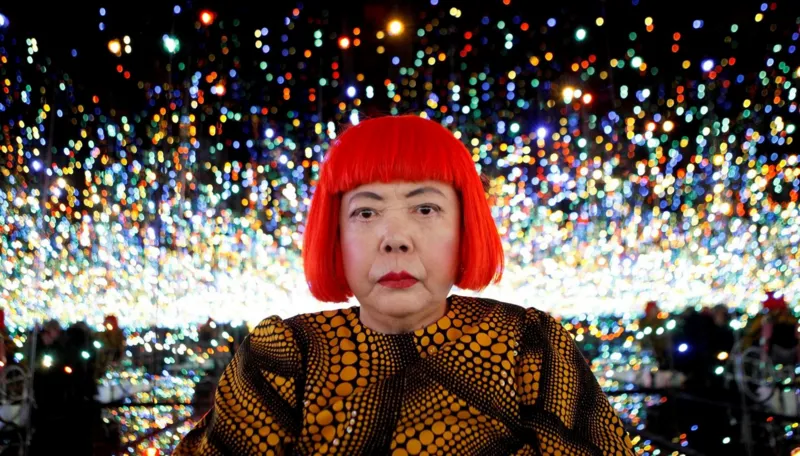
Her Infinity Mirror Rooms became particularly influential. Using mirrors, lights and carefully constructed spaces, Kusama created environments that appeared to stretch indefinitely. Visitors were surrounded by reflections and points of light, producing an experience that suggested vastness, repetition and the dissolution of individual boundaries.
The installations became hugely popular with audiences around the world. Kusama’s exhibitions also benefited from the rise of social media, where photographs of visitors inside her colourful and immersive environments helped introduce her work to a new generation.
Her popularity extended far beyond traditional art institutions. Her distinctive visual language appeared in public spaces, commercial collaborations and major cultural exhibitions. In 2023, a giant sculpture inspired by Kusama herself was displayed outside the Louis Vuitton and Samaritaine sites in Paris, illustrating the extent to which her artistic identity had become part of global popular culture.
The pumpkin became another defining symbol of Kusama’s career. Her brightly coloured pumpkins covered with polka dots combined playfulness with her broader fascination with repetition and infinity. For Kusama, pumpkins also carried a more intimate emotional meaning, representing comfort and stability.
She once described the vegetable as something that spoke to her and gave her peace of mind. That personal attachment helped transform an ordinary object into one of the most recognisable motifs in contemporary art.
Kusama’s works also achieved extraordinary commercial success. One of her paintings sold for about $10.5m in 2022, placing her among the highest-earning female artists at auction. Her market success reflected the broader institutional recognition that arrived after decades in which she had remained outside the mainstream of the international art world.
Her exhibitions became major public events. A presentation of her Infinity Mirror Rooms at Tate Modern in London was extended repeatedly because of its exceptional popularity. Catherine Wood, interim director of Tate Modern, described it as the gallery’s most visited exhibition, saying visitors responded to Kusama’s ability to create a feeling of wonder and infinity.
Kusama’s influence also extended across generations. Artists, designers and audiences have drawn on her use of repetition, immersive environments and bold colour. Her work demonstrated how deeply personal experiences could become a universal artistic language.
Her career was also significant because of the way it challenged the traditional structures of the art world. Kusama spent much of her early career working in an environment where women and artists outside established networks faced substantial barriers to recognition. Her eventual international success helped establish her as a major figure in postwar and contemporary art.
Despite becoming famous late in life, she continued to produce new work. Her official representatives said she never stopped painting and continued exploring themes of love and the eternal soul until her final days.
Her death comes as exhibitions of her work continue to draw audiences internationally. The Yayoi Kusama Museum in Tokyo has been hosting “KUSAMA’s POP”, while a major exhibition is scheduled at Amsterdam’s Stedelijk Museum from September 2026 through January 2027.
Kusama’s legacy is therefore unlikely to fade with her death. Her red wigs, polka dots, pumpkins and mirrored spaces have become instantly recognisable symbols, but her importance extends beyond those images.
She created a distinctive artistic vocabulary from experiences that were often painful and difficult to communicate. Through repetition and accumulation, she transformed hallucinations into paintings, sculptures and environments that encouraged millions of people to reconsider their relationship with space, identity and infinity.
For decades, Kusama described herself as an outsider, even after achieving extraordinary international recognition. That tension remained central to her story: an artist who spent years struggling to be heard ultimately became one of the most visible and commercially successful artists of her generation.

Her company said her wishes would be carried forward through art, with the hope that her work would continue to offer strength and inspiration to people around the world.
Yayoi Kusama leaves behind a body of work that is both intensely personal and remarkably accessible. Her art could be encountered in a museum, photographed on a phone or experienced inside a seemingly endless room of lights and reflections. Few contemporary artists succeeded in creating such a recognisable visual world.
At 97, Kusama’s life ended in Tokyo, but the universe she created through dots, mirrors, pumpkins, repetition and infinity will continue to exist in galleries and public spaces around the world. Her career stands as a testament to persistence, experimentation and the ability of an artist’s private vision to eventually become a shared global experience.
Related News:
 Whistler’s Mother and why its fame frustrated artist
 Exhibition Revisits Life of 18th-Century Black Court Figure
 Harry and Meghan’s Australia Visit Sparks Debate
 Disneyland Adds Facial Recognition at Entrances
 Escobar’s Hippos May Be Moved to India Zoo
 China Fireworks Factory Blast Kills 21 in Hunan
 Sycamore Gap Artwork Chosen After Public Vote
 Cannes filmmakers split over AI’s role in cinema
 Thailand Tightens Visa Rules to Curb Tourist Misbehavior
 The Obamalisk: Inside the Controversial $850m Presidential Center
 Dreyfus Statue Finally Gets Permanent Paris Home
 Can Anyone Replace Graham Norton? Chat Show Challenge
 Five Years of Taliban Rule Leave Afghanistan in Crisis
 Australia Races to Find Tourists Missing in Nepal
 Nepal Flood Death Toll Tops 300 as Second Flood Feared
 Ozzy Osbourne: The Prince of Darkness Bows Out, Leaving Behind a Legacy of Metal and Myth
 Unseen Killers of the Deep Inside the UK Lab Uncovering the Silent Deaths of Sea Creatures
 Gen Z Embraces the Big, Bold ‘Fake’ Indian Wedding Party Trend
 My Husband Won’t Stop Playing with Lego and It’s Driving Me Nuts
 Sean Hayes Reimagined: From Sitcom Stardom to Serious Stage Acclaim
 Russell T Davies Warns of Declining UK Gay Rights Amid Rise of Reform UK and Trump Influence
 Terence Stamp, ’60s British Film Legend and Star of Superman, Dies at 87
 September’s Must-See Films: From Spinal Tap II to Leonardo DiCaprio’s Latest Thriller
 Watchdog, Cornflakes and Courage: Remembering John Stapleton, a Broadcaster Who Did It All
 Beloved Actress Dame Patricia Routledge Dies Aged 96
 Karen Carney Shines on Strictly Come Dancing Week Two Despite Tango Wobbles
 Jilly Cooper: The Bonkbuster Queen Who Redefined Romantic Fiction
 Paedophile Singer Ian Watkins Dies After Prison Attack
 Strictly Celebs Starstruck as Cynthia Erivo Shines
 Man Charged Over 2020 Death of Tattoo Artist Georgina Ward
 Kate Winslet to Narrate Film Highlighting King’s Environmental Mission
 Top Christmas Books Reads: Classics to Cozy Romcoms
 Pauline Collins, Beloved ‘Shirley Valentine’ Star, Dies at 85
 I’m a Celebrity 2025 line-up revealed: Osbourne joins
 VAR Must Rein Its Neck In to Save Football’s Spirit
 From Lego to Pokémon: How Adults Are Driving UK Toy Market Growth
 Pokémon to open world’s first theme park in Japan next year
 SS Rajamouli Announces ‘Varanasi,’ a Mythic Time-Travel Epic
 Director Michael Caton-Jones Reflects on Career and Beginnings
 Rusty Bond-Era Aston Martin Restored to £1m Glory
 Pavarotti statue frozen in Italian ice rink sparks backlash
 John Lithgow criticises Rowling stance in trans debate
 Draco Malfoy Emerges as Lunar New Year Icon in China
 Top 10 Must-See Films Arriving This February
 Rising Costs Force Families to Rethink Days Out
 Teen Admits Filming Westfield Chair Prank
 Ticketmaster Fees Rise Despite Recent US Junk Fee Crackdown
 Scott Mills Sacked by BBC Over Personal Conduct Claims
 Army Probes Apache Flyover at Kid Rock’s Nashville Estate
 M&S Demands Urgent Action on Rising Violent Retail Crime
 Robots Outpace Humans in Beijing Half-Marathon
 Kezia Dugdale Warns of Possible Reversal of Equal Rights Gains
 Unveiling Hidden Masters: Female Artists Take Centre Stage
 Stephen Fry Sues Tech Organisers For £100k Following Stage Fall
 Greens Face Internal Row Over Antisemitism Claims
 The Burning Lens: An Iranian Artist’s Visual Resistance
 Barrister Criticises Trial After Suicide Case Verdict
 US Awaits Iran Reply on New Ceasefire Proposal
 Maldives Cave Diving Tragedy Raises Safety Alarm
 Pope Meets Families in Italy Toxic Waste Zone
 Discontent grows around Putin amid war strain
 Farage and Reform UK Reshape British Politics
 Starmer Leadership Under Pressure After Setbacks
 Saving the Scalloped Hammerhead: The Pacific Battle
 Trump’s Mount Rushmore Speech: A Divisive Anniversary
 British Teens in EU Face Soaring UK University Fees
 Rotterdam Museum Honours Artist With Peanut Butter Floor
 England and Norway Fans Turn Miami Into World Cup Carnival
 UK Schools Struggle as Classrooms Top 40C
 Sydney Arts Venue Faces Eviction After Religious Protests
 Olympus Awaits Unesco Heritage Recognition
 Houthis Strike Saudi Arabia as Middle East Tensions Rise
 Powerful 7.7-Magnitude Earthquake Hits Eastern Indonesia
 Westminster Council Threatens Charing Cross Soup Kitchen
 Burnham unveils £65m drought aid for farmers
 Gen Z turns to BirdTok for a gentler digital escape
 Queue row erupts on Wales’ highest mountain
 Indian Jewellery Ad Pulled After Backlash Over Outfit
 Nepal-Tibet Flood Leaves 270 Dead and 1,400 Missing
 Ghent Professors Questioned Cofnas Appointment