Published: 10 September 2026. The English Chronicle Desk. The English Chronicle Online.
Twenty-five years after the September 11 attacks transformed the United States and reshaped global security policy, experts are warning that the country’s counter-terrorism capabilities are facing renewed pressure as resources are redirected, experienced officials leave government service and terrorism receives less attention within the broader national security agenda.
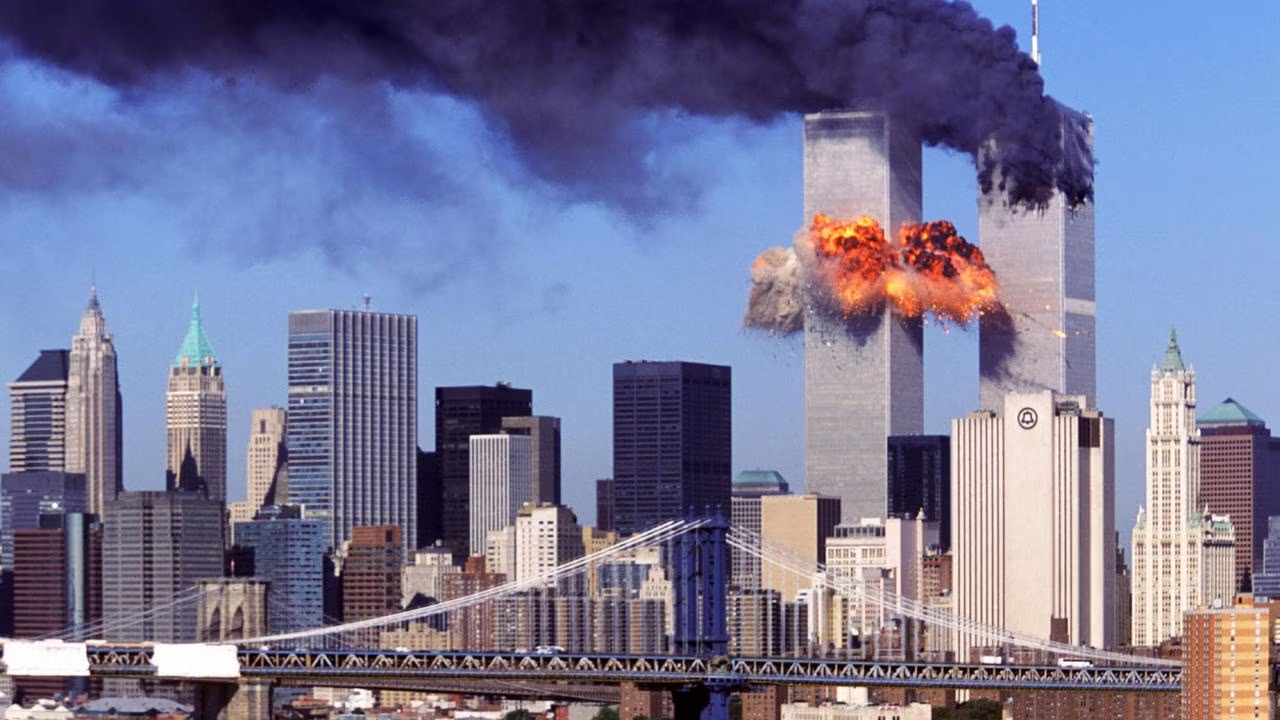
The warning comes as the United States marks a quarter-century since the attacks carried out by al-Qaida under Osama bin Laden, which killed nearly 3,000 people in New York, Washington and Pennsylvania on September 11, 2001. The attacks triggered the US-led “war on terror”, prolonged military campaigns overseas and major changes to the country’s intelligence, law enforcement and homeland security institutions.
Although the United States has not experienced another terrorist attack on the scale of 9/11, security specialists say the absence of a comparable catastrophe should not be interpreted as evidence that the threat has disappeared. Instead, they argue, the nature of terrorism has changed while institutional attention and resources have increasingly shifted toward other national security priorities.
Bruce Hoffman, a terrorism expert at Georgetown University, has warned that the counter-terrorism system constructed after 9/11 is gradually being weakened by budget pressures, personnel losses and a decline in the importance attached to terrorism as a national security issue.

Hoffman has described the development as particularly concerning because terrorism is an intermittent threat that can remain relatively quiet for years before producing consequences on an enormous scale. He has argued that complacency could recreate some of the conditions that existed before the 2001 attacks, when warnings about al-Qaida were not given sufficient attention.
The debate comes at a time when the United States intelligence community is managing an increasingly broad range of threats. Strategic attention has shifted significantly toward China and Russia, while Washington is also dealing with cyber threats, geopolitical competition, organised crime, border security and domestic political violence.
Many analysts support the earlier decision to move some resources away from terrorism and toward long-term strategic competition with major state powers. However, critics of the current approach argue that the shift has gone too far and that counter-terrorism capabilities could be weakened to a point where the country becomes less prepared for an unexpected attack.
Colin Clarke, executive director of the Soufan Center, has described the situation as the result of several overlapping factors, including funding pressures, personnel losses and institutional fatigue. After two decades of intensive counter-terrorism operations, he said many officials were eager to concentrate on different strategic challenges.
That fatigue is particularly important because counter-terrorism depends heavily on institutional knowledge and experienced personnel. Specialists who have spent years tracking extremist networks, understanding recruitment patterns and identifying emerging threats cannot always be replaced quickly.
Concerns have also been raised about morale inside the intelligence community. Critics say the political treatment of intelligence agencies under President Donald Trump has contributed to uncertainty and discouragement among career officials.
The appointments of Tulsi Gabbard as director of national intelligence and Kash Patel as FBI director have also attracted criticism from intelligence veterans, who have questioned whether both officials possess sufficient senior-level experience for such important positions.
The Trump administration has additionally changed the way it defines and prioritises counter-terrorism. Criminal organisations such as Mexican drug cartels have been designated as foreign terrorist organisations, a move that has required government agencies to devote additional resources to groups that were previously treated primarily as organised crime threats.
For the 2026 financial year, requested funding for the principal agencies within the civilian intelligence community totals about $81 billion. Yet experts say the size of the overall intelligence budget does not necessarily mean sufficient resources are available for every individual threat.
With finite personnel and financial resources, expanding the counter-terrorism mission could potentially reduce the amount of attention available for monitoring extremist organisations such as al-Qaida and Islamic State affiliates.
The administration released an updated counter-terrorism strategy in May, but the document has generated criticism from analysts who believe it places too much emphasis on leftwing violence, criminal networks and cartels while failing to adequately address the growth of rightwing extremism in the United States.
Devorah Margolin of the Washington Institute for Near East Policy described the strategy as a significant shift. She argued that while counter-terrorism policies naturally need to evolve as threats change, the current approach appears to place greater emphasis on political priorities than on the overall terrorism landscape.
The concern is not limited to Islamist extremist organisations. The American threat environment has become more fragmented since 9/11, with individuals and small groups capable of becoming radicalised without direct instruction from established terrorist organisations.
This makes traditional counter-terrorism methods more complicated. Large organisations with identifiable leaders, communication structures and overseas bases can be monitored through conventional intelligence techniques. Lone actors or small networks, by contrast, may leave fewer warning signs and can move from radicalisation to violence rapidly.
Security experts continue to monitor al-Qaida despite the organisation’s reduced visibility. A recent United Nations assessment based on information provided by member states said al-Qaida’s senior leadership remained marginalised, while its capability and intention to conduct external operations remained unclear.
Analysts remain divided over what that means. Some believe the organisation has lost much of its operational capacity and ambition. Others caution that a lack of visible activity does not necessarily mean the threat has disappeared and could instead reflect a deliberate strategy of patience.
The history of 9/11 provides a powerful reminder of the danger of assuming that a period of relative calm means a threat no longer exists.
Before the attacks, al-Qaida had already demonstrated its willingness and ability to target American interests. Bin Laden had publicly declared war against the United States in the 1990s, while the organisation was responsible for attacks against US embassies in East Africa in 1998 and the bombing of the USS Cole near Yemen in 2000.
The 9/11 attacks eventually exposed serious weaknesses in the way American intelligence agencies processed and shared information. Congressional investigations found that US authorities had received numerous warnings about al-Qaida but failed to connect critical pieces of information effectively. Problems involving communication between the FBI and CIA were among the failures later identified.
Those lessons resulted in major reforms across the US national security system. Intelligence agencies expanded their cooperation, counter-terrorism became a central priority and enormous resources were directed toward preventing another major attack.
The country has subsequently prevented or disrupted numerous terrorist plots, while the number and scale of attacks have remained far below the devastation witnessed in 2001.
However, the threat has not disappeared entirely. In 2009, an attempted bombing of a passenger aircraft approaching Detroit failed when the explosives did not detonate as intended. In 2019, a Saudi Arabian air force officer killed three people at a US military installation in Florida in an attack that was linked to an al-Qaida affiliate in Yemen.
According to figures cited by the Center for Strategic and International Studies, more than 100 attacks by violent Islamic extremists connected to the broader jihadist movement have occurred in the United States since 2001.
Experts stress that the continued presence of such threats requires a balanced approach rather than a return to the extraordinary security mobilisation that followed 9/11.
Don Rassler of the Combating Terrorism Center at West Point said Islamist extremist groups remain an important concern, but the reduction in resources and personnel means the United States may have to accept a greater level of terrorist risk.

The challenge for American policymakers is therefore not simply deciding whether terrorism remains a priority, but determining how much attention and funding should be devoted to it alongside increasingly complex threats from major powers, cyber operations, domestic extremism and organised crime.
As the 25th anniversary of 9/11 approaches, experts say the central lesson remains unchanged: terrorist threats can evolve quietly before suddenly becoming highly consequential.
The absence of another attack comparable to 9/11 represents a significant achievement for American security agencies, but specialists caution against allowing that success to create complacency. They argue that maintaining experienced personnel, institutional knowledge, intelligence-sharing systems and sufficient resources will remain essential if the United States is to identify emerging threats before they develop into another national tragedy.
For a country still deeply shaped by the events of September 11, 2001, the warning is both historical and immediate. The terrorist threat facing America today may look very different from the one that existed 25 years ago, but experts say the consequences of underestimating it could once again be severe.
Related News:
 US states redraw maps after voting rights ruling
 US ‘Narco Boat’ Strikes Draw Global Outcry
 Is America Ready for an AOC Presidential Run?
 Trump Calls Iran War ‘Small Potatoes’ Despite US Deaths
 Putin Intensifies Territorial Demands Before US Talks
 Trump to Recheck Green Cards from 19 Nations After DC Attack
 Trump Escalates Minnesota Immigration Surge Amid Rising Tensions
 Greenland Faces Pivotal Summit Over Arctic Power Struggle
 Trump Threatens Strong Action If Iran Executes Protesters
 Trump Receives Machado’s Nobel Medal in White House Meeting
 EU Says US Ties Have Suffered ‘Big Blow’ After Greenland Crisis
 Thousands Protest ICE Operations in Nationwide US Day of Action
 Epstein Files Reveal Trump Officials’ Emails with Financier
 Thousands Protest ICE in New York Against Trump Deportation Campaign
 Trump Praises ‘Terrific’ Petro After White House Talks
 Clinton Testimony Erupts in Fiery Exchange
 Trump Faces Questions Over Iran Conflict Plan
 UK Prepares Aircraft Carrier for Middle East Crisis
 Pete Hegseth Iran War Remarks Spark Alarm
 Trump’s Harsh Rhetoric on Iran Sparks Global Alarm
 Iran Crisis Tests Trump’s Global Leadership
 Trump Faces Crisis as Iran Reopens Hormuz Tensions
 Charles Faces Trump Test in High-Stakes US Visit
 UK Stands Firm on Falklands Amid US Rift
 US Court Ruling Reshapes Voting Rights Landscape
 Cartel crackdown raises fears of fresh violence
 Trump orders US troop pullout from Germany
 Judge halts deportation of Yemeni refugees in US
 Trump likens US Navy actions to ‘pirates’
 Trump approval plunges amid Iran war fears
 Giuliani hospitalised in critical condition
 Ohio’s Battle for Trust: Democrats Vying to Flip the Buckeye State
 Trump Threatens UN Budget Cuts as US Pushes ‘Trade Over Aid’ Agenda
 Trump warns Iran as Middle East tensions surge again
 Indiana Republicans Defy Trump in Key Vote Test
 US Court Restores Abortion Pill Access Temporarily
 Ohio Primaries Set Stage for Crucial Midterms
 Afghan Families Left in Limbo Face Risk of Deportation
 Tensions Emerge in Netanyahu-Trump Alliance
 US Awaits Iran Reply on New Ceasefire Proposal
 Immigration Judges Fear Pressure in Trump Era
 Hormuz Talks Near Critical Stage
 Trump’s Revenge Drive Deepens GOP Divide
 Former ICC prosecutor condemns US sanctions
 Gunman Killed After White House Security Shootout
 Trump Claims Iran Peace Deal Near Completion
 US Midterm Primaries: Democrats Target Key Republican Seats
 House Curbs Trump’s War Powers in Rare Rebellion
 Mystery Grows Over Mitch McConnell’s Health
 Senate Halts Defense Bill Over Iran Clashes
 Trump Jokes, Jabs and Press Tensions at WHCA Dinner
 Houthis Strike Saudi Arabia as Middle East Tensions Rise
 Israeli Strike in Southern Lebanon Kills Seven
 Five Years of Taliban Rule Leave Afghanistan in Crisis
 Trump dismisses concerns over 250-day carrier deployment
 Trump Calls Strait of Hormuz ‘American Territory’
 Trump Faces Iran War Crisis Before Midterm Vote
 Trump announces major US oil deal with Venezuela
 Ukraine Villagers Demand Answers After Deadly Arms Depot Strike
 Trump Hardens Canada Trade Stance as Talks Stall
 Judge Allows Pentagon Firings at Stars and Stripes
 Europe’s democracies face a growing far-right threat
 Trump Pledges $5,000 if Republicans Win Midterms
 BBC to Apologise Over Edited Trump Speech Amid Backlash
 Britain deploys RAF specialists to assist Belgium with drone threats
 Greene Pushes Epstein Files Amid Trump Fallout
 Shadow Fleet at Sea: Europe’s Battle Against Illicit Oil Shipping
 Greenland Crisis Forces Europe to Draw a Line With Trump
 UK and US Drop in Global Corruption Index Rankings
 Canberra Poster Seizure Sparks Free Speech Row
 Jacinda Ardern Move Sparks Kiwi Reflection
 Injured Mojtaba Khamenei Elevated as Iran Leader
 Air Canada CEO Faces Outcry Over Recent Language Misstep
 Relationship with Trump may be beyond repair, Starmer warned
 Ben Roberts-Smith Denies War Crime Allegations in First Statement
 Investigation Into Anti-Trump Motives After Gala Shooting
 Trump Sends 5,000 More US Troops to Poland
 Maldives Cave Diving Tragedy Raises Safety Alarm
 Bayeux Tapestry Revives Franco-British Ties
 Trump gives $45,000 holiday gifts to White House aides