
Published: 23 September 2026. The English Chronicle Desk. The English Chronicle Online.
The UK government is preparing to establish a new national centre dedicated to countering foreign disinformation, deepfakes and other forms of information warfare, with Prime Minister Andy Burnham saying Britain needs stronger defences against hostile state activity in the digital information environment.
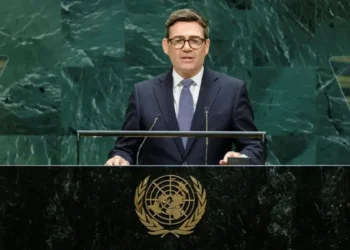
Burnham announced the creation of the National Centre for Information Defence during his address to the United Nations General Assembly in New York. The centre is expected to bring together security and intelligence agencies, law enforcement bodies, government departments and social media companies to identify, attribute and disrupt information attacks linked to foreign powers.
The proposal comes as governments across Europe face growing concerns about the use of artificial intelligence, fabricated online material and coordinated social media campaigns to influence public debate. The British government has identified foreign information manipulation as part of a wider set of hybrid security threats that can include cyberattacks, deceptive websites, manipulated documents and coordinated online activity.
In his UN speech, Burnham said the UK would enter the next decade with greater awareness of the risks posed by such campaigns. He argued that information attacks could influence how people viewed their own communities and country, potentially deepening social divisions and creating distrust.

The prime minister specifically identified Russia as a major source of concern. He said Russian agencies had used bots, fake websites and falsified newspaper articles as part of efforts to spread disinformation. He also claimed that Russian-linked operations had forged the branding of 28 British organisations, including universities and the BBC, while amplifying far-right narratives.
Burnham also referred to evidence that Russia had attempted to interfere in the UK’s 2019 general election. His remarks reflected longstanding British concerns about foreign interference in democratic processes and the growing difficulty of distinguishing authentic information from deliberately manipulated material online.
The proposed National Centre for Information Defence is intended to give the UK a more coordinated response. Rather than relying on separate institutions to identify individual incidents, the centre would bring expertise together to monitor threats, determine where hostile activity originates and support efforts to disrupt campaigns judged to be linked to foreign states.
Artificial intelligence is expected to be a major part of the challenge. Advances in generative AI have made it easier to produce convincing photographs, audio recordings, videos and written material at speed. Such material can be distributed through social media and other online platforms, potentially reaching large audiences before its authenticity can be properly examined.
Deepfakes are particularly difficult because they can create apparently realistic representations of people saying or doing things that never happened. The technology can be used for entertainment and legitimate creative purposes, but governments have become increasingly concerned about its potential use in political manipulation, fraud and hostile information operations.
Burnham said artificial intelligence could multiply the threat posed by information attacks. The government’s approach therefore places information security alongside more traditional areas of national security, reflecting the growing overlap between technology, public confidence and international relations.
The prime minister also connected resilience against disinformation with wider social and economic conditions. He argued that people experiencing financial pressure or uncertainty about their future could be more vulnerable to misleading information and online influence. Young people outside employment, education or training were among the groups he highlighted.
That argument places the proposed security initiative within a broader government approach to social resilience. Burnham said reducing inequality, improving living standards and creating opportunities would also form part of the effort to strengthen society against manipulation.
The government has said the new centre will focus on hostile state information attacks rather than ordinary political disagreement. The distinction is significant because any government programme dealing with misinformation and online content faces questions about how legitimate political expression can be protected while foreign interference is addressed.
The centre is expected to work with social media companies as well as intelligence and law enforcement organisations. Cooperation between government and technology companies could become increasingly important because much of the information targeted by hostile campaigns is distributed through privately operated digital platforms.
The initiative also follows wider British efforts to help other countries defend their democratic processes. Burnham said the UK had already supported Moldova in protecting its elections from Russian interference and that Britain was prepared to share its experience with other European countries facing similar challenges.
With several elections expected across Europe in the coming years, governments are examining how foreign actors might attempt to exploit political divisions, social tensions or uncertainty. The UK says cooperation between countries will be necessary because online information campaigns can cross national borders almost instantly.
Burnham’s announcement came during a broader UN speech in which he presented national security as extending beyond military strength. He argued that a country’s social cohesion and ability to withstand manipulation were also important elements of national security.
The announcement also came amid discussion between Britain and the United States about the appropriate response to Russia. US President Donald Trump had recently criticised the tone of previous British rhetoric towards Moscow, while the UK government maintained that Russian threats and hybrid activities remained serious security concerns.
Downing Street said the UK remained aligned with its allies on the need to defend against hostile activity and that Russian aggression would not deter British support for Ukraine. The exchange illustrates the wider diplomatic environment in which Britain’s new information-defence policy is being developed.
The UK government has previously warned about foreign information manipulation and interference operations that use fake websites, coordinated social media accounts and fabricated material to promote narratives favourable to Russia. Such campaigns have been identified as part of broader hybrid activity intended to weaken confidence in democratic institutions.
The proposed centre is therefore not being presented as an entirely new response to the problem, but as an effort to create a more organised national structure. The government believes a central capability could improve coordination between organisations that already monitor cyber threats, foreign interference and online activity.
Foreign Affairs Select Committee chair Emily Thornberry welcomed the announcement, saying the creation of a dedicated centre had been a major recommendation of the committee’s report on disinformation diplomacy published earlier in 2026. She argued that previous government approaches had been fragmented and that a more coordinated structure could improve Britain’s response to foreign information campaigns.
The challenge, however, extends beyond identifying false information. Modern information operations can combine genuine facts with misleading claims, selectively edited material and emotionally charged narratives. A campaign does not necessarily need to convince every person of a particular claim to have an impact; it may instead seek to create confusion, distrust or hostility between different sections of society.
That makes public resilience an important part of the government’s strategy. Burnham said communities would need greater ability to recognise and challenge misleading information themselves, suggesting that national security would increasingly depend on the ability of ordinary citizens to assess what they encounter online.
The issue is becoming more urgent as artificial intelligence develops rapidly. Content that once required specialist technical skills can now be generated using widely available tools, increasing the potential scale of manipulation. At the same time, the speed of social media means that false or misleading material can circulate internationally before authorities have time to respond.

For Britain, the new centre will therefore face a difficult balance between rapid intervention and protection of legitimate democratic debate. Its effectiveness will depend not only on technical capabilities but also on clear procedures for identifying foreign interference, cooperation between public institutions and technology companies, and public confidence in the information being provided by authorities.
The government says the National Centre for Information Defence will help Britain detect, attribute and disrupt hostile state information attacks while strengthening democratic resilience. Its creation reflects a broader recognition that modern national security increasingly includes the battle over information itself.
As Britain moves towards a new decade of technological and geopolitical uncertainty, the government is seeking to ensure that hostile actors cannot easily exploit digital platforms, artificial intelligence or social divisions. Whether the new centre can translate that ambition into an effective long-term defence will depend on how it is structured, how transparently it operates and how successfully it works with both domestic institutions and international partners.
Related News:
 UK Unveils Centre to Counter Foreign Disinformation
 Reform UK funding: mystery billionaire revealed
 Doomsday Clock Nears Midnight Amid Global Crises
 Ghent Professors Questioned Cofnas Appointment
 Australia gives users control over social media algorithms
 Europe’s democracies face a growing far-right threat
 Election Candidate Abuse Raises Alarm in England
 Tom Watson Takes Senior Role at Palantir
 Lib Dems Prepare for Election Amid Reform Challenge
 UK Fighter Jet Purchase Could Breach Nuclear Treaty, Warns CND
 Russia repeatedly targets UK military satellites, warns Space Command chief
 British Woman in Iran ‘Losing Hope’ Amid Ongoing Detention
 BBC Journalist Held and Interrogated in Vietnam
 Britain deploys RAF specialists to assist Belgium with drone threats
 BBC director-general and news chief resign amid bias row
 Rama Rebukes Mahmood for Targeting Albanian Families
 Russian Vessel Used Lasers on RAF Pilots, UK Claims
 Starmer China visit raises human rights pressure on Beijing
 UK and EU Signal Fresh Push for Defence Cooperation Talks
 UK New Car Discounts Near £6,000 as Prices Are Slashed
 Starmer Condemns ‘Depraved’ Russian Strikes on Ukraine
 Trump and Chagos Deal Rift Over Iran Strikes
 Andrew Mountbatten-Windsor Arrest After FBI Radar
 Farage Chagos Islands Row Sparks Fury
 Trump Tariffs Threat Spark UK and EU Alarm
 UK Teen Social Media Ban Trials Begin
 Ministers Urged to Act Faster on Deepfakes Threat
 Gordon Brown urges court for crimes against children
 Yvette Cooper: UK Must Follow Principles, Not US Pressure
 UK Minister Denies Iran Missile Threat to Britain
 Cluster Strikes Test Israel’s Missile Defences
 Army Probes Apache Flyover at Kid Rock’s Nashville Estate
 Relationship with Trump may be beyond repair, Starmer warned
 Artemis II Returns After Historic Moon Flyby
 Iran Crisis Tests Trump’s Global Leadership
 Charles Faces Trump Test in High-Stakes US Visit
 UK Stands Firm on Falklands Amid US Rift
 Cartel crackdown raises fears of fresh violence
 US states redraw maps after voting rights ruling
 Canadian Fiddler Sues Google Over AI Defamation Claim
 US ‘Narco Boat’ Strikes Draw Global Outcry
 UK Pushes for New EU Goods Trade Deal
 UK firms accused of ‘AI washing’ boom
 Farage and Reform UK Reshape British Politics
 Starmer Leadership Under Pressure After Setbacks
 Deadly Russian Air Raids Strike Across Ukraine
 UK Ministers Lobby Trump Over Under-16s Social Media Ban
 New South Wales Premier Chris Minns Signals Tough Road Ahead for Labor
 Labour MPs Urge Burnham to Revive UK Aid Target
 Israeli Strike in Southern Lebanon Kills Seven
 Is America Ready for an AOC Presidential Run?
 Former Diplomats Urge UK and France to Act on Palestine
 RAF Barnham Protests Fuel Tensions in Norfolk Town
 UK Risks Falling Behind in AI Race
 Exeter Approves Saudi Military Training Partnership
 Ukraine Villagers Demand Answers After Deadly Arms Depot Strike
 London Launches First Self-Driving Taxis
 Survivor Sues Musk’s xAI Over AI Abuse Images
 Green Leader Targets Starmer’s Former Seat
 Daughter Finds Bones in Parents’ Burned-Out Car
 Bayeux Tapestry Revives Franco-British Ties
 Trump Calls Iran War ‘Small Potatoes’ Despite US Deaths
 Reform Faces Fresh Financial Controversy
 Masked Protesters Bring Dover Port Traffic to Standstill
 UN expert urges UK to rethink Israel policy
 UK plans tougher Israel stance with settlement trade ban
 New Mexico Takes Facebook to Trial Over Data Scandal
 Anthropic Blocks AI Misuse Linked to Weapons Threats
 Pavlohrad Strike Kills Five, Injures 67
 Patriot Platform Raises Concern Across Britain
 Royal Crown Branded Enslaved Africans in Britain’s Slave Trade
 Israel Accused of Undermining Palestinian Life
 Trump Threatens EU Over Canada Partnership Proposal
 Iran School Strike Raises War Crimes Questions, UN Says
 Russia’s Max App Raises Surveillance Concerns
 Middle powers seek new alliances amid Trump era
 British Columbia Sues OpenAI Over School Shooting
 US Networks Suspend Trump White House Pool Coverage
 King Refers Jamaica Slavery Petition to Privy Council
 AI Takes Centre Stage in Trump-Xi Talks