**Published: 28 August 2026. The English Chronicle Desk. The English Chronicle Online**
Devastating flash floods and landslides along the Nepal-Tibet border have killed hundreds of people and left hundreds more missing, as rescue teams continue to search through areas buried by water, mud and rock.
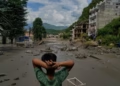
The disaster struck early on Wednesday, sending a powerful surge through river valleys in northern Nepal and across the border into Tibet. Roads and bridges were destroyed, buildings were swept away and vehicles were carried downstream by the force of the flood.
The full scale of the catastrophe is still emerging. Nepalese authorities have reported hundreds of deaths and more than 900 people missing, while Chinese state media has reported hundreds missing on the Tibetan side.
The situation has also been complicated by the possibility of further flooding. A large body of water formed behind debris from the landslide briefly overflowed on Friday, prompting Chinese authorities to temporarily halt some rescue operations.
Here is what is known about the disaster, its possible cause and the continuing risks.

## What caused the disaster?
Initial reports suggested that an earthquake may have triggered the landslide responsible for the flooding. However, subsequent analysis by the United States Geological Survey indicated that the seismic event was generated by a glacial collapse and debris flow.
The USGS said the collapse produced a seismic event equivalent to magnitude 5.2 and caused catastrophic effects downstream.
Scientists believe part of a glacier in the Himalayas collapsed into a river valley, sending enormous quantities of ice, rock and debris into the watercourse.
The resulting surge travelled rapidly downstream towards populated areas and important transport routes near the Nepal-China border.
Professor Mike Searle, an Earth sciences expert at Oxford University, said the sequence may have involved a landslide occurring first, followed by water becoming temporarily dammed before the blockage gave way.
The amount of debris seen in footage from the disaster suggests that a huge volume of material entered the river system before the flood wave reached communities downstream.
The affected region lies around 64km north of Kathmandu and includes areas popular with mountaineers, trekkers and religious pilgrims.
Video footage showed an enormous wall of mud, rocks and water moving through valleys, destroying buildings and vehicles.
One particularly striking sequence showed floodwaters and debris rushing through a gorge along the Trishuli River before overwhelming the Rasuvagadhi border checkpoint, a major crossing between Nepal and China.
Severe flooding was also reported along the Bhote Koshi and Narayani river systems.
Deaths and destruction were recorded on both sides of the international border.
## Why is there a risk of another flood?
The immediate disaster has not ended.
One of the biggest concerns for emergency authorities is the formation of temporary natural dams created when landslides or debris block a river.
The International Centre for Integrated Mountain Development, known as ICIMOD, has warned that debris deposited in narrow sections of rivers could obstruct water flow.
If enough water accumulates behind such a blockage, the temporary dam can eventually collapse, releasing another destructive surge downstream.
Chinese authorities have separately warned of a high risk involving a newly formed barrier lake near the border.
The lake developed at the confluence of the Chhochen Khola and Purepu Tsangpo rivers after the landslide deposited material across the river system.
State media reported that around 2.5 million cubic metres of water had accumulated in the lake, with several million more cubic metres expected to enter it.
The lake briefly overflowed on Friday, causing Chinese emergency teams to suspend some rescue activities because of fears that a sudden release of water or debris could create another flood.
Water levels later fell slightly and state media reported that the immediate risk had come under control, allowing rescue operations to resume.
Engineering teams have been deployed to monitor the lake and surrounding conditions. Drones have also been used to deliver equipment and supplies to difficult-to-reach areas.
The situation remains closely monitored because heavy rainfall is forecast in the region.
## How many people have died or gone missing?
The casualty figures remain fluid because rescuers are still reaching affected locations and authorities are attempting to reconcile information from different sources.
Nepalese police have reported at least 489 deaths, with hundreds of people still missing.
Nepal’s National Disaster Risk Reduction and Management Authority reported that 910 people were missing as of Thursday evening. The figure included foreign nationals as well as members of the Nepalese army and police.
Nepal has also published the names of 537 foreign nationals who have been out of contact since the disaster. Among them are 33 British nationals.
The number of missing people reported by China is separate. Chinese state broadcaster CCTV reported that 558 people were missing in Tibet as of Friday afternoon, with five deaths recorded.
It remains unclear whether some people appear in both the Nepalese and Chinese figures because of the movement of tourists and pilgrims across the border.
That uncertainty has made it difficult for families and foreign governments to establish the precise whereabouts of missing travellers.
## Why were so many tourists in the region?
The border area is an important route for tourism and pilgrimage.
Mount Kailash, located in Tibet, is regarded as sacred by Hindus and is also an important religious site for Buddhists, Jains and followers of the Bon tradition.
Thousands of pilgrims travel through Nepal on journeys towards the mountain, with the route attracting visitors from India and other countries.
The region is also popular with trekkers and adventure tourists because of its Himalayan landscape.
The disaster therefore struck an area containing both local communities and large numbers of international visitors.
Several missing foreign nationals were travelling with organised tour groups, while others were travelling independently.
The destruction of roads and telecommunications infrastructure has made it particularly difficult for tour operators and governments to determine who reached safety before the flooding.
## What are governments doing?
Nepal and China have mobilised large-scale emergency responses.
China’s Premier Li Qiang travelled to Gyirong to oversee rescue and relief operations, while President Xi Jinping called for an “all-out” search for missing people and stronger monitoring and early-warning systems.
Nepal’s Prime Minister Balendra Shah described the disaster as a deeply distressing national emergency and said authorities would coordinate with China.
Neighbouring India has also offered humanitarian assistance.
Prime Minister Narendra Modi said India was prepared to provide Nepal with all possible forms of humanitarian support.
The United Nations has said its teams and partners are mobilising supplies and personnel to support the Nepalese government’s response.
The United States has pledged $500,000 in emergency assistance for shelter, water, sanitation and other relief requirements.
The UK has also offered £5m in support for Nepal and said it would work to assist British nationals affected by the disaster.
Diplomatic officials are continuing to work with Nepalese authorities and tour operators to establish the whereabouts of missing British citizens and other foreign nationals.
## Could climate change have contributed?
Scientists are investigating whether long-term changes in the Himalayan environment may have increased the vulnerability of the region.
The Hindu Kush Himalaya is experiencing rapid warming, which is contributing to glacier loss and changes in mountain environments.
However, scientists have cautioned against immediately describing the flood as a direct consequence of climate change.
Geologist Daniel Shugar, who was among the scientists to suggest that glacial activity may have triggered the disaster, said thinning glaciers associated with warming could potentially increase the likelihood of instability.
But he stressed that it was too early to establish a definitive link between climate change and this particular collapse.
Simon Cook, a geoscientist at the University of Dundee, said climate change could nevertheless influence the conditions in which such events occur.
Scientists are particularly interested in the role of permafrost, permanently frozen ground that can help stabilise steep mountain slopes.
As temperatures rise, permafrost can thaw and weaken, potentially increasing the likelihood of landslides in some high-altitude environments.
Cook said his team believed it had identified the likely area where the glacier collapse occurred, near Langtang Lirung, around 15km west of the main flood site.
The precise chain of events is still being reconstructed.
## What happens next?
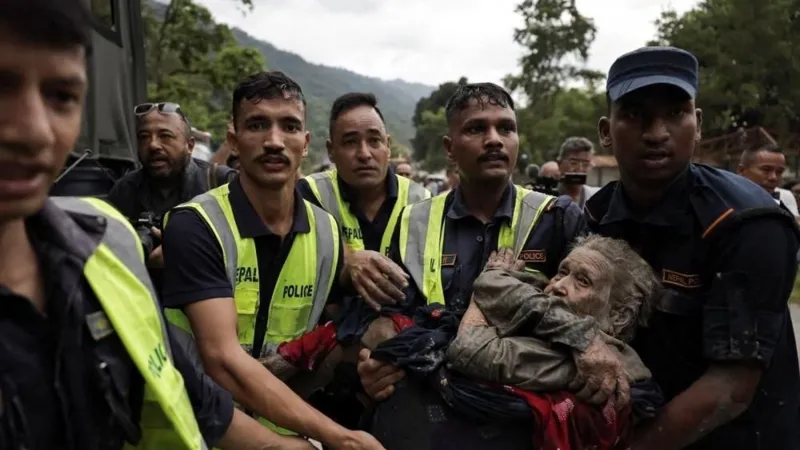
For rescue teams, the immediate priority remains finding survivors and recovering those who have died.
For families, the priority is establishing whether missing relatives are alive and where they are.
The continuing threat of secondary flooding makes the operation especially dangerous. Rescuers must balance the urgency of reaching isolated communities with the possibility that unstable slopes, blocked rivers or rising barrier lakes could trigger another surge.
Authorities are therefore monitoring river levels, rainfall, mountain slopes and temporary water bodies while working to reopen damaged transport routes.

The disaster has also highlighted the vulnerability of communities and tourism infrastructure in the Himalayas, where a single glacial collapse or landslide can rapidly transform a remote river valley into a dangerous flood corridor.
As search teams continue their work, officials are warning people in affected areas to follow local safety instructions and remain away from potentially unstable rivers and flood zones.
The final human toll may take days or longer to establish.
For now, hundreds of families across Nepal, China, India, Britain and other countries remain anxiously waiting for news, while rescuers confront one of the most challenging emergencies the region has faced in recent years.
The central question is no longer simply what caused the devastating flood. It is whether the mountains and rivers have stabilised enough to allow the search for survivors to continue safely.
Related News:
 Venezuela Quake Death Toll Surpasses 4,000
 Wildfires Force Mass Evacuations in France And Spain
 Powerful 7.7-Magnitude Earthquake Hits Eastern Indonesia
 Wildfires rage across Europe as hundreds arrested in France
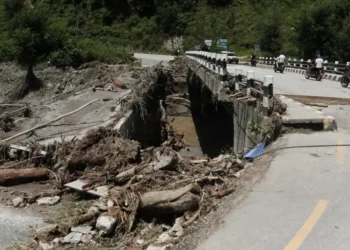 Nepal Flood Death Toll Tops 300 as Second Flood Feared
 South Africa’s Garden Route Gem Faces Looming Water Crisis
 Aberdeen Chosen for GB Energy HQ at Marischal Square
 Scotland’s Climate Plans Face Scrutiny Over ‘Science Fiction’ Targets
 Ocean Warming Drives Massive Marine Life Loss, Study Warns
 Tropical Flowers Shift Blooming Due to Climate Crisis
 UK Energy Reform Could Cut Bills by £200
 Evacuations Ordered as California Wildfires Spread Fast
 UK Records Earliest Spring as Nature Awakens Fast
 North Sea Drilling to Cut UK Imports Only Slightly
 Queensland Braces for Potential Second Severe Cyclone Hit
 Moldova River Crisis Exposes War’s Hidden Cost
 Heavier SUVs Accelerate Britain’s Pothole Crisis
 Cyclone Vaianu Forces Mass Evacuations in New Zealand
 Chornobyl Still at Risk 40 Years After Disaster
 Crackdown Backfires on UK Climate Protesters
 Older Than Dinosaurs: Secrets of Mayfly Dance Revealed
 Capitalism ‘Suicidal’, Warns Petro at Climate Summit
 Coalition pushes fossil fuel phaseout plan
 Record May Heat to Cold Front in Eastern Australia
 Norway Doubles Down on Oil and Gas for Europe Energy Security
 Doomsday Clock Nears Midnight Amid Global Crises
 Tractor Breakdown Tests Lincolnshire Farmers
 Britons Build Emergency Supplies Amid Rising Fears
 Migratory Bird Crisis: UK Numbers Plunge Despite Record Warmth
 UK Faces Mass Water Shortages by 2055, Lords Warn
 Sycamore Gap Artwork Chosen After Public Vote
 Pope Meets Families in Italy Toxic Waste Zone
 UK rejects EV charging VAT cut amid Treasury clash
 Essex valley emerges as rising English wine hub
 Hope for mountain bongos returns to Kenya
 UN Issues Urgent Warning: Imminent Return of El Niño
 Europe Swelters as UK and France Smash Heat Records
 Germany Summons Chinese Envoy Over Russian Troop Training
 Sydney Records Hottest June Since 1859 as Expert Warns New High a ‘Signature’ of Global Warming
 UK Heatwaves Ignite Crisis of Sleep and Public Safety
 UK Seas Face Extreme Heatwave as Global Temperatures Surge
 Europe Pushes for Binding Heat Safety Laws at Work
 Europe Scorched as Record Heatwaves Grip the Continent
 UK Power Grid Strained by Summer Heatwave
 UK Schools Struggle as Classrooms Top 40C
 London Tube Heat Reaches Dangerous Levels
 Olympus Awaits Unesco Heritage Recognition
 Three-Quarters of England’s Riverbanks Still Off Limits
 London’s 2026 ‘Great Stink’ Raises Sewer Concerns
 Burnham unveils £65m drought aid for farmers
 Gen Z turns to BirdTok for a gentler digital escape
 Battery Fires Cost UK Recycling Industry £1bn
 Nearly 90,000 ordered to flee Reno wildfire
 Heavy Casualties Feared as Flash Flood Sweeps Nepal-Tibet Border
 France Faces Calls to Ban Alpine Marmot Hunting
 Nepal-Tibet Flood Leaves 270 Dead and 1,400 Missing
 Australia Races to Find Tourists Missing in Nepal
 France Eases Cheese Rules as Drought Hits Farms
 Former Railway Line Named Britain’s Favourite Path
 China Warns of Second Flood From High-Risk Lake
 Kent Nurse Missing After Nepal-Tibet Flash Flood
 Drought Raises Flood Risk as UK Autumn Approaches
 # Last Message Before Nepal Flood Left Family Waiting