Published: 13 August 2026. The English Chronicle Desk. The English Chronicle Online
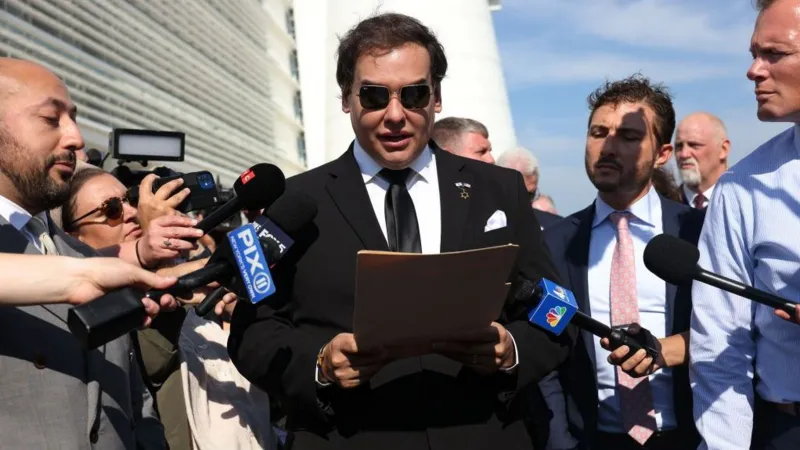
Former US congressman George Santos has been permanently banned from trading on prediction-market operator Kalshi after the company alleged that he used non-public information to place bets connected to his own attendance at US President Donald Trump’s State of the Union address.
Kalshi said its compliance team concluded that Santos’s trading activity showed signs of insider dealing and warranted a lifetime ban from the platform.
The company said the decision was taken independently and did not depend on waiting for regulators or law-enforcement agencies to take action.
The case adds to growing scrutiny surrounding prediction markets, where users can trade contracts based on the outcomes of political, economic and other real-world events.
Santos responded to the ban on X, thanking Kalshi for the decision while appearing to question the company’s own future.
“Let’s see how much longer you guys are around for,” he wrote.
The BBC has contacted Santos for comment.

Bets linked to State of the Union attendance
According to Kalshi’s disciplinary notice, Santos placed a series of bets in February on a market connected to whether he would attend Trump’s State of the Union address.
The company said he made sizeable trades between 2 and 25 February.
Kalshi alleged that Santos’s position was particularly problematic because the event concerned his own behaviour and was therefore something he could directly influence.
The platform said some of Santos’s public comments about whether he intended to attend the address were false or misleading.
According to the company, those statements affected contract prices while Santos continued trading.
Kalshi said Santos ultimately made $17,839.57 from the activity.
The company later referred the case to federal authorities after its internal monitoring systems identified what it considered suspicious trading behaviour.
The alleged use of non-public information is particularly sensitive in prediction markets because contract prices can change rapidly when traders receive information that is not yet widely available.
Federal investigation and financial penalty
The Kalshi ban follows a separate federal investigation into Santos’s State of the Union trades.
In July, Santos agreed to pay $35,000 to settle an investigation by the Commodity Futures Trading Commission.
Kalshi separately imposed a penalty of $71,356, according to the company.
The disciplinary action demonstrates the increasingly complicated regulatory environment facing prediction-market operators as they expand.
Platforms such as Kalshi and rival Polymarket have experienced significant growth as users increasingly seek to trade contracts tied to elections, economic indicators, sports and other events.
That growth has also brought greater scrutiny over market manipulation, conflicts of interest and the use of information that may not be available to other traders.
Prediction markets argue that their products can provide useful information about collective expectations. Critics, however, have raised concerns about whether some markets create incentives for participants to manipulate outcomes or exploit privileged information.
A controversial political career
Santos’s latest dispute comes after one of the most controversial political careers in recent US history.
He was elected to Congress in 2022 after campaigning as a Republican representing New York.
Shortly after his election, extensive questions emerged about claims he had made about his education, employment, family history and other aspects of his biography.
Investigations eventually revealed that Santos had fabricated significant parts of his personal and professional background.
The controversy eventually led to his expulsion from the House of Representatives, making him only the sixth member in US history to be expelled.
His legal troubles continued after he left Congress.
Santos pleaded guilty to wire fraud and aggravated identity theft. He admitted to stealing the identities of nearly a dozen people, including relatives of deceased individuals.
He was sentenced to seven years in prison but served only three months after Trump commuted his sentence.
His political downfall made him a highly unusual figure in American public life, and his subsequent involvement with prediction markets has now created another legal and regulatory controversy.
Why the Kalshi case matters
The Santos case illustrates a fundamental challenge for prediction markets: determining when ordinary trading crosses the line into prohibited conduct.
A trader with specialised knowledge can potentially have an advantage over other participants.
That becomes particularly significant when the person trading is also directly connected to the event being traded.
In Santos’s case, Kalshi argued that his ability to influence whether he attended the State of the Union address created an obvious conflict of interest.
The company said its compliance team determined that his behaviour amounted to activity resembling insider dealing.
The platform’s decision to impose a lifetime ban also demonstrates how seriously prediction-market operators are attempting to address suspicious trading as the industry becomes more established.
Prediction markets under scrutiny
Prediction markets have moved rapidly from a niche financial product into a more visible part of the US online economy.
Users can buy and sell contracts linked to questions such as who will win an election, whether economic indicators will reach a particular level or whether a specific event will occur.
Supporters argue that market prices can provide a real-time indication of collective expectations.
The growth of these platforms has nevertheless attracted questions about regulation.
Unlike traditional betting companies, prediction-market operators often position themselves as financial-market businesses, placing them within a different regulatory framework.
That distinction has generated significant debate among regulators, lawmakers and industry participants.
As trading volumes increase, platforms are being expected to demonstrate that they can identify suspicious behaviour, prevent manipulation and protect the integrity of their markets.
Unusual trading patterns
Kalshi said it and other prediction-market platforms have detected an increase in unusual trading patterns.
The company and Polymarket have both faced growing pressure to strengthen monitoring systems as their user bases expand.
Modern trading platforms can analyse account activity, transaction sizes, timing and other behavioural indicators to identify potentially suspicious patterns.
But determining whether unusual trading represents misconduct can be complicated.
A trader may make a large bet because they have a strong opinion, because they believe they have identified an overlooked piece of information or because they have access to information unavailable to the wider market.
Regulators and companies therefore have to distinguish legitimate trading strategies from activity involving manipulation or prohibited information.
The Santos case highlights how difficult that distinction can become when the trader has a direct personal connection to the underlying event.
Political markets create additional risks
Markets involving political events are particularly sensitive because participants may have access to information through professional or personal networks.
Election-related markets, for example, can be influenced by campaign decisions, private polling, candidate activity and other information that may not immediately be available to the public.
Prediction-market operators have therefore faced increasing pressure to establish clear rules governing who can participate in specific markets.
The Santos episode could contribute to that debate.
If a person can directly influence the outcome of an event and simultaneously trade contracts predicting that outcome, the potential conflict is considerably more obvious than in an ordinary market.
Regulators watching closely
The involvement of the Commodity Futures Trading Commission demonstrates the level of regulatory attention surrounding prediction markets.
As the sector expands, regulators are likely to focus increasingly on market integrity, consumer protection and the possibility of manipulation.
The industry is also facing questions about how its products should be classified and regulated.
Prediction-market companies have argued that their contracts provide valuable information and should be treated as financial instruments.
Opponents have questioned whether certain markets effectively resemble gambling products.
Those debates are likely to continue as more consumers become familiar with prediction trading.
Santos’s continuing legal troubles
For Santos, the Kalshi controversy is another chapter in a long series of legal and political disputes.
His expulsion from Congress followed months of scrutiny over his finances and personal history.
His guilty plea in the federal criminal case brought another major legal consequence.
His subsequent release after Trump commuted his sentence attracted further public attention.
The prediction-market case does not amount to a new criminal conviction against Santos. Kalshi’s lifetime ban is a disciplinary action by a private company, while the CFTC settlement was a separate regulatory matter.
The distinction is important as the allegations surrounding his trading continue to attract public interest.
The future of prediction markets
Prediction markets are likely to become increasingly sophisticated as technology improves and trading volumes increase.
That expansion will bring opportunities as well as risks.
Better surveillance systems could help platforms detect suspicious activity more quickly. At the same time, increasingly complex markets may create new forms of manipulation that regulators have not previously encountered.

The industry will therefore face pressure to develop clear rules governing conflicts of interest, privileged information and market participation.
The Santos case provides a high-profile example of the challenges involved.
A trader betting on an event that he can personally influence presents an unusually clear conflict, but future cases may involve far more complicated relationships between traders and the events underlying their positions.
For Kalshi, the lifetime ban sends a strong message that it intends to police its markets aggressively.
For regulators, however, the broader question is whether prediction markets can maintain market integrity as they become increasingly mainstream.
The Santos episode has ensured that debate will continue.
What began as a set of bets linked to a former congressman’s attendance at a presidential address has become another test of how prediction markets handle insider information, conflicts of interest and the growing demands of financial-market regulation.
Related News:
 Spirit Airlines shuts down after 34 years amid crisis
 Severn Trent CEO Reward Package Doubled Despite Public Anger
 Weight-Loss Drugs Transform Fashion Shopping Habits
 EasyJet Takeover Sparks Fears Over Passengers’ Future
 Pubs and Hotels Face Business Rates Reform Review
 Shein targets $27bn valuation in Hong Kong debut
 Firms on both sides fear damage from US-Canada trade war
 US CEOs Earn 614 Times More Than Workers
 AI Crash Could Trigger Global Downturn, Bailey Warns
 Global markets face turmoil as Hormuz crisis deepens
 Tim Wilson Sells Out Controversial Share Market Bet
 Wealthy Britons Flee Gulf War but Avoid UK Taxes
 UniCredit’s Bold Move to Reshape European Banking
 UK Wage Growth Slows as Jobs Market Holds Firm
 Oil and Gas Prices Surge Amid Iran-Israel Attacks on Gasfields
 City Firms See Sharpest Fortune Reversal in Thirty Years
 Student Loan Interest May Rise Despite 6% Cap
 Europe EV Demand Surges as Fuel Prices Rise
 Carmakers Face £3bn Gap in UK Loan Payout Scandal
 Albanese Rejects Gas Export Tax Push
 $13bn World Cup Set to Break All Revenue Records
 BBC News Faces Deep Cuts in 2,000 Job Plan
 New UK advice scheme to boost savings and investing
 City & Guilds Faces Governance Crisis Over Sale
 US Awaits Iran Reply on New Ceasefire Proposal
 Reeves Fights to Keep Treasury Role Amid Labour Turmoil
 Victoria Labor Launches Apprenticeship Expansion Plan
 UK rejects EV charging VAT cut amid Treasury clash
 UK firms accused of ‘AI washing’ boom
 Nationwide Faces Governance Scrutiny Ahead of AGM
 Hungary Targets Oligarchs with Proposed Landmark Wealth Tax
 New Investment ‘Trump Accounts’ Launch for US Children
 Apollo Launches £5.7bn Bid for Aviation Giant easyJet
 Europe Weighs Hormuz Navigation Fee Plan
 Trump Refuses to Sign Housing Bill, But Law Takes Effect
 Weight-Loss Drugs Offer Food Savings Mainly to High Earners
 Canada to Match Trump’s 50% Tariffs Dollar for Dollar
 New Tata Chairman Faces Tough Road Ahead
 Canada hits US goods with tariffs up to 50%
 Europe Faces Winter Gas Supply Anxiety
 UK Households Could Save £173 on Fixed Energy Deals
 Burnham Faces Mounting Budget Challenges
 Post Office Scandal Compensation Tops £1 Billion as Victims Finally See Justice
 Big Pharma Investment Freeze Puts UK Life Sciences Sector Under Strain
 Great Britain’s Energy Operator Commits to Strengthening Grid to Prevent Blackouts
 UK House Price Growth Slows as Buyers Exercise Caution Ahead of Autumn Budget
 Kemi Badenoch Unveils ‘Golden Rule’ to Halve Spending Cuts for Deficit Reduction at Tory Conference
 New V-Level qualification to transform post-16 education
 Real living wage set to rise nearly 7% for UK workers in 2026
 Reeves Faces Setback as Labour May Miss Homes Target
 Trump’s UK Ambassador Urges North Sea Drilling to Strengthen US Ties
 Ryanair Chief UK Economy ‘Doomed’ Under Labour
 M&S Profits More Than Halve After Cyber-Attack
 Millionaires group urge Reeves to introduce wealth tax to ‘lift kids out of poverty’
 From Lego to Pokémon: How Adults Are Driving UK Toy Market Growth
 Starmer Says Labour’s Economic Plan Needs Years to Deliver
 Historic £100-Weekly Pension Boost Brings Relief for UK Mineworkers
 Starmer Faces Parliamentary Battles Over UK-EU ‘Reset’ Plan
 ScottishPower Tops List of Worst UK Energy Suppliers
 Trump Fed bid heads to Supreme Court
 BT Names New Openreach Chief Amid Major Fibre Expansion
 UK Unemployment Rate Climbs to 5.2% Peak
 Farage Faces Backlash Over Crypto Cameo Endorsements
 Rising Costs Force Families to Rethink Days Out
 US and Iran Agree to Two-Week Provisional Ceasefire
 Central Bank Chiefs Hold Crisis Simulation in Washington
 UK Staycations Rise as Travel Fears Grow
 Former Brexit Chief Calls for Rejoining the EU
 Millions Face Food Poverty as Consumer Confidence Hits Record Low
 Silent Tracks: Rail Line Without Passengers
 Trump and Xi Convene in Beijing for Historic High-Stakes Summit
 UK Eases Russian Oil Sanctions as Fuel Costs Soar
 Mid-Year Surge to Push Average Annual Bills Beyond £1,900
 Tube Strike Brings Capital to a Standstill Over Shift Disputes
 No Brutal EV Price War For British Motorists
 Gas Prices Fall Below $4 Following US-Iran Peace Deal
 EU Slashes Steel Quotas But Grants UK Favourable Rates
 Trump Faces Backlash Over $2bn Earnings Since Return
 Starling Bank Trims Jobs for AI Future
 Unions Warn Labour Over Zero-Hours Contract Reforms