Published: 14 August 2026 | The English Chronicle Desk | The English Chronicle Online
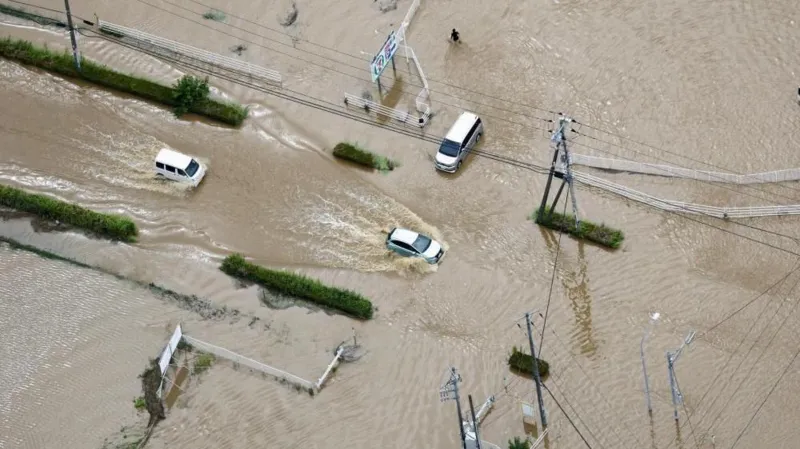
Eastern Japan is facing a major flooding and landslide emergency after exceptionally heavy rainfall killed at least eight people, disrupted transport and left thousands of people stranded, including travellers at Tokyo’s Narita Airport.
Authorities described the rainfall as an “unprecedented” event, with Chiba prefecture, immediately east of Tokyo, bearing the brunt of the extreme weather. More than 20,000 households lost electricity, while roads and railway lines were disrupted by flooding and landslides.
A level five emergency warning, the highest level in Japan’s disaster alert system, was issued on Thursday as the situation deteriorated. The warning was later downgraded to level four on Friday morning, but authorities continued to urge people to remain alert to the dangers of flooding, landslides and further disruption.
The extreme weather has also highlighted the wider risks facing Japan and neighbouring countries after a succession of powerful storms moved across East Asia and the western Pacific this week.

Record rainfall overwhelms eastern Japan
The most serious conditions were reported in Chiba, where rainfall reached extraordinary levels from Thursday afternoon.
Authorities said some areas recorded more than 100mm of rain in a single hour. The volume was several times the normal rainfall expected during August and represented an exceptional level of precipitation for the region.
Chiba Governor Toshihito Kumagai described the situation as unlike anything he had experienced during his years responding to disasters.
He said authorities were concentrating on protecting lives and continuing rescue operations while warning residents about the continuing threat from swollen rivers, flooded roads and unstable ground.
The Japan Meteorological Agency also described the rainfall as being at an unprecedented level.
Meteorologists explained that unusually warm and humid air had been moving into eastern Japan while colder air remained higher in the atmosphere. The combination created highly unstable conditions capable of producing intense and sustained rainfall.
The rain was expected to continue into Friday, increasing concerns that already saturated ground could become even more unstable.
Deaths reported across affected areas
At least eight people have died, according to reports from Japanese media including NHK, Kyodo and the Asahi Shimbun.
Among those killed was a woman who became trapped inside a vehicle submerged on a flooded road. Two other people reportedly collapsed in the streets and later died.
The deaths have added to fears that the final toll could rise if further flooding or landslides occur.
Emergency services have been working to reach people trapped by floodwater, while local authorities have urged residents in vulnerable areas to move to safer locations.
More than 100,000 households were asked to evacuate on Thursday as the severity of the rainfall became apparent.
Although the highest emergency warning was later reduced, authorities stressed that the danger had not disappeared.
For residents living near rivers, steep slopes and low-lying areas, even a reduction in rainfall intensity may not immediately remove the threat. Water can continue flowing into rivers and drainage systems after the heaviest rain has passed, while saturated hillsides can remain vulnerable to collapse.
Thousands affected by transport disruption
The extreme weather has caused widespread disruption to transport across eastern Japan.
Several railway services remained suspended on Friday morning, while major highways were closed because of flooding and dangerous road conditions.
Passengers were stranded at stations as services were interrupted, leaving many unable to reach their homes or workplaces.
Narita Airport, one of Japan’s most important international aviation hubs, was also affected. Thousands of passengers found themselves stranded or facing significant delays as transport connections to and from the airport were disrupted.
Airport officials said flights were expected to operate normally on Friday, although Japan Airlines warned that some services could experience delays.
The disruption demonstrated how quickly extreme rainfall can affect a densely populated metropolitan region where millions of people depend on railways, roads and airports every day.
Some residents were forced to spend the night in emergency accommodation.
Around 1,800 people reportedly stayed overnight at the Chiba Prefectural Government building after becoming stranded.
For those caught in the disruption, the experience was particularly alarming because the rainfall intensified rapidly.
One resident in Ichikawa, Chiba, told NHK that the rain appeared to arrive suddenly and unexpectedly. With electricity cut off, she was also concerned about whether her business would be able to reopen in the following days.
Power cuts add to the pressure
The rainfall also caused extensive electricity disruption.
More than 20,000 households in Chiba lost power as the storms affected infrastructure and caused damage across the prefecture.
Power outages can make flooding emergencies more difficult because residents may lose access to lighting, communications, refrigeration and other essential services.
For businesses, prolonged outages can create additional financial pressure, particularly when roads remain closed or customers are unable to travel.
Emergency authorities have therefore been dealing with several problems simultaneously: rescuing people, monitoring floodwater, assessing landslide risks, restoring electricity and attempting to reopen transport routes.
Wider storm activity across Asia
The rainfall in eastern Japan comes after a week of unusually active weather across the region.
Japan, the Philippines and China have all experienced the effects of successive storms, with several systems moving across the western Pacific at around the same time.
Dolphin brought heavy rainfall and damaging winds to parts of Japan, including Okinawa, where power supplies were disrupted, trees were brought down and flights were cancelled.
The Philippines has also faced repeated flooding concerns, prompting authorities to close schools and government offices in parts of the north.
China was affected by another powerful storm after authorities evacuated more than a million people ahead of its landfall in the east.
The simultaneous development of multiple weather systems has placed additional pressure on emergency services across the region.
Japan faces an increasingly difficult weather challenge
Japan is highly experienced in dealing with natural disasters.
The country has sophisticated warning systems, strong building standards and extensive emergency-response infrastructure because it regularly faces earthquakes, typhoons, floods and landslides.
However, the scale and speed of extreme rainfall events can still overwhelm local systems.
Climate scientists have warned that a warmer atmosphere can hold more moisture, potentially increasing the intensity of extreme rainfall when suitable weather conditions develop.
This does not mean that every individual rainfall event can automatically be attributed to climate change. Weather systems are influenced by numerous factors, including atmospheric circulation, ocean temperatures and local geography.
But the increasing frequency and intensity of extreme weather events have strengthened concerns about how communities should prepare for future disasters.
Evacuation warnings remain critical
Japanese authorities have repeatedly stressed the importance of acting quickly when evacuation warnings are issued.
Heavy rainfall can change conditions within a short period. A road that appears passable can rapidly become submerged, while a hillside that has remained stable for decades can collapse after prolonged rainfall.
Officials therefore continue to advise residents to avoid unnecessary travel and remain aware of local evacuation instructions.
The lowering of the emergency alert from level five to level four does not mean that all danger has passed. Rather, it reflects a change in the immediate level of emergency while significant risks remain.
Residents in areas affected by flooding and landslides are being urged to continue monitoring official information.
Businesses and communities face disruption
Beyond the immediate threat to life, the rainfall is likely to create significant economic disruption.
Retailers, restaurants, manufacturers and other businesses may be unable to operate normally if electricity supplies remain interrupted or customers cannot reach commercial areas.
Transport closures can also affect deliveries and supply chains.
Small businesses may be particularly vulnerable because even a short period of closure can result in lost income.
For residents whose homes have been flooded or damaged, the recovery process could take considerably longer.
Cleaning, repairs, insurance claims and the replacement of damaged possessions can impose substantial financial and emotional burdens.
A warning as the weather remains unsettled
The immediate priority for authorities remains rescue and protecting people in areas at risk.
Although the most severe warning has been downgraded, officials are continuing to monitor conditions closely because rainfall and saturated ground can create hazards even after the main storm has weakened.
The situation also comes as meteorologists anticipate an unusually active typhoon season in the wider region.
That means communities across Japan and neighbouring countries may face further periods of severe weather in the weeks ahead.

The latest disaster is therefore not simply a story about one extraordinary spell of rain. It is also a reminder of the vulnerability of densely populated communities to rapidly developing extreme weather.
For the people of Chiba and surrounding areas, the immediate concern is survival, recovery and restoring normal life after a devastating deluge. For authorities, the challenge is to ensure that rescue efforts reach those still in danger while preparing communities for whatever weather may come next.
The deaths of at least eight people underline the human cost of the disaster. As floodwaters recede and transport networks gradually recover, attention will turn to assessing the damage and understanding how such extraordinary rainfall overwhelmed eastern Japan.
The events of this week have once again demonstrated that even a country with extensive experience and advanced infrastructure cannot afford to underestimate the power of extreme weather.
Related News:
 Typhoon Dolphin triggers mass evacuations in China
 Cyclone Vaianu Forces Mass Evacuations in New Zealand
 Deadly Earthquake Hits Philippines
 At Least 19 Killed After Powerful Earthquake Hits Southern Philippines
 Venezuela Quake Death Toll Surpasses 4,000
 Two Killed as Firefighting Helicopters Collide During Greece Wildfire Mission
 Drone Warnings Issued as South Korea Battles Historic Heatwave
 Canada wildfire surges as residents brace for worst
 Dozens of Flood Warnings in England After Days of Non-Stop Rain

 BRRRITAIN: Met Office Issues Yellow Weather Warning for More Snow
 Fast-moving Wildfires Rage Across Southwestern US
 Major 7.1 Earthquake Strikes Off Malaysian Tourist Coast
 UK Winter Nowhere Near a Record Breaker Despite Floods and Storms
 UK Records Warmest Day of the Year as Temperatures Exceed 18 °C
 Bodies of Two Chinese Backpackers Found in Floodwaters
 Evacuations Ordered as California Wildfires Spread Fast
 Queensland Braces for Potential Second Severe Cyclone Hit
 Philippines Accuses Chinese Fishermen of Cyanide Dumping
 The Great May Meltdown: Europe Braces for a Historic Swing from Arctic Chill to Extreme Late-Spring Heat
 Mangrove Forests Recover After Years of Damage
 Asia Prepares for Severe El Niño Threat
 Japanese Bear That Injured Four Still Missing
 Hundreds of Aftershocks Shake Philippines as Fears Grow Over Rising Death Toll
 Temperatures Set to Fall This Week, But Forecasters Warn Heat Could Return Soon
 Why Extreme Heat Can Cause Trees to Collapse and What Experts Say Can Be Done
 Sydney Records Hottest June Since 1859 as Expert Warns New High a ‘Signature’ of Global Warming
 UK Braces for Prolonged Heatwave as Amber Alerts Issued
 ‘Extreme’ Marine Heatwave Forecast for UK Waters
 Deadly Spain Wildfire Leaves 11 Dead, 19 Missing
 UK Heatwaves May Have Claimed Thousands of Lives
 UK Heatwave Nears Two-Week Milestone as High Temperatures Continue Across the Country
 Tokyo’s Push for Shorts at Work Sparks Debate as Some Women Raise Concerns Over ‘Leg Hair Harassment’
 Rain Forecast to Return This Weekend as Parts of UK Edge Closer to Drought Conditions
 No Helicopters Available to Fight Wildfires as ‘Crisis Management’ Plans Activated
 Thousands Evacuated in France as Wildfires Spread Across Regions
 Venezuelans Still Seek Answers One Month After Quakes
 France Evacuates Tourist Area as Wildfires Spread
 Wildfires Force Mass Evacuations in France And Spain
 Wildfires Threaten Bordeaux as Mass Evacuations Grow
 Wildfires Advance Toward Farmland Near Bordeaux
 French Wildfire Sparks Rare Lightning Storm Near Bordeaux
 Fourth Heatwave Brings 35C Temperatures to UK
 French Firefighters Battle ‘David vs Goliath’ Wildfire
 Magnitude 7.1 Earthquake Strikes Japan, Several Injured
 People Trapped in Japan Shopping Centre After Earthquake
 Many Trapped Inside Japanese Shopping Centre After Earthquake
 Japan Quake Survivors Recall Terror as Homes Crumble
 Wildfires Intensify in South-West France as Region Braces for 40C Heatwave
 Amber Heat Health Alerts Issued as UK Heatwave Set to Reach 35C Peak
 Japan Earthquake Death Toll Rises to 30 as Aftershocks and Extreme Heat Slow Rescue Operations
 Heatwave-Linked Excess Deaths in England Nearly Double Compared with Last Year, New Analysis Suggests
 Storms Set to End UK Heatwave with Flood Warnings
 Canadians Defy Evacuation Orders as Wildfires Spread
 Beijing Braces for Torrential Rain as Dolphin Moves Inland
 UK Heatwave Set to End as Cooler Weekend Arrives
 West Midlands Fire Crews Battle Hotspots After Wildfires
 South Africa’s Garden Route Gem Faces Looming Water Crisis
 Draft Severe Weather Plan Following Storm Flooding
 What is Groundwater Flooding and Why Dorset is Seeing ‘Historical Highs’
 Snow and Rain Warnings as Cold Snap Continues in the UK
 How Do You Modernise Mango Farming? India’s Growers Urged to Innovate as Climate Change Hits
 Duterte Refuses to Attend ICC Pre-Trial Hearing Over ‘Drug War’ Case
Storm Hernando: Edinburgh Airport Flights Cancelled in US Travel Chaos
Duterte Refuses to Attend ICC Pre-Trial Hearing Over ‘Drug War’ Case
Storm Hernando: Edinburgh Airport Flights Cancelled in US Travel Chaos
 Sri Lanka Sets Weekly Shutdown to Save Fuel
 Nepal to swear in ex-rapper as new prime minister
 Moldova River Crisis Exposes War’s Hidden Cost
 Fading Maple Leaf: Why Indian Students Are Reconsidering the Canadian Dream
 Crackdown Backfires on UK Climate Protesters
 Capitalism ‘Suicidal’, Warns Petro at Climate Summit
 US Awaits Iran Reply on New Ceasefire Proposal
 Pope Meets Families in Italy Toxic Waste Zone
 Discontent grows around Putin amid war strain
 UN Issues Urgent Warning: Imminent Return of El Niño
 Trump Approves $700m Coal Industry Investment
 Man Praised for Saving Neighbours After Lightning Strike Sparks House Fire
 Net Zero School Remains Cool and Open as Heatwave Tests Britain’s Buildings
 Europe Scorched as Record Heatwaves Grip the Continent
 London Tube Heat Reaches Dangerous Levels
 Thailand mourns 12-year-old shooting victim at funeral