
Published: 03 July 2026. The English Chronicle Desk. The English Chronicle Online.
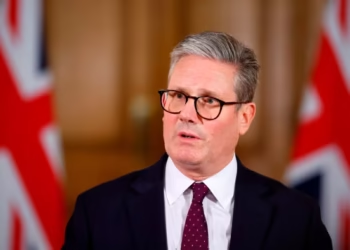
Prime Minister Keir Starmer has announced a significant shift in national budget priorities this week. He pledged fifteen billion pounds in new funding for the nation’s armed forces and manufacturing. The long-awaited defence investment plan aims to secure his legacy before leaving Downing Street. However, serious concerns have emerged regarding the true economic impact of this major policy. A detailed analysis of government figures reveals that these changes could cost ten thousand jobs. This new data suggests that moving funds to defence may prove to be counterproductive.
The government intends to raise over six billion pounds through unidentified cuts to departmental budgets. An additional four billion pounds in funding remains entirely unaccounted for in the current proposal. Researchers at the Transition Security Project examined these shifts to understand the real-world employment effects. They concluded that while defence spending creates jobs, the losses elsewhere will be far more significant. The findings challenge claims from the Prime Minister and the Chancellor regarding overall economic growth. Taking money away from other sectors will result in a net loss for the nation.
Khem Rogaly serves as the co-author of the recent report on these financial figures. He argues that the concept of a defence dividend remains a misleading narrative for the public. Job losses are now expected to result from this latest funding settlement by the government. The opportunity cost of prioritising military spending over other needs is now becoming very sharp. Far more jobs are created when the government invests in health, education, and the climate. The rise of autonomous weapons and artificial intelligence also means that military spending is less efficient. These advanced technologies often require fewer human workers than traditional infrastructure projects across the country.
Andrea Egan represents the interests of Unison as the general secretary for the national union. She described the analysis as a timely warning about the dangers of these planned budget cuts. Moving money away from vital departments will harm schools and hospitals across the entire nation. She labelled this plan as both costly and wasteful for the future of the British people. The government maintains that defence serves as a primary engine for growth in our country. They claim that the plan will support hundreds of thousands of jobs and many new apprenticeships. Ministers insist the strategy will back British workers, local businesses, and vital national technical innovation.
Government spokespeople also note that the country faces a new era of complex global threats. This reality demands a new era of defence transformation to rebuild our war-fighting combat readiness. The primary goal is to target resources so that we are ready for future global challenges. Starmer unveiled the plan after nearly a year of difficult internal arguments within his administration. These deep disagreements even led to the resignation of the defence secretary, John Healey, recently. The funding gap will ultimately need to be resolved by the next prime minister very soon.
The new Member of Parliament for Makerfield, Andy Burnham, appears to be the likely successor. He stated on Thursday that he remains committed to financing all national defence spending commitments properly. He told a prominent radio host that he was unaware of the shortfalls until this announcement. The government has confirmed that the largest budget cuts will impact energy and transport departments. Two major road improvement projects have already been stopped as a result of this shift. Energy officials are currently reviewing potential reductions to home insulation and carbon capture technology schemes.
The Prime Minister maintains that every pound in this plan will work twice for us. He claims it will deliver growth and opportunity while reinforcing our essential national security interests. However, the new research shows that military spending creates far fewer jobs than other sectors. Government data indicates that an extra twenty-five billion pounds in defence will create sixty thousand jobs. This suggests that every million pounds of investment creates roughly two point four direct domestic jobs. Other sectors generate significantly more employment opportunities for every single pound spent by the state. Figures from the Office for National Statistics show that transport spending generates over eleven jobs per million. Every million pounds spent on energy and net zero targets creates ten jobs for the economy. This disparity means that cutting two billion pounds from departments will cost us twenty thousand jobs. That loss is double the total number of jobs generated by the new defence investment plan. Researchers believe these figures show that defence supply chains are often highly international in nature. This suggests the government is spending billions to create jobs in countries outside the United Kingdom.
The state is currently spending over two billion pounds on new fighter jets for the military. These aircraft are largely manufactured within the United States rather than in our own domestic factories. Experts also suggest that modern high-end defence manufacturing is becoming increasingly automated and less labour-intensive. David Edgerton is a professor in the history of science and technology at King’s College London. He noted that the import content of road projects is usually lower than that of weaponry. It is also quite possible that military equipment requires fewer workers than similar spending on infrastructure. There is no reason to expect military expenditure to generate more jobs than other types of investment. We should expect defence spending to be far less productive than investments in schools or factories. The current economic strategy may therefore sacrifice long-term growth for short-term political and military objectives. This debate over fiscal priorities will likely continue to dominate the national conversation for some time.
Related News:
 Reeves Faces Setback as Labour May Miss Homes Target
 Virgin Trains Moves Closer to Challenging Eurostar Monopoly
 Trump’s UK Ambassador Urges North Sea Drilling to Strengthen US Ties
 Ryanair Chief UK Economy ‘Doomed’ Under Labour
 M&S Profits More Than Halve After Cyber-Attack
 Millionaires group urge Reeves to introduce wealth tax to ‘lift kids out of poverty’
 From Lego to Pokémon: How Adults Are Driving UK Toy Market Growth
 Canada Passes Carney’s First Budget in Tight Parliamentary Vote
 Starmer Says Labour’s Economic Plan Needs Years to Deliver
 Virgin Media Fined £23.8m Over Telecare Safety Failures
 Starmer Faces Parliamentary Battles Over UK-EU ‘Reset’ Plan
 Reeves Pub Business Rates U-Turn Calms Labour Revolt
 ScottishPower Tops List of Worst UK Energy Suppliers
 Markets Slide As Gold Rally Signals Risk From Trump Greenland Tariff Plan
 UK Eyes Global Investment with Visa Fee Refunds
 City & Guilds pay surge sparks backlash amid £22m cuts
 UK Inflation Hits 3.4% in December, Ending Five-Month Decline
 Trump Fed bid heads to Supreme Court
 ‘Black Tax’: Burden, Pride and Survival for African Workers
 AI job losses UK: Britain faces sharper employment shock
 India-EU Free Trade Deal Marks Historic Economic Shift
 Telstra AI jobs cuts as automation drive expands
 BT Names New Openreach Chief Amid Major Fibre Expansion
 UK Banks Plot Payment Backup Amid Trump Fears
 UK Unemployment Rate Climbs to 5.2% Peak
 UK shelves £110m border project amid trade strain
 Rachel Reeves Faces Middle East Conflict Test
 Grocery Inflation Rises Amid War Fears
 BrewDog sold Highland estate for knockdown price after abandoning reforestation plans
 Rising Costs Force Families to Rethink Days Out
 Oil Slides, Stocks Jump on Trump Peace Signals
 UK inflation held at 3% before global energy price hit
 Ticketmaster Fees Rise Despite Recent US Junk Fee Crackdown
 M&S Demands Urgent Action on Rising Violent Retail Crime
 New Era for Sick Pay as Millions Gain Critical Rights
 US and Iran Agree to Two-Week Provisional Ceasefire
 Stefano Gabbana Resigns as Chair of Italian Luxury Giant
 Rolls-Royce SMR Secures £600m Boost for Nuclear Future
 Aegon Sells Historic UK Arm to Standard Life for £2bn
 Central Bank Chiefs Hold Crisis Simulation in Washington
 UK Staycations Rise as Travel Fears Grow
 Former Brexit Chief Calls for Rejoining the EU
 Albanese Rejects Gas Export Tax Push
 Oil Prices Surge Above $120 Amid Iran Blockade Fears
 Trump orders US troop pullout from Germany
 Silent Tracks: Rail Line Without Passengers
 Tough Fiscal Realities Await Next Scottish Government
 DeepMind Staff Vote to Unionize Over US Military Contract
 Global Conflict Hits Home As Bullock Warns Of Economic Pain
 STV Election Coverage Disrupted Amid Bitter Pay Dispute
 Aramco Surges as East-West Pipeline Counters Gulf Tensions
 High Stakes in Beijing as Trump and Xi Meet Amid Global Turmoil
 Lotus Boss Pledges Future to Norfolk and Seeks State Support
 Trump and Xi Convene in Beijing for Historic High-Stakes Summit
 High Street Crisis: Fears Grow Over Post Office Closures
 UK Firms Freeze Spending as Iran Conflict Bites
 Rubles and Resilience: How Russia-China Border Towns Thrive
 UK Eases Russian Oil Sanctions as Fuel Costs Soar
 Reeves to Fast-Track Clean Energy Amid Iran Crisis
 Oil Markets Face ‘Red Zone’ Threat Amid Iran Crisis
 Belfast Approves Pilot Extension of Sunday Trading Hours
 Kevin Warsh sworn in as Fed chair amid economic backlash
 Discontent grows around Putin amid war strain
 Mid-Year Surge to Push Average Annual Bills Beyond £1,900
 Tube Strike Brings Capital to a Standstill Over Shift Disputes
 Tube Strike Brings Capital to a Standstill Over Shift Disputes
 BP Stands Firm on Amanda Blanc Amid Boardroom Storm
 UK House Prices Drop For Third Month Due To War Fears
 No Brutal EV Price War For British Motorists
 Gas Prices Fall Below $4 Following US-Iran Peace Deal
 Is JD Vance the Ultimate Fall Guy for Trump’s Shaky Iran Deal?
 EU Slashes Steel Quotas But Grants UK Favourable Rates
 Sainsbury’s Boss Optimistic As Grocery Inflation Eases
 Trump Faces Backlash Over $2bn Earnings Since Return
 Creditors Eye Thames Water Even Under Nationalisation
 Record £28m Fine for Virgin Media Over Cancellation Woes
 Jet2 Sees Summer Surge Despite Global Tensions
 Ukraine Creates Long-Range Strike Command
 BBC Faces Real Jeopardy as Licence Fee Income Declines
 Thames Water Future Remains Uncertain Amid Funding Crunch