Published: 10 August 2026. The English Chronicle Desk. The English Chronicle Online
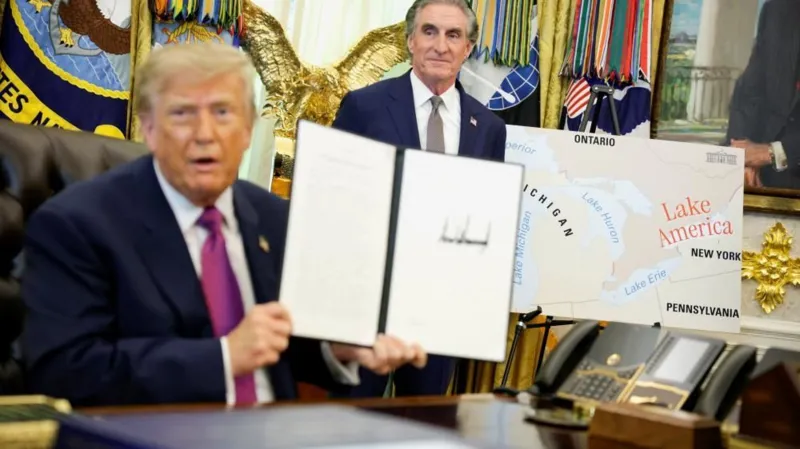
US President Donald Trump has signed an executive order seeking to rename Lake Ontario as “Lake America”, adding a new and highly symbolic dispute to already strained relations between the United States and Canada.
Trump announced the move as the two countries remain locked in a worsening trade confrontation. Washington has imposed new 50% tariffs on $20bn (£15.2bn; C$28bn) worth of Canadian goods after trade negotiations broke down, while Canada has said it will respond with “dollar for dollar” counter-tariffs.
The proposed name change applies to the United States’ official geographic naming system. However, because Lake Ontario is a shared body of water between the US and Canada, Washington’s decision does not oblige Canadian authorities or the international community to adopt the new name.
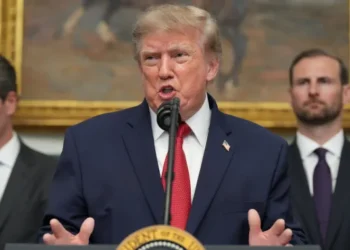
Trump said the change was effective immediately when he signed the order in the Oval Office. The executive order directs the US Department of the Interior to update the Geographic Names Information Service, the federal repository for official domestic geographic names, within 30 days.
The decision was quickly rejected by Canadian officials, who insisted that the lake’s longstanding name would remain unchanged in Canada.
Canadian Prime Minister Mark Carney said the name Lake Ontario has centuries of history and cannot simply be replaced by a unilateral decision from Washington.

“Things must be called by their name, and this lake is called Lake Ontario – today and forever,” Carney said.
He pointed out that the name predates both the Canadian Confederation and the United States Declaration of Independence. Lake Ontario’s name can be traced back more than four centuries and has deep historical connections to Indigenous languages and the region’s history.
Carney’s response reflected the broader deterioration in relations between the two North American neighbours, whose economies are closely intertwined but whose political relationship has become increasingly confrontational.
The lake itself is geographically significant. It is the smallest of the five Great Lakes and forms part of the international boundary between the Canadian province of Ontario and the US state of New York.
The Great Lakes have long been regarded as a shared environmental and economic resource. They support shipping, fisheries, tourism, drinking-water supplies and industrial activity on both sides of the border.
Canadian officials therefore dismissed Trump’s proposed renaming as having no practical effect on how the lake is identified in Canada.
Ontario Premier Doug Ford was among those who immediately rejected the proposal.
“It’s Lake Ontario to Canadians and the rest of the world. Now and forever,” Ford wrote.
Other Canadian premiers and ministers also criticised the move, reinforcing the view that Canadian institutions would continue using Lake Ontario.
The disagreement also exposed a complicated question about who has the authority to name shared bodies of water.
There is no single universally recognised international organisation responsible for determining the names of international waters. Individual governments can establish official names for geographic features within their own administrative systems, but those decisions do not necessarily determine what other countries call the same feature.
That distinction was illustrated by Trump’s earlier decision to rename the Gulf of Mexico as the “Gulf of America”.
After returning to the White House in 2025, Trump signed an executive order instructing US agencies to use the new name. Mexico rejected the change, arguing that a single country could not unilaterally rename a shared international body of water.
The Gulf dispute also became entangled in a legal battle involving Google.
Google changed how the gulf was displayed on its mapping service depending on the user’s location. Users in the United States saw “Gulf of America”, while users in Mexico continued to see “Gulf of Mexico”. Users in other countries were shown “Gulf of Mexico (Gulf of America)”.
The issue demonstrated how geographic naming disputes can extend beyond government documents and into technology platforms, journalism and international communications.
Trump’s previous Gulf of Mexico order also triggered a dispute with the Associated Press after the White House restricted AP reporters’ access to presidential events because the news organisation declined to adopt “Gulf of America” in its reporting. The AP subsequently sued the administration, and the legal dispute remains unresolved.
The Lake Ontario announcement has similarly produced contrasting reactions in Washington.
Interior Secretary Doug Burgum welcomed Trump’s decision and said the department would implement the order.
“The places and waters that border our nation and support our economy should reflect the greatness of the United States,” Burgum said.
He added that the US Geological Survey maps the country for the world and indicated that the agency would implement the president’s instruction.
But Democratic politicians strongly criticised the proposal.
Debbie Dingell, a Democratic congresswoman from Michigan, called the order “idiotic” and said she would introduce legislation in Congress seeking to nullify the name change.
“The Great Lakes are a shared treasure that generations of Americans and Canadians have worked together to protect,” she said.
New York Governor Kathy Hochul, whose state is the only US state bordering Lake Ontario, also rejected the new name.
Hochul said New York would continue calling the body of water Lake Ontario.
The political disagreement comes at a particularly sensitive moment for US-Canadian relations.
Trade tensions have intensified after negotiations between Washington and Ottawa collapsed. Both governments have accused the other of introducing last-minute demands that prevented an agreement.
The United States has imposed additional tariffs on Canadian products, while Canada has prepared retaliatory measures.
Trump has repeatedly criticised Canada’s trade policies and said on Thursday that his decision to rename the lake was not intended as a direct message to Ottawa. At the same time, he linked his frustration with Canada to the wider trade dispute, accusing America’s northern neighbour of having “ripped us off” for years.
Canadian officials have rejected the characterisation of the country’s trade relationship with the United States.
Despite the increasingly hostile rhetoric, there were signs that negotiations might not be permanently closed.
Canadian trade minister Dominic LeBlanc said Washington had withdrawn some demands concerning French-language labelling, one of several disagreements that contributed to the collapse of negotiations. US officials, however, disputed the Canadian account and said Washington had never demanded changes relating to language.
The conflicting statements suggested that both sides remained willing to defend their positions publicly while leaving some room for renewed talks.
The Lake Ontario dispute is also notable because of the cultural significance attached to the names of the Great Lakes.
Four of the five lakes – Ontario, Huron, Michigan and Erie – have names derived from Indigenous languages or Indigenous terminology. Lake Superior’s name has French origins and was later incorporated into English usage.
For generations, the Great Lakes have represented the interconnected geography of the United States and Canada rather than a dividing line between the two countries.
Lake Ontario, in particular, has played a major role in the development of communities on both sides of the border. Its waters connect major urban centres, ports and industrial regions, while the lake’s surrounding landscapes have become important destinations for tourism and recreation.
The proposal to call it “Lake America” therefore carries significance beyond a simple change in terminology.
For Trump’s administration, the move is part of a broader effort to assert US sovereignty and national identity through geographic naming. Supporters argue that American landmarks and geographic features should reflect the country’s identity and interests.
Critics, however, say the decision is unnecessary and risks creating another point of friction with an important ally at a time when cooperation is already under strain.
The practical consequences are likely to be limited in Canada. Canadian federal and provincial institutions are expected to continue using Lake Ontario, meaning the same body of water could have different official names in the two countries.
The development could also create complications for international maps, databases, shipping documents, educational materials and media organisations, particularly if US agencies begin consistently using “Lake America” while Canadian authorities retain the traditional name.

Ultimately, the dispute highlights the limits of unilateral geographic naming.
Trump can direct US federal agencies to adopt a new name within the American government’s systems, but he cannot compel Canada to accept it. Nor can Washington alone determine what the rest of the world calls the lake.
For Canadians, the answer from Ottawa and Ontario has been unequivocal: the lake remains Lake Ontario.
For the Trump administration, however, the proposed “Lake America” name represents another example of the president’s willingness to use geographic symbols to advance a broader political message.
As the United States and Canada continue negotiating over tariffs and trade, a dispute over the name of one of their shared Great Lakes has become an unexpected new measure of just how far relations between the neighbours have deteriorated.
Related News:
 Trump Faces Crisis as Iran Reopens Hormuz Tensions
 Trump likens US Navy actions to ‘pirates’
 Trump approval plunges amid Iran war fears
 Ohio’s Battle for Trust: Democrats Vying to Flip the Buckeye State
 Trump Threatens UN Budget Cuts as US Pushes ‘Trade Over Aid’ Agenda
 US Awaits Iran Reply on New Ceasefire Proposal
 Kevin Warsh sworn in as Fed chair amid economic backlash
 Hormuz Talks Near Critical Stage
 UK Pushes for New EU Goods Trade Deal
 Reeves Fights to Keep Treasury Role Amid Labour Turmoil
 Trump Claims Iran Peace Deal Near Completion
 Firms on both sides fear damage from US-Canada trade war
 Modi’s London Visit Seals Historic UK-India Trade Pact Amid Global Tensions
 Rachel Reeves to lead UK trade push in Saudi Arabia amid rights debate
 Canada Passes Carney’s First Budget in Tight Parliamentary Vote
 India’s Labour Law Overhaul Sparks Fierce Debate
 Trump to Recheck Green Cards from 19 Nations After DC Attack
 Carney’s Alberta Pipeline Deal Sparks Immediate Pushback
 Trump Escalates Minnesota Immigration Surge Amid Rising Tensions
 Greenland Faces Pivotal Summit Over Arctic Power Struggle
 Mark Carney Walks Diplomatic Tightrope on China Visit
 Trump Threatens Strong Action If Iran Executes Protesters
 Government Unveils Northern Powerhouse Rail Plans
 Greenland Crisis Forces Europe to Draw a Line With Trump
 Trump Fed bid heads to Supreme Court
 Historic Abu Dhabi Talks Bring US, Ukraine and Russia Together
 Trump Pulls Canada from His Controversial ‘Board of Peace’ Plan
 EU Says US Ties Have Suffered ‘Big Blow’ After Greenland Crisis
 ‘Repatriate the Gold’: Germany Debates Bringing Reserves Home
 Thousands Protest ICE Operations in Nationwide US Day of Action
 Epstein Files Reveal Trump Officials’ Emails with Financier
 Thousands Protest ICE in New York Against Trump Deportation Campaign
 Trump Praises ‘Terrific’ Petro After White House Talks
 Sanders Condemns Billionaire ‘Greed’ in California Tax Debate
 Clinton Testimony Erupts in Fiery Exchange
 UK Prepares Aircraft Carrier for Middle East Crisis
 Pete Hegseth Iran War Remarks Spark Alarm
 UK Doubles Steel Tariffs to 50% to Protect Domestic Plants
 Trump to Deploy “God Squad” Over Gulf Wildlife Protections
 Can Congress Stop US Sports Teams From Moving Cities?
 Trump Slams UK Ties and Threatens To Rewrite Trade Deal
 Iron Worker Challenges Trump Loyalist in Ohio
 Iran Reimposes Strait of Hormuz Restrictions Amid Tension
 Charles Faces Trump Test in High-Stakes US Visit
 UK Stands Firm on Falklands Amid US Rift
 Southeast Asia Turns to Russia Amid Energy Crisis
 US Calls Australia Media Law “Foreign Extortion”
 Capitalism ‘Suicidal’, Warns Petro at Climate Summit
 Oil Prices Surge Above $120 Amid Iran Blockade Fears
 US Court Ruling Reshapes Voting Rights Landscape
 US states redraw maps after voting rights ruling
 BBC News Faces Deep Cuts in 2,000 Job Plan
 Trump orders US troop pullout from Germany
 Judge halts deportation of Yemeni refugees in US
 Giuliani hospitalised in critical condition
 Trump warns Iran as Middle East tensions surge again
 US ‘Narco Boat’ Strikes Draw Global Outcry
 Ohio Primaries Set Stage for Crucial Midterms
 Afghan Families Left in Limbo Face Risk of Deportation
 Middle East Crisis Escalates as Oil Routes Shake Markets
 Tensions Emerge in Netanyahu-Trump Alliance
 Norway Doubles Down on Oil and Gas for Europe Energy Security
 Beijing Becomes Centerstage for Global Diplomatic Ballet
 Trump Sends 5,000 More US Troops to Poland
 US green card applicants must apply from abroad, DHS says
 Albanese Defends Tax Reforms Amid Emotional Speech
 Discontent grows around Putin amid war strain
 Former ICC prosecutor condemns US sanctions
 Gunman Killed After White House Security Shootout
 US Midterm Primaries: Democrats Target Key Republican Seats
 House Curbs Trump’s War Powers in Rare Rebellion
 Ukraine Creates Long-Range Strike Command
 Labour MPs Urge Burnham to Revive UK Aid Target
 Trump Refuses to Sign Housing Bill, But Law Takes Effect
 Senate Halts Defense Bill Over Iran Clashes
 Houthis Strike Saudi Arabia as Middle East Tensions Rise
 Is America Ready for an AOC Presidential Run?
 Canada to Match Trump’s 50% Tariffs Dollar for Dollar
 Trump Calls Strait of Hormuz ‘American Territory’
 France Eases Cheese Rules as Drought Hits Farms