Published: 25 July 2026. The English Chronicle Desk. The English Chronicle Online.
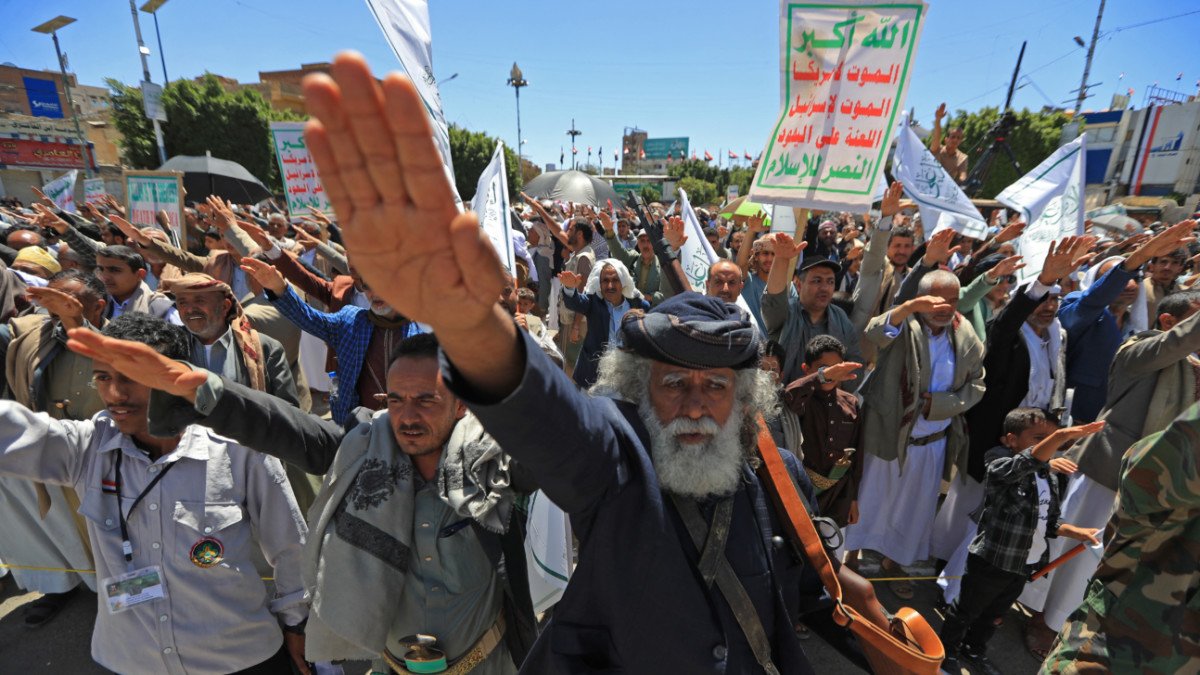
The conflict engulfing the Middle East intensified significantly on Saturday after Yemen’s Iran-backed Houthi movement claimed responsibility for a missile attack targeting the southern Saudi Arabian city of Jizan. The strike came just hours after Saudi Arabia launched air raids against Houthi military positions in Yemen, marking a dangerous escalation that threatens to widen an already volatile regional war involving Iran, the United States and several Gulf states.
The latest exchange of attacks has opened a fresh front in the conflict, adding further instability to a region already facing mounting military confrontations. The developments coincide with Iran’s continued blockade of the Strait of Hormuz, one of the world’s most strategically important maritime routes, while the Houthis have announced their own maritime blockade targeting Saudi Arabia and commercial shipping in the Red Sea.
The Houthis described Saudi Arabia’s recent military operations as a “dangerous escalation” and warned that Riyadh would face retaliation. Within hours, the group claimed it had launched a missile at Jizan, a city near the Saudi-Yemen border that has frequently been targeted during previous phases of the long-running conflict.
Although Saudi authorities had not immediately confirmed the extent of damage or casualties, the attack underscored the growing threat posed by the regional expansion of hostilities.

Saudi Arabia’s military campaign followed a series of Houthi attacks earlier this week against commercial and Saudi-linked vessels navigating the Red Sea. The Saudi-led coalition said its air strikes were carefully targeted at Houthi military facilities being used to threaten international shipping lanes and regional security.
Coalition spokesperson Turki al-Maliki stated that the operation had successfully destroyed military targets involved in attacks on commercial vessels. He described the campaign as a decisive response intended to restore maritime security while confirming that the military operation had concluded.
According to Yemeni security officials, Saudi air strikes targeted a naval facility in the port city of Hodeida along with military infrastructure on Kamaran Island, both considered strategically important for Houthi operations along Yemen’s western coastline.
The Red Sea has become one of the most contested waterways since the conflict intensified. Commercial shipping companies have faced increasing risks from missile attacks, drones and naval blockades, forcing many operators to reconsider routes through one of the world’s busiest trade corridors.
Security analysts warn that prolonged disruption in the Red Sea, combined with continuing tensions in the Strait of Hormuz, could have significant consequences for global energy supplies and international trade.
The latest escalation unfolded as US President Donald Trump indicated that Washington had not yet decided whether to launch large-scale military strikes against Iran, despite reports suggesting senior American officials were actively discussing potential military options.
Speaking to reporters at the White House, Trump said diplomatic discussions with Tehran were continuing and suggested Iranian officials were becoming increasingly serious during negotiations.
His remarks followed media reports claiming that senior advisers had met to examine possible military responses as regional tensions continue to grow.
While declining to confirm any decision regarding military action, Trump emphasised that negotiations remained active, leaving open the possibility that diplomacy could still prevent a wider confrontation.
The President also addressed reports alleging that Russia and China were assisting Iran by providing intelligence and military support.
Trump rejected suggestions that either country was actively arming Tehran, saying he believed assurances provided by Chinese President Xi Jinping and Russian President Vladimir Putin that they would not become directly involved.
Those comments contrasted with several reports suggesting that Iran has continued receiving varying forms of strategic assistance as regional hostilities deepen.
Meanwhile, security warnings have spread across the Middle East.
Several US embassies have advised American citizens that opportunities to leave certain countries could become increasingly limited if the security situation deteriorates further. The guidance reflects growing concern that the conflict may expand beyond its current theatres.
Iran’s Islamic Revolutionary Guard Corps has also warned residents in neighbouring countries to avoid areas hosting American military forces, signalling the possibility of additional attacks against US facilities throughout the region.
Elsewhere, the United States military reported another confrontation involving commercial shipping.
According to US Central Command, American naval forces intercepted the merchant vessel M/T Lavine in the Gulf of Oman after it allegedly attempted multiple times to breach the US blockade targeting Iranian ports.
Military officials said repeated warnings were ignored before American forces fired into the ship’s engine compartment, disabling the vessel without targeting its crew.
The incident marked the second commercial ship disabled since Washington reinstated its maritime blockade against Iran.
The conflict also intensified in Iraq, where explosions were reported near Irbil International Airport, home to a contingent of US military advisers.
Security officials in Iraq’s semi-autonomous Kurdish region said coalition air defence systems intercepted and destroyed five explosives-laden drones approaching military facilities.
Witnesses reported hearing multiple explosions while thick black smoke rose near the airport complex. American military officials did not immediately comment on the reported drone attacks.
Iran’s Revolutionary Guards also claimed responsibility for separate attacks targeting US military facilities elsewhere in the Gulf.
According to Iranian statements, missiles struck the Udairi military base in Kuwait, reportedly destroying ammunition storage facilities. Tehran further claimed it had targeted a watchtower associated with the US Navy’s Fifth Fleet headquarters in Bahrain.
US Central Command did not immediately verify either claim.
Authorities in Bahrain and Jordan separately confirmed that their air defence systems intercepted aerial attacks linked to Iran on Friday, highlighting how the conflict is increasingly affecting multiple countries across the region.
Military experts warn that the growing number of simultaneous confrontations significantly increases the risk of miscalculation.

Unlike previous periods of tension confined largely to individual conflicts, the current crisis now stretches from Yemen and the Red Sea to Iraq, Kuwait, Bahrain and the Gulf of Oman, involving state militaries, proxy forces and international naval operations.
Diplomatic efforts to reduce tensions continue behind the scenes, but there is little evidence that any of the major actors are prepared to step back.
For Saudi Arabia, protecting maritime trade and national security remains the immediate priority. For the Houthis, the latest missile strike demonstrates their willingness to expand military operations in response to coalition attacks.
For the United States and its regional allies, the challenge is becoming increasingly complex as multiple flashpoints merge into a broader regional confrontation.
With missile exchanges, drone attacks, naval blockades and threats against commercial shipping occurring simultaneously, fears are growing that the Middle East may be entering one of its most dangerous periods in recent years, with consequences extending far beyond the region itself.
Related News:
 UK Prepares Aircraft Carrier for Middle East Crisis
 Middle East Crisis Escalates as Oil Routes Shake Markets
 Tensions Emerge in Netanyahu-Trump Alliance
 Former ICC prosecutor condemns US sanctions
 Taliban global ties grow as rights fears mount
 Trump Receives Machado’s Nobel Medal in White House Meeting
 Thousands Protest ICE Operations in Nationwide US Day of Action
 Epstein Files Reveal Trump Officials’ Emails with Financier
 Thousands Protest ICE in New York Against Trump Deportation Campaign
 Thousands Protest Iran Strikes Outside US Embassy London
 US Bombers Arrive at RAF Base Amid Rising Iran Tensions
 Ukraine war briefing: Zelenskyy offers help to Saudi Crown prince on combatting Iranian drones
 Trump orders US troop pullout from Germany
 Activists allege abuse after Gaza flotilla seizure
 Trump likens US Navy actions to ‘pirates’
 Global order shifts amid Trump-era turmoil
 Australia pushes Pacific security pact amid China tension
 Indiana Republicans Defy Trump in Key Vote Test
 US Awaits Iran Reply on New Ceasefire Proposal
 Putin Declares Russia Victory at Scaled Victory Day Parade
 Hormuz Talks Near Critical Stage
 Hunger increasingly weaponised in global conflicts
 Discontent grows around Putin amid war strain
 Trump Claims Iran Peace Deal Near Completion
 Millions Gather for Khamenei’s Six-Day State Funeral
 Seoul proposes historic peace talks to replace Korean War armistice
 Israeli Strike in Southern Lebanon Kills Seven
 Trump dismisses concerns over 250-day carrier deployment
 Trump to Recheck Green Cards from 19 Nations After DC Attack
 Trump Escalates Minnesota Immigration Surge Amid Rising Tensions
 Greenland Faces Pivotal Summit Over Arctic Power Struggle
 Iran unrest slows under brutal crackdown and global tensions
 EU Says US Ties Have Suffered ‘Big Blow’ After Greenland Crisis
 Trump Praises ‘Terrific’ Petro After White House Talks
 Clinton Testimony Erupts in Fiery Exchange
 Middle East Flights Halted After Iran Strikes
 Mojtaba Khamenei Chosen as Iran’s New Supreme Leader
 Tehran Oil Depot Strikes Darken City With Toxic Smoke
 Pete Hegseth Iran War Remarks Spark Alarm
 Mojtaba Khamenei Supporters Rally as Iranians Fear Repression
 Iran Defiance Grows Amid US-Israel War Pressure
 Hormuz Crisis Sparks Global Oil Market Fears
 Injured Mojtaba Khamenei Elevated as Iran Leader
 Yvette Cooper: UK Must Follow Principles, Not US Pressure
 Trump Iran War Stance Hardens as Conflict Widens
 MAGA Anxiety and the Iran War: A Movement Divided at CPAC
 Iran Crisis Tests Trump’s Global Leadership
 Trump Signals Hope for New Iran Talks as Ceasefire Fades
 US and Iran Pursue Extension of Ceasefire via Pakistan
 Trump Faces Crisis as Iran Reopens Hormuz Tensions
 GOP Senator Criticizes Trump’s Feud With Pope Leo XIV
 Charles Faces Trump Test in High-Stakes US Visit
 UK Stands Firm on Falklands Amid US Rift
 Investigation Into Anti-Trump Motives After Gala Shooting
 Southeast Asia Turns to Russia Amid Energy Crisis
 Ukraine Urges UK to Seize Russian Oil Tankers
 US Calls Australia Media Law “Foreign Extortion”
 USS Gerald R Ford Ends Record Naval Deployment
 Oil Prices Surge Above $120 Amid Iran Blockade Fears
 US Court Ruling Reshapes Voting Rights Landscape
 US states redraw maps after voting rights ruling
 Judge halts deportation of Yemeni refugees in US
 Trump approval plunges amid Iran war fears
 Ohio’s Battle for Trust: Democrats Vying to Flip the Buckeye State
 Trump Threatens UN Budget Cuts as US Pushes ‘Trade Over Aid’ Agenda
 Trump warns Iran as Middle East tensions surge again
 US ‘Narco Boat’ Strikes Draw Global Outcry
 Ohio Primaries Set Stage for Crucial Midterms
 Afghan Families Left in Limbo Face Risk of Deportation
 Trump Announces 3-Day Russia–Ukraine Ceasefire Deal
 Fear and Betrayal: The Chilling Case of Kouri Richins
 Tulsi Gabbard exits after turbulent intelligence tenure
 Gunman Killed After White House Security Shootout
 House Curbs Trump’s War Powers in Rare Rebellion
 Grief and Devotion Amidst the Rubble of Nabatieh
 Iran Prepares for Massive Six-Day Funeral for Khamenei
 Trump’s Mount Rushmore Speech: A Divisive Anniversary
 Iran Mourns: Millions at Khamenei’s Final Procession
 Venezuela Quake Death Toll Surpasses 4,000
 Is America Ready for an AOC Presidential Run?