Published: 16 September 2026. The English Chronicle Desk. The English Chronicle Online
Violence involving Islamist extremist groups in Africa’s Sahel region is on course to reach its highest recorded level this year, according to figures compiled by the Armed Conflict Location and Event Data project, or Acled, highlighting the continuing expansion of militant activity across Mali, Burkina Faso and Niger.
The latest figures come 25 years after the 11 September 2001 attacks in the United States, which were carried out by al-Qaida under the leadership of Osama bin Laden. While al-Qaida’s global position has changed substantially since then, its affiliated organisations remain active in parts of Africa, with the Sahel emerging as one of the most persistent centres of Islamist militant violence.
Acled data show the scale of the change in the central Sahel. In 2016, the organisation recorded 63 incidents involving jihadist groups across Mali, Burkina Faso and Niger. That figure rose dramatically to 2,845 incidents in 2025. A further 2,145 such events had already been recorded during the first part of 2026, putting the region on course to pass 3,000 incidents if current trends continue.
The figures measure conflict events rather than providing a direct count of deaths. They nevertheless demonstrate how frequently armed confrontations, attacks and other forms of violence involving jihadist groups are occurring across the three countries.

The rise in the Sahel contrasts with the broader global picture. According to the 2026 Global Peace Index, terrorism deaths worldwide have fallen to their lowest level since 2008. The Sahel, however, remains one of the regions most severely affected by terrorism and wider security violence.
The report said more than 9,000 people were killed in security incidents across Burkina Faso, Mali and Niger during 2025, according to figures cited from the United Nations.
Among the most active organisations is Jama’at Nusrat ul-Islam wa al-Muslimin, commonly known as JNIM, an al-Qaida-linked coalition that has expanded its influence across parts of the Sahel.
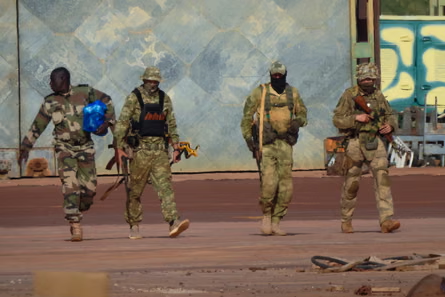
In Mali, JNIM and the Tuareg-dominated Azawad Liberation Front launched a major offensive in April, targeting strategic towns, government forces and Russian personnel supporting Mali’s military authorities. The offensive involved ambushes, vehicle-borne attacks, drones and raids, according to the report.
The fighting resulted in major losses for government forces and their allies and demonstrated the ability of militant and rebel groups to operate against heavily armed opponents.
Among the most significant developments was an attack in the garrison town of Kati, north-west of Bamako, where Mali’s defence minister was killed in a suicide attack on his residence. The country’s military intelligence chief was also killed.
Other attacks struck Mali’s international airport, while rebels regained control of the strategic city of Kidal after government soldiers withdrew and Russian mercenaries surrendered. The developments represented a setback for the military authorities, which had previously regarded control of Kidal as an important symbol of their territorial authority.
JNIM has continued to operate in Mali in the months since the offensive. The group has also expanded its activities into neighbouring countries, although the intensity and nature of the violence vary considerably from one location to another.
Burkina Faso has become another major theatre of JNIM activity. According to the report, the group has claimed responsibility for more than 130 attacks in the country during 2026, including operations increasingly close to the capital, Ouagadougou.
Niger presents a somewhat different picture. JNIM has claimed at least 17 attacks there, but the group is less active than its principal rival, Islamic State in the Greater Sahara, according to a recent United Nations assessment based on intelligence provided by member states.
The rivalry between jihadist organisations is an important feature of the conflict. Not all violence involving extremist groups is directed against government forces or foreign military personnel. Rival armed organisations also compete for territory, influence and resources, contributing to instability across the region.
Government forces and Russian military personnel have also been responsible for killings during the conflict, according to the reporting. This means that the overall death toll cannot simply be attributed to jihadist attacks, as the conflict involves multiple armed actors and overlapping disputes.
Analysts also caution against assuming that the expansion of jihadist groups in Africa represents a direct return to the global strategy pursued by al-Qaida around the time of the 9/11 attacks.
Ulf Laessing, a senior analyst at the Konrad Adenauer Foundation, said groups operating in the Sahel are highly localised despite their ideological connections to al-Qaida or Islamic State. He noted that there has been no known attack in Europe or the United States planned in the Sahel.
The distinction is significant. While JNIM is formally linked to al-Qaida, experts say it has largely concentrated on local and regional objectives, including control of territory, influence over communities and attacks against state forces.
Africa’s Islamist militant landscape also extends beyond the central Sahel. In east Africa, al-Shabaab remains a major armed organisation in Somalia, where it has maintained influence over substantial rural areas for years.
Acled senior analyst Peter Bofin said the organisation remained one of the continent’s deadliest militant groups. Acled recorded more than 10,000 reported deaths associated with al-Shabaab-related violence over the previous 18 months, according to the report.
Al-Shabaab has also developed financial networks extending across Somalia and the wider region. Although pressure on some of its revenue collection in Mogadishu has reportedly increased, the organisation continues to draw resources from areas where it retains influence.
Groups loosely linked to Islamic State are also active in several African countries, including the Democratic Republic of Congo, Mozambique, Chad and Nigeria. Their activities vary from country to country, and local political and economic conditions play an important role in shaping the conflicts.
The growth of militant organisations in Africa has attracted increasing attention from al-Qaida’s propaganda networks. Yet analysts say Africa was not central to al-Qaida’s strategic thinking 25 years ago.
The organisation’s original global campaign was heavily focused on the United States, its allies and governments in the Middle East. In the years following the 9/11 attacks, al-Qaida and its affiliates were associated with major attacks in Europe and elsewhere that killed hundreds of people.
Its senior leadership is now considerably weaker. A recent UN assessment described al-Qaida’s central leadership as marginalised and said its capability and intention to conduct external operations remained unclear.
The organisation has also not formally announced a successor to Ayman al-Zawahiri, who was killed in Kabul by the United States in 2022. Saif al-Adel, an Egyptian militant believed to be 66, is widely considered the de facto leader, although he has not publicly assumed the role in the manner of previous al-Qaida leaders.
Western intelligence agencies believe other senior members of the organisation are based in Afghanistan, where al-Qaida has maintained a limited infrastructure.
Outside Africa, the al-Qaida affiliate considered most committed to the group’s historic international agenda is al-Qaida in the Arabian Peninsula, or AQAP, based primarily in Yemen.
The United Nations has described AQAP as an important component of the wider al-Qaida movement. The organisation continues to possess an estimated 2,000 fighters, largely operating in mountainous areas between Abyan and Shabwa.
Its operational activity, however, has declined sharply. Acled recorded 63 AQAP-related events during the first seven months of 2025 compared with 19 during the same period in 2026, representing an approximately 70% reduction.
The contrasting figures illustrate how the geography of militant activity has changed over the past quarter-century. Al-Qaida’s central organisation has weakened, while some affiliated or associated groups have become deeply embedded in local conflicts.
In the Sahel, persistent insecurity is linked not only to extremist ideology but also to weak governance, political instability, competition over resources, ethnic and sectarian tensions and disputes over territory. These conditions can create opportunities for armed organisations to recruit, impose authority or exploit grievances.
The number of militants involved in some African groups is also substantial. Analysts estimate that organisations such as JNIM and al-Shabaab have tens of thousands of fighters or supporters within their broader networks. However, comparing their manpower directly with al-Qaida’s forces before 2001 can be misleading because the organisations have different structures, objectives and operating environments.
The current situation therefore presents a complex security challenge rather than a simple continuation of the conflict that followed 9/11.

For governments across the Sahel, the immediate challenge remains containing armed groups while restoring effective state authority and protecting civilian populations. For international policymakers, the rise in violence raises questions about how best to respond to conflicts in which local grievances, political instability and transnational militant ideologies overlap.
The latest Acled figures provide a stark measure of the scale of the problem. With more than 2,100 jihadist-related conflict events already recorded this year in Mali, Burkina Faso and Niger, the region is on course for another year of exceptionally high violence.
Twenty-five years after al-Qaida’s most notorious attack transformed international security policy, the organisation’s centre of gravity has shifted. The Sahel has become one of the principal arenas in which al-Qaida-linked and Islamic State-linked groups are fighting for territory and influence.
Yet analysts stress that the current conflicts remain primarily local and regional in character. Understanding that distinction will be important as governments and international organisations seek to respond to the growing insecurity without assuming that every militant advance in Africa represents the same type of threat that al-Qaida posed to the world a quarter-century ago.
Related News:
 Seven Women’s Deaths Renew South Africa Femicide Anger
 Patriot Platform Raises Concern Across Britain
 Piddington Votes for Symbolic Independence Over Asylum Plan
 Undercover officer deceived women with ‘grotesque and cruel’ lies, spycops inquiry told
 Melania Trump Epstein remarks spark survivor backlash
 NHS Safety Fears as Nurses Cover Doctor Gaps
 Walsall Rapist Jailed After Hate-Filled Online Trail
 Two Children Die in Wolverhampton House Fire Tragedy
 US Labor Department in turmoil after secretary resigns
 Trump DOJ Targets James Comey Again
 Police Suspect Help in Missing Alice Springs Girl Case
 US Charges Sinaloa Governor in Major Cartel Case
 Cartel crackdown raises fears of fresh violence
 US ‘Narco Boat’ Strikes Draw Global Outcry
 Barrister Criticises Trial After Suicide Case Verdict
 Immigration Judges Fear Pressure in Trump Era
 Murder Probe Continues After Arrest Release
 Dreyfus Statue Finally Gets Permanent Paris Home
 Westminster Council Threatens Charing Cross Soup Kitchen
 BBC Warned About Missing Clothes of Murder Victim
 Israeli Strike in Southern Lebanon Kills Seven
 Is America Ready for an AOC Presidential Run?
 Cambridge Professor Jason Arday Found Dead at Home
 Five Years of Taliban Rule Leave Afghanistan in Crisis
 Ghent Professors Questioned Cofnas Appointment
 RAF Barnham Protests Fuel Tensions in Norfolk Town
 Ukraine Villagers Demand Answers After Deadly Arms Depot Strike
 Masked Protesters Bring Dover Port Traffic to Standstill
 Armed Suspect Attacks Ohio Governor Candidate
 Ministers Condemn Far-Right Unrest in Portsmouth
 Councils spend £125m on illegal children’s care
 Pavlohrad Strike Kills Five, Injures 67
 Reform UK Receives Record £36m Donation From Crypto Billionaire
 Man Arrested in Mississippi Woman’s Death
 Israel Accused of Undermining Palestinian Life
 Election Candidate Abuse Raises Alarm in England
 Fugitive Developer Rants at NSW Corruption Inquiry
 Slave-Trade Wealth Embedded in Britain’s Financial System
 New Evidence Deepens Church of England Slavery Reckoning
 Lisa Nandy Calls for Tougher Action on Social Media Doxxing
 NBC Helicopter Crash in Los Angeles Kills Three
 Tasers Introduced in UK Prisons to Combat Rising Violence and Protect Staff
 Mass Arrests in London as Protest Defies Ban on Palestine Action
 Urgent Action Needed on Windrush Compensation as Survivors Speak of “Waiting to Die”
 Zarah Sultana Seeks Legal Action After Bitter Clash with Jeremy Corbyn Over Party Membership Funds
 Channel Crossings Surge: Over 1,000 People Arrive in the UK in Small Boats in a Single Day
 Kosovo agrees to host Britain’s refused asylum seekers
 FBI Director Kash Patel Defends Girlfriend Amid Government Jet Claims
 French Taxi Driver Cleared in David Lammy Theft Case After Fare Dispute
 ‘Reckless’ cuts to victims’ services will cost more than they save
 Indian authorities demolish Kashmir home linked to Red Fort blast
 Greene Pushes Epstein Files Amid Trump Fallout
 Venezuela Threatens Nobel Winner Machado with Fugitive Status
 Most Tories Expect to Support a Farage-Led Government
 Jordan Bardella: France’s Young Presidential Contender
 ‘It’s a Complete Scandal’: Aristocrat’s Fight for Prison Children
 Teen Admits Filming Westfield Chair Prank
 Fugitive Dezi Freeman Killed in Rural Victoria Shootout
 M&S Demands Urgent Action on Rising Violent Retail Crime
 Ben Roberts-Smith Denies War Crime Allegations in First Statement
 Kezia Dugdale Warns of Possible Reversal of Equal Rights Gains
 China Fireworks Factory Blast Kills 21 in Hunan
 Florida Surgeon ‘Devastated’ Over Fatal Surgery Error
 DeSantis’s ‘Alligator Alcatraz’ Faces Final Shutdown
 Farage and Reform UK Reshape British Politics
 Starmer Leadership Under Pressure After Setbacks
 Trump’s Mount Rushmore Speech: A Divisive Anniversary
 New Footage Revives Peter Falconio Mystery
 Ukraine Creates Long-Range Strike Command
 Le Pen’s Popularity Holds Despite Conviction
 Burnham unveils £65m drought aid for farmers
 British Museum Faces Questions Over Peter Thiel’s Private Bayeux Viewing
 Trump Calls Iran War ‘Small Potatoes’ Despite US Deaths
 Typhoon Saudel Triggers Mass Evacuations in China
 Europe’s democracies face a growing far-right threat
 New Mexico Takes Facebook to Trial Over Data Scandal
 Royal Crown Branded Enslaved Africans in Britain’s Slave Trade
 UK Pay Growth Slows to 3.9% as Rate Decision Nears
 Bank Urged to Slow Bond Sales as UK Costs Rise