Published: 07 October 2026. The English Chronicle Desk. The English Chronicle Online
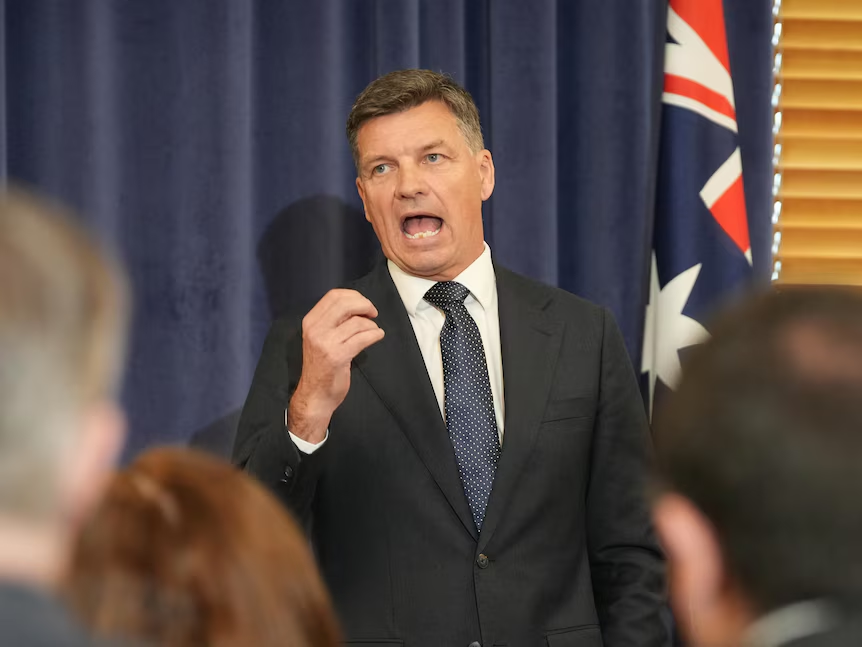
Richard Morecroft was widely recognised as one of Australia’s familiar television news faces, but away from the studio and the seriousness of the evening bulletin, he devoted much of his life to something very different: rescuing vulnerable wildlife.
The former ABC presenter, who has died aged 70 after being diagnosed with cancer earlier this year, is being remembered not only for his distinguished broadcasting career but also for his extraordinary commitment to wildlife rescue and conservation.
Among the stories that have emerged following his death is one that captures a particularly personal side of Morecroft. In the late 1980s, he became the foster carer of a tiny orphaned flying fox named Archie. The infant bat was bottle-fed, wrapped in nappies and, at times, kept warm beneath Morecroft’s shirt while he continued his work at the ABC.
The unusual arrangement became the subject of a documentary and later a book, both titled *Raising Archie*. For those who knew Morecroft and his work with wildlife rescuers, the story has become one of the most enduring examples of his compassion.

Mikla Lewis, a co-founder of WIRES, Australia’s largest wildlife rescue organisation, recalled the first time she heard from Morecroft. She was working in the organisation’s office in the late 1980s when the telephone rang.
The caller introduced himself simply as Richard Morecroft and said he wanted to join the wildlife rescue organisation as a volunteer.
Lewis remembered the moment because the request was so unexpected. Morecroft was already a prominent broadcaster, yet he was approaching the organisation not as a celebrity seeking publicity but as someone who wanted to help animals in need.
Not long afterwards, Lewis learned of a baby flying fox that required a foster carer. That animal became Archie, beginning a remarkable chapter in Morecroft’s life.
The young flying fox required intensive care. Morecroft bottle-fed the animal, kept him wrapped in nappies and ensured he remained warm and secure. At times, Archie was kept underneath Morecroft’s shirt while he was working at the ABC. The animal was even kept beneath his desk while Morecroft presented the news.
The contrast was striking. Millions of viewers knew Morecroft as a composed and authoritative news presenter appearing on television, while behind the scenes he was caring for a fragile baby bat that depended on him for survival.
The story eventually reached a much wider audience through a documentary and a book. Yet according to Lewis, the significance of Archie extended far beyond the unusual nature of the story.
She recalled that Morecroft genuinely loved the animal and was deeply committed to giving it the best possible chance of returning to the wild.
Flying foxes have often been misunderstood in Australia. Large colonies can become controversial when they settle close to residential areas, with residents sometimes objecting to their noise and smell. The animals have also faced habitat loss and other environmental pressures.
For wildlife rescuers, however, flying foxes are highly intelligent, social and important members of Australia’s ecosystems. Their survival is closely connected to the availability of forests and natural habitat.
Lewis said that Morecroft and other volunteers understood that the animals were not responsible for the loss of their natural environments.
That understanding shaped Morecroft’s approach to wildlife rescue. His involvement was not about turning a wild animal into a pet. Instead, the objective was always rehabilitation and eventual release.
More than three decades later, his work with Archie remains a powerful illustration of that philosophy.
Following Morecroft’s death, tributes have highlighted his generosity, humanity and passion for the natural world. Australian Prime Minister Anthony Albanese described his humanity as unwavering and remembered both his love of the arts and his deep commitment to the environment.
Albanese also referred to the remarkable image of Morecroft caring for a baby flying fox beneath his desk while presenting the news.
For those who worked with him, however, Morecroft’s contribution went well beyond the memorable story of Archie.
After his period as Archie’s foster carer, he remained a long-term supporter of WIRES and continued helping the organisation in a variety of ways. He became an auctioneer at an annual fundraising event in Sydney, using his communication skills and public profile to support wildlife rescue.
Lewis recalled that Morecroft would finish presenting the ABC’s evening news bulletin and then make his way to the fundraising event, sometimes arriving in a taxi and rushing through the building to begin helping.
His contribution was not limited to raising money. Lewis said he also used his experience in broadcasting and communications to assist with training volunteers and offered his professional skills whenever the organisation needed them.
That willingness to help became a defining feature of his relationship with wildlife rescuers.
Morecroft was unable to attend WIRES’ 40th anniversary celebrations earlier this year because of health problems. His absence was felt by people who had worked with him over many years, but his influence remained evident.
For wildlife rescuers, his legacy lies partly in the attention he helped bring to the importance of rehabilitation. His involvement demonstrated that wildlife conservation could become part of everyday life, even for someone whose professional responsibilities placed him in front of millions of television viewers.
His story with Archie also helped change perceptions about flying foxes. At a time when the animals were often treated as a nuisance, the image of a respected broadcaster carefully caring for an orphaned baby helped reveal another side of their lives.
The tiny animal under Morecroft’s shirt represented something larger: the responsibility humans have towards wildlife affected by habitat destruction, injury and loss.
Morecroft himself articulated that principle when discussing the purpose of fostering flying foxes decades ago. The goal, he explained, was not to make them pets but to give them the best possible opportunity to return to their natural environment.
If rehabilitation succeeded, the animal would eventually rejoin its colony and no longer need human care.
That philosophy remains central to wildlife rescue. Successful rehabilitation is ultimately measured not by how closely an animal bonds with its carer, but by whether it can once again survive independently in the wild.
In that sense, Archie’s story reflected Morecroft’s broader approach to conservation. His affection for the young flying fox was genuine, but his greatest hope was always that the animal would eventually no longer need him.
The story also provides a more intimate portrait of a broadcaster whose public career was defined by professionalism and calm authority. Behind that public image was a man willing to make room in his life for an orphaned animal that needed care.
His death has therefore prompted tributes from beyond the broadcasting world. Colleagues and friends have remembered his work on television, while wildlife advocates have recalled his generosity and the practical support he provided to rescuers.
For WIRES and those who knew him, his legacy is not simply a television career or a memorable documentary. It is also the example he set through years of volunteering, fundraising and advocacy.

Richard Morecroft’s life demonstrated how public influence can be used to support causes that receive far less attention than mainstream news and entertainment. His decision to volunteer, his care for Archie and his continuing support for wildlife rescuers all reflected a deep concern for Australia’s natural environment.
The image of Morecroft presenting the news while a tiny flying fox rested safely beneath his desk may be unusual, but it has become an enduring symbol of the man remembered by those who knew him.
Archie eventually represented the very outcome Morecroft wanted: rehabilitation rather than captivity, and a return to the wild rather than dependence on humans.
His passion for wildlife rescue has now become part of his wider legacy. For those who worked alongside him, the affection he showed towards a small, vulnerable animal was not an isolated act of kindness. It was part of a lifelong commitment to helping wildlife survive and return to the environment where it belonged.
Related News:
 Escobar’s Hippos May Be Moved to India Zoo
 Man killed in shark attack on Great Barrier Reef
 Record-Breaking Heat Looms Over South-East Australia as Catastrophic Fire Risk Escalates
 How Sandhill Ashes Rebuilt a Bushfire-Hit Rural Community
 Governments Fail Murray-Darling River Projects
 Record May Heat to Cold Front in Eastern Australia
 The pothole puzzle: Britain’s roads in crisis
 Hope for mountain bongos returns to Kenya
 Three-Quarters of England’s Riverbanks Still Off Limits
 Australia gives users control over social media algorithms
 Nepal PM calls deadly flood a global climate warning
 UN Warns of Narrowing Window to Restore Forests
 Europe’s Record Heat Summer Signals Climate Risks
 Berlin App Helps Residents Protect City Trees
 Edinburgh Glasshouses Reopen After Major Restoration
 Polanski Says Leadership Not Tied to By-election Result
 Car Crashes Into Newcastle Crowd, Ten Injured
 ‘Extinct’ Antelope Returns to Sahara, Bringing Hope
 Liberal Turmoil Threatens Victorian Election Hopes
 PM pushes urgent hate speech and gun laws after Bondi terror attack
 Bondi memorial flowers preserved in lasting tribute artwork
 Judi Dench Champions Fight to Save London’s Green Spaces
 Half the World’s Largest Cities Face Rising Water Stress
 Silence and Unity Mark Bondi Terror Attack Memorial
 Chikungunya Spread in Europe Climbs as Climate Warms
 ‘It’s a horrible feeling’: Loma Bropho’s Struggle to Secure Housing
 Anthony Albanese Must Uphold Rights for All Australians
 Ocean Warming Drives Massive Marine Life Loss, Study Warns
 Greenpeace $345m Ruling Sparks Appeal Battle
 ‘Drinking from a Fetid Pond’: Superbug Genes in Lough Neagh
 Family of Alleged Bondi Gunman Seeks Name Suppression
 Rising Costs Force Families to Rethink Days Out
 Extreme Weather: Europe Shivers as Cyclone Narelle Hits
 Middle East Deluge: Freak Storms Bangle Desert Nations
 Sam Konstas Dropped as Australia Unveils New Contract List
 M&S Demands Urgent Action on Rising Violent Retail Crime
 Medellín’s Green Revolution: A Global Climate Blueprint
 Labor Reforms NDIS Amidst Mounting Budget Concerns
 Urban Flood Crisis: A Growing Threat to English Homes
 Greens Face Internal Row Over Antisemitism Claims
 EU Deal May Force UK Ban on Cancer-Linked Weedkiller
 Barrister Criticises Trial After Suicide Case Verdict
 Britain’s Quest to Crown Its Ultimate Butterfly Superstar
 UK Faces Mass Water Shortages by 2055, Lords Warn
 Tony Abbott Returns as New Liberal Party President
 Pope Meets Families in Italy Toxic Waste Zone
 Farage and Reform UK Reshape British Politics
 Trump’s Mount Rushmore Speech: A Divisive Anniversary
 British Teens in EU Face Soaring UK University Fees
 Southern Europe Reels as Wildfires Force Mass Evacuations
 Britain’s Mini Fan Craze Sparks Major Waste Crisis
 Colombia’s Fight Over Fossil Fuels
 England and Norway Fans Turn Miami Into World Cup Carnival
 UK Schools Struggle as Classrooms Top 40C
 Olympus Awaits Unesco Heritage Recognition
 Westminster Council Threatens Charing Cross Soup Kitchen
 Burnham unveils £65m drought aid for farmers
 Queue row erupts on Wales’ highest mountain
 British Museum Faces Questions Over Peter Thiel’s Private Bayeux Viewing
 Swedish Mining Push Puts Sami Land Rights Under Pressure
 Abusive ex used Tesla to control and harass former partner
 Man Arrested in Mississippi Woman’s Death
 UK Retailers Accused of Breaking Refund Laws
 Mahmood Warns Far Right Over Asylum Protests
 UK Rent Gap Puts Low-Income Families Under Pressure
 Democrat Says ICE Restricted Detention Camp Oversight
 Tropics May Wait Longest for Net-Zero Climate Benefits
 Frome Community Loses Bid for Major Regeneration Site
 Free Speech Emerges as Key UK Election Issue
 Madrid Tent Camp Grows as Spain Housing Crisis Deepens
 London Facial Recognition Trial Ends With False Alert
 Pelicot Trial Play Comes to London for One Night
 UK University Strikes Spread as Financial Pressure Grows
 Burnham Opens Door to Possible UK Return to EU
 Healey urged to act as UK energy bills rise 4%
 Badenoch Raises Prospect of 2027 UK Election
 French School Protests Escalate as 400 Schools Close
 Salinas Struggles to Keep the American Dream Alive
 Tories Plan Major Overhaul of UK Environmental Rules
 Gosport Protesters Clash With Police Over Migrant Rescue