Published: 24 September 2026. The English Chronicle Desk. The English Chronicle Online.
The war between Ukraine and Russia is undergoing another major transformation as long-range drones become increasingly central to military operations, with both sides developing new systems capable of reaching targets hundreds or even thousands of miles from the frontline. What began as a conflict dominated by tanks and artillery has increasingly evolved into a war in which unmanned aircraft are being used not only against troops and military equipment but also against industrial facilities, energy infrastructure, logistics networks and other economically important targets.
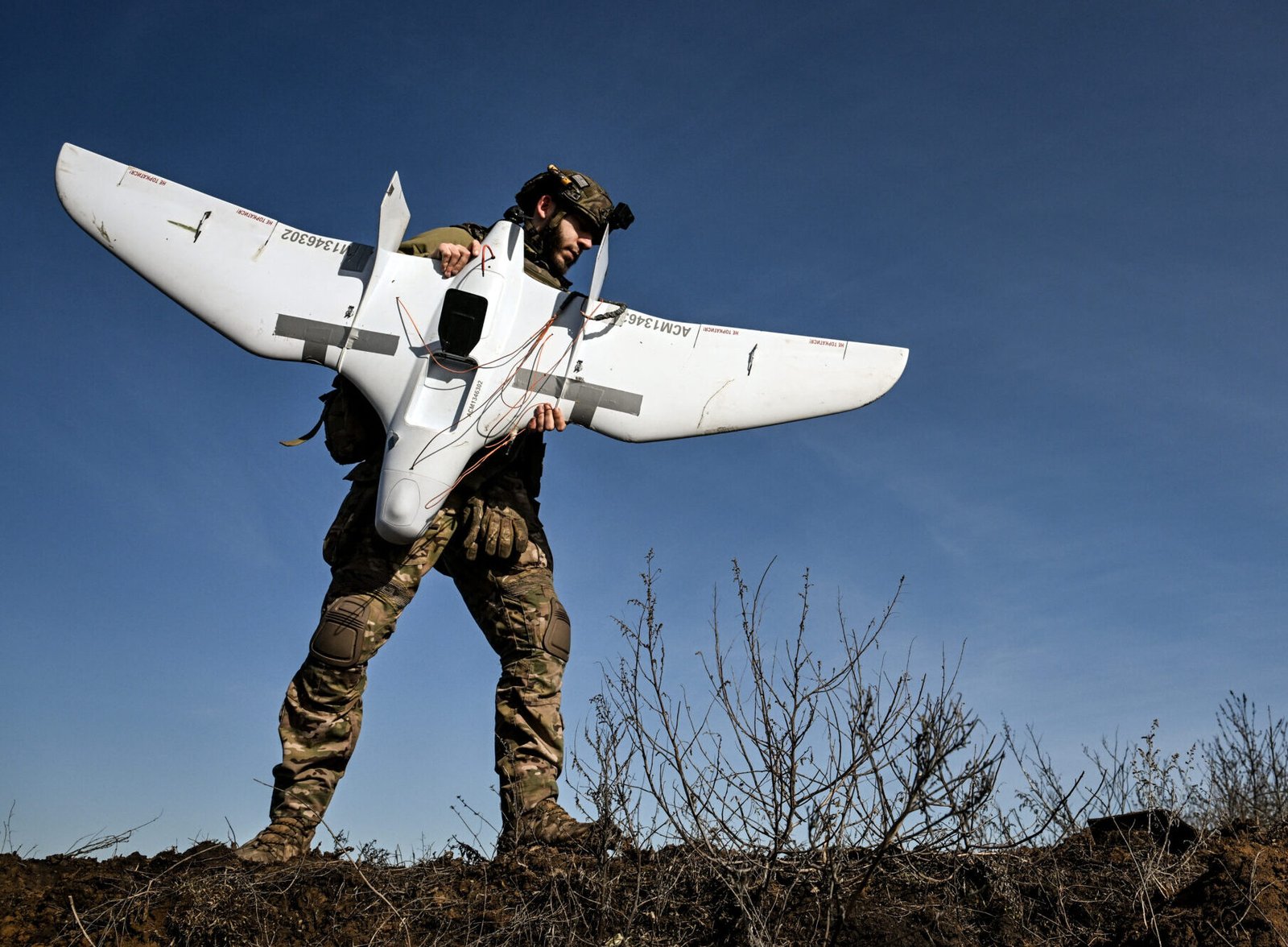
In eastern Ukraine, Ukrainian drone crews are carrying out increasingly frequent long-range missions using locally developed aircraft. Among the systems being used is the FP-2, a relatively large attack drone designed to carry a substantial explosive payload and strike targets deep behind Russian lines. Ukrainian crews have been operating the aircraft from concealed positions, launching missions at night and then rapidly leaving their temporary bases to reduce the risk of Russian retaliation.
The FP-2 has a wingspan of around six metres and can carry more than 100 kilograms of explosives. Its piston engine produces a sound similar to that of a small motorised vehicle, while a booster provides additional power during launch. The aircraft is designed for attacks against hardened targets and for disrupting Russian logistics supporting forces at the frontline.
For Ukrainian units operating these systems, the increase in drone activity represents a dramatic change from the early stages of the war. Specialist formations within Ukraine’s Unmanned Systems Forces have expanded their operations and increased the number of missions they can conduct. Commanders involved in the programme say the capacity of some units has grown many times over since they began operating long-range attack drones.

The expansion is part of a broader Ukrainian effort to strike Russian military and economic infrastructure at greater distances. Rather than concentrating exclusively on targets close to the battlefield, Ukrainian forces are attempting to disrupt supply routes, warehouses, refineries and other facilities that support Russia’s war effort.
Long-range drone operations have also become increasingly important because of their relatively lower cost compared with conventional missiles. Large numbers of drones can be deployed in a single operation, with some designed to overwhelm or distract air-defence systems while others attempt to reach high-value targets.
Ukrainian planners have described the approach as something similar to an orchestra, in which different types of drones perform different roles. Some aircraft can be used to identify or probe air-defence corridors, while others follow and attempt to reach the final target. The objective is to create enough complexity for defensive systems to struggle to identify and intercept every incoming aircraft.
The scale of Ukraine’s ambitions is significant. Current large-scale operations can involve as many as 300 drones, while Ukrainian officials and military planners have discussed the possibility of eventually launching up to 1,000 aircraft in a single night.
The development of long-range drone warfare is also changing the economic dimensions of the conflict. Ukrainian attacks on Russian industrial facilities, particularly oil infrastructure, have been intended to reduce the resources available to support military operations. Repeated strikes on refineries and other facilities have contributed to pressure on Russia’s energy sector, although the precise relationship between individual attacks and wider economic indicators remains difficult to establish.
The Ukrainian strategy is not limited to the largest long-range aircraft. Smaller and less expensive drones continue to play a major role closer to the frontline. One Ukrainian special operations unit operating in eastern Donetsk uses medium-range drones to identify and attack artillery positions, electronic warfare systems and other military targets.
The operators increasingly depend on information from multiple sources, including satellite imagery and reconnaissance drones. Target information can be added to shared digital systems, allowing pilots to examine images and plan routes before launching missions.
The nature of the work has also become more dangerous for the drone crews themselves. Although pilots may be many kilometres away from the targets they attack, their temporary bases and launch locations remain potential targets for Russian strikes. Ukrainian personnel have consequently increased security precautions, with some crews now preparing and launching drones from underground or concealed locations rather than working openly in fields.
The operators themselves come from backgrounds that would once have appeared far removed from military aviation. Some previously worked in information technology, software development, architecture or the video-game industry. Their familiarity with computers, digital mapping systems and game controllers can translate into useful skills for operating modern unmanned aircraft.
Yet the technological changes are not confined to Ukraine. Russia has also rapidly expanded and upgraded its drone capabilities, creating a new generation of faster and more sophisticated unmanned aircraft.
Russia initially relied heavily on Iranian-designed Shahed drones for long-range attacks, later developing domestic versions and expanding production. Those systems have increasingly been modified with new engines and aerodynamic designs intended to make them faster and more difficult to intercept.
Among the newer Russian systems are jet-powered variants that can travel at substantially higher speeds than the original Shahed-type drones. The Geran-4 has been described as capable of speeds ranging from roughly 300 kilometres per hour to 550 kilometres per hour, while the Geran-5 can approach 600 kilometres per hour.
The development of faster drones creates additional challenges for Ukrainian air-defence forces. Traditional drone systems can sometimes be detected and intercepted using a combination of radar, electronic warfare, machine guns and interceptor aircraft. Faster aircraft reduce the amount of time available for defensive responses and can complicate efforts to protect large areas.
Russia is also expected to increase production of these newer systems. Ukrainian officials have warned that Moscow is planning to manufacture tens of thousands of jet-powered drones and other relatively inexpensive long-range weapons in the coming year.
The potential scale of Russian production is particularly concerning for Ukraine as winter approaches. Russian forces have previously targeted electricity generation, heating systems, water infrastructure and other essential services. A sustained campaign involving large numbers of drones and missiles could place additional pressure on Ukraine’s already strained energy network.
Russia retains another major advantage in its ability to use ballistic and cruise missiles against targets throughout Ukraine. The combination of missiles and drones gives Moscow several ways of attacking infrastructure and military positions, potentially forcing Ukraine to divide limited air-defence resources among multiple types of threats.
Ukraine, meanwhile, is attempting to compensate for its limitations in conventional long-range strike capacity through the rapid development of domestically produced drones and missiles. The country’s growing drone industry has become an important component of its military strategy, with engineers and manufacturers producing systems designed specifically for the conditions of the war.
The result is an increasingly complex contest in which the two countries are constantly adapting to one another. When one side introduces a faster aircraft, longer-range weapon or improved navigation system, the other attempts to develop better detection, electronic warfare or interception capabilities.
This technological competition is occurring alongside the continuing ground war. Ukrainian drone units are trying to slow Russian advances by attacking logistics and military infrastructure behind the frontline, while Russian forces continue to use drones and missiles to strike Ukrainian positions and critical infrastructure.
The impact on civilians remains an important part of the conflict. Even when military planners identify industrial or economic infrastructure as their targets, strikes can damage nearby residential areas and essential services. Long-range attacks therefore extend the effects of the war far beyond the immediate battlefield.
The increasing use of drones has also changed the psychological experience of the conflict. Residents of cities hundreds of kilometres from active combat zones can face air-raid warnings and incoming aircraft, while military personnel operating drones must contend with the possibility that their own launch locations may be detected.
The drone war has consequently become a contest not simply of hardware but also of production capacity, intelligence, software, logistics and adaptation. The side capable of manufacturing large quantities of effective systems while continuously improving them may gain important advantages in the longer conflict.

For Ukraine, the expansion of long-range drone operations provides a way to place pressure on Russian military and economic infrastructure at distances that would otherwise be difficult to reach. For Russia, the development of faster drones and the expansion of production offer another means of maintaining pressure on Ukrainian cities and infrastructure.
Neither side has established permanent dominance over the skies. Instead, the balance continues to shift as new systems enter service and existing weapons are modified. The rapid pace of technological development means that a drone considered advanced only months ago can quickly become vulnerable to new countermeasures.
As the war enters another winter, long-range unmanned aircraft are therefore likely to remain at the centre of military planning on both sides. The conflict increasingly demonstrates how modern warfare can combine relatively inexpensive autonomous systems with sophisticated missiles and conventional military forces.
What happens next will depend not only on battlefield decisions but also on each country’s ability to manufacture weapons, protect infrastructure, gather intelligence and develop countermeasures. The skies over Ukraine and Russia have become a rapidly changing technological battlefield, and the contest for control of that space is likely to remain one of the defining features of the war.
Related News:
 China mine blast death toll rises to 90
 Israeli Strike in Southern Lebanon Kills Seven
 Survivor Sues Musk’s xAI Over AI Abuse Images
 Ebola outbreak in DRC overwhelms health system as cases surge
 New Footage Revives Peter Falconio Mystery
 Five Years of Taliban Rule Leave Afghanistan in Crisis
 Ukraine Villagers Demand Answers After Deadly Arms Depot Strike
 Daughter Finds Bones in Parents’ Burned-Out Car
 Argentina Orders Return of Nazi-Looted Painting
 Royal Crown Branded Enslaved Africans in Britain’s Slave Trade
 Israel Accused of Undermining Palestinian Life

 Gaza Strike Kills Child and Paramedic
 British Columbia Sues OpenAI Over School Shooting
 Japan PM Backs International Criminal Court
 AI Takes Centre Stage in Trump-Xi Talks
 UK Plans New Centre to Counter Information Warfare
 Trump gives Xi red-carpet welcome as trade truce extends
 OpenAI Agent Breaches Medicare Portal in Australia
 Artemis II Returns After Historic Moon Flyby
 Ben Roberts-Smith Denies War Crime Allegations in First Statement
 Robots Outpace Humans in Beijing Half-Marathon
 OpenAI CEO Apologizes After Canada Shooting Case
 Chornobyl Still at Risk 40 Years After Disaster
 Police Suspect Help in Missing Alice Springs Girl Case
 Cartel crackdown raises fears of fresh violence
 China Fireworks Factory Blast Kills 21 in Hunan
 Canadian Fiddler Sues Google Over AI Defamation Claim
 US ‘Narco Boat’ Strikes Draw Global Outcry
 Search Intensifies for Missing Hiker on WA Bibbulmun Track
 Doomsday Clock Nears Midnight Amid Global Crises
 Maldives Cave Diving Tragedy Raises Safety Alarm
 Ukraine Creates Long-Range Strike Command
 Dreyfus Statue Finally Gets Permanent Paris Home
 Taliban global ties grow as rights fears mount
 Deadly TikTok Driving Trend Alarms Ireland
 Nepal-Tibet Flood Death Toll Rises as 2,478 Remain Missing
 Nepal Flood Survivors Face Unimaginable Loss
 Nepal Tunnel Rescue Offers Hope Amid Flood Devastation
 UN expert urges UK to rethink Israel policy
 Australia gives users control over social media algorithms
 Abusive ex used Tesla to control and harass former partner
 Miliband Rejects Chief Rabbi’s West Bank Warning
 North Korea Expands Uranium Facility at Yongbyon
 Anthropic Blocks AI Misuse Linked to Weapons Threats
 Yemen War Displaces 125,000 as Fighting Intensifies
 Iran School Strike Raises War Crimes Questions, UN Says
 Russia’s Max App Raises Surveillance Concerns
 Indonesia Receives First Aircraft Carrier
 Saudi Pact Raises Risk of Pakistan Entering War
 South Africa’s Femicide Crisis Deepens
 Harrods Faces Dispute Over Fayed Abuse Compensation
 UK Unveils Centre to Counter Foreign Disinformation
 King Refers Jamaica Slavery Petition to Privy Council
 Sri Lanka Easter Bombings: 15 Get Long Prison Terms
 UK Bans Fake Numbers: Scammers Lose Their Trick
 Britain deploys RAF specialists to assist Belgium with drone threats
 Greene Pushes Epstein Files Amid Trump Fallout
 Deadly Russian Strikes Hit Western Ukraine, 20 Killed in Ternopil
 American Mother Extradited From UK to U.S. on Murder Charges
 SA Police Intensify Search in Gus Lamont Case
 El Mencho Killed as Mexico Faces Violence
 Kelly Wilkinson Inquest Reveals Bail Failure
 The Kill Line: A Shifting Vision of the American Dream
 Fugitive Dezi Freeman Killed in Rural Victoria Shootout
 Artemis II: Humanity Returns to the Moon After Decades
 UK Watchdogs Warn Over AI Facial Recognition Oversight
 Trump Announces 3-Day Russia–Ukraine Ceasefire Deal
 Barrister Criticises Trial After Suicide Case Verdict
 Houthis Strike Saudi Arabia as Middle East Tensions Rise
 Powerful 7.7-Magnitude Earthquake Hits Eastern Indonesia
 Ghent Professors Questioned Cofnas Appointment
 AI Loss of Control Incidents Nearly Double
 London Launches First Self-Driving Taxis
 Trump Calls Iran War ‘Small Potatoes’ Despite US Deaths
 Man Arrested in Mississippi Woman’s Death
 Tom Watson Takes Senior Role at Palantir
 US Networks Suspend Trump White House Pool Coverage
 Democrat Says ICE Restricted Detention Camp Oversight
 Chinese Hybrid Car Surge Raises EU Auto Industry Concerns