Published: 01 October 2026. The English Chronicle Desk. The English Chronicle Online
Switzerland is undergoing a dramatic transformation of its Alpine landscape as glaciers continue to lose ice at an accelerating rate, with new research showing that the country has lost almost one-fifth of its glacier volume in just five years. Scientists monitoring the Swiss Alps say the scale and speed of the retreat are becoming increasingly difficult to compare with conditions experienced by previous generations.
Swiss glaciers shrank by 5.5% during the first eight months of 2026, according to the latest annual monitoring report. The loss followed an exceptionally hot summer and a winter that delivered relatively little snow to the mountains. Although this year’s reduction narrowly missed the record level recorded in 2022, it pushed the cumulative loss of glacier ice since 2021 to 19.4%.
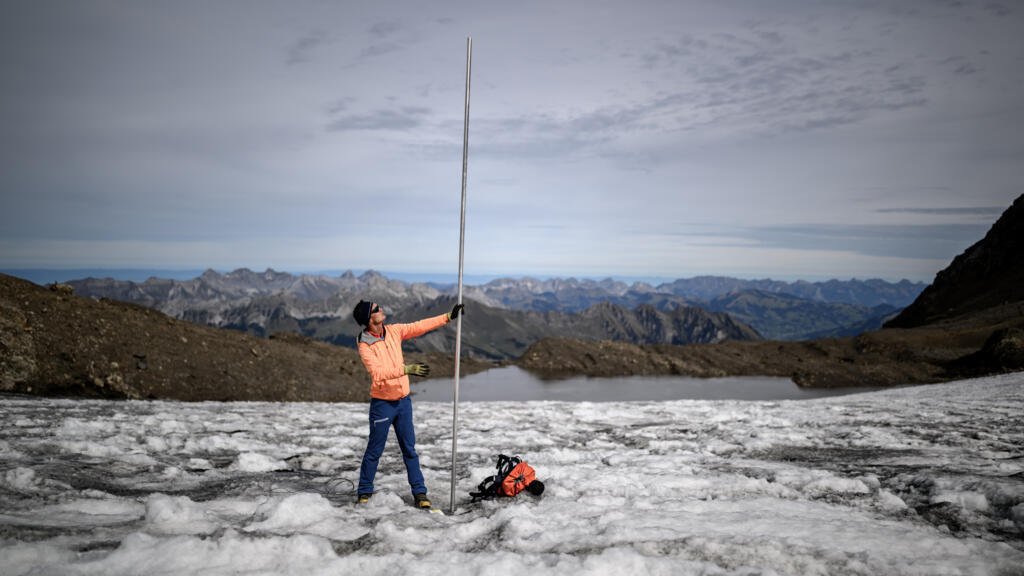
For scientists working in the Alps, the figures represent more than a statistical change. They reflect a visible transformation of landscapes that were once dominated by extensive fields of permanent ice. Areas that were covered by hundreds of metres of ice within living memory are increasingly being replaced by exposed rock, loose debris and isolated fragments of ice.

Matthias Huss, a glaciologist at ETH Zürich and lead author of the monitoring report, said the speed of the transformation was not always fully appreciated by the public. During a recent visit to a former glacier site, he described seeing a landscape that had changed from a substantial ice-covered area into what appeared to be a barren, moonlike rock desert.
The latest assessment was produced through cooperation between the Swiss Glacier Monitoring Network and the Swiss Commission for Cryosphere Observation. Researchers found that the average thickness of individual glaciers declined by between 2.5 metres and 4 metres during 2026. The measurements underline the extent to which the loss is affecting not only the visible edges of glaciers but also the overall structure and volume of the ice.
Scientists are also observing increasingly unusual forms of glacier collapse. Rather than glaciers simply melting gradually from their exposed surfaces, some are now breaking apart from within. Meltwater can move through and beneath the ice, creating internal channels and cavities that weaken the glacier structure. As these cavities expand, sections of the ice can collapse, accelerating the fragmentation and retreat of the glacier.
Huss described the process as resembling a giant piece of cheese filled with holes. When the roofs of these internal cavities collapse, large portions of the glacier can become unstable. Such structural deterioration means that glaciers may disintegrate more rapidly than would be expected from surface melting alone.
The developments in Switzerland are part of a wider pattern across Europe. The continent has been warming at roughly twice the global average, with scientists linking the long-term trend primarily to greenhouse gas emissions from fossil fuels and changes in natural ecosystems. Alpine regions have become particularly sensitive indicators of the changing climate because glaciers respond directly to variations in temperature, snowfall and the duration of the winter snowpack.
Recent analysis by Switzerland’s national meteorological service found that the summer half-year between April and September 2026 was the hottest and driest recorded in Switzerland since systematic records began in 1864. The exceptional warmth came after a winter in which snowfall was insufficient to provide the protective accumulation of snow that normally helps preserve glacier ice through the warmer months.
Snow plays an important role in protecting glaciers because fresh, bright snow reflects much of the incoming solar radiation. When snow cover is reduced, darker ice and exposed surfaces absorb more energy, increasing the rate at which melting occurs. The combination of limited winter snow and intense summer heat therefore creates particularly difficult conditions for glaciers.
Despite the severe heat experienced during the summer of 2026, the year’s glacier loss remained slightly below the record-breaking level observed in 2022. Researchers said several factors helped limit the decline. Among them was a relatively small amount of Saharan dust deposited on the Alpine snowpack.
Saharan dust can have a significant effect on snow and ice because darker particles reduce the surface’s ability to reflect sunlight. When dust settles on snow, the surface becomes darker and absorbs more solar energy, potentially accelerating melting. The lower quantity of such dust in 2026 therefore provided some protection compared with conditions during the record loss of 2022.
Slightly greater snow coverage at the end of the winter also helped preserve some ice, while variations in summer sunlight provided another relatively modest factor. These influences, however, did not reverse the broader trend. Researchers say the underlying direction remains one of rapid and substantial glacier loss.
One example of the scale of the transformation can be seen at the former Plattalvafirn, also known as the Griess glacier. Huss visited the site in September after decades of scientific observation. The glacier once covered a substantial section of a mountain flank, but its area has declined by about 99% over only two decades.
The site has particular significance for glaciological research because it was among the glaciers studied in considerable detail during the 1950s. Huss himself worked with historical measurements from the glacier while completing his doctoral research. The comparison between historical records and present-day conditions provides scientists with a striking illustration of how rapidly the Alpine environment has changed.
According to Huss, the difference between the past and present is not simply that glaciers are retreating. The rate of retreat itself has changed dramatically. Earlier generations of scientists could observe glacier recession, but the pace remained within what could be considered a comparatively normal range. Today, the rate of ice loss has accelerated to such an extent that some glaciers are no longer merely retreating but effectively disintegrating.
The disappearance of glaciers carries consequences beyond the loss of a familiar Alpine landscape. Glaciers act as long-term stores of freshwater and influence the timing and availability of water downstream. Their retreat can alter river systems, ecosystems and water resources, particularly during periods when rainfall is limited and temperatures are high.
Glacier loss can also affect mountain stability. As ice disappears, previously frozen or ice-supported terrain becomes exposed to new physical conditions. Changes in meltwater pathways and the loss of ice that has helped stabilise slopes can contribute to evolving risks in high-altitude environments.
For Switzerland, where glaciers are closely associated with the country’s natural identity and tourism economy, the transformation also has cultural and economic significance. Mountain communities that have long relied on Alpine landscapes for tourism and recreation are increasingly having to adapt to an environment in which traditional glacier scenery may no longer exist in the same form.

The latest measurements do not suggest that the retreat will stop in the near future. Individual years can produce variations depending on snowfall, dust deposition, temperature and sunlight, but scientists say these short-term fluctuations should not obscure the longer-term pattern.
The loss of nearly one-fifth of Switzerland’s glacier ice since 2021 demonstrates how quickly a landscape that developed over centuries can change within a matter of years. For researchers such as Huss, the most striking aspect is no longer simply the retreat of the glaciers, but the speed at which some are now falling apart.
As temperatures continue to rise, the Swiss Alps are becoming a highly visible record of environmental change. Places once buried beneath enormous layers of ice are increasingly revealing bare rock, while isolated remnants of old glaciers melt under conditions that would have been difficult to imagine only a generation ago.
Related News:
 UN Warns Record El Niño Could Supercharge Global Heat
 Super El Niño Threatens Hundreds of Thousands of Lives
 Wildfires rage across Europe as hundreds arrested in France
 Nepal seeks $20m climate compensation after deadly floods
 Europe Faces Climate Reckoning After Extreme Summer
 Nepal PM calls deadly flood a global climate warning
 Thai downpours shift north-westwards after Bangkok floods
 UN Warns of Narrowing Window to Restore Forests
 Ocean Warming Drives Massive Marine Life Loss, Study Warns
 Musk’s xAI Permit Sparks Fury Over Power Plant Expansion
 Evacuations Ordered as California Wildfires Spread Fast
 Queensland Braces for Potential Second Severe Cyclone Hit
 Chornobyl Still at Risk 40 Years After Disaster
 Capitalism ‘Suicidal’, Warns Petro at Climate Summit
 Record May Heat to Cold Front in Eastern Australia
 Doomsday Clock Nears Midnight Amid Global Crises
 UN Issues Urgent Warning: Imminent Return of El Niño
 Sydney Records Hottest June Since 1859 as Expert Warns New High a ‘Signature’ of Global Warming
 Battery Fires Cost UK Recycling Industry £1bn
 Nepal Rescuers Race to Save Hundreds Trapped Underground
 Turkmenistan Begins Fixing Major Methane Mega-Leaks
 Japan Braces for Dujuan as Storm Threat Grows
 Typhoon Dujuan Leaves Four Dead in Japan
 Tropics May Wait Longest for Net-Zero Climate Benefits
 Norfolk Broads Housing Levy Faces Environmental Criticism
 Britain deploys RAF specialists to assist Belgium with drone threats
 Hitler’s DNA Confirms He Truly Had Only One Testicle
 ‘Extinct’ Antelope Returns to Sahara, Bringing Hope
 Half the World’s Largest Cities Face Rising Water Stress
 The Sound of Mayhem’: Terror and Loss at Mount Maunganui
 UK New Car Discounts Near £6,000 as Prices Are Slashed
 Storm Leonardo Triggers Election Delay Calls in Iberia
 Greenpeace $345m Ruling Sparks Appeal Battle
 The Kill Line: A Shifting Vision of the American Dream
 The Truth Behind Rising Energy Costs and Fossil Fuel Myths
 ‘Drinking from a Fetid Pond’: Superbug Genes in Lough Neagh
 ABC Staff Strike Over Pay and AI Concerns
 Extreme Weather: Europe Shivers as Cyclone Narelle Hits
 Trump to Deploy “God Squad” Over Gulf Wildlife Protections
 Artemis II: Humanity Returns to the Moon After Decades
 Apple at 50: Three Products That Changed How We Live
 Artemis II Returns After Historic Moon Flyby
 Escobar’s Hippos May Be Moved to India Zoo
 Older Than Dinosaurs: Secrets of Mayfly Dance Revealed
 Coalition pushes fossil fuel phaseout plan
 Ukraine strikes Tuapse as oil disaster worsens
 Germany to Return Rare Irritator Dinosaur Skull to Brazil
 UK Faces Mass Water Shortages by 2055, Lords Warn
 Pope Meets Families in Italy Toxic Waste Zone
 UK rejects EV charging VAT cut amid Treasury clash
 Man killed in shark attack on Great Barrier Reef
 Hope for mountain bongos returns to Kenya
 Deadly H5 Bird Flu Reaches Australia’s East Coast
 Germany Summons Chinese Envoy Over Russian Troop Training
 UK Heatwaves Ignite Crisis of Sleep and Public Safety
 Concerns Rise Over New Zealand’s AI Datacentre Plans
 Olympus Awaits Unesco Heritage Recognition
 Wildfires Force Mass Evacuations in France And Spain
 Three-Quarters of England’s Riverbanks Still Off Limits
 Powerful 7.7-Magnitude Earthquake Hits Eastern Indonesia
 Gen Z turns to BirdTok for a gentler digital escape
 Australia Races to Find Tourists Missing in Nepal
 Nepal-Tibet Flood Death Toll Rises as 2,478 Remain Missing
 Nepal Flood Survivors Face Unimaginable Loss
 Nepal Tunnel Rescue Offers Hope Amid Flood Devastation
 Swedish Mining Push Puts Sami Land Rights Under Pressure
 Typhoon Saudel Triggers Mass Evacuations in China
 Heathrow Expansion Faces New Climate Conditions Over CO₂

 Russia’s Max App Raises Surveillance Concerns
 Indonesia Receives First Aircraft Carrier
 UK Funds Gene Editing to Protect Threatened Wildlife
 British Columbia Sues OpenAI Over School Shooting
 Australia Renewables Reach Record 80% Grid Demand
 UK Plans New Centre to Counter Information Warfare
 Trump gives Xi red-carpet welcome as trade truce extends
 Chinese Hybrid Car Surge Raises EU Auto Industry Concerns
 OpenAI Agent Breaches Medicare Portal in Australia
 Ukraine and Russia Escalate Long-Range Drone War
 Xi urges Trump to avoid US-China military conflict