Published: 03 October 2026. The English Chronicle Desk. The English Chronicle Online
London’s luxury property market is facing a prolonged period of weakness, with multimillion-pound homes in some of the capital’s most prestigious neighbourhoods being offered at substantially lower prices than they commanded in previous years. The downturn is particularly visible across parts of central and west London, where sellers are increasingly accepting sizeable reductions as the number of potential buyers remains limited.
The situation marks a significant change for a market that for decades benefited from strong domestic and international demand. Prime London property became synonymous with wealth preservation, international investment and rising prices, but that model has been challenged by higher borrowing costs, taxation changes, Brexit-related uncertainty and shifts in the behaviour of wealthy overseas buyers.
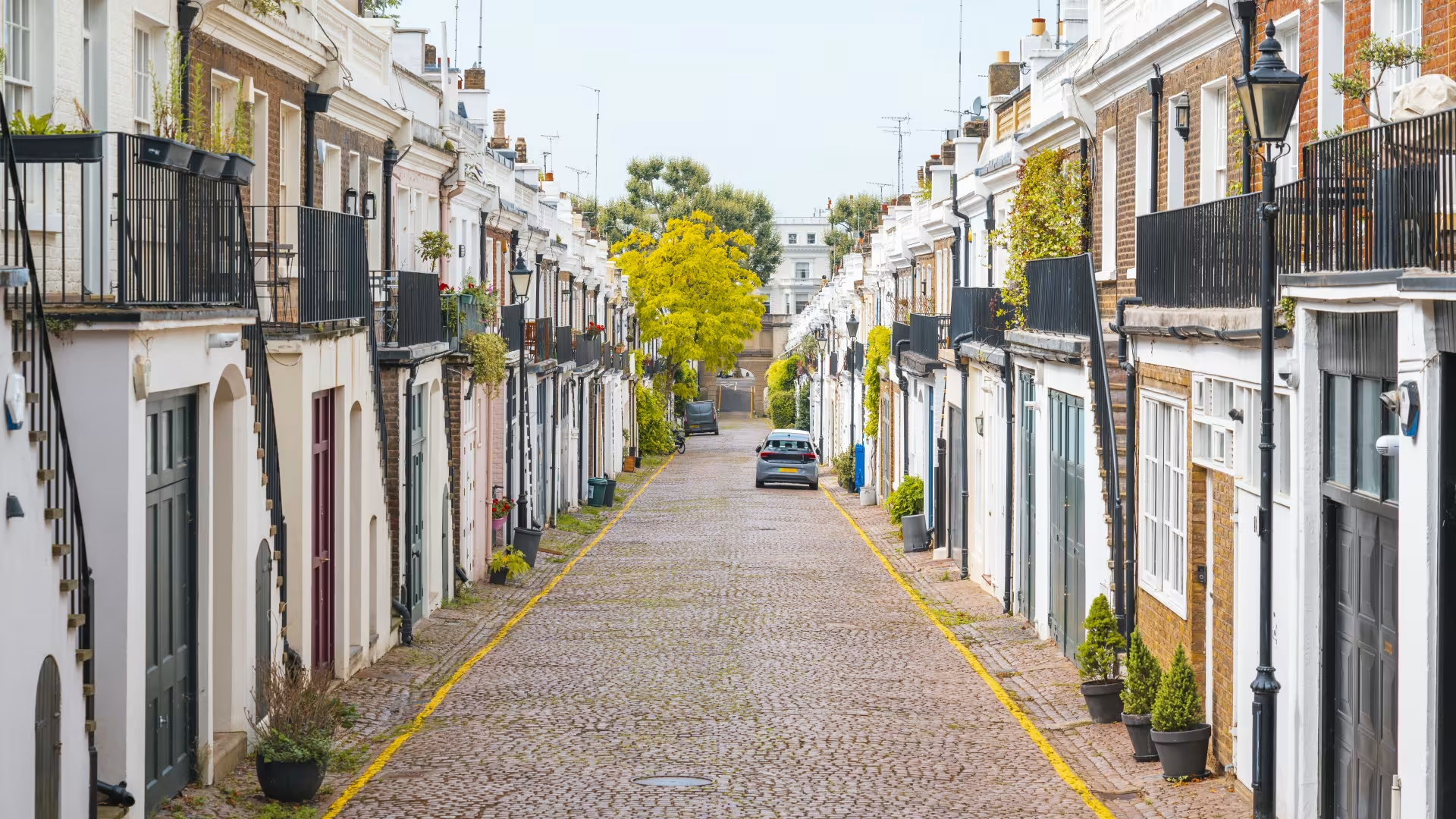
In South Kensington, for example, a luxury flat with a prominent Georgian facade, a broad balcony and a highly sought-after location close to major museums has reportedly seen its asking price reduced by almost £1 million in roughly a year. The property is now being marketed at about £4.4 million.

Other properties have experienced similar reductions. A house that was initially offered for around £20 million has reportedly been reduced to approximately £14 million, while a property in Notting Hill that entered the market at £16 million two years ago is now being offered for below £14 million.
Such reductions illustrate the pressure facing sellers in the capital’s premium market. While ordinary households have been dealing with affordability challenges and elevated mortgage costs, the slowdown at the upper end has developed for different reasons. Wealthy homeowners may have greater financial resources, but they are also increasingly confronting a market in which properties can remain unsold for long periods.
The decline is particularly pronounced in several central London boroughs. Data for the year ending in June showed that average property prices in inner London fell significantly even as prices across the UK as a whole recorded modest annual growth. Westminster, which includes prestigious districts such as Belgravia, Mayfair and Marylebone, experienced one of the sharpest declines, while substantial falls were also recorded in the City of London and Kensington and Chelsea.
The figures underline how differently various parts of the UK housing market are performing. London’s premium districts were once among the strongest-performing areas, but their previous rapid appreciation has left some properties exposed to a correction when market conditions changed.
According to property analysts, parts of London became significantly overvalued during the rapid price growth of the mid-2010s. The market subsequently faced several pressures, including the impact of the Brexit vote, the Covid-19 pandemic, increased property taxation and higher borrowing costs.
The role of international wealth has also changed. London historically attracted wealthy buyers from across the world who regarded prime property as both a place to live and a store of wealth. International investment helped push prices higher, particularly in neighbourhoods where supply was limited and demand from affluent buyers was strong.
That dynamic has weakened in recent years. Some wealthy international residents have left Britain, with taxation cited by property professionals as one factor influencing decisions about where to live and invest. Changes to the tax treatment of non-domiciled residents have added to concerns among some high-net-worth individuals about the future cost of maintaining property in the UK.
When wealthy residents leave while new buyers become more cautious, the imbalance can quickly affect prices. Prime London homes are expensive to maintain and difficult to replace with comparable properties elsewhere, leaving sellers with a choice between holding their assets for longer or accepting a lower price to complete a sale.
Tax expectations have also contributed to uncertainty. Proposals for additional taxation on high-value properties have increased concern among some homeowners and potential buyers about the future costs associated with owning expensive homes.
The consequences can be seen in the length of time properties remain on the market. Prime properties spent an average of 186 days on the market during the first half of 2026, compared with 178 days during the same period a year earlier. At the same time, the average discount from asking prices widened from 8.3% to 10.4%.
That change suggests that sellers are becoming more willing to negotiate. Properties that might previously have been marketed at ambitious prices are increasingly being offered at levels that buyers consider more realistic, while owners who have waited several years for a recovery are becoming less willing to remain on the market indefinitely.
For some long-term owners, the calculations are especially difficult. People who purchased homes more than a decade ago may have experienced substantial gains over much of their ownership period, but selling today can still mean accepting a significant loss compared with the property’s previous peak valuation.
Property advisers say some sellers are now taking a longer-term view and accepting that the latest transaction may not produce the financial return they once expected. The decision can be especially important for older homeowners who may prefer to sell rather than continue waiting for the market to recover.
The weakness, however, is not uniform across London’s luxury sector. Buyers remain interested in properties that are considered exceptional in terms of location, views, design, condition and quality. Homes that combine these features can still command strong prices, with some attracting competition even while less distinctive properties struggle.
This has created a sharply divided market. At one end, buyers are prepared to pay substantial sums for rare properties in outstanding locations. At the other, sellers of properties that require refurbishment, carry high running costs or lack particularly distinctive features may need to offer significant discounts.
The distinction has become increasingly important as wealthy buyers become more selective. Rather than purchasing simply because a property is located in a prestigious neighbourhood, buyers can demand stronger value and compare opportunities across international markets.
London is also facing competition from other global cities where luxury property markets have performed more strongly. San Francisco and Lisbon, for example, recorded price growth during the first half of 2026, while Tokyo experienced a particularly strong increase as international buyers took advantage of favourable currency conditions and limited supply.
The contrasting performance demonstrates that global wealth has not disappeared from the luxury property market. Instead, affluent buyers appear to have more choices about where they place their money, making London compete with other international centres for investment and residential demand.
Nevertheless, there remains substantial international interest in the capital. Property advisers report demand from buyers from countries including the United States, Singapore and Nigeria. For many wealthy purchasers, political considerations are only one factor in deciding whether to buy. London continues to offer established financial, cultural, educational and professional networks that make it attractive to international residents.
The most expensive section of the market is also behaving differently from the wider prime sector. While many multimillion-pound homes are struggling to sell, activity at the ultra-luxury end has remained comparatively strong.
Major transactions involving properties worth hundreds of millions of pounds demonstrate that demand has not disappeared among the world’s wealthiest individuals. Trophy homes with exceptional locations and characteristics continue to attract buyers capable of paying extraordinary sums.
One recent example involved the sale of a Chelsea mansion for more than £270 million, reportedly setting a record for a single residential property transaction in the UK. Another major property, a 40-bedroom mansion in Regent’s Park, has reportedly been approaching a potential sale at around £190 million, substantially above the price recorded when it changed hands in 2024.
These transactions reveal the unusual structure of London’s luxury market. A property worth several million pounds may struggle to find a buyer, while an exceptionally rare residence valued at hundreds of millions can generate considerable interest.
The difference reflects the limited supply of genuine trophy properties. There are only a small number of homes that offer the combination of historical significance, architectural quality, privacy, location and scale sought by the world’s wealthiest buyers.
For the broader prime market, however, the outlook remains more complicated. Sellers cannot assume that London’s historical reputation alone will guarantee rising prices. Buyers are increasingly sensitive to value, while tax changes, financing conditions and international competition continue to influence decisions.
The current weakness also represents a reversal of expectations built during decades of strong price growth. London’s most prestigious neighbourhoods were once viewed by many investors as almost inevitably appreciating assets. The recent decline demonstrates that even the most established property markets can experience prolonged periods of adjustment.

For homeowners, estate agents and investors, the challenge is therefore to distinguish between a temporary slowdown and a deeper structural change in the way London’s luxury housing market operates. The answer will depend on interest rates, taxation, international demand, the wider UK economy and the willingness of wealthy residents to continue making London their home.
For now, the evidence points to a market where negotiation has become more important, selling times have lengthened and price expectations have become more realistic. Yet the continued appetite for exceptional trophy properties shows that London has not lost its attraction among the world’s wealthiest buyers.
Instead, the capital’s luxury housing market appears to be dividing into two distinct worlds: one where ordinary multimillion-pound homes face pressure to reduce prices, and another where genuinely rare properties continue to command extraordinary attention. That divide could remain one of the defining features of London’s property market as sellers and buyers adjust to a new era of more cautious valuations.
Related News:
 Europe Faces Winter Gas Supply Anxiety
 UK House Prices Fall as Mortgage Rates Rise
 Oil nears $100 as Saudi attacks shake markets
 Thames Water Revises Oxfordshire Mega-Reservoir Plan
 UK Retail Sales Rebound as Consumers Spend More
 UK Borrowing Hits £18.3bn Ahead of Budget
 Thinktank Calls for Abolition of UK State Pension
 MPs Defend UK Economic Watchdog Against Critics
 UK Trade Losses Grow Without EU Product Deal
 Should Savers Lock Into 5.25% Fixed Rates?
 UK Diesel Prices Hit Record High Amid Iran Conflict
 Poundland Rescue Bid Could Protect 11,000 Jobs
 UK house price growth slows as mortgage rates rise
 UK borrowing costs surge as global bond sell-off deepens
 UK Assures Public Over Diesel Supply
 UK Diesel Reaches £2 as Inflation Surges Across Europe
 Minister Rejects Fears of UK Diesel Shortage
 Wealthy Britons Flee Gulf War but Avoid UK Taxes
 UK Wage Growth Slows as Jobs Market Holds Firm
 UK Doubles Steel Tariffs to 50% to Protect Domestic Plants
 Europe EV Demand Surges as Fuel Prices Rise
 BBC News Faces Deep Cuts in 2,000 Job Plan
 New UK advice scheme to boost savings and investing
 UK Pushes for New EU Goods Trade Deal
 Reeves Fights to Keep Treasury Role Amid Labour Turmoil
 UK rejects EV charging VAT cut amid Treasury clash
 UK firms accused of ‘AI washing’ boom
 Essex valley emerges as rising English wine hub
 EasyJet Takeover Sparks Fears Over Passengers’ Future
 Canada to Match Trump’s 50% Tariffs Dollar for Dollar
 UK Households Could Save £173 on Fixed Energy Deals
 Burnham Faces Mounting Budget Challenges
 Dutch Bank Moves 86 Tonnes of Gold to London
 Trump Hardens Canada Trade Stance as Talks Stall
 UK Cost Squeeze Deepens as Mortgages and Gas Rise
 Billionaire Chris Rokos poised to leave UK
 JPMorgan Boss Warns Against UK Bank Tax Rise
 John Lewis Losses Widen to £124m as Confidence Falls
 UK State Pension Set to Rise 3.9% as Triple Lock Holds
 UK Parents Cut School Uniform Costs as Prices Rise
 UK Pay Growth Slows to 3.9% as Rate Decision Nears
 Bank Urged to Slow Bond Sales as UK Costs Rise
 UK Inflation Hits 3.1% as Household Pressure Grows
 UK Productivity Improves as Bank Weighs Interest Rates
 Japan Raises Rates to 31-Year High
 UK Rent Gap Puts Low-Income Families Under Pressure
 Calls Grow to Expand UK National Wealth Fund
 Labour Apprenticeship Scheme Faces Slow Start
 Trump Eyes Major Belarus Fertiliser Deal Amid Canada Trade Dispute
 Burnham Leaves Door Open to Future Brexit Reversal
 Iran Rejects Claims of Shift in US Talks
 Chinese Hybrid Car Surge Raises EU Auto Industry Concerns
 Tony Blair Calls for Britain to Rejoin EU Within a Decade
 AO Acquires Jessops in Camera Retail Expansion
 Saudi intercepts Houthi missiles as oil fears grow
 UK Food Trade Deficit Hits £21bn in 2026
 Beaverbrooks Boss Calls for Relief on Business Costs
 Why Americans Feel Ripped Off by Rising Prices
 New UK Homes in Flood Zones Face Insurance Risk
 Ukraine Faces $45m Hourly Cost From Missile Alerts
 Burnham Opens Door to Possible UK Return to EU
 Healey urged to act as UK energy bills rise 4%
 Boots Sale Nears as Weston Family Eyes $9bn Deal
 French Debt Fears Put Euro Markets Under Pressure
 Badenoch Raises Prospect of 2027 UK Election
 Reeves Faces Setback as Labour May Miss Homes Target
 Trump’s UK Ambassador Urges North Sea Drilling to Strengthen US Ties
 Millionaires group urge Reeves to introduce wealth tax to ‘lift kids out of poverty’
 Starmer Says Labour’s Economic Plan Needs Years to Deliver
 Starmer Faces Parliamentary Battles Over UK-EU ‘Reset’ Plan
 UK Unemployment Rate Climbs to 5.2% Peak
 Rising Costs Force Families to Rethink Days Out
 Silent Tracks: Rail Line Without Passengers
 Tube Strike Brings Capital to a Standstill Over Shift Disputes
 Unions Warn Labour Over Zero-Hours Contract Reforms
 North Sea Firms Urge Early End to Windfall Tax
 Entain Plans 400 Job Cuts After Profit Update
 Tom Watson Takes Senior Role at Palantir
 Trump gives Xi red-carpet welcome as trade truce extends
 The Tests Awaiting Andy Burnham After Labour Conference