Published: 06 October 2026. The English Chronicle Desk. The English Chronicle Online.
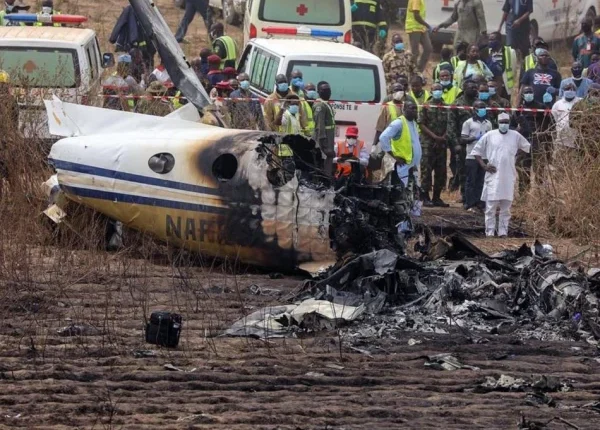
A Nigerian military aircraft has crashed in the country’s southern region, killing all 32 people on board in a devastating accident that has prompted an emergency search and recovery operation.
The victims included 25 passengers and seven crew members, according to Nigerian President Bola Tinubu. The aircraft was reportedly carrying out a routine mission linked to the country’s economic centre, Lagos, when it went down in the Igbo-koda area of Ondo state on Monday, 5 October.
The crash has raised fresh concerns about military aviation safety in Nigeria, where armed forces regularly operate aircraft in support of security, transport and logistical missions across the country.
Nigeria’s aviation minister, Festus Keyamo, said the aircraft lost contact with radar shortly after taking off at about 9am local time. Authorities subsequently determined that the aircraft had crashed while travelling from Edo state towards Lagos.

The exact circumstances that led to the crash remain unclear. Officials have not yet provided a definitive explanation for why contact with the aircraft was lost or whether mechanical failure, weather conditions, human error or another factor contributed to the accident.
The aircraft was later located near a naval facility, allowing rescue and recovery teams to begin operations in the area.
The Nigerian Air Force confirmed that the aircraft involved was an ATR-42, a twin-engine turboprop aircraft commonly used for regional transport. The model has been used in a variety of civilian and military roles in different countries, including passenger transport and logistical operations.
Following the crash, military personnel were deployed to the area as authorities attempted to secure the site and recover those who had been on board.
Images and video footage circulating on social media showed members of the recovery operation travelling by boat towards the crash site. The location appeared to be difficult to access, with rescuers navigating waterways and vegetation while searching the surrounding area.
Local residents also gathered near the scene as news of the crash spread.
One local resident described seeing several trees damaged when the aircraft came down. Debris and personal belongings were subsequently found in the area, including clothing and footwear believed to have belonged to people on board.
The discovery of the wreckage and human remains has transformed what began as a missing-aircraft alert into one of the country’s most serious aviation accidents in recent months.
President Tinubu’s confirmation that all 32 people aboard the aircraft died has brought an end to hopes that there might be survivors. The identities of the victims and further details about their mission were expected to be established as authorities continued their investigation.
Military aviation accidents can be particularly difficult to investigate because aircraft may operate in areas where civilian flight-tracking infrastructure is limited and because the missions themselves can involve specialised routes and operational requirements.
The loss of radar contact shortly after take-off is likely to become an important part of the investigation. Investigators will need to establish the aircraft’s final flight path, altitude and speed, as well as determine whether any warning signs were recorded before communication was lost.
They may also examine maintenance records, crew qualifications, weather conditions and the aircraft’s operational history.
The recovery operation is expected to play an important role in determining what happened. Investigators typically rely on physical evidence from the wreckage, including the condition of engines, flight-control systems and other components, to establish whether mechanical or structural problems contributed to an accident.
The crash occurred while the aircraft was reportedly carrying out a routine mission, making the sudden loss of contact particularly significant.
Nigeria has a large and complex security environment, requiring its military to conduct operations over extensive distances. The country’s armed forces have been involved in counter-insurgency and security operations in several parts of the country, while military aircraft are also used for transportation, surveillance and logistical support.
Although the precise purpose of this particular flight has not been fully explained, officials have described it as a routine mission connected with travel towards Lagos.
Lagos is Nigeria’s largest city and economic centre, and regular military and government aviation movements take place in and around the region.
The crash in Ondo state also highlights the geographical challenges faced by emergency responders. The area where the wreckage was found includes waterways and vegetation, making access more difficult than it would be at a conventional airport or open landing site.
The presence of a nearby naval base appears to have helped authorities identify and reach the area where the aircraft came down.
The Nigerian Air Force’s response involved search and recovery personnel who worked at the site while local residents watched developments from nearby areas.
Authorities are expected to maintain control of the crash site while investigators collect evidence. Such measures are essential to prevent debris from being disturbed and to ensure that important evidence remains available for examination.
The families of the victims now face the difficult process of receiving information about their relatives and arranging the recovery and identification of remains.
A military aircraft accident involving 32 deaths can have consequences extending well beyond the immediate loss of life. It can affect operational capacity, military morale and public confidence in aviation safety.
For the Nigerian government and military authorities, determining the cause of the accident will therefore be an important priority.
If investigators discover a mechanical or maintenance problem, questions could arise about inspection procedures and the condition of other aircraft in the fleet. If human factors are involved, authorities may need to review training, operational procedures or crew workload. Weather and environmental conditions will also need to be examined before any conclusion is reached.
At this stage, however, it would be premature to attribute responsibility to any particular factor.
The available information establishes that the aircraft lost radar contact shortly after take-off and subsequently crashed in southern Nigeria. The ATR-42 wreckage was found near a naval facility, and recovery teams were sent to the area. Officials have confirmed that there were no survivors among the 32 people aboard.
The investigation will now be crucial in establishing the full sequence of events.
Aviation investigations can take considerable time, particularly when an accident occurs in a difficult environment. Investigators may need to reconstruct the aircraft’s final movements, examine recovered components and review communications between the crew and ground authorities.
The findings could also have implications for Nigeria’s military aviation policy.
Ensuring that aircraft are properly maintained and that crews receive appropriate training is essential for any armed force operating transport aircraft. Military aviation frequently involves demanding conditions, and routine flights can become dangerous if technical or operational problems go undetected.
The tragedy has already drawn attention to the human cost of such risks.
Behind the official figures are 32 individuals whose families, colleagues and communities are now facing a sudden and devastating loss. The passengers and crew were reportedly travelling on what had been considered a routine mission, making the fatal outcome particularly difficult for those connected to them.
As recovery efforts continue, the focus will gradually shift from locating the aircraft and recovering the victims to understanding why the crash happened.

Nigerian authorities are expected to provide further information as the investigation progresses. Until the evidence has been fully examined, officials are likely to avoid drawing conclusions about the cause of the accident.
The crash serves as a stark reminder of the risks associated with military aviation and the importance of rigorous maintenance, operational discipline and emergency preparedness.
For now, the central fact remains the scale of the tragedy: all 32 people aboard the Nigerian military aircraft lost their lives when the aircraft crashed in Ondo state during a journey linked to Lagos.
The investigation into the accident will determine whether the disaster resulted from a technical failure, operational problem, environmental conditions or another cause. Whatever the eventual findings, the immediate priority remains supporting the victims’ families, completing the recovery operation and establishing the facts surrounding one of Nigeria’s latest major aviation tragedies.
Related News:
 UK Prepares Aircraft Carrier for Middle East Crisis
 North Korea Fires Missiles Amid US-South Korea Drills
 Russia Drone Attack Intensifies Ukraine War Pressure
 China’s Secret Mountain Ruins Rise Again in New Cold War
 ‘The frontline is like Terminator’: Ukraine’s fighting robots
 RAF Typhoons scrambled amid Russian drone threat near Nato
 Trump orders US troop pullout from Germany
 Ukraine strikes Tuapse as oil disaster worsens
 Trump likens US Navy actions to ‘pirates’
 Putin Declares Russia Victory at Scaled Victory Day Parade
 Ebola outbreak in DRC overwhelms health system as cases surge
 Zelenskyy warns over Oreshnik threat as Kyiv hit
 Hunger increasingly weaponised in global conflicts
 Discontent grows around Putin amid war strain
 Russian Frigate Fires Warning Shots Near British Yacht
 Trump dismisses concerns over 250-day carrier deployment
 Russian Missiles Intensify Pressure on Kyiv
 South Africa’s Femicide Crisis Deepens
 Tropics May Wait Longest for Net-Zero Climate Benefits
 UK Pauses Chagos Deal Amid US Opposition
 Trump Asked Xi About Buying US Weapons
 Putin Orders Russian Army Expansion as War Intensifies
 South Korea demands apology over DMZ mine blast
 Economic growth and political strain reshape Benin
 Ukraine’s New FP-7 Missile Makes Combat Debut
 Cairo Mural Sparks Debate Over Ancient Egyptian Identity
 Russian Strikes Disrupt Kyiv Bridge Traffic
 Germany Pledges €1bn Military Aid to Ukraine
 Lithuania Offers to Fund Permanent US Military Base
 BBC to Apologise Over Edited Trump Speech Amid Backlash
 Greene Pushes Epstein Files Amid Trump Fallout
 December Run-Off in Chile as Election Produces No Winner
 Zelenskyy Signs Fighter Jet Deal Amid Russian Drone Attacks
 Shadow Fleet at Sea: Europe’s Battle Against Illicit Oil Shipping
 Tiny Curacao Makes History as Smallest Nation to Reach World Cup
 US Suspends Afghan Immigration After White House Shooting
 Georgians Defy Government Crackdown After Year of Protests
 ‘Extinct’ Antelope Returns to Sahara, Bringing Hope
 Irish Beach Tragedy: Irish Drown at Whitehaven Beach in Australia
 Sanctioned oil tankers sail Channel amid Russia scrutiny
 Pentagon Signals Reduced Role in Deterring North Korea
 UK and US Drop in Global Corruption Index Rankings
 SA Police Intensify Search in Gus Lamont Case
 Canberra Poster Seizure Sparks Free Speech Row
 Evo Morales Returns After Mysterious Absence
 Jacinda Ardern Moves To Australia Following Her US Fellowships
 Jacinda Ardern Move Sparks Kiwi Reflection
 Middle East Airspace Crisis Strands Thousands
 Nick Greiner Warns Over Election Review Fallout
 Kelly Wilkinson Inquest Reveals Bail Failure
 Tehran Strikes Mark War’s Most Devastating Night
 Injured Mojtaba Khamenei Elevated as Iran Leader
 Gordon Brown urges court for crimes against children
 The Kill Line: A Shifting Vision of the American Dream
 Pakistan Targets Militant Hideouts in Afghanistan
 Air Canada CEO Faces Outcry Over Recent Language Misstep
 Extreme Weather: Europe Shivers as Cyclone Narelle Hits
 Asia Turns Back to Coal Amid Middle East Energy Crisis
 Relationship with Trump may be beyond repair, Starmer warned
 Trump’s Six-Week Iranian War: The High Cost of Ignorance
 Ben Roberts-Smith Denies War Crime Allegations in First Statement
 RFU Backs Borthwick Despite England’s Poor Six Nations
 Trump Rejects Tehran Peace Plan as Regional Truce Crumbles
 Fear and Betrayal: The Chilling Case of Kouri Richins
 Maldives Cave Diving Tragedy Raises Safety Alarm
 NDIS Overhaul Sparks Intense Clash Across Australia
 Britain’s Crowning Butterfly Takes the Nation by Storm
 Fifa Official Under Investigation Over Hand Gesture Controversy
 Grief and Devotion Amidst the Rubble of Nabatieh
 Canada Secure Historic Last 16 Spot with Late Goal
 England and Norway Fans Turn Miami Into World Cup Carnival
 Olympus Awaits Unesco Heritage Recognition
 Powerful 7.7-Magnitude Earthquake Hits Eastern Indonesia
 Bayeux Tapestry Revives Franco-British Ties
 British Columbia Sues OpenAI Over School Shooting
 Trump gives Xi red-carpet welcome as trade truce extends
 Republican Senator Questions Trump Ad Spending
 US Sends Third Carrier to Middle East
 Lula Warns of Bolsonaro Family Return as Brazil Votes
 Yemen government launches offensive against Houthis