Published: 08 October 2026. The English Chronicle Desk. The English Chronicle Online
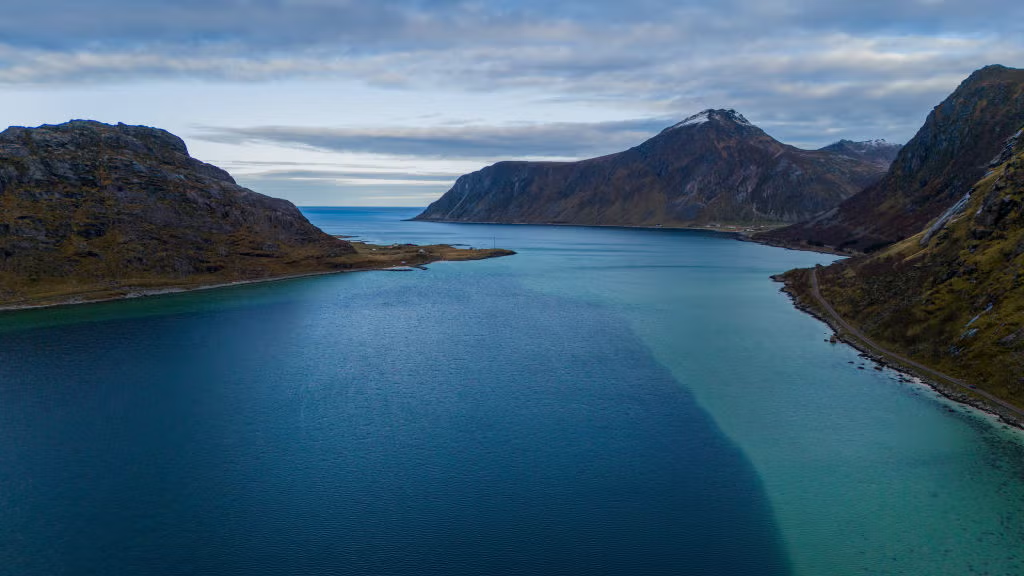
A long-running environmental dispute in Norway has entered a new and potentially more consequential phase after the government granted a mining company permission to continue depositing waste into Førde fjord, despite a Supreme Court ruling that found the original dumping permit unlawful.
The decision has reignited anger among residents, environmental campaigners and legal experts in the small west coast community of Vevring, where opposition to the Engebø titanium mine has continued for 17 years. For campaigners, the government’s latest move is not simply a disagreement over industrial pollution. They argue it raises fundamental questions about environmental protection, the authority of the courts and the future of Norway’s internationally recognised fjords.
The latest chapter began on 17 June, when local residents gathered at a school in Vevring to follow the Supreme Court’s decision. After years of legal challenges, Norway’s highest court ruled against the government, concluding that the permit allowing mining waste to be discharged directly into Førde fjord was illegal.

For those who had spent years campaigning against the project, the ruling represented a major victory. Ingvild Fonn Asmervik, a project leader with Friends of the Earth Norway, described the moment as one of the most emotional experiences of the campaign. Local fisher Anne-Line Thingnes Førsund, whose family has lived beside the fjord for generations, said the decision felt like a huge weight had finally been lifted.
The relief did not last long.
Only days after the Supreme Court judgment, a government lawyer appeared on a televised debate programme to discuss plans for a temporary permit that would allow the mine to continue disposing of waste while authorities considered the next stage of the project. Four days later, the mining company applied for fresh permission.
In late September, Norway’s climate and environment ministry granted the new permit, allowing the Engebø mine to deposit waste into the fjord for three years.
For Førsund and other campaigners, the decision was deeply frustrating after years of legal and political efforts. She said local residents had responded to consultations, submitted objections and pursued every available avenue to challenge the project.
The dispute centres on submarine tailings deposition, a method in which crushed rock and other mining waste are transported through pipelines and discharged underwater. Supporters of the practice argue that it can provide an alternative to storing enormous quantities of mining waste on land. Critics, however, warn that fine particles can spread through marine ecosystems and affect organisms far beyond the immediate dumping area.
Norway is one of the few countries where submarine tailings disposal remains permitted. The practice has been banned or prohibited in much of the world, including North America, Australia, Brazil, China, Russia and much of Europe. Only a limited number of countries continue to allow similar methods.
Norway’s own Institute of Marine Research has warned that mining waste released into the sea can contain fine particles and toxic substances capable of accumulating in marine organisms and disrupting ecosystems.
The environmental concerns are particularly significant in Førde fjord, which is regarded as one of Norway’s relatively pristine fjord environments. Campaigners fear that continued disposal could alter the ecological character of an area that supports marine life and has long been central to local livelihoods.
The Engebø mine project was first proposed by Nordic Mining in 2006. The Norwegian government subsequently approved a permit for waste disposal into the fjord, prompting Friends of the Earth Norway to launch a series of legal challenges.
The dispute eventually reached the Supreme Court, where the legality of the permit was examined during a week-long hearing earlier this year. While the court rejected the legal basis of the original permit, mining operations had already progressed. The mine began releasing waste into the fjord in late 2024.
Nordic Mining has defended its operations and has indicated that it intends to continue working with Norwegian authorities. The company has argued that claims suggesting its operations must immediately stop do not accurately reflect the legal situation surrounding the project.
The Norwegian government has also defended its decision to issue the new permit. At the heart of its argument is the strategic importance of titanium.
The Engebø mountain contains one of the world’s largest known deposits of rutile, a titanium-bearing mineral. Titanium has become increasingly important to European policymakers because of its industrial uses and concerns about secure access to critical raw materials.
The European Union added titanium to its list of critical minerals in 2020. Norwegian authorities argue that developments since the original permit was granted have strengthened the public-interest case for the project.
A ministry spokesperson has described the Engebø project as important for both Norway and Europe, pointing to the strategic value of the mineral deposit and the limited number of European countries with significant titanium resources.
But legal experts have questioned whether that justification can overcome the Supreme Court’s ruling. Tarjei Ellingsen Røsvoll, an associate professor of administrative and constitutional law at the University of Inland Norway, has argued that the court’s decision leaves little room for treating the original permit as valid.
He warned that allowing the dumping to continue after the court had declared the earlier permit unlawful could damage public confidence in Norway’s legal and administrative institutions.
The dispute has also attracted attention because of wider concerns about pollution in Norwegian coastal waters. Recent research has raised questions about nutrient pollution from fish farms, while Atlantic salmon populations have fallen to historically low levels in parts of the country.
This broader environmental context has intensified fears that industrial activity could place additional pressure on marine ecosystems already facing multiple threats.
Scientists remain particularly concerned about the long-term consequences of mining waste. Terje van der Meeren, a research professor at Norway’s Institute of Marine Research, has warned that finely milled waste can behave like dust and spread through water.
The Engebø operation involves waste containing a chemical that can degrade into carbon disulphide, a substance known for its toxic effects on the nervous system. Scientists are concerned that fine particles could move beyond the immediate discharge area and affect fish spawning grounds and other parts of the ecosystem.
Evidence from earlier Norwegian mining operations has added to those concerns. Researchers studying Repparfjord in northern Norway found elevated levels of metals including lead, arsenic and chromium in haddock decades after a copper mine had discharged waste into the fjord during the 1970s.
Other research has identified historic effects associated with submarine tailings disposal in marine organisms including plankton, crabs and fish eggs.
Scientists stress that the environmental consequences can vary depending on the material being discharged, the characteristics of the fjord and the way waste is deposited. But the historical evidence has made the potential long-term effects an important part of the debate over Engebø.
Norway’s environmental authorities and the mining industry face a difficult balancing act. The country wants to develop domestic supplies of minerals considered strategically important to Europe while also maintaining its reputation for environmental stewardship and protecting its unique coastal ecosystems.
For the people of Vevring, however, the dispute is deeply personal.
Førsund has spent much of her adult life campaigning against the mine and has watched several generations of local residents become involved in the fight. Some of the people who joined early demonstrations are no longer alive.
She says the fjord represents much more than a geographical feature or an environmental resource. For generations, it has provided food, employment, cultural identity and a connection between local families and the natural world.
Campaigners are now preparing for another legal challenge to the temporary permit. In the meantime, waste disposal is expected to continue while the legal and administrative process unfolds.
The case could have consequences beyond Vevring. If Norway continues to approve submarine tailings disposal in the name of securing critical minerals, environmental groups fear the Engebø decision could encourage similar projects elsewhere.

The government, meanwhile, faces the challenge of demonstrating that the economic and strategic benefits of mining can be reconciled with its obligations to protect marine environments and respect judicial decisions.
For residents living beside Førde fjord, the latest permit has transformed what had briefly appeared to be the end of a 17-year struggle into another chapter.
The fjord remains at the centre of the dispute, carrying both the waste of a modern mining project and the hopes of communities determined to protect the waters that have sustained them for generations.
Related News:
 Europe Faces Climate Reckoning After Extreme Summer
 Norfolk Broads Housing Levy Faces Environmental Criticism
 Berlin App Helps Residents Protect City Trees
 Drax Datacentre Faces Major Carbon Emissions Concerns
 Ocean Warming Drives Massive Marine Life Loss, Study Warns
 Heavier SUVs Accelerate Britain’s Pothole Crisis
 Capitalism ‘Suicidal’, Warns Petro at Climate Summit
 Record May Heat to Cold Front in Eastern Australia
 Norway Doubles Down on Oil and Gas for Europe Energy Security
 UK rejects EV charging VAT cut amid Treasury clash
 Wildfires rage across Europe as hundreds arrested in France
 Battery Fires Cost UK Recycling Industry £1bn
 Turkmenistan Begins Fixing Major Methane Mega-Leaks
 UN Warns Record El Niño Could Supercharge Global Heat
 Heathrow Expansion Faces New Climate Conditions Over CO₂
 Australia Renewables Reach Record 80% Grid Demand
 Super El Niño Threatens Hundreds of Thousands of Lives
 Chinese Hybrid Car Surge Raises EU Auto Industry Concerns
 Swiss Glaciers Lose Nearly One-Fifth of Ice in Five Years
 Europe’s Record Heat Summer Signals Climate Risks
 Edinburgh Glasshouses Reopen After Major Restoration
 Asos Investigates Hack Claims After Customer Alerts
 Tech-Optimist Scientists Less Likely to Take Climate Action
 Virgin Trains Moves Closer to Challenging Eurostar Monopoly
 New laws to bolster UK’s defences against cyber attacks on NHS, transport and energy
 EU launches Grok AI probe into X over explicit images
 AI job losses UK: Britain faces sharper employment shock
 UK AI avatar firm Synthesia valuation jumps to $4bn
 TikTok Design Faces EU Crackdown Over Addictive Features
 BT Names New Openreach Chief Amid Major Fibre Expansion
 AI fears hit UK wealth and comparison sites
 UK Firms Warned of Rising Iran Cyber Threats
 Yorkshire Water Funding Sparks Debate Amid Fines and Pay Row
 Tesla Enters British Energy Market Following Ofgem Approval
 The Truth Behind Rising Energy Costs and Fossil Fuel Myths
 ‘Drinking from a Fetid Pond’: Superbug Genes in Lough Neagh
 New £10bn rescue plan offered for Thames Water
 UK Energy Reform Could Cut Bills by £200
 Trump to Deploy “God Squad” Over Gulf Wildlife Protections
 Older Than Dinosaurs: Secrets of Mayfly Dance Revealed
 Disney+ Wins Champions League Rights in Key Markets
 DeepMind Staff Vote to Unionize Over US Military Contract
 UK Faces Mass Water Shortages by 2055, Lords Warn
 Pope Meets Families in Italy Toxic Waste Zone
 Hope for mountain bongos returns to Kenya
 SpaceX Prepares for Historic Valuation Launch
 Trump Faces Backlash Over $2bn Earnings Since Return
 Deadly H5 Bird Flu Reaches Australia’s East Coast
 Sydney Records Hottest June Since 1859 as Expert Warns New High a ‘Signature’ of Global Warming
 UK Heatwaves Ignite Crisis of Sleep and Public Safety
 Record £28m Fine for Virgin Media Over Cancellation Woes
 The Carbon Capture Con: Wasted Billions for Taxpayers
 Meta Under Fire: The Battle Over Addictive Social Media Design
 Thames Water Future Remains Uncertain Amid Funding Crunch
 Wildfires Force Mass Evacuations in France And Spain
 Weight-Loss Drugs Offer Food Savings Mainly to High Earners
 Burnham unveils £65m drought aid for farmers
 Gen Z turns to BirdTok for a gentler digital escape
 UK Risks Falling Behind in AI Race
 London Launches First Self-Driving Taxis
 UK Subsidence Claims Surge After Record-Breaking Summer
 Reform Faces Fresh Financial Controversy
 Swedish Mining Push Puts Sami Land Rights Under Pressure
 McLaren to Create 1,000 UK Jobs in £450m Investment
 AI CEOs Call for Slower Development
 UK Heatwaves Set to Worsen Pothole Damage, RAC Warns
 Tom Watson Takes Senior Role at Palantir
 Tropics May Wait Longest for Net-Zero Climate Benefits
 Trump gives Xi red-carpet welcome as trade truce extends
 Xi urges Trump to avoid US-China military conflict
 Nepal PM calls deadly flood a global climate warning
 TalkTalk Races to Sell Arms as Administration Looms
 Sheikh Tahnoon and the UAE’s AI Ambitions
 French Debt Fears Put Euro Markets Under Pressure
 BT Broadband Pauses Raise Digital Switchover Concerns
 North Sea Strike Threatens UK Fuel Supplies
 Argentina Protesters Resist Milei’s Land Sale Drive
 Poland Pushes Energy Security Beyond Russian Gas
 Ghesquière imagines a warmer future for Louis Vuitton
 Sardinia Village Emerges as Longevity Hotspot