Published: 10 August 2026. The English Chronicle Desk. The English Chronicle Online
A fast-moving wildfire in western Canada has forced thousands of people from their homes, destroyed properties and claimed at least one life, prompting authorities in British Columbia to declare a state of emergency as firefighters struggle to contain the rapidly expanding blaze.
The Bald Range fire, burning in and around Summerland in British Columbia’s Okanagan region, has grown dramatically since it was first detected on Friday. Officials said the fire had reached about 13,618 hectares, or roughly 136 sq km, after doubling in size in a short period.
The speed and intensity of the blaze have left residents with little time to react. Some people described watching the sky change within hours before being ordered to leave, while others fled as flames approached their neighbourhoods.
Summerland Mayor Doug Holmes warned residents and emergency authorities to prepare for potentially worsening conditions.

“We have to brace ourselves for the worst,” Holmes told Reuters, reflecting the uncertainty facing communities as firefighters battle a fire capable of generating its own extreme weather.
One person has died in connection with the wildfire. Canadian police said an 80-year-old woman from Meadow Valley, north-west of Summerland, died suddenly while attempting to escape her home with a family member. Police said they believed her death was related to the wildfire.
The incident has added to the anxiety among residents who were already facing the prospect of losing their homes.
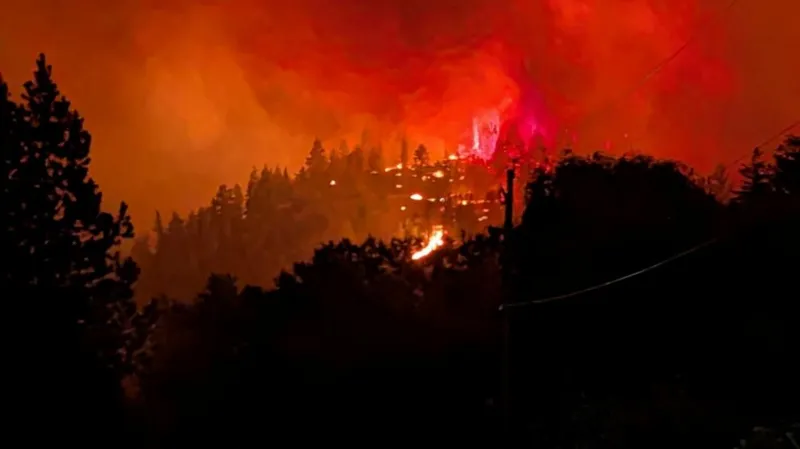
Keegan Radomski, a Summerland resident, said she left her property with seven other people only moments before the fire reached the area. Images she shared showed flames and burning treetops rising beyond a nearby hillside.
“This is right by our house,” she said, describing the frightening moment she realised how quickly the fire was advancing.
Radomski has not been able to return home since evacuating on Friday. She said neighbours who remained in the area had reported that numerous properties on their street had already been destroyed.
“There are homes that have been confirmed gone, and a lot are in the area near our home,” she said. “So, we’re pretty scared. The uncertainty is scary.”
That uncertainty is widespread across the affected communities. Authorities have issued evacuation orders in parts of Summerland, Peachland and surrounding regional districts, while additional areas remain under evacuation alerts.
British Columbia Premier David Eby said the fire had developed with extraordinary speed and intensity. At a news conference, he said a fire official had compared the event to “a bomb going off”.
Eby said homes and properties had been lost and that some residents had become trapped after conditions changed rapidly, requiring rescue operations.
The provincial state of emergency gives authorities additional powers to impose restrictions, protect essential supplies and coordinate resources during the crisis. Officials are using those powers as emergency crews attempt to protect communities and prevent the fire from spreading further.
Summerland, a community of roughly 12,000 people, has been among the areas most severely affected. Peachland, with a population of around 6,500, has also seen residents ordered to leave.
For many people, the evacuation has been an experience they had hoped never to face.
Earl Kurz, who has lived in Peachland for three decades, said his community had received evacuation alerts many times before, but Friday was different.
“We have been on evacuation alert many times,” he said. “This is the first time we were actually evacuated.”
Kurz recalled being on a boat with his wife on Okanagan Lake when the weather appeared to change almost before their eyes. What began as a clear afternoon quickly became hazy as smoke spread across the horizon.
By nightfall, dark clouds had formed above the advancing fire.
“We watched it from the lake,” Kurz said. “It was unreal.”
Several hours later, police arrived at his home and ordered the couple to evacuate. They eventually found safety in a camper some distance from the fire.
The blaze has also created a difficult situation for residents with livestock. The Okanagan region has a significant number of horses, and evacuating large animals during an emergency is considerably more complicated than moving people.
Canadian broadcaster CBC reported that some horse owners were unable to relocate their animals. Some residents reportedly left gates open in the hope their animals would be able to move away from the flames themselves.
Others attempted to make their animals easier to identify later by painting markings on them.
The situation illustrates the broader disruption caused by the fire, which has affected homes, businesses, roads and local communities while forcing emergency authorities to concentrate resources on protecting lives.
Another major concern is the behaviour of the fire itself. Officials said the flames have become so intense that they are generating their own weather systems. Such conditions can produce lightning and powerful changes in wind, making fires more difficult to predict and control.
For firefighters, that means the situation can change rapidly even when conditions initially appear manageable. A shift in wind direction can push flames into new areas, while smoke and extreme heat can make firefighting operations more dangerous.
The Bald Range fire is part of a wider wildfire crisis that has affected Canada during the summer. Hundreds of fires have been burning across the country, with Ontario experiencing particularly severe activity in July.
The scale of the fires has also created consequences beyond Canada’s borders. Smoke from Canadian wildfires has travelled into the United States, affecting air quality in states including Minnesota and New York.
At points during the summer, Toronto’s air quality deteriorated sharply as smoke spread across parts of the country. The continuing wildfire situation has therefore become not only a Canadian emergency but also a regional environmental and public-health concern.
The smoke has also become entangled with politics. US President Donald Trump previously threatened additional tariffs against Canada in connection with smoke drifting across the border, adding an economic dimension to an already serious environmental crisis.
For people in British Columbia, however, the immediate concern is far more personal: whether they will have homes to return to.
As evacuation orders remain in place, many residents are waiting away from their communities for updates from authorities. Some have left with only essential belongings, while others are trying to determine whether relatives, friends, pets and livestock have reached safety.
The emotional strain is compounded by uncertainty over the fire’s next movement. Even residents who escaped safely do not know whether their properties have survived.
Emergency authorities continue to urge people in threatened areas to follow evacuation instructions and remain away from zones where orders are in place. Returning too early can put both residents and rescue workers at risk.
The fire also highlights the growing challenge faced by communities across Canada as increasingly destructive wildfire seasons place pressure on emergency services, local governments and residents.

For Summerland, Peachland and surrounding communities, the focus remains on protecting lives and limiting further destruction. The full extent of the damage will only become clear once conditions allow emergency teams and residents to safely assess affected areas.
Until then, thousands of people remain displaced, waiting for the fire to be brought under control and hoping they will eventually be able to return home.
For those who escaped with their lives, the memories of Friday’s sudden transformation from an ordinary summer day into an emergency are likely to remain long after the flames have disappeared.
The immediate priority is containment. The longer-term challenge will be rebuilding homes, restoring communities and confronting the growing risks posed by Canada’s increasingly severe wildfire seasons.
Related News:
 Two Killed as Firefighting Helicopters Collide During Greece Wildfire Mission
 At Least 19 Killed After Powerful Earthquake Hits Southern Philippines
 Thousands Evacuated in France as Wildfires Spread Across Regions
 Wildfires Intensify in South-West France as Region Braces for 40C Heatwave
 Dozens of Flood Warnings in England After Days of Non-Stop Rain
 Fast-moving Wildfires Rage Across Southwestern US
 Shutting North Sea ‘Will Drive Up Carbon Emissions’
 As Trump Retreats from Climate Goals, China Is Becoming a Green Superpower
 Storm Hernando: Edinburgh Airport Flights Cancelled in US Travel Chaos
 Storm Hernando: Edinburgh Airport Flights Cancelled in US Travel Chaos
 UK Winter Nowhere Near a Record Breaker Despite Floods and Storms
 UK Records Warmest Day of the Year as Temperatures Exceed 18 °C
 Millions Left Without Power as Grid Fails
 Red Skies and Raging Floods: One Dead as Storm Erminio and Saharan Dust Grip Greece
 Evacuations Ordered as California Wildfires Spread Fast
 Queensland Braces for Potential Second Severe Cyclone Hit
 Capitalism ‘Suicidal’, Warns Petro at Climate Summit
 The Great May Meltdown: Europe Braces for a Historic Swing from Arctic Chill to Extreme Late-Spring Heat
 Deadly Earthquake Hits Philippines
 Temperatures Set to Fall This Week, But Forecasters Warn Heat Could Return Soon
 Why Extreme Heat Can Cause Trees to Collapse and What Experts Say Can Be Done
 African Fishermen Blame Chinese Trawlers for Declining Catches
 Deadly Spain Wildfire Leaves 11 Dead, 19 Missing
 Venezuela Quake Death Toll Surpasses 4,000
 Rain Forecast to Return This Weekend as Parts of UK Edge Closer to Drought Conditions
 No Helicopters Available to Fight Wildfires as ‘Crisis Management’ Plans Activated
 Venezuelans Still Seek Answers One Month After Quakes
 Wildfires Force Mass Evacuations in France And Spain
 Wildfires Threaten Bordeaux as Mass Evacuations Grow
 Wildfires Advance Toward Farmland Near Bordeaux
 French Wildfire Sparks Rare Lightning Storm Near Bordeaux
 French Firefighters Battle ‘David vs Goliath’ Wildfire
 Amber Heat Health Alerts Issued as UK Heatwave Set to Reach 35C Peak
 Storms Set to End UK Heatwave with Flood Warnings
 Europe’s Rivers Dry Up as Climate Crisis Deepens
 ‘Extinct’ Antelope Returns to Sahara, Bringing Hope
 What is Groundwater Flooding and Why Dorset is Seeing ‘Historical Highs’
 BRRRITAIN: Met Office Issues Yellow Weather Warning for More Snow
 Temperatures Dip Below Freezing as Arctic Air Sweeps Across the UK
 Snow and Rain Warnings as Cold Snap Continues in the UK
 Flooding May Worsen Before It Improves as More Rain Forecast for the UK
 Eight Skiers Found Dead After California Avalanche
 How Do You Modernise Mango Farming? India’s Growers Urged to Innovate as Climate Change Hits
Major 7.1 Earthquake Strikes Off Malaysian Tourist Coast
How Do You Modernise Mango Farming? India’s Growers Urged to Innovate as Climate Change Hits
Major 7.1 Earthquake Strikes Off Malaysian Tourist Coast
 Greenpeace $345m Ruling Sparks Appeal Battle
 Conservation Budgets Hit by Increased Fly‑Tipping Costs
 Study Says Only Two Nations May Survive Nuclear War
 Net Zero by 2050 ‘Cheaper Than One Fossil Fuel Crisis’
 Scotland Braces for 80mph Gales and ‘Intense Rain’
 ‘The Invisible Killer’: Chiang Mai Air Quality Crisis Sparks Pediatric Health Emergency
 7.4-Magnitude Earthquake Jolts Eastern Indonesia; Tsunami Warning Lifted
 The Banbridge Rescue: 300 Sheep Saved from Massive Hay Shed Inferno
 Tragic End to Outback Search as Floods Claim a Life
 Paradise Aground: Cruise Ship Evacuated After Striking Reef Near ‘Cast Away’ Island
 Moldova River Crisis Exposes War’s Hidden Cost
 Cyclone Vaianu Forces Mass Evacuations in New Zealand
 OpenAI CEO Apologizes After Canada Shooting Case
 Escobar’s Hippos May Be Moved to India Zoo
 Ukraine strikes Tuapse as oil disaster worsens
 “The Climate Multiplier”: Assessing the Dual Threat of Disease-Bearing Mosquitoes and Heat-Related Mortality
 Pope Meets Families in Italy Toxic Waste Zone
 Man killed in shark attack on Great Barrier Reef
 Hope for mountain bongos returns to Kenya
 UN Issues Urgent Warning: Imminent Return of El Niño
 Airline Leaders Warn 2050 Net Zero Target May No Longer Be Achievable
 Net Zero School Remains Cool and Open as Heatwave Tests Britain’s Buildings
 Headline: Three-Year-Old Rescued Alive Six Days After Devastating Venezuela Earthquake
 Girl Survives 32 Hours Under Rubble After Venezuela Quake
 China Storms Claim Fifteen Lives in Tragic Surge
 Europe Scorched as Record Heatwaves Grip the Continent
 UK Heatwaves May Have Claimed Thousands of Lives
 UK Heatwave Nears Two-Week Milestone as High Temperatures Continue Across the Country
 Britain Set for ‘Bumper Year’ for Butterflies as Conservationists Predict Strong Season
 France Evacuates Tourist Area as Wildfires Spread
 Three-Quarters of England’s Riverbanks Still Off Limits
 Many Trapped Inside Japanese Shopping Centre After Earthquake
 Major Incident Declared in Suffolk as 90 Firefighters Battle Heathland Wildfire
 Drone Warnings Issued as South Korea Battles Historic Heatwave
 US, RWE Reach Major Deal as Offshore Wind Projects End