Published: 16 September 2026. The English Chronicle Desk. The English Chronicle Online
The discovery of the bodies of seven women in and around the area near Johannesburg’s international airport has renewed widespread anger and fear in South Africa, where campaigners have long demanded stronger action against gender-based violence and femicide.
Five of the women were found within the space of a week, while the other two deaths were discovered earlier in the surrounding area. The cases have prompted renewed questions about the safety of women and the effectiveness of efforts to prevent violence against them.
Among the victims was Elizabeth “Tsontso” Moselakgomo, a 38-year-old woman who disappeared on 9 September after leaving home for a run. Her eight-year-old daughter alerted relatives when she failed to return, after which her disappearance attracted widespread attention online. Her body was found several days later and formally identified by relatives on Monday.
The news of Moselakgomo’s death was met with grief among friends, fellow runners and women’s rights campaigners. Her disappearance had become widely known, with people sharing information in the hope of finding her.

Police said on Saturday that four women’s bodies had been discovered in Kempton Park since 15 July. Kempton Park is located across the highway from OR Tambo International Airport, one of the country’s major transport hubs. Two further bodies were discovered in Olifantsfontein on Monday and Tuesday, while another woman was found dead in an area to the south-east.
The circumstances surrounding the deaths are being investigated. Police have deployed specialist investigators and have urged women in the Kempton Park area to exercise caution, particularly when walking or running alone in isolated locations.
That advice, however, has generated criticism from women’s rights advocates and runners who argue that women should not be expected to carry the primary responsibility for preventing violence against them.
Women For Change, an advocacy organisation, said many women already take precautions, including informing others about their whereabouts and sharing their routes when exercising. The organisation argued that repeated instructions for women to remain vigilant did not address the underlying causes of violence.
The reaction reflects a long-running frustration among campaigners in South Africa. Women’s organisations have spent years demanding stronger government action against gender-based violence, arguing that the scale and persistence of killings require more than warnings directed at potential victims.
South Africa’s official crime figures illustrate the broader scale of the problem. According to the latest police statistics cited in the report, more than 27,600 people were murdered in the year ending 31 March 2024. Of those victims, 5,578 were women.
The figures do not mean that every killing of a woman is legally classified as femicide. The term is generally used to describe the killing of women or girls because of their gender, although definitions and methods of recording such crimes can vary. Campaigners use the term to draw attention to patterns of violence against women that they believe require specific policy and institutional responses.
The latest deaths have therefore become more than a series of individual criminal investigations. They have revived a national debate about whether existing measures are sufficient to protect women and hold perpetrators accountable.
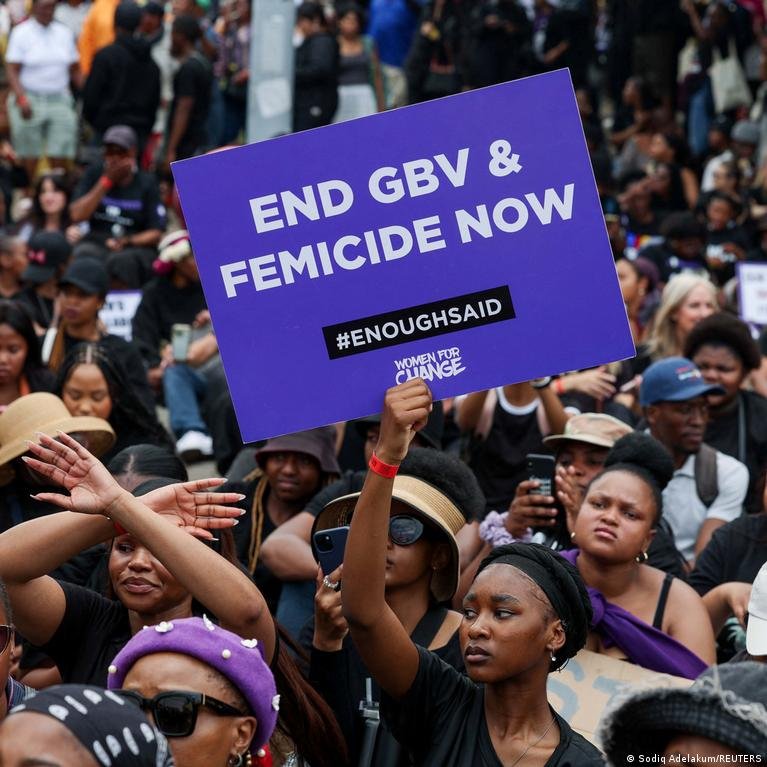
South Africa’s government has previously faced strong public pressure over the issue. In November 2025, hundreds of women protested in Johannesburg ahead of the G20 summit, demanding greater action against gender-based violence. President Cyril Ramaphosa subsequently described gender-based violence and femicide as a national crisis.
Campaigners have continued to argue that declarations alone are not enough and that stronger implementation, resources and accountability are needed.
The latest cases have also raised questions about whether the deaths could be connected. Detectives initially said they were examining the possibility of a serial killer. Police later cautioned against drawing that conclusion.
On Monday, police spokesperson Athlenda Mathe said investigators had not found evidence at that stage establishing that a serial killer was responsible. She also confirmed that a suspect in the July killing of the first woman discovered in Kempton Park was in custody. Police have not established that case as connected to the other deaths.
The distinction is important because investigators are still examining the circumstances surrounding each death. Until evidence establishes a connection, the cases cannot be treated as a single series of crimes.
President Ramaphosa said on Tuesday that he had instructed police authorities to prioritise the ongoing murder investigations. The direction comes as pressure grows on law enforcement agencies to establish what happened to the women and whether any wider pattern exists.
The identities and circumstances surrounding several of the other victims have not yet been fully established publicly. Police investigations are continuing, and authorities have not confirmed the gender of the person or people responsible for the other killings.
The deaths have also prompted calls for men to play a greater role in confronting violence against women and children. Campaigners argue that preventing gender-based violence cannot be achieved solely through measures aimed at women who may become victims.
Bafana Khumalo, co-executive director of Sonke Gender Justice, said men needed to challenge attitudes that allow violence against women to be ignored or treated as someone else’s problem. He argued that men should hold one another accountable and recognise violence against women as a wider social responsibility.
That argument has become increasingly prominent in South Africa’s national conversation about gender-based violence. Women’s rights advocates have frequently said that meaningful change requires addressing perpetrators, social attitudes, institutional failures and the conditions that allow violence to continue.
For Moselakgomo’s friends, the tragedy has a deeply personal dimension. Sakane Mokoena, who met her about two years ago after Moselakgomo joined a running club, described her as a joyful, kind and caring person who often spoke about her daughter.
Moselakgomo had joined the club partly so she would not have to train alone. Friends remembered her as someone who was closely connected to her daughter and whose family responsibilities were central to her life.
Her death has resonated particularly strongly with South Africa’s running community. Running clubs across the country organised events in her memory, turning an individual tragedy into a wider expression of solidarity and concern about women’s safety.
Mokoena said the attention surrounding Moselakgomo’s disappearance and death offered an opportunity to force a broader discussion about what is happening to women in South Africa. She expressed hope that the public response would encourage both the government and police to strengthen efforts to protect women.
The response also highlights a difficult contradiction faced by many women. They are repeatedly advised to avoid isolated areas, exercise in groups, share their locations and remain alert, yet advocates argue that these precautions cannot guarantee safety and should not replace effective policing and prevention.
For authorities, the immediate priority remains establishing the facts of each case. Investigators must identify the victims, determine the circumstances of their deaths, establish whether there are links between cases and identify those responsible where evidence permits.
For campaigners, however, the issue extends beyond these investigations. They want the latest deaths to become another catalyst for action on gender-based violence rather than another moment of public grief followed by limited change.
The concentration of discoveries around Kempton Park and neighbouring areas has intensified anxiety among local residents, particularly women who walk, run or travel through less populated areas. Police warnings may provide immediate safety guidance, but the public debate has made clear that many women expect longer-term measures to address the underlying threat.

South Africa’s continuing struggle with gender-based violence has therefore returned to the national spotlight through the deaths of seven women. Their cases are still being investigated, and authorities have cautioned against conclusions that are not supported by evidence.
But the grief surrounding Moselakgomo and the fear expressed by women across the country have already reopened a broader question: how can South Africa move from recognising gender-based violence as a national crisis to delivering sustained action capable of making women safer?
For friends, families and campaigners, the answer cannot rest solely on asking women to change how they live, work or exercise. The demand increasingly centres on prevention, accountability, effective investigations and a wider social responsibility to confront violence against women.
As police continue their investigations, the deaths have become a painful reminder of why campaigners have continued to press for action. The hope among those mourning Moselakgomo is that her death, and those of the other women, will not simply become another statistic, but will strengthen the determination to address the violence that has caused such widespread fear and grief.
Related News:
 Patriot Platform Raises Concern Across Britain
 Piddington Votes for Symbolic Independence Over Asylum Plan
 Undercover officer deceived women with ‘grotesque and cruel’ lies, spycops inquiry told
 Melania Trump Epstein remarks spark survivor backlash
 NHS Safety Fears as Nurses Cover Doctor Gaps
 Walsall Rapist Jailed After Hate-Filled Online Trail
 Two Children Die in Wolverhampton House Fire Tragedy
 US Labor Department in turmoil after secretary resigns
 Trump DOJ Targets James Comey Again
 Police Suspect Help in Missing Alice Springs Girl Case
 US Charges Sinaloa Governor in Major Cartel Case
 Cartel crackdown raises fears of fresh violence
 US ‘Narco Boat’ Strikes Draw Global Outcry
 Barrister Criticises Trial After Suicide Case Verdict
 Immigration Judges Fear Pressure in Trump Era
 Murder Probe Continues After Arrest Release
 Dreyfus Statue Finally Gets Permanent Paris Home
 Westminster Council Threatens Charing Cross Soup Kitchen
 BBC Warned About Missing Clothes of Murder Victim
 Israeli Strike in Southern Lebanon Kills Seven
 Is America Ready for an AOC Presidential Run?
 Cambridge Professor Jason Arday Found Dead at Home
 Five Years of Taliban Rule Leave Afghanistan in Crisis
 Ghent Professors Questioned Cofnas Appointment
 RAF Barnham Protests Fuel Tensions in Norfolk Town
 Ukraine Villagers Demand Answers After Deadly Arms Depot Strike
 Masked Protesters Bring Dover Port Traffic to Standstill
 Armed Suspect Attacks Ohio Governor Candidate
 Ministers Condemn Far-Right Unrest in Portsmouth
 Councils spend £125m on illegal children’s care
 Pavlohrad Strike Kills Five, Injures 67
 Reform UK Receives Record £36m Donation From Crypto Billionaire
 Man Arrested in Mississippi Woman’s Death
 Israel Accused of Undermining Palestinian Life
 Election Candidate Abuse Raises Alarm in England
 Fugitive Developer Rants at NSW Corruption Inquiry
 Slave-Trade Wealth Embedded in Britain’s Financial System
 New Evidence Deepens Church of England Slavery Reckoning
 Lisa Nandy Calls for Tougher Action on Social Media Doxxing
 Tasers Introduced in UK Prisons to Combat Rising Violence and Protect Staff
 Mass Arrests in London as Protest Defies Ban on Palestine Action
 Urgent Action Needed on Windrush Compensation as Survivors Speak of “Waiting to Die”
 Zarah Sultana Seeks Legal Action After Bitter Clash with Jeremy Corbyn Over Party Membership Funds
 Channel Crossings Surge: Over 1,000 People Arrive in the UK in Small Boats in a Single Day
 Kosovo agrees to host Britain’s refused asylum seekers
 FBI Director Kash Patel Defends Girlfriend Amid Government Jet Claims
 French Taxi Driver Cleared in David Lammy Theft Case After Fare Dispute
 ‘Reckless’ cuts to victims’ services will cost more than they save
 Indian authorities demolish Kashmir home linked to Red Fort blast
 Greene Pushes Epstein Files Amid Trump Fallout
 Venezuela Threatens Nobel Winner Machado with Fugitive Status
 Most Tories Expect to Support a Farage-Led Government
 Jordan Bardella: France’s Young Presidential Contender
 ‘It’s a Complete Scandal’: Aristocrat’s Fight for Prison Children
 Teen Admits Filming Westfield Chair Prank
 Fugitive Dezi Freeman Killed in Rural Victoria Shootout
 M&S Demands Urgent Action on Rising Violent Retail Crime
 Ben Roberts-Smith Denies War Crime Allegations in First Statement
 Kezia Dugdale Warns of Possible Reversal of Equal Rights Gains
 China Fireworks Factory Blast Kills 21 in Hunan
 Florida Surgeon ‘Devastated’ Over Fatal Surgery Error
 DeSantis’s ‘Alligator Alcatraz’ Faces Final Shutdown
 Farage and Reform UK Reshape British Politics
 Starmer Leadership Under Pressure After Setbacks
 Trump’s Mount Rushmore Speech: A Divisive Anniversary
 New Footage Revives Peter Falconio Mystery
 Ukraine Creates Long-Range Strike Command
 Le Pen’s Popularity Holds Despite Conviction
 Burnham unveils £65m drought aid for farmers
 British Museum Faces Questions Over Peter Thiel’s Private Bayeux Viewing
 Internal Exclusions Surge in England’s Schools
 Trump Calls Iran War ‘Small Potatoes’ Despite US Deaths
 Typhoon Saudel Triggers Mass Evacuations in China
 Europe’s democracies face a growing far-right threat
 New Mexico Takes Facebook to Trial Over Data Scandal
 Royal Crown Branded Enslaved Africans in Britain’s Slave Trade
 Australia’s Indigenous Population Was Far Larger Before Colonisation
 UK Pay Growth Slows to 3.9% as Rate Decision Nears
 Bank Urged to Slow Bond Sales as UK Costs Rise