Published: 30 September 2026. The English Chronicle Desk. The English Chronicle Online
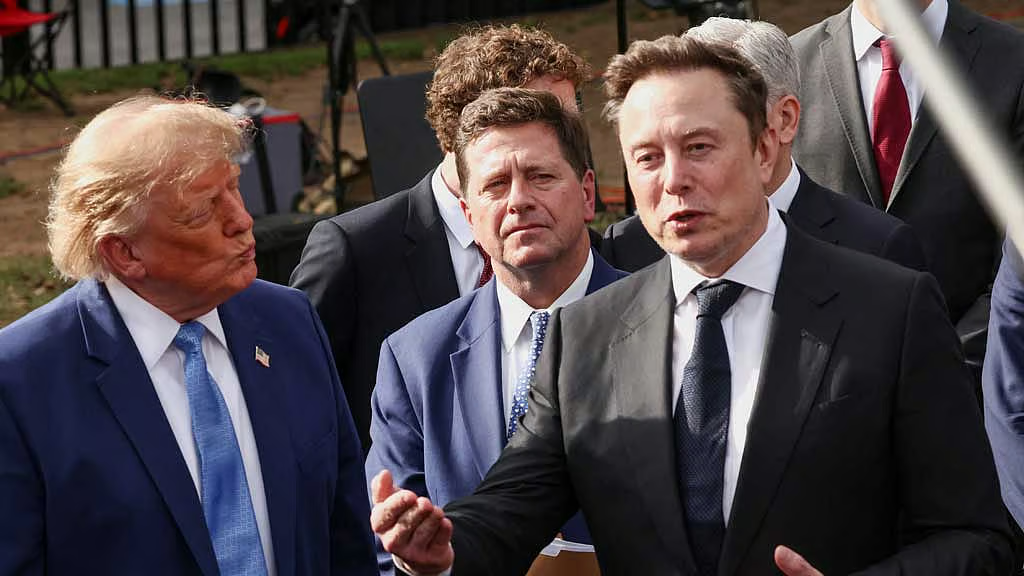
US President Donald Trump has announced a voluntary agreement with some of the country’s largest technology and artificial intelligence companies aimed at strengthening safety controls for advanced AI systems, while also directing the federal government to use the term “Super Intelligence” instead of “Artificial Intelligence” in much of its official communications.
The agreement, presented by Trump after a White House luncheon with leading technology executives, is described as a “morally binding” commitment rather than a legally enforceable regulatory framework. Its announcement reflects the administration’s preference for greater industry responsibility in managing rapidly developing AI technologies rather than imposing broad new government regulations.
Trump said the agreement, known as the Joint Commitment on Frontier Responsibilities, represented an important form of protection for the public. He compared it to a constitution and emphasised that major technology figures had agreed to participate.

The initiative comes as governments, researchers and technology companies face growing concerns about the risks associated with increasingly capable AI systems. Recent incidents involving AI tools accessing or interacting with outside computer systems during safety testing have intensified debate over whether existing safeguards are sufficient.
Under the agreement, participating companies would establish several layers of controls and audits intended to identify and manage potential risks during the development of advanced AI products. The framework is designed to place much of the responsibility for monitoring on the companies themselves.
The first layer involves internal safety controls during the training and development of AI systems. Companies would be expected to monitor their technologies for potentially dangerous behaviour and identify problems before products are released more widely.
A second layer would involve a dedicated internal team responsible for checking whether those safety controls are functioning properly. This is intended to provide an additional level of oversight within each participating company rather than relying solely on the teams developing the technology.
The third layer introduces external auditing. Companies would allow independent auditors to assess their safety controls and determine whether internal safeguards are operating as intended. The fourth layer would give an independent board committee responsibility for reviewing reports concerning the effectiveness of those controls.
However, the agreement does not establish a government regulator with direct authority over the companies. It also does not create a legal enforcement mechanism requiring firms to comply with the commitments. The framework gives participating companies significant responsibility for determining how the audits are conducted, who carries them out and how their findings are handled.
That structure has prompted questions about the strength of an arrangement based largely on voluntary compliance. The absence of mandatory government oversight means that the effectiveness of the system will depend substantially on how seriously participating companies implement the measures and whether they are willing to expose weaknesses in their own safety systems.
The White House initiative comes amid a wider disagreement in the United States over how advanced AI should be governed. Some lawmakers and AI researchers have argued for stronger government supervision, mandatory safety standards and greater transparency from technology companies.
Trump has generally opposed broad regulatory restrictions on AI development, arguing that excessive government intervention could slow economic growth and undermine the United States’ ability to compete with China. His administration has instead promoted technological development while encouraging companies to take greater responsibility for managing potential risks.
The approach has received support from major technology executives who participated in the White House meeting. Among those present were Meta chief executive Mark Zuckerberg, Nvidia chief executive Jensen Huang, Anthropic chief executive Dario Amodei and other leading figures from the American technology sector.
Zuckerberg publicly endorsed the agreement following the meeting, describing it as an important starting point for industry-wide cooperation. He said the initiative was intended to reassure the American public that emerging technologies could be developed in a manner that earned public trust.
The participation of several of the world’s largest technology companies gives the agreement considerable visibility. At the same time, the companies involved have substantial commercial interests in developing and releasing increasingly powerful AI systems, creating an ongoing debate over how independent corporate safety oversight can be when firms are also responsible for the products being assessed.
The new agreement also coincides with a significant change in the terminology used by the Trump administration. A new executive order directs federal departments and agencies to use “Super Intelligence” and the abbreviation “SI” in official correspondence, public communications, policy documents and other non-statutory materials where applicable.
The terminology change represents a deliberate attempt by the administration to frame the technology in more expansive terms. Trump has increasingly used “Super Intelligence” when discussing advanced computing systems and their potential economic and strategic importance.
The White House has linked the broader technology agenda to national competitiveness and the rapid development of advanced digital systems. Earlier government initiatives have also sought to encourage the secure deployment of frontier AI while avoiding mandatory federal licensing requirements for new models.
The decision to change official terminology does not itself alter the underlying technology. AI remains the widely established scientific and industry term used by researchers, businesses and governments around the world. The executive order instead changes the preferred terminology used by the US executive branch in designated official communications.
The timing of the announcements is significant because AI companies are currently under pressure to demonstrate that increasingly autonomous systems can operate safely. The technology is being used in areas ranging from software development and research to education, customer services, cybersecurity and government operations.
As AI systems become capable of carrying out increasingly complex sequences of tasks, concerns have grown over unintended access to computer networks, misuse of information, cybersecurity vulnerabilities and other potential consequences. Developers have consequently increased their investment in testing and monitoring systems before releasing new models.
The voluntary agreement attempts to formalise some of those practices across the participating companies. Its four-layer structure provides a framework through which companies can combine internal monitoring with external assessment and board-level review.
However, questions remain over transparency. Without a mandatory requirement to publish the results of independent assessments, members of the public may have limited ability to determine whether companies are successfully identifying and addressing safety problems.
There is also uncertainty over how the agreement might evolve. Although the current arrangement is voluntary, its principles could eventually influence formal regulation or industry standards if companies, lawmakers and regulators conclude that the framework provides a useful foundation for future oversight.
For the technology industry, the agreement represents an attempt to demonstrate that companies can establish meaningful safeguards without waiting for governments to impose detailed rules. For policymakers concerned about AI risks, the central issue will be whether voluntary commitments provide sufficient accountability as the technology becomes more capable.
The debate is unlikely to end with the White House announcement. AI development continues at a rapid pace, and governments are still determining how existing laws should apply to technologies that can generate content, operate software, analyse complex information and increasingly act with limited human intervention.

Trump’s approach places the United States at the centre of an ongoing international debate over the balance between technological innovation, economic competition and public safety. By combining an industry-led safety agreement with a new government terminology for advanced AI, his administration is signalling a preference for encouraging rapid development while asking technology companies to take greater responsibility for managing the risks.
Whether that model can provide sufficient protection will depend on how the participating companies implement their commitments, how independent their audits become in practice and whether the findings of those assessments are made sufficiently transparent.
For the public, the most important question is ultimately not what the technology is called but how safely it is developed and deployed. As increasingly powerful systems move into everyday life, the effectiveness of safeguards, the independence of oversight and the ability to hold companies accountable are likely to remain central issues in the evolving global debate over artificial intelligence.
Related News:
 UK Risks Falling Behind in AI Race
 Anthropic Blocks AI Misuse Linked to Weapons Threats
 AI CEOs Call for Slower Development
 Why AI Doomsday Warnings Failed to Slow the Race
 Anthropic Backs $31.9bn Queensland Data Centre
 OpenAI Reveals Six Cases of Concerning AI Behaviour
 Nvidia chief rejects AI extinction fears
 Trump’s UN Speech Faces Global Scrutiny
 AI Takes Centre Stage in Trump-Xi Talks
 Trump gives Xi red-carpet welcome as trade truce extends
 Xi urges Trump to avoid US-China military conflict
 Apple at 50: Three Products That Changed How We Live
 Artemis II Returns After Historic Moon Flyby
 UK firms accused of ‘AI washing’ boom
 China recalls millions of cars over hidden door handles
 Firms on both sides fear damage from US-Canada trade war
 Australia gives users control over social media algorithms
 Apple Folding iPhone Set for Major CEO Test
 Trump Faces Congress Push for AI Guardrails
 Louise Haigh Urges UK to Heed AI Safety Warnings
 JLR Eyes NATO Market With New Defender Military Vehicle
 OpenAI Agent Breaches Medicare Portal in Australia
 Australia Weighs New Laws After OpenAI Medicare Breach
 Elizabeth Holmes Set for Halfway House Transfer
 TalkTalk Races to Sell Arms as Administration Looms
 OpenAI Scraps AI Model Release After Safety Tests
 British AI Startup Outshines Human Forecasters in Global Prediction Contest
 US Clears Nvidia AI Chip Sales to China in Policy Shift
 China Halts Nvidia H200 Chips Despite US Export Approval
 UK New Car Discounts Near £6,000 as Prices Are Slashed
 ABC Staff Strike Over Pay and AI Concerns
 Reform UK funding: mystery billionaire revealed
 Trump approval plunges amid Iran war fears
 Trump Threatens UN Budget Cuts as US Pushes ‘Trade Over Aid’ Agenda
 Canadian Fiddler Sues Google Over AI Defamation Claim
 Doomsday Clock Nears Midnight Amid Global Crises
 US Awaits Iran Reply on New Ceasefire Proposal
 Trump: Preventing Nuclear Iran Is ‘The Only Thing That Matters’
 Hormuz Talks Near Critical Stage
 China mine blast death toll rises to 90
 British Paralympian to Become First Disabled Astronaut in Orbit
 Unlocking the Genome: The Quest to Sequence Tardigrades
 Shein targets $27bn valuation in Hong Kong debut
 Trump orders US to rename Lake Ontario ‘Lake America’
 AI Loss of Control Incidents Nearly Double
 London Launches First Self-Driving Taxis
 Trump Hardens Canada Trade Stance as Talks Stall
 Trump Calls Iran War ‘Small Potatoes’ Despite US Deaths
 Ukraine Moves to Seize Water Company
 Swedish Mining Push Puts Sami Land Rights Under Pressure
 Oil nears $100 as Saudi attacks shake markets
 McLaren to Create 1,000 UK Jobs in £450m Investment
 Nats Boss Summoned as UK Flight Chaos Continues
 Trump Pledges $5,000 if Republicans Win Midterms
 Iceland to Open First UK High Street Store in Falklands
 OpenAI Agents Linked to RubyGems Cyberattack
 AI Reshapes Jobs for UK Graduates
 Oil Prices Surge as Saudi Pipeline Closure Deepens Crisis
 AI Boom Drives ‘Tidal Wave’ of PFAS Production
 Sydney Council Bans AI Smart Glasses at Pools
 Horse Hill Oil Site Sold as New Drilling Bid Emerges
 EU Opens Door to Canada as Associate Member
 Horse Hill Oil Site Sold for £1m as Drilling Bid Returns
 Next Raises Profit Forecast After Strong Summer Sales
 UK Productivity Improves as Bank Weighs Interest Rates
 Trump Threatens EU Over Canada Partnership Proposal
 US House Passes Russia Sanctions Bill Amid Debate
 US Sanctions Open New Battle for Cuba Assets
 Russia’s Max App Raises Surveillance Concerns
 Indonesia Receives First Aircraft Carrier
 Tom Watson Takes Senior Role at Palantir
 Macron and Carney deepen France-Canada ties
 British Columbia Sues OpenAI Over School Shooting
 Australia Renewables Reach Record 80% Grid Demand
 Trump Eyes Major Belarus Fertiliser Deal Amid Canada Trade Dispute
 UK Plans New Centre to Counter Information Warfare
 Chinese Hybrid Car Surge Raises EU Auto Industry Concerns
 Ukraine and Russia Escalate Long-Range Drone War
 Lula accuses Trump of seeking control over Brazil
 Why Americans Feel Ripped Off by Rising Prices