Published: 28 August 2026. The English Chronicle Desk. The English Chronicle Online
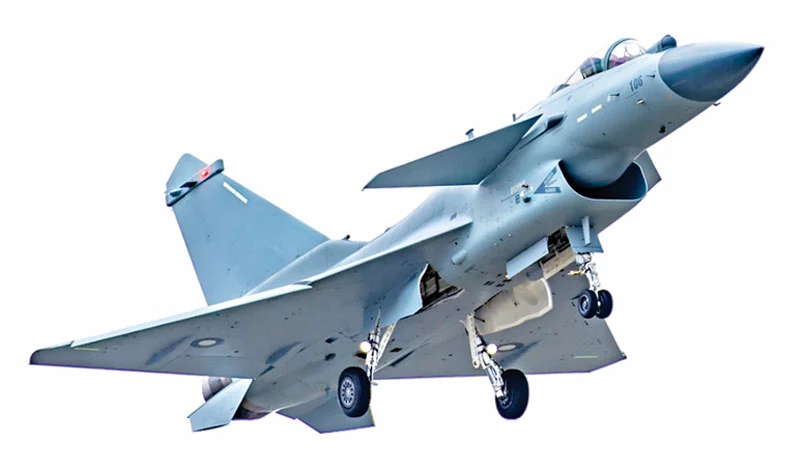
Bangladesh is moving ahead with one of its most significant military modernisation programmes in years, advancing plans to acquire Chinese J-10CE multirole fighter jets and attack helicopters while also pursuing the Eurofighter Typhoon as part of a broader effort to strengthen the country’s air power.
The developments are attracting attention in India, where defence analysts are watching closely as Bangladesh expands its access to modern combat aircraft and broadens its defence relationships beyond its traditional suppliers.
Bangladesh’s Prime Minister’s Information and Broadcasting Adviser Zahed Ur Rahman said this week that a draft agreement had been prepared for the procurement of Chinese-made J-10CE fighters and attack helicopters. The proposed modernisation package also includes VIP helicopters and unmanned aerial vehicle systems, with the government hoping to proceed during the current financial year if funding is available.
The J-10CE plan is particularly significant because it would introduce a modern multirole combat aircraft into a Bangladesh Air Force fleet that still relies heavily on older Chinese-origin fighters.

At the same time, Bangladesh has already signed a Letter of Intent with Italy’s Leonardo for the Eurofighter Typhoon. The agreement was signed in December 2025 and was described by Bangladesh’s Inter-Services Public Relations directorate as a step towards introducing modern multirole combat aircraft into the country’s frontline fleet. The number and precise configuration of Typhoons have not been publicly specified.
Together, the moves suggest that Dhaka is considering a substantial transformation of its air-force structure rather than simply replacing individual ageing aircraft.
Why Bangladesh is looking to modernise
The Bangladesh Air Force has long operated a mixture of Chinese and Russian-origin platforms, but much of its combat fleet consists of aircraft that are approaching or have already passed the period in which modern air forces would normally seek replacement.
The J-10CE offers Bangladesh a relatively modern fourth-generation-plus multirole fighter with advanced radar, weapons and electronic systems.
The government has also openly pointed to the recent India-Pakistan conflict as one factor influencing its interest in the Chinese fighter.
Zahed Ur Rahman cited the reported performance of Chinese J-10 aircraft during the conflict and argued that the aircraft offered a potentially lower-cost alternative to Western fighters such as the Rafale and Eurofighter Typhoon. His comments reflect a wider shift in how Dhaka is assessing the balance between acquisition cost and combat capability.
The comments have generated considerable attention because the J-10CE is operated by Pakistan and has become an important part of discussions about the effectiveness of Chinese military technology.
However, claims surrounding specific combat results during the India-Pakistan conflict remain politically sensitive and should not automatically be treated as definitive evidence of the aircraft’s superiority over Western systems.
For Bangladesh, the more important consideration may be that the conflict provided a real-world demonstration of a modern Chinese combat aircraft being employed in a high-intensity regional confrontation.
The Eurofighter dimension
Bangladesh’s interest in the Eurofighter adds another layer to the modernisation programme.
The Typhoon is a sophisticated European multirole combat aircraft operated by several NATO and European air forces. Bangladesh’s Letter of Intent with Leonardo does not by itself constitute a completed purchase contract, and the government has not publicly disclosed the number of aircraft it intends to acquire.
Nevertheless, the agreement is strategically important.
The combination of interest in the J-10CE and the Typhoon would give Bangladesh access to two very different defence ecosystems.
A Chinese fighter fleet would deepen Dhaka’s already extensive military relationship with Beijing, while the Eurofighter programme could provide a connection to European aerospace technology and defence industries.
That diversification could offer Bangladesh greater flexibility in future procurement.
It could also create significant logistical and training challenges.
Operating aircraft from different technological ecosystems requires separate maintenance arrangements, weapons integration, pilot training programmes, spare-parts pipelines and technical expertise.
For a country with a comparatively modest defence budget, sustaining a mixed fleet of sophisticated aircraft could become a substantial long-term undertaking.
Why India is watching
Bangladesh and India share a long border, extensive economic links and deep historical connections. Their relationship has also traditionally involved substantial cooperation in security, trade, transport and regional connectivity.
Dhaka’s military modernisation does not automatically indicate preparation for confrontation with India.
Bangladesh has legitimate reasons to strengthen its air-defence and air-surveillance capabilities, including protection of its airspace, maritime interests and national infrastructure.
Nevertheless, modern fighter acquisitions inevitably have regional consequences.
If Bangladesh introduces a sizeable fleet of J-10CE fighters alongside other advanced aircraft, its ability to conduct beyond-visual-range air operations, maritime patrol support and integrated air defence could improve significantly.
India has a much larger and more technologically diverse air force, including Rafale, Su-30MKI, Tejas and other combat aircraft. It also possesses substantially greater strategic depth, infrastructure and defence resources.
Therefore, even a major Bangladesh acquisition would not suddenly overturn the conventional military balance between the two countries.
The more important issue is the gradual improvement in Bangladesh’s ability to defend its airspace and impose greater costs on any potential adversary.
That could alter strategic calculations in the Bay of Bengal and eastern South Asia over time.
China’s expanding defence relationship with Dhaka
China is already Bangladesh’s largest source of military equipment, supplying combat aircraft, naval vessels, tanks, missile systems and other platforms over several decades.
The J-10CE programme would deepen that relationship.
For Beijing, Bangladesh occupies an important geographical position between South Asia and Southeast Asia, with access to the Bay of Bengal and proximity to India.
China’s relationship with Bangladesh therefore extends beyond weapons sales.
Infrastructure investment, trade, technology cooperation and defence ties have all contributed to a broader strategic relationship.
For Dhaka, meanwhile, Chinese equipment has often been attractive because of its comparatively competitive cost and the willingness of Beijing to provide military hardware without the same political conditions sometimes associated with Western suppliers.
That does not necessarily mean Bangladesh is choosing China over every other partner.
The simultaneous interest in the Eurofighter demonstrates that Dhaka may instead be attempting to maintain multiple defence relationships.
The Turkish factor
Turkey is another country increasingly relevant to Bangladesh’s defence ambitions.
Dhaka has shown interest in expanding military cooperation with Ankara, particularly in areas involving defence technology, unmanned systems and helicopters.
However, claims that Bangladesh has already decided to purchase Turkish attack helicopters should be treated cautiously.
The latest confirmed government statements describe an ongoing procurement process for attack helicopters without publicly identifying a final Turkish platform or announcing a completed Turkish helicopter contract.
That distinction is important because defence procurement can take years between preliminary interest, negotiations, letters of intent, contracts and actual deliveries.
Nevertheless, greater Turkish involvement would further diversify Bangladesh’s defence partnerships and reduce dependence on a single supplier.
Could this change South Asia’s power balance?
The answer depends on what Bangladesh ultimately buys and, perhaps more importantly, what supporting systems accompany the aircraft.
Modern air power is not determined simply by the number of fighter jets.
A credible air force requires pilot training, airborne early-warning systems, ground-based air defence, electronic warfare, secure communications, intelligence and surveillance capabilities, maintenance infrastructure, precision weapons and sufficient stocks of spare parts and ammunition.
The J-10CE, for example, becomes considerably more capable when integrated into a wider network involving modern radar, command-and-control systems and long-range air-to-air missiles.
The same principle applies to the Eurofighter.
If Bangladesh successfully develops an integrated network around its new aircraft, its air force could become substantially more capable than its current fleet figures alone would suggest.
That would not make Bangladesh a peer competitor to India.
India’s defence-industrial base, military budget, aircraft numbers, missile capabilities, naval strength and strategic assets remain on an entirely different scale.
But Bangladesh could become a more capable regional military actor.
That distinction matters.
A new strategic environment
Bangladesh’s air-force modernisation is also taking place during a period of wider geopolitical change.
Relations between Dhaka and New Delhi have become more complicated, while Bangladesh is simultaneously strengthening links with China, Turkey and other international partners.
Reuters has reported that Bangladesh is also considering whether to participate in a new defence arrangement involving Saudi Arabia, Turkey and Pakistan, a development that analysts say could test Dhaka’s longstanding policy of avoiding formal alignment with competing geopolitical blocs.
If Bangladesh were to combine deeper defence cooperation with China and Turkey with stronger relations with Pakistan and other external powers, India would inevitably examine the implications.
At the same time, Dhaka has strong economic reasons to avoid becoming locked into an overtly anti-Indian or anti-Western military alignment.
Bangladesh’s economy depends heavily on international trade, particularly exports to Europe, Britain and the United States, while millions of Bangladeshi workers in the Middle East contribute substantial remittances.
This makes strategic balancing important.

Modernisation rather than confrontation
The most significant point about Bangladesh’s emerging air-force programme may therefore be that it represents modernisation rather than an immediate attempt to challenge India.
The country’s current fleet requires replacement and upgrading, and Dhaka is seeking aircraft capable of operating in a substantially more advanced technological environment.
The J-10CE offers one route.
The Eurofighter offers another.
Attack helicopters, UAVs and other surveillance systems could provide additional capabilities.
Whether these plans become a fully integrated force will depend on financing, contracts, delivery schedules, training and infrastructure.
The cost will also be considerable.
Buying advanced aircraft is only the beginning. Bangladesh would have to maintain them for decades, train pilots and technicians, establish weapons stocks and build the command-and-control architecture needed to exploit their capabilities.
What India could face in the future
For India, the immediate military threat from Bangladesh’s planned purchases is limited.
But New Delhi is likely to pay close attention to the long-term trajectory.
A Bangladesh Air Force equipped with modern Chinese fighters, potentially complemented by European aircraft, Turkish defence technology and sophisticated unmanned systems would be a significantly different force from the one India has dealt with historically.
The biggest change would not necessarily be the raw number of aircraft.
It would be the improvement in Bangladesh’s ability to detect, track and respond to threats across its airspace.
That could affect Indian planning along the eastern frontier and in the Bay of Bengal.
It could also encourage India to strengthen its own air infrastructure and surveillance capabilities in the northeast and eastern regions.
In that sense, Bangladesh’s modernisation could contribute to a gradual shift in the regional security equation without fundamentally overturning the balance of power.
For Dhaka, the challenge will be maintaining strategic autonomy while managing the cost and complexity of a modern air force.
For New Delhi, the challenge will be responding without turning legitimate Bangladeshi defence modernisation into a self-fulfilling regional arms competition.
For South Asia as a whole, the developments demonstrate how defence procurement is increasingly connected to the wider competition among China, India, Turkey, Europe and other powers.
Bangladesh’s choices over the next several years could therefore become an important indicator of the region’s evolving strategic landscape.
Related News:
 North Korea Fires Missiles Amid US-South Korea Drills
 Discontent grows around Putin amid war strain
 Nepal-Tibet Flood Leaves 270 Dead and 1,400 Missing
 Nine Killed in Karachi Consulate Protest
 UK Prepares Aircraft Carrier for Middle East Crisis
 Anti-Regime Iranians Turn Anger Toward Trump
 Russia Drone Attack Intensifies Ukraine War Pressure
 China’s Secret Mountain Ruins Rise Again in New Cold War
 ‘The frontline is like Terminator’: Ukraine’s fighting robots
 Cyclone Vaianu Forces Mass Evacuations in New Zealand
 Is Britain Ready? Experts Warn of ‘Bizarre’ Military Delay
 Robots Outpace Humans in Beijing Half-Marathon
 MoD Has Lost Track of Veteran Recall List, Says Adviser
 RAF Typhoons scrambled amid Russian drone threat near Nato
 Southeast Asia Turns to Russia Amid Energy Crisis
 Escobar’s Hippos May Be Moved to India Zoo
 USS Gerald R Ford Ends Record Naval Deployment
 Trump orders US troop pullout from Germany
 Ukraine strikes Tuapse as oil disaster worsens
 Trump likens US Navy actions to ‘pirates’
 North Korean Women’s Football Club to Visit Seoul in Rare Cross-Border Trip
 China Fireworks Factory Blast Kills 21 in Hunan
 Australia pushes Pacific security pact amid China tension
 BJP Sweeps West Bengal in Historic Breakthrough
 US Awaits Iran Reply on New Ceasefire Proposal
 One Nation Stuns Australia With Historic Farrer Win
 Putin Declares Russia Victory at Scaled Victory Day Parade
 Hormuz Talks Near Critical Stage
 China mine blast death toll rises to 90
 Maldives Cave Diving Tragedy Raises Safety Alarm
 Zelenskyy warns over Oreshnik threat as Kyiv hit
 Thailand Tightens Visa Rules to Curb Tourist Misbehavior
 Russian Frigate Fires Warning Shots Near British Yacht
 Starmer Faces Fierce Backlash From Senior Defence Figures
 Trump Questions Future of US Role in Nato Alliance
 Infrastructure Cuts to Cost 10,000 UK Jobs
 Millions Gather for Khamenei’s Six-Day State Funeral
 Starmer Faces Nato Heat on Spending
 China’s Pacific Missile Test Sparks Regional Concern
 Venezuela Quake Death Toll Surpasses 4,000
 Houthis Strike Saudi Arabia as Middle East Tensions Rise
 Pradhan Resigns Amid Protests
 Taliban global ties grow as rights fears mount
 Seoul proposes historic peace talks to replace Korean War armistice
 Powerful 7.7-Magnitude Earthquake Hits Eastern Indonesia
 Israeli Strike in Southern Lebanon Kills Seven
 Five Years of Taliban Rule Leave Afghanistan in Crisis
 Trump dismisses concerns over 250-day carrier deployment
 Russian Missiles Intensify Pressure on Kyiv
 Vietnam Youth Rally Behind Hanoi ‘Justice Tree’
 China Probes Alleged Formaldehyde Use on Cabbages
 Shein targets $27bn valuation in Hong Kong debut
 China recalls millions of cars over hidden door handles
 Heavy Casualties Feared as Flash Flood Sweeps Nepal-Tibet Border
 Four Bodies Found as Jeju Missing Persons Scandal Deepens
 Australia Races to Find Tourists Missing in Nepal
 Nepal Flood Death Toll Tops 300 as Second Flood Feared
 Yayoi Kusama, Iconic Polka Dot Artist, Dies at 97
 Families Fly to Nepal in Search of 33 Missing Britons