Published: 17 September 2026. The English Chronicle Desk. The English Chronicle Online
The Conservatives are stepping up pressure on Chancellor John Healey to rule out tax increases ahead of the UK government’s autumn Budget, as economic policy moves higher up the political agenda in Westminster.
The Conservative challenge comes less than six weeks before the Budget, which the government has confirmed will take place on 28 October 2026. Healey, who became Chancellor of the Exchequer in July, has said the Budget will be based on fiscal discipline and will meet the government’s fiscal rules.
Andrew Griffith, the newly appointed Conservative shadow chancellor, is using his first major economic speech in the role to argue that uncertainty over future taxation is affecting businesses and taxpayers. The Conservatives are calling on the government to provide greater clarity over whether taxes will rise in the upcoming Budget.
Griffith has argued publicly that concerns about future taxation could influence decisions by businesses and wealthy taxpayers. He has also urged ministers to remove what he describes as uncertainty facing small businesses and self-employed people.

The Conservative Party has made economic policy a central part of its opposition strategy as it seeks to challenge the Labour government’s approach ahead of the next general election. Griffith was appointed shadow chancellor as part of Conservative leader Kemi Badenoch’s wider reshuffle of the shadow cabinet earlier this month. The party said he would lead a new economic unit alongside the shadow business secretary and shadow chief secretary to the Treasury.
Griffith’s speech is expected to focus particularly on small businesses and regulation. He has also appointed Conservative peer Craig Mackinlay and Robert Colvile, the outgoing director of the Centre for Policy Studies, as advisers to examine ways of reducing regulatory burdens on businesses.
The Conservatives’ immediate demand for a commitment against tax rises comes as the government prepares its first full Budget under Healey. The Chancellor’s official announcement confirmed that the 28 October Budget would be intended to provide greater stability for households and businesses while maintaining compliance with the government’s fiscal rules.
The government has not committed to ruling out all tax increases. As a result, the question of taxation is likely to remain a major point of political disagreement in the weeks leading up to the Budget.
The wider economic backdrop is also significant. The Bank of England’s Monetary Policy Committee is scheduled to announce its September decision on interest rates on 17 September. The Bank’s previous decision, in July, kept Bank Rate at 3.75%, with six members voting to maintain the rate and three voting for an increase to 4%. At that meeting, the Bank noted continuing uncertainty surrounding energy prices and expected inflationary pressures.
The September monetary-policy decision is taking place at the same time as political debate intensifies over the government’s fiscal plans. Interest-rate decisions are made independently by the Bank’s Monetary Policy Committee, while taxation and government spending are matters for the elected government and Parliament.
The relationship between the two is nevertheless important for households and businesses. Interest rates affect borrowing costs, while tax policy influences disposable income, business costs and government revenues. Inflation and employment conditions can also affect the government’s room for manoeuvre.
The Conservatives are seeking to link those economic pressures to their argument that businesses need certainty about future taxation. Their position is that the government should provide reassurance before companies make investment and employment decisions.
The government has instead emphasised fiscal discipline and economic stability. When the Budget date was announced, the Treasury said the Budget would meet the government’s fiscal rules and provide businesses and families with stability to plan for the future.
Another issue attracting political attention is the appointment of Paul Nowak, general secretary of the Trades Union Congress, as a non-executive director of the Bank of England’s Court of Directors.
The appointment was formally announced by HM Treasury on 16 September. Nowak is one of three new non-executive directors appointed to the Bank’s Court, alongside David Craig and Hanneke Smits. Craig and Nowak have four-year terms, while Smits will begin her term in January 2027.
The appointment has been used by Conservative figures as part of a wider argument about the Labour government’s relationship with organised labour. However, the institutional role of the Court needs to be distinguished from the Bank’s monetary-policy functions.
The Bank of England’s Court acts as its board and is responsible for matters including the Bank’s strategy, governance, budget and risk framework. Interest-rate decisions are instead taken by the independent Monetary Policy Committee. The government’s official announcement specifically describes the Court as responsible for oversight of the Bank’s administration rather than setting interest rates.
There is also historical context to the appointment. Nowak has succeeded Frances O’Grady, the former TUC general secretary, as a non-executive director. The succession means that a representative with senior trade-union experience continues to have a place on the Bank’s Court.
The Conservative criticism therefore forms part of a wider political argument over the government’s economic direction rather than representing a change to the Bank’s monetary-policy structure.
The coming Budget is likely to provide the more important test of competing economic approaches. Until 28 October, however, the precise combination of tax measures, spending decisions and other fiscal policies remains uncertain.
For the Conservatives, the immediate objective is to make taxation and business conditions central themes of the political debate. Their argument is that businesses and households need clarity before making financial decisions.
For Labour ministers, the challenge is to balance competing pressures on public finances with commitments on public services, investment and economic growth. The government’s decision to emphasise fiscal rules in announcing the Budget indicates that the management of public finances will be a central part of its presentation.
Small businesses are likely to feature prominently in that discussion. They face a range of costs beyond taxation, including wages, energy, borrowing and regulatory compliance. The Conservatives’ decision to commission a report on cutting red tape reflects their intention to focus on those wider pressures as well as the tax system.
The political debate is also unfolding against changing economic conditions. The Bank of England has previously highlighted uncertainty around inflation, energy prices and economic activity. Its September decision and accompanying assessment will provide further information about how policymakers view those risks, although monetary policy and fiscal policy remain separate areas of responsibility.

For households, the significance of the Budget will ultimately depend on the measures announced and how they affect incomes, costs and public services. For businesses, the implications will include taxation, regulation, investment incentives and the broader economic environment.
The Conservatives’ demand for a promise against tax rises therefore sets up a clear political argument ahead of the Budget, but it does not establish what measures the government will ultimately announce. The Chancellor has not provided a comprehensive commitment ruling out all tax increases.
As Westminster turns towards 28 October, economic policy is likely to remain at the centre of political debate. The Conservatives are seeking to frame the discussion around taxation, regulation and business confidence, while the government has emphasised fiscal discipline and stability. The Bank of England’s independent decisions on interest rates add another important dimension to the economic environment in which the Budget will be delivered.
The next major point of clarity will come with the Budget itself, when the government sets out its taxation and spending decisions and Parliament begins the process of scrutinising them. Until then, claims about future tax measures remain political arguments rather than confirmed policy.
Related News:
 BBC News Faces Deep Cuts in 2,000 Job Plan
 Reeves Fights to Keep Treasury Role Amid Labour Turmoil
 Burnham Faces Mounting Budget Challenges
 Reform Faces Questions Over £72m Donations
 Farage Threatens Union Funding Ban Over Reform Donations
 North Sea Firms Urge Early End to Windfall Tax
 UK Pay Growth Slows to 3.9% as Rate Decision Nears
 Bank Urged to Slow Bond Sales as UK Costs Rise
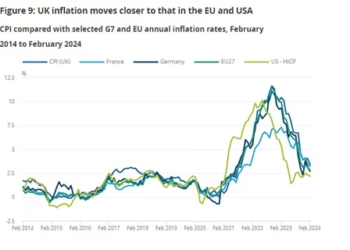 UK Inflation Hits 3.1% as Household Pressure Grows
 UK Youth Jobs Gap Reveals Deep Regional Divide
 Entain Plans 400 Job Cuts After Profit Update
 David Lammy Faces Possible Legal Challenge Over Foreign Office Secondment Scheme
 Lucy Powell urged ministers to reconsider costly legal case for Labour donor’s firm
 Tories Push to Dilute Labour’s Workers’ Rights Bill
 Wealthy Britons Flee Gulf War but Avoid UK Taxes
 UK Wage Growth Slows as Jobs Market Holds Firm
 UK Doubles Steel Tariffs to 50% to Protect Domestic Plants
 New UK advice scheme to boost savings and investing
 City & Guilds Faces Governance Crisis Over Sale
 UK Pushes for New EU Goods Trade Deal
 UK rejects EV charging VAT cut amid Treasury clash
 Labour MPs Urge Burnham to Revive UK Aid Target
 Trump Refuses to Sign Housing Bill, But Law Takes Effect
 Unions Warn Labour Over Zero-Hours Contract Reforms
 UK Households Could Save £173 on Fixed Energy Deals
 Reform Faces Fresh Financial Controversy
 UK Cost Squeeze Deepens as Mortgages and Gas Rise
 Spire Healthcare Agrees £1bn Takeover by Toscafund
 UK House Prices Fall as Mortgage Rates Rise
 UK plans tougher Israel stance with settlement trade ban
 Oil nears $100 as Saudi attacks shake markets
 John Lewis Losses Widen to £124m as Confidence Falls
 Reform UK Receives Record £36m Donation From Crypto Billionaire
 Thames Water Revises Oxfordshire Mega-Reservoir Plan
 UK Retailers Accused of Breaking Refund Laws
 UK State Pension Set to Rise 3.9% as Triple Lock Holds
 UK Parents Cut School Uniform Costs as Prices Rise
 Fashion Firms Urge UK-Made NHS and Army Uniforms
 JLR Eyes NATO Market With New Defender Military Vehicle
 Slave-Trade Wealth Embedded in Britain’s Financial System
 Mayors Could Gain Greater Powers Over Water Firms
 EU Opens Door to Canada as Associate Member
 Lords Call for Tobacco-Style Gambling Ad Ban
 Next Raises Profit Forecast After Strong Summer Sales
 Chancellor Rachel Reeves Pushes for Sweeping Changes to Environmental Protections to Accelerate Development
 Tanni Grey-Thompson Faces Abuse Over Opposition to Assisted Dying Bill
 Mahmood Pledges Reform of Modern Slavery Laws After Court Blocks Deportation Appeal
 Senior Tories Condemn Badenoch’s Vow to Repeal Climate Change Act as Catastrophic
 Digital ID Plans Ignite Debate Over £600m Treasury Tax Boost and Privacy Concerns
 Kemi Badenoch Unveils ‘Golden Rule’ to Halve Spending Cuts for Deficit Reduction at Tory Conference
 Trump’s UK Ambassador Urges North Sea Drilling to Strengthen US Ties
 French Taxi Driver Cleared in David Lammy Theft Case After Fare Dispute
 Millionaires group urge Reeves to introduce wealth tax to ‘lift kids out of poverty’
 Major Rent Reform Ends No-Fault Evictions in England
 Peers Flood Assisted Dying Bill with 942 Amendments
 Starmer Says Labour’s Economic Plan Needs Years to Deliver
 Virgin Media Fined £23.8m Over Telecare Safety Failures
 UK Government Borrowing Drops to £11.6bn in December
 Tim Walz urges Trump to withdraw federal agents immediately
 UK shelves £110m border project amid trade strain
 Reeves Must Back Defence Plan or Face Dismissal, Says Unite Chief
 Proposed Law Leaves Gap for Children of Convicted Paedophiles
 Farage Faces Backlash Over Crypto Cameo Endorsements
 Unions Raise Concerns Over Doctors’ Pay Dispute
 Crackdown Backfires on UK Climate Protesters
 Albanese Rejects Gas Export Tax Push
 Millions Face Food Poverty as Consumer Confidence Hits Record Low
 Silent Tracks: Rail Line Without Passengers
 Kevin Warsh sworn in as Fed chair amid economic backlash
 US green card applicants must apply from abroad, DHS says
 Albanese Defends Tax Reforms Amid Emotional Speech
 Burnham unveils £65m drought aid for farmers
 US CEOs Earn 614 Times More Than Workers
 Trump Hardens Canada Trade Stance as Talks Stall
 UK Subsidence Claims Surge After Record-Breaking Summer
 Swedish Mining Push Puts Sami Land Rights Under Pressure
 Billionaire Chris Rokos poised to leave UK
 Trump gives $45,000 holiday gifts to White House aides
 JPMorgan Boss Warns Against UK Bank Tax Rise
 Horse Hill Oil Site Sold as New Drilling Bid Emerges