Published: 06 October 2026. The English Chronicle Desk. The English Chronicle Online
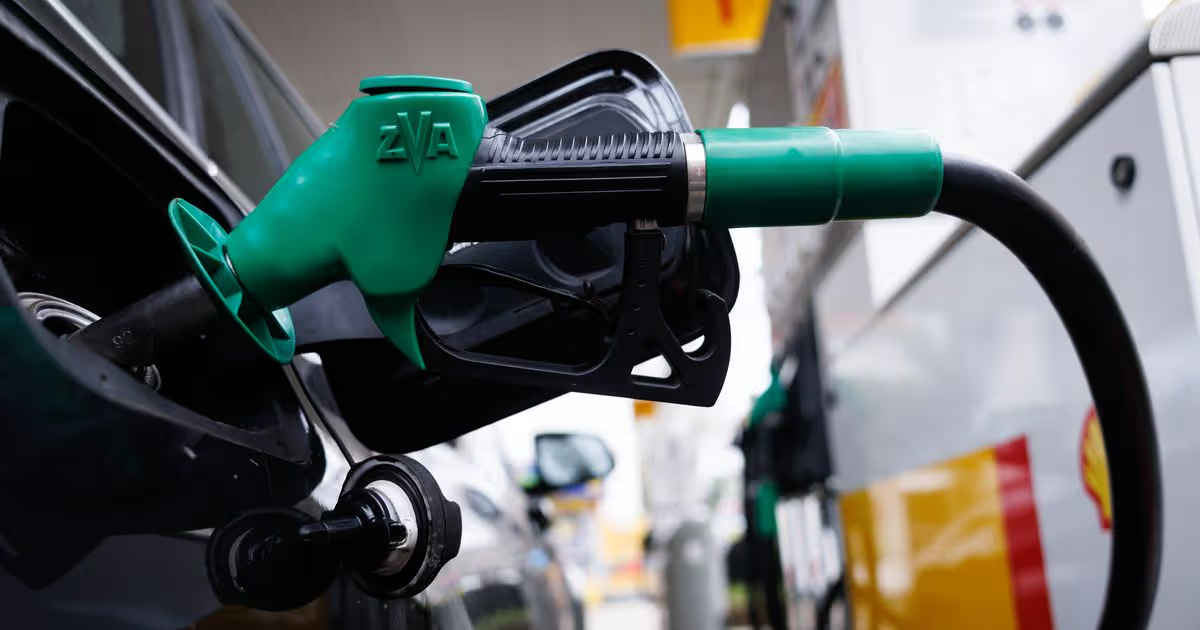
Scotland’s remote island communities are facing an intensifying cost-of-living squeeze as diesel prices climb to some of the highest levels in the United Kingdom, leaving residents with little choice but to absorb sharply rising transport costs in places where driving is often essential for work, healthcare, shopping and everyday life.
While fuel prices have risen across Britain, people living in the Hebrides and Shetland say the impact is particularly severe because island communities already face higher prices and limited alternatives to private vehicles. With long distances between settlements, scarce public transport and the additional cost of transporting goods by sea, an increase at the pump can quickly affect almost every part of household spending.
Across mainland Britain, diesel has reached around £2 a litre, while petrol prices have also risen substantially in recent months. On some Scottish islands, however, diesel prices have climbed well above the national average, with individual forecourts reporting prices above £2.20 a litre during the sharpest increases.

For islanders, the issue is not simply the price of filling a vehicle. Higher fuel costs can feed into food prices, deliveries, healthcare journeys, commuting expenses and the cost of maintaining essential services.
Adam, 43, who lives on North Uist in the Outer Hebrides, said diesel had reached £2.28 a litre locally. His family relies on two diesel cars for employment and transporting their three children, while his own daily routine can involve a substantial amount of driving.
His regular commute alone covers around 45 miles each day, but family responsibilities add significantly more mileage. He said the household had been forced to reconsider its spending as fuel and food costs continued to rise.
For Adam, the additional expense is particularly difficult because islanders already expect to pay more for many goods and services. Products have to travel farther to reach remote communities, while deliveries can involve longer journeys and higher transport costs.
He said the latest surge in diesel prices had made an already expensive way of life considerably harder, with his family increasingly choosing cheaper food options to manage household costs.
The geographical reality of island life means that seemingly short errands can quickly become long journeys. In larger mainland communities, residents may have access to alternative shops, bus routes, trains or nearby healthcare facilities. On the islands, those alternatives are often limited or unavailable.
Adam said he drives roughly 15,000 miles a year, while his wife, who works as a health visitor, drives even more. Despite covering similar professional distances to colleagues elsewhere in Scotland, the family faces substantially higher fuel costs because of where they live.
The rising cost of transport is also affecting access to public services. Adam described taking his daughter to Stornoway for a paediatric hearing assessment after receiving a medical referral.
The journey involved arranging ferry travel, driving more than 100 miles and paying for accommodation. Although patients can receive some assistance through a travel reimbursement scheme, he said the available support does not always cover the real cost of travelling from a remote island.
For families already struggling with higher household expenses, such journeys can turn what is officially a free healthcare service into a significant financial burden.
The problem is not unique to the Outer Hebrides. In Shetland, residents say fuel prices are similarly difficult to absorb despite the islands’ close association with the North Sea oil and gas industry.
Bob, a postman living in Shetland, said residents had long been accustomed to paying more for fuel than people elsewhere in Britain. But the latest increase has renewed concerns about fuel poverty.
Shetland has historically been closely connected to the energy industry, making the high local cost of fuel particularly frustrating for residents. Bob said it seemed ironic that the region was situated near major oil and gas infrastructure while islanders themselves faced some of the highest pump prices in the country.
He also pointed to the growing role of renewable energy in the islands, arguing that the contrast between energy production and household costs could be difficult for residents to understand.
For many workers, driving is not a matter of convenience but necessity. Bob said that a large proportion of jobs are concentrated in Lerwick, meaning people living outside the town often have to drive to work.
Although public buses operate, their schedules do not always match working hours, making them impractical for many employees.
Vehicle choice can also be shaped by the harsh conditions. While Bob drives a small Fiat 500 to reduce fuel consumption, he said many island residents use larger four-wheel-drive vehicles because of the weather and difficult road conditions.
For those households, the financial impact of higher diesel prices can be particularly severe.
The situation is also changing everyday behaviour among younger islanders. Ryan, 25, from Benbecula in the Outer Hebrides, said many people he knows have begun reducing journeys that are not strictly necessary.
For people working close to the minimum wage, even a relatively modest increase in fuel prices can consume a significant portion of their income. Ryan works at a nearby hotel and relies on his car because public transport options are extremely limited.
The cost of travelling to work has forced him to reduce other spending, including trips with his girlfriend. Journeys to restaurants or other places that once formed part of their routine have become less frequent because of the additional fuel expense.
Ryan believes local businesses are also likely to feel the consequences. If residents make fewer discretionary journeys, restaurants, shops and leisure businesses can lose customers at precisely the time when their own operating costs are increasing.
The geographical scale of the islands makes the situation more difficult. The Western Isles stretch for roughly 130 miles, while travelling from one end of an individual island can itself take a considerable amount of time.
For many households, several fuel tanks may be required every month simply to maintain ordinary routines involving work, shopping, childcare and family responsibilities.
Residents have responded in practical ways where possible. Ryan said some islanders have begun taking fuel containers to the mainland and filling them with cheaper diesel or petrol when travelling away from the islands.
Such behaviour is not entirely new. During winter, when severe weather can disrupt ferry deliveries and cause fuel shortages, some residents routinely stock up on fuel. But the latest price increases have given the practice a new financial motivation.
Ryan said prices on the Isle of Skye can be significantly lower than those in some parts of the Western Isles, creating an incentive for people travelling to the mainland to return with additional fuel.
For households already under financial pressure, saving even a few pence per litre can become worthwhile when buying a substantial amount of fuel.
The crisis also exposes the wider vulnerability of remote communities to national and international energy shocks. Scotland’s islanders have little ability to avoid the impact of global oil prices because transportation is embedded in almost every aspect of island life.
Fuel is required not only by private motorists but also by businesses, delivery companies, public services and transport operators. Higher fuel costs can therefore travel through the local economy, eventually appearing in the prices of food, goods and services.
The latest rise has followed a period of international instability in energy markets, with fuel prices pushed higher by geopolitical developments and uncertainty over supplies.
For islanders, however, the consequences are felt locally and immediately.
The challenge is particularly significant for policymakers seeking to maintain populations in remote parts of Scotland. Encouraging people to remain in or move to island communities requires more than promoting their natural beauty and strong social networks. Affordable transport, reliable public services and manageable household costs are essential to making those communities viable in the long term.
Adam believes there is a disconnect between political ambitions to repopulate remote areas and the practical realities faced by residents. When families must travel long distances for basic services and pay considerably more for fuel, the financial barriers to island living can become increasingly difficult to overcome.
Yet despite the pressures, many residents remain determined to stay.

Ryan said island life can be considerably harder than the romantic image of remote communities often presented to visitors. The islands may offer spectacular landscapes, close-knit communities and a strong sense of belonging, but residents also face higher costs and fewer alternatives when essential services or prices become difficult.
For him, that sense of community remains one of the strongest reasons people continue to live there.
As diesel prices remain elevated, Scotland’s islanders are once again being reminded of how heavily their lives depend on transport. A journey to work, a trip to the supermarket or a visit to a doctor can involve miles of driving, ferry crossings and careful financial planning.
The current fuel shock has therefore become more than a problem at the petrol pump. It is placing pressure on household budgets, local businesses, public services and the long-term sustainability of remote communities.
For residents of the Hebrides and Shetland, the hope is that fuel prices will eventually ease. Until then, families are cutting journeys, changing shopping habits, travelling farther to find cheaper fuel and relying on community support to absorb costs that are increasingly difficult to avoid.
Related News:
 UK Diesel Prices Hit Record High Amid Iran Conflict
 UK Diesel Reaches £2 as Inflation Surges Across Europe
 Minister Rejects Fears of UK Diesel Shortage
 North Sea Strike Threatens UK Fuel Supplies
 Wealthy Britons Flee Gulf War but Avoid UK Taxes
 UK Wage Growth Slows as Jobs Market Holds Firm
 UK Doubles Steel Tariffs to 50% to Protect Domestic Plants
 Unions Raise Concerns Over Doctors’ Pay Dispute
 10 Scenic Stays in Scotland’s Highlands & Islands
 BBC News Faces Deep Cuts in 2,000 Job Plan
 New UK advice scheme to boost savings and investing
 UK Pushes for New EU Goods Trade Deal
 Reeves Fights to Keep Treasury Role Amid Labour Turmoil
 UK rejects EV charging VAT cut amid Treasury clash
 Essex valley emerges as rising English wine hub
 Labour MPs Urge Burnham to Revive UK Aid Target
 Europe Faces Winter Gas Supply Anxiety
 UK Households Could Save £173 on Fixed Energy Deals
 Burnham Faces Mounting Budget Challenges
 UK House Prices Fall as Mortgage Rates Rise
 Oil nears $100 as Saudi attacks shake markets
 John Lewis Losses Widen to £124m as Confidence Falls
 Thames Water Revises Oxfordshire Mega-Reservoir Plan
 North Sea Firms Urge Early End to Windfall Tax
 UK Retail Sales Rebound as Consumers Spend More
 UK Rent Gap Puts Low-Income Families Under Pressure
 Calls Grow to Expand UK National Wealth Fund
 Labour Apprenticeship Scheme Faces Slow Start
 UK Borrowing Hits £18.3bn Ahead of Budget
 Burnham Leaves Door Open to Future Brexit Reversal
 Thinktank Calls for Abolition of UK State Pension
 MPs Defend UK Economic Watchdog Against Critics
 GP List Policy Risks Cutting Off Vulnerable Patients
 Tony Blair Calls for Britain to Rejoin EU Within a Decade
 UK Trade Losses Grow Without EU Product Deal
 AO Acquires Jessops in Camera Retail Expansion
 UK Food Trade Deficit Hits £21bn in 2026
 Should Savers Lock Into 5.25% Fixed Rates?
 Beaverbrooks Boss Calls for Relief on Business Costs
 Burnham Opens Debate on Pension Triple Lock for Care
 New UK Homes in Flood Zones Face Insurance Risk
 Burnham Opens Door to Possible UK Return to EU
 Poundland Rescue Bid Could Protect 11,000 Jobs
 Healey urged to act as UK energy bills rise 4%
 UK house price growth slows as mortgage rates rise
 UK borrowing costs surge as global bond sell-off deepens
 UK Assures Public Over Diesel Supply
 Badenoch Raises Prospect of 2027 UK Election
 London Luxury Homes Face a Prolonged Property Slump
 London Council Warns of 150% Council Tax Rise
 UK Weighs Chinese Car Tariffs Amid EU Trade Push
 BT Agrees £400m TalkTalk Rescue Deal
 Reeves Faces Setback as Labour May Miss Homes Target
 Kate Winslet to Narrate Film Highlighting King’s Environmental Mission
 Trump’s UK Ambassador Urges North Sea Drilling to Strengthen US Ties
 Older Women Vanish from BBC Screens, Review Confirms Bias
 Streeting moves on doctor pay to end strike dispute
 Send spending gap leaves deprived areas behind
 Hidden Crisis: Domestic Abuse Suicide Toll in UK
 UK Unemployment Rate Climbs to 5.2% Peak
 BBC World Cup Presenting Duties Shared Among Trio
 Wales Approves Assisted Dying Bill Consent
 CPS Updates Guidance on Honour-Based and Dowry Abuse
 Asylum Seekers to Work After Year-Long Wait
 Inquiry into HMRC child benefit errors launched by NAO
 Rising Costs Force Families to Rethink Days Out
 Scott Mills Sacked by BBC Over Personal Conduct Claims
 Palantir Boss Defends NHS Deal Amid Government Break Clause
 Relationship with Trump may be beyond repair, Starmer warned
 UK Government Poised to Revive Stalled Hillsborough Law
 Home Office Faces Legal Risks Over Asylum Hotel Living
 Crisis in NHS Surgery Scheduling Hits Patients Hard
 Unions Warn Labour Over Zero-Hours Contract Reforms
 British Museum Faces Questions Over Peter Thiel’s Private Bayeux Viewing
 Bayeux Tapestry Revives Franco-British Ties
 Entain Plans 400 Job Cuts After Profit Update
 Tom Watson Takes Senior Role at Palantir
 The Tests Awaiting Andy Burnham After Labour Conference
 London Facial Recognition Trial Ends With False Alert
 How City fandom became fiercely defensive