Published: 15 June 2026. The English Chronicle Desk. The English Chronicle Online.
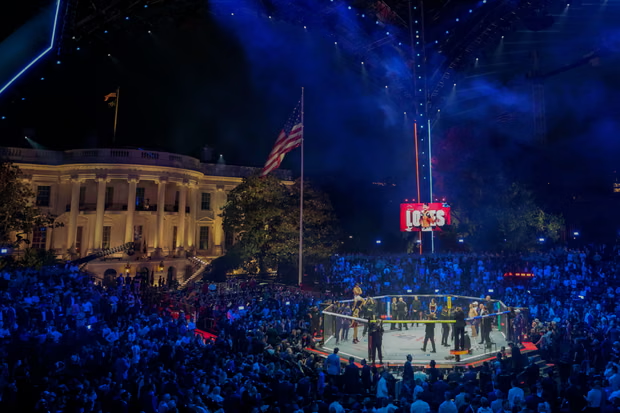
For most of its two hundred and fifty year history, the White House South Lawn has been reserved for state dinners, diplomatic ceremonies, Easter egg rolls, turkey pardons, and carefully choreographed displays of presidential power. On Sunday night it hosted cage fights. Beneath a giant steel canopy known as the Claw, with military flyovers overhead and thousands of spectators spread across the South Lawn and nearby Ellipse, Donald Trump celebrated his eightieth birthday and the forthcoming two hundred and fiftieth anniversary of United States independence by staging the first professional sporting event in White House history. The night also defied one of the day’s biggest concerns. Forecasts had warned that severe thunderstorms could disrupt the outdoor event, prompting organizers to delay the start by an hour. But not a single drop of rain fell on the grounds. The spectacle ended shortly after one in the morning on Monday with one of the bigger upsets in Ultimate Fighting Championship history as Justin Gaethje rallied from several perilous moments to stop the previously unbeaten Ilia Topuria after four brutal rounds and claim the undisputed lightweight championship.
I am from America, Gaethje said afterwards to a roaring crowd. Two hundred and fifty years ago, we were way bigger than six to one underdogs, and look at this country now. It was a fitting conclusion to an evening that often felt less like a sporting event than a demonstration of raw American power. Donald Trump and Ultimate Fighting Championship chief executive Dana White emerged from the White House at dusk to a military color guard and a rare combined flyover by the Blue Angels and Thunderbirds. Later, a giant bomber thundered over the South Lawn. A recruitment advertisement from the newly renamed Department of War aired during the broadcast. Chants of patriotism echoed throughout the purpose-built grandstands all night. The guest list reflected the unusual collision of politics, technology, and combat sports. Meta chief Mark Zuckerberg watched from seats not far from the Winklevoss twins, while cabinet officials, foreign dignitaries, and political allies drifted through the ringside area throughout the evening. Yet if the event was intended as a celebration of American strength and exceptionalism, it also repeatedly descended into something cruder.
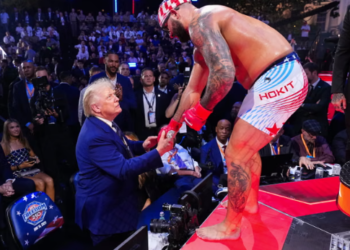
The most striking example came after prospect Josh Hokit stopped Derrick Lewis in the second round of their heavyweight bout. After exiting the cage to present Donald Trump with a necklace at ringside, Hokit delivered a rambling post-fight interview that veered from praise for the president to religion before concluding with a false conspiracy claim about Michelle Obama. The remark, one of the oldest and most persistent smears directed at the former first lady, drew cheers from some sections of the crowd and bewilderment from others. Even on a night that had already blurred the line between civic ceremony, political rally, and pay-per-view entertainment, Hokit still found a way to lower the level of discourse. Observers noted that the inclusion of such targeted personal attacks on a political stage reflects a deeper trend in contemporary cultural polarization. The international press quickly picked up on the incident, noting the stark contrast between the traditional dignity of the venue and the raw nature of the rhetoric broadcast to millions worldwide.
Hokit’s comments were not the evening’s only political barb. When former champion Sean O’Malley faced Canada’s Aiemann Zahabi, the bout took on a nationalistic fervor. Donald Trump donned a white American hat cageside while patriotic chants rang out from sections of the crowd. At various points spectators shouted about Canada being the fifty first state, echoing Donald Trump’s repeated taunts about annexing America’s northern neighbor, while others urged O’Malley to destroy his opponent. The crowd erupted when O’Malley finished Zahabi by second-round technical knockout, celebrating the first victory by an American fighter over a foreign-born opponent on the card. Before leaving the cage, O’Malley thanked the fans gathered on the Ellipse and paid tribute to Dana White. The atmosphere highlighted a growing intersection of sport and intense national identity. This blending of statecraft and aggressive sports entertainment marks a new era in public relations. Critics have raised concerns about utilizing federal property for events that generate massive commercial revenue and partisan messaging.
The fights themselves rarely lacked entertainment. Every bout on the seven-fight card ended by knockout or technical knockout, the first time that has happened in the long history of the organization. Ciryl Gane stopped Alex Pereira to claim the interim heavyweight title, while Hokit, O’Malley, and Bo Nickal all delivered emphatic victories in front of the president. But the night belonged to Gaethje. The thirty-seven-year-old American entered as a heavy underdog against Topuria, the unbeaten Georgian-Spanish champion who many regard as the sport’s top pound-for-pound fighter. Topuria appeared in control early and repeatedly hurt Gaethje with body shots and combinations. The second round ended with Topuria pinning Gaethje against the cage directly in front of Donald Trump, appearing firmly in control. Yet the American weathered the storm. By the third round, Topuria’s face was swollen and bloodied. By the fourth, the champion was struggling to see. After a ringside doctor examined him between rounds, Topuria’s corner ultimately stopped the fight before the fifth.
That guy had me in trouble, Gaethje said. He had me rocked. He smoked my liver. But I stuck in it. The victory completed a career-long pursuit of the undisputed lightweight championship and provided the home crowd with an American winner in the main event. As fireworks exploded above the White House to patriotic music past one in the morning on Monday, Donald Trump entered the cage to congratulate Gaethje and greet his mother. The evening ended as it had begun, with a display of pageantry on a scale rarely seen in American sports. The historical significance of transforming the executive mansion into a sports arena will likely be debated for years to come. Supporters view the evening as a brilliant populist masterstroke that brought a popular sport to the heart of American democracy. Detractors argue that the event degraded the office and diminished the global prestige traditionally associated with the White House. Regardless of political alignment, the event has undeniably set a new precedent for how sports and state power intersect.
The global broadcast drew massive viewership numbers, signaling a highly successful commercial venture for the organizers. Social media platforms were flooded with reactions ranging from awe at the military displays to condemnation of the political vitriol. For the United Kingdom audience, the spectacle provided a fascinating if jarring look into modern American political culture. The combination of corporate tech titans, military might, and cage fighting under the Washington sky offered a vivid picture of contemporary society. As the cleanup begins on the historic south grounds, the echoes of the historic night linger in the public discourse. The transition from diplomatic garden parties to blood-stained canvas represents a cultural shift that cannot be easily undone. Donald Trump has once again demonstrated his unique ability to command global media attention by breaking traditional molds. Whether this remains a unique occurrence or becomes a regular feature of the presidency remains to be seen. For now, the sporting world celebrates a legendary athletic achievement, while the political world grapples with the new boundaries of presidential decorum.
Related News:
 Capitol Attack Anniversary Sparks Deep Political Divide
 Trump Labels Renee Good a ‘Paid Agitator’ After Minneapolis ICE Killing
 Trump targets Iran trade with 25% tariff warning
 Trump Receives Machado’s Nobel Medal in White House Meeting
 Thousands Protest ICE Operations in Nationwide US Day of Action
 Epstein Files Reveal Trump Officials’ Emails with Financier
 Thousands Protest ICE in New York Against Trump Deportation Campaign
 US-Cuba Negotiations Shift as Oil Blockade Looms
 Ukraine war briefing: Zelenskyy offers help to Saudi Crown prince on combatting Iranian drones
 New Policy Allows US Troops to Carry Personal Firearms
 Michigan Battleground: Middle East Crisis Stirs US Senate Race
 Congresswoman Condemns Trump Over Iran Conflict
 Trump Signals Hope for New Iran Talks as Ceasefire Fades
 Trump’s Presidency: A House of Cards Collapsing?
 GOP Senator Criticizes Trump’s Feud With Pope Leo XIV
 Trump Starts $166bn Tariff Refund Process
 Investigation Into Anti-Trump Motives After Gala Shooting
 UK Urged to Adopt ‘Trade Bazooka’ Against Tariff Threats
 USS Gerald R Ford Ends Record Naval Deployment
 Trump orders US troop pullout from Germany
 Indiana Republicans Defy Trump in Key Vote Test
 Tensions Emerge in Netanyahu-Trump Alliance
 Fear and Betrayal: The Chilling Case of Kouri Richins
 Trump in Beijing: The Strongman Fantasy Made Flesh
 Trump Tightens Grip on GOP with Primary Victory
 Democrats release 2024 election report amid fierce backlash
 US judge dismisses Kilmar Abrego Garcia indictment
 Tulsi Gabbard exits after turbulent intelligence tenure
 Former ICC prosecutor condemns US sanctions
 Trump Weighs Retreat from Controversial $1.8bn Slush Fund
 Trump Allies Funded Hidden Network to Discredit US Vote
 The Dreamers Losing Jobs Under Trump’s Red Tape
 Battle for Washington: Mayoral Race Braces for Trump
 Trump Urged to Condemn UFC Fighter Over Obama Slurs
 Trump Halts Senate Hearing for Intel Pick Jay Clayton
 The Obama Center: Hope and Anxiety on Chicago’s South Side
 US Military Pacific Boat Strike Kills Three People
 FBI Chief Faces Backlash Over Premature Social Media Posts
 Trump’s Mount Rushmore Speech: A Divisive Anniversary
 House Democrats Divided Over Israel Military Funding Bid
 Houthis Strike Saudi Arabia as Middle East Tensions Rise
 Federal Immigration Shift: Officers Leave Louisiana for Minneapolis
 Friedman Uninvited From 2024 Adelaide Writers’ Week
 Trump press secretary attacks reporter over ICE question
 Spoof “Make America Go Away” Caps Rally Denmark Over Greenland
 Trump Fed bid heads to Supreme Court
 Partial US Government Shutdown Hits Homeland Security Funding
 New Poll Reveals Reform UK Stance on British Citizenship
 New Zealand Covid Response Praised Despite Lingering Scars
 Diplomacy on the Brink: Pakistan’s Risky Peace Mission
 Teenage Titan: Sooryavanshi Smashes IPL Records
 Canadian Mother and Daughter Released From ICE Detention
 Reform UK Pledges To Halt Visas Over Reparations Demands
 US and Iran Agree to Two-Week Provisional Ceasefire
 Israel Defies Ceasefire as Lebanon Operations Persist
 Pakistan Brokers Historic Peace Deal Amid Rising Tensions
 Islamabad Hosts Historic Peace Talks Between Iran and USA
 Security Alert Near Israeli Embassy as Police Investigate
 Machado Rallies in Madrid as Venezuela Stays Frozen Out
 Louisiana Tragedy: Eight Children Die in Mass Shooting
 US-Iran Standoff: Will Trump Deploy Ground Troops?
 UK Stands Firm on Falklands Amid US Rift
 High Stakes in Beijing as Trump and Xi Meet Amid Global Turmoil
 Trump and Xi Convene in Beijing for Historic High-Stakes Summit
 Aussie Race Row: Coalition Accused of Scapegoating
 Trump Pledges 5,000 Troops for Poland in U-Turn
 Cannes filmmakers split over AI’s role in cinema
 Trump’s Grip on the GOP Tested in Texas Senate Battle
 Washington Brokerage Sparking Hope Amid Regional Firestorms
 US Condemns ‘Two-Tier’ UK Policing After Student Murder
 Trump Appeals for Middle East Calm but Conflict Escalates
 Millions in British Charity Funds Linked to Illegal Settlements
 Russian Tanker Captain Remanded in UK Court After Channel Seizure
 US Courts Back Trump on Park Signage Removals
 US Airman Avoids British Court in Indecent Exposure Case
 Trump Swaps Planes Amid Iran Tensions
 Rotterdam Museum Honours Artist With Peanut Butter Floor
 Bangkok Nightclub Blaze Claims 30 Lives Amid Negligence Probe
 Yemen Accuses Iran of Violating National Sovereignty
 Florida Executes One of Its Oldest Death Row Prisoners