Published: 01 October 2026. The English Chronicle Desk. The English Chronicle Online
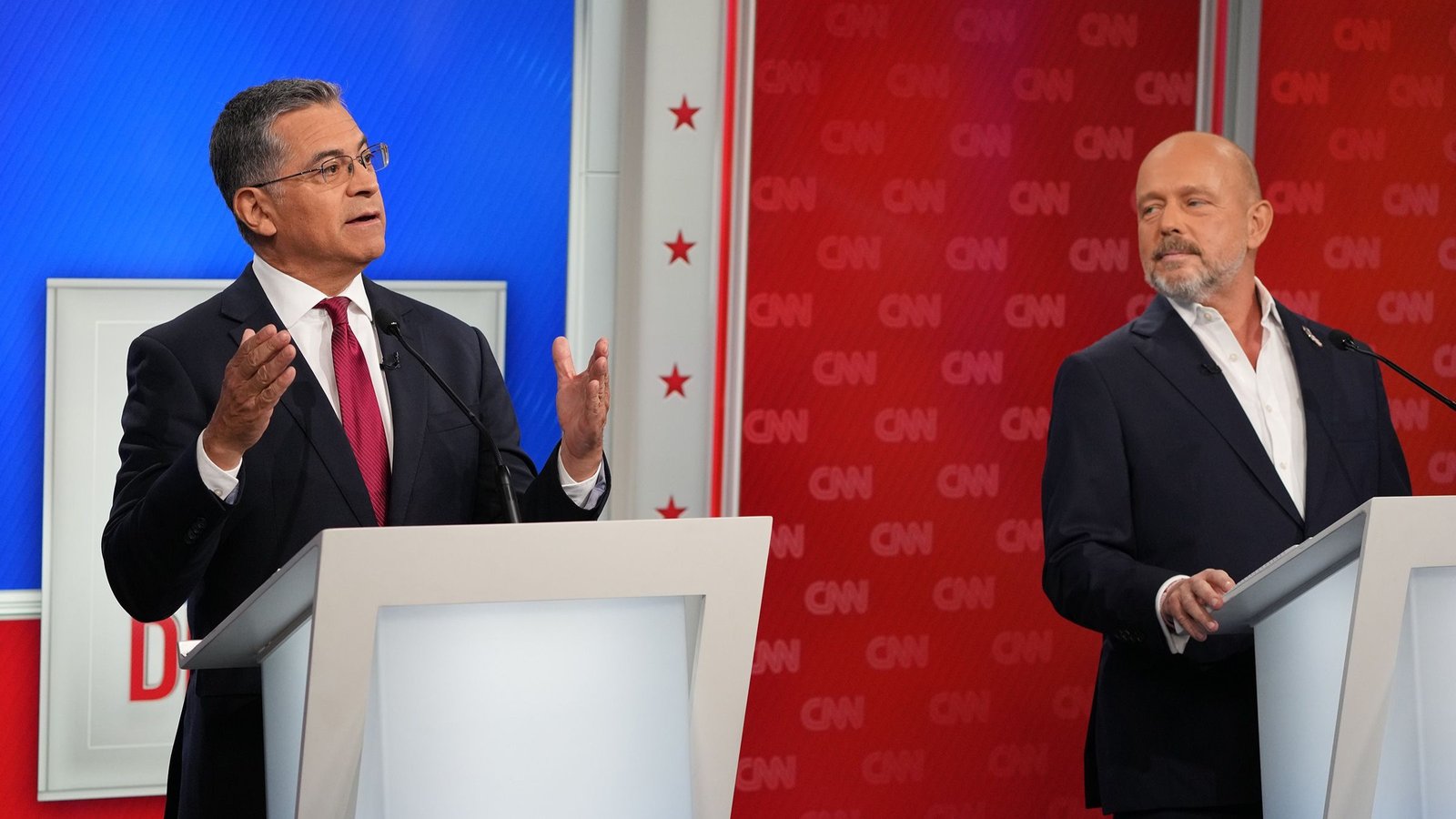
Xavier Becerra and Steve Hilton clashed over taxes, immigration, artificial intelligence and the influence of Donald Trump during a tense televised debate that offered California voters a direct comparison between two sharply different approaches to governing the state.
The hour-long CNN debate on Wednesday came just days before election officials begin sending ballots to voters for the 3 November gubernatorial election. It was the first and only scheduled one-on-one debate between the Democratic and Republican candidates, giving both an important opportunity to make their arguments before voters in the country’s most populous state.
Becerra, 68, a former congressman, California attorney general and US health and human services secretary under President Joe Biden, presented his political experience as an advantage at a time when California is facing high housing and energy costs, pressure on public services and continuing disputes with the Trump administration.
Hilton, 57, a former Fox News host, British political adviser and technology entrepreneur, sought to present himself as an alternative to the Democratic establishment that has dominated California politics for years. He argued that long-standing state policies and regulations had contributed to high living costs and said voters should consider a change in direction.

The two candidates repeatedly returned to the question of affordability, one of the central concerns in the campaign. Hilton has made lower taxes and reduced regulation major elements of his platform. He has proposed eliminating state income taxes on earnings up to $150,000 and has argued that reducing regulatory barriers could encourage more housing construction and ease pressure on household budgets.
Becerra challenged the financial implications of Hilton’s proposals, arguing that major tax reductions would leave the state with difficult choices over funding for schools, healthcare and other public services. He said California’s affordability problems also had to be considered in the context of broader economic pressures, including federal policies and international developments affecting energy prices.
The debate also highlighted the continuing importance of Trump in California’s gubernatorial contest. Trump endorsed Hilton during the Republican’s primary campaign, helping consolidate conservative support behind him. Since then, Hilton has sought to emphasize his own political identity while arguing that California needs practical solutions rather than another cycle of partisan conflict.
Becerra repeatedly connected Hilton to Trump and the president’s policies. During a discussion about artificial intelligence, Becerra argued that Hilton’s approach reflected the Trump administration’s preference for less direct regulation of the technology sector.
Hilton responded by accusing Becerra of making Trump the centre of his campaign instead of addressing California’s domestic problems. He argued that voters were looking for action on living costs, housing, homelessness and government regulation rather than continued arguments about Washington politics.
Trump’s political standing in California has made the relationship particularly significant. The state remains heavily Democratic, and the governor’s race is taking place against a national political backdrop in which California has frequently opposed the Trump administration on immigration, environmental policy, technology regulation and other issues.
Artificial intelligence emerged as another important point of disagreement, although the candidates shared some common ground. Both indicated that California should regulate AI and data centres, reflecting growing concern over the technology’s impact on employment, energy demand, water resources and local communities.
Hilton argued that California should remain a major centre for the AI industry while ensuring that excessive regulation does not push companies and jobs to other states. He questioned whether Becerra would be willing to impose meaningful restrictions on a powerful industry that has contributed financially to political campaigns.
Becerra said AI regulation should focus on protecting workers and communities while allowing responsible investment to continue. He argued that new data centres should provide tangible benefits, including employment and infrastructure improvements, rather than placing additional pressure on local resources.
Immigration produced the most personal exchange of the evening. Becerra, the son of Mexican immigrants, challenged Hilton over his approach to immigration enforcement and accused him of supporting policies that would treat different groups of immigrants differently.
Hilton rejected the accusation and described Becerra’s remarks as unacceptable. He said his immigration policy would focus on removing people who commit serious crimes while reducing political confrontation over immigration.
The exchange reflected a broader disagreement over California’s relationship with federal immigration enforcement. Becerra has opposed the Trump administration’s deportation policies and has argued that California should protect immigrant communities. Hilton has said the state should cooperate more closely with federal authorities in cases involving people who pose a public-safety threat.
Hilton also attacked Becerra over his record as health secretary, particularly the federal government’s handling of unaccompanied migrant children during the Biden administration. Becerra defended the work of his department and rejected accusations that his policies placed vulnerable children at unnecessary risk.
The candidates also differed over voting rules. Hilton supported a proposed voter identification measure that would require identification for in-person voting, while Becerra opposed it and argued that such requirements could create additional barriers for eligible voters.
Both candidates, however, agreed on another major ballot issue: a proposed one-time tax on billionaires. The measure would impose a 5% levy on the assets of California residents with wealth above $1bn. Becerra’s opposition has put him at odds with some progressive figures who support the proposal, while Hilton has also rejected it.
The debate unfolded against a political landscape shaped by voter concerns about California’s high cost of living and the direction of state government. Housing affordability, energy prices, homelessness and public education have all emerged as significant campaign issues.
Hilton argued that years of Democratic control had produced excessive regulation and rising costs. He said his administration would seek to reduce bureaucracy, encourage housing construction and make California more affordable for working families.
Becerra countered that California’s economic problems could not be solved simply by cutting taxes and regulations. He presented himself as a candidate with experience in government who could work on housing, employment, healthcare and infrastructure while defending the state’s interests in its disputes with Washington.
The candidates also offered contrasting assessments of California’s political legacy. Hilton described himself as an outsider prepared to challenge the Sacramento establishment. Becerra argued that governing the state requires experience and familiarity with its complex institutions.
“There aren’t training wheels in the governor’s office,” Becerra said during the debate, arguing that the responsibilities of the position require someone prepared to take office immediately.
Hilton, meanwhile, maintained that Californians should not assume that established political experience automatically produces better results. His campaign has focused on voters dissatisfied with the state’s current direction and those seeking a significant change in policy.

The debate therefore became as much a discussion about political identity as individual policies. Becerra repeatedly framed the election around California’s relationship with Trump, while Hilton sought to make the contest primarily about the state’s cost of living and dissatisfaction with long-term Democratic rule.
With ballots soon arriving, the televised encounter gave voters a final major opportunity to hear both candidates directly before the November election. The debate did not erase the fundamental differences between them, but it clearly exposed the competing arguments that will shape the closing weeks of the campaign: whether California’s problems require continuity and experienced government leadership, or a substantial shift in taxes, regulation and the state’s political direction.
California voters will make that choice when they cast their ballots on 3 November, with the governor’s race unfolding alongside a broader national debate over the future of the Democratic Party, Republican politics and the role of states in responding to the Trump administration.
Related News:
 US National Guard Member Killed in DC Shooting
 Trump Escalates Minnesota Immigration Surge Amid Rising Tensions
 Democrats Push Affordability to Challenge Trump Ahead of Votes
 Greenland Faces Pivotal Summit Over Arctic Power Struggle
 Government Unveils Northern Powerhouse Rail Plans
 Trump press secretary attacks reporter over ICE question
 Kyrsten Sinema Faces High-Profile Lawsuit Over Marriage Interference
 ‘He Believed Help Was Coming’: Why Iran’s Protesters Feel Betrayed
 Trump Fed bid heads to Supreme Court
 Trump officials continue false claims after Alex Pretti shooting
 Fulton election raid hits Georgia election office
 Partial US Government Shutdown Hits Homeland Security Funding
 Thousands Protest ICE Operations in Nationwide US Day of Action
 Epstein Files Reveal Trump Officials’ Emails with Financier
 Thousands Protest ICE in New York Against Trump Deportation Campaign
 Sinema payment row deepens after $9,000 transfer claim
 Nurses’ families fear breakup under UK immigration crackdown
 California Democrats Vow Trump Reckoning
 Trump’s Surgeon General Pick Evades Vaccine Questions
 Clinton Testimony Erupts in Fiery Exchange
 Adelaide University Faces Backlash Over Event Cancellation
 Thousands Protest Iran Strikes Outside US Embassy London
 Can Congress Stop US Sports Teams From Moving Cities?
 Can King Charles Calm Trump on Key US Visit?
 Melania Trump Epstein remarks spark survivor backlash
 Trump Signals Hope for New Iran Talks as Ceasefire Fades
 US Catholics Caught Between President and the Pope
 Iron Worker Challenges Trump Loyalist in Ohio
 Trump Faces Crisis as Iran Reopens Hormuz Tensions
 GOP Senator Criticizes Trump’s Feud With Pope Leo XIV
 UK Stands Firm on Falklands Amid US Rift
 Trump at Press Dinner Sparks Tension
 Investigation Into Anti-Trump Motives After Gala Shooting
 Trump Defiant After Washington Hotel Shooting
 Identity Revealed: Suspected Washington Gunman Named
 US Court Weighs Fate of TPS for Migrants
 Trump orders US troop pullout from Germany
 Judge halts deportation of Yemeni refugees in US
 White House Security Case Sparks Political Firestorm
 Trump approval plunges amid Iran war fears
 Ohio’s Battle for Trust: Democrats Vying to Flip the Buckeye State
 Trump Threatens UN Budget Cuts as US Pushes ‘Trade Over Aid’ Agenda
 Trump warns Iran as Middle East tensions surge again
 US ‘Narco Boat’ Strikes Draw Global Outcry
 Ohio Primaries Set Stage for Crucial Midterms
 Afghan Families Left in Limbo Face Risk of Deportation
 Tensions Emerge in Netanyahu-Trump Alliance
 US Awaits Iran Reply on New Ceasefire Proposal
 Immigration Judges Fear Pressure in Trump Era
 Kevin Warsh sworn in as Fed chair amid economic backlash
 US green card applicants must apply from abroad, DHS says
 Tulsi Gabbard exits after turbulent intelligence tenure
 Hormuz Talks Near Critical Stage
 Former ICC prosecutor condemns US sanctions
 Gunman Killed After White House Security Shootout
 DeSantis’s ‘Alligator Alcatraz’ Faces Final Shutdown
 Prosecutor Proposes Law to Combat Election Deceit
 House Curbs Trump’s War Powers in Rare Rebellion
 AOC Backs El-Sayed in Tight Michigan Senate Primary
 US Courts Back Trump on Park Signage Removals
 Trump’s Mount Rushmore Speech: A Divisive Anniversary
 Court Rejects Florida Campus Speech Restrictions
 Trump Refuses to Sign Housing Bill, But Law Takes Effect
 Houthis Strike Saudi Arabia as Middle East Tensions Rise
 Trump Orders Signs Criticising Smithsonian Museum
 Is America Ready for an AOC Presidential Run?
 Trump Calls Strait of Hormuz ‘American Territory’
 Trump Hardens Canada Trade Stance as Talks Stall
 Trump Calls Iran War ‘Small Potatoes’ Despite US Deaths
 Trump gives $45,000 holiday gifts to White House aides
 New Mexico Takes Facebook to Trial Over Data Scandal
 Trump’s Washington Projects Face Architectural Criticism
 US Networks Suspend Trump White House Pool Coverage
 Trump and Mamdani Hold Cordial Gracie Mansion Meeting
 Trump Eyes Major Belarus Fertiliser Deal Amid Canada Trade Dispute
 Democrat Says ICE Restricted Detention Camp Oversight
 Xi urges Trump to avoid US-China military conflict
 Lula accuses Trump of seeking control over Brazil
 Republican Senator Questions Trump Ad Spending
 Kristi Noem Files for Divorce After 34 Years