Published: 10 August 2026. The English Chronicle Desk. The English Chronicle Online
More than one million people have been evacuated across eastern China as Typhoon Dolphin brought torrential rain, powerful winds and the threat of widespread flooding and landslides, with Shanghai recording its heaviest 24-hour rainfall in more than 150 years.
The powerful storm made landfall in eastern China before weakening rapidly as it moved inland. Despite losing strength, authorities warned that the danger had not passed, with prolonged rainfall expected to affect large parts of eastern and central China for several more days.
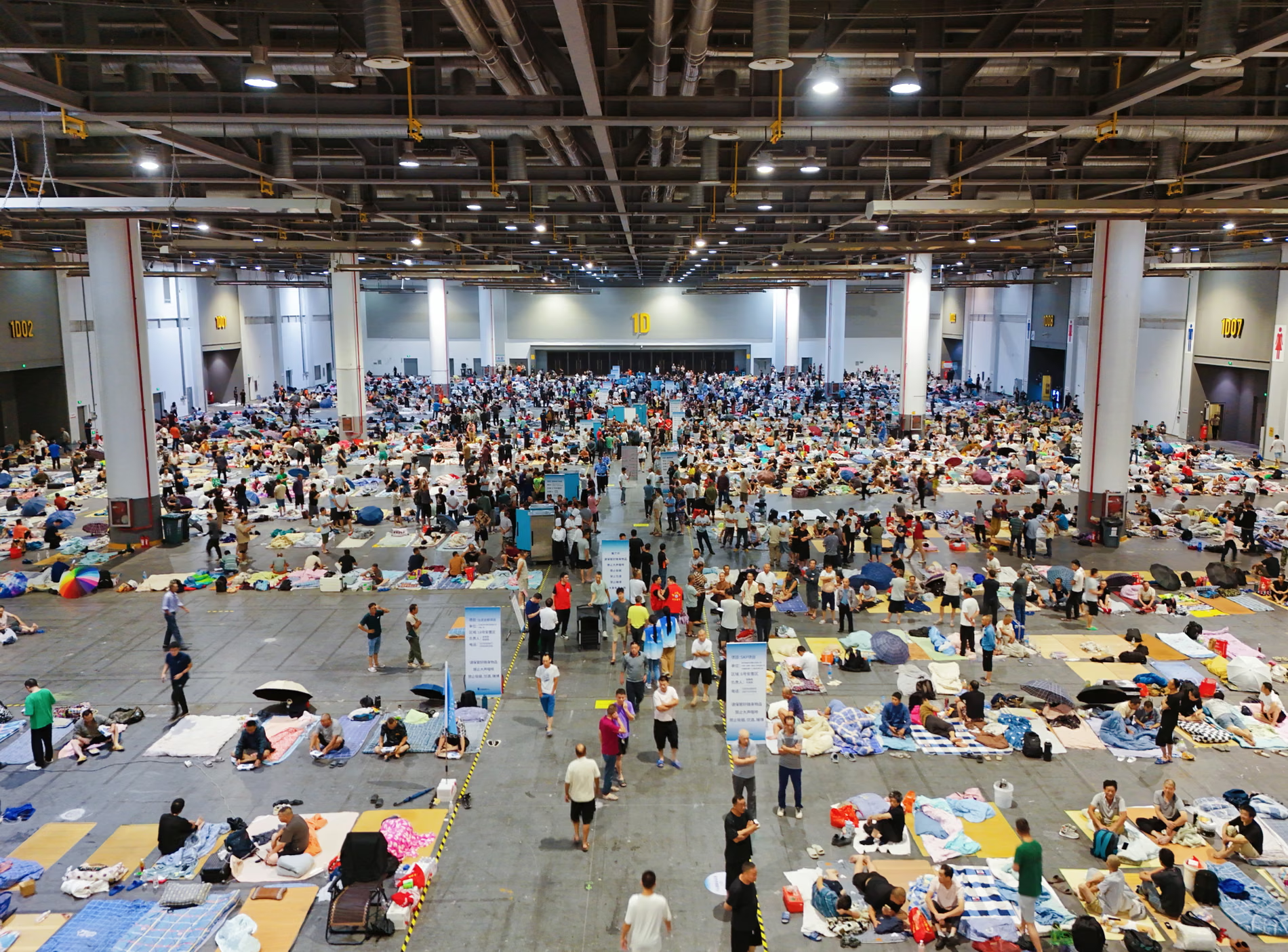
The scale of the evacuation reflects the seriousness of the threat. Wenzhou, a coastal city in Zhejiang province, said more than 900,000 people had been relocated from areas considered vulnerable to the storm. The city also opened more than 1,500 emergency shelters.
In neighbouring Fujian province, authorities moved approximately 98,900 people away from high-risk areas. Shanghai, China’s financial and commercial hub, also dramatically expanded its evacuation operation, with 215,600 people moved to safer locations by Sunday evening.
The number in Shanghai was substantially higher than the 30,300 people initially reported as having been evacuated.

The most striking evidence of Dolphin’s impact came from rainfall measurements in Shanghai.
A weather station in central Shanghai recorded almost 313mm of rain during the 24 hours leading up to 7am on Monday. According to the information supplied by authorities and weather monitoring services, this was the highest 24-hour rainfall recorded at that station in more than 150 years of records.
Another weather station in the city reportedly recorded close to 400mm during the same period.
The extraordinary rainfall caused flooding in numerous parts of Shanghai. Images and videos circulated on Chinese social media showing streets covered in water, while the phrase “Shanghai turns into the sea” became a trending topic on Weibo.
Among the locations affected were areas around Wukang Mansion, one of Shanghai’s best-known tourist landmarks.
The flooding created major disruption in a city that normally functions as one of Asia’s busiest transportation and financial centres.
Shanghai’s two airports cancelled more than 1,300 flights as the storm approached and severe weather affected aviation operations. Public transport services were also disrupted, with many local railway services suspended.
Authorities urged residents to remain indoors during periods of intense rainfall and warned that the accumulated rainfall could create dangerous conditions even after the typhoon itself weakened.
The danger extended well beyond Shanghai.
Rainfall recorded across Zhejiang province between Friday evening and Monday morning averaged approximately 173mm. The figure was reported to have exceeded rainfall levels associated with several previous major typhoons, including Lekima and Bavi.
Forecasters warned that some areas could receive another 200mm to 400mm of rain over the following days.
China maintained an orange alert for heavy rainfall, while officials warned that prolonged downpours could trigger flooding, landslides and other secondary disasters through Wednesday.
Dolphin had weakened to a tropical storm by around 5am on Monday. However, weakening does not necessarily eliminate the threat from a tropical system. Storms can continue to carry enormous quantities of moisture inland, producing prolonged and potentially dangerous rainfall far from the original landfall area.
As Dolphin moved northwards and further inland, heavy rain was forecast across several provinces, including Shandong, Henan, Hubei, Anhui, Jiangsu and Zhejiang, as well as Shanghai.
The disruption also affected other parts of East Asia.
In Taiwan, ferry services were suspended and more than 180 flights were cancelled as strong winds and heavy rainfall associated with the storm reached the island.
Before reaching mainland China, Dolphin affected Japan’s southern Okinawa prefecture. Six people were reported injured, while electricity supplies were disrupted to more than 50,000 buildings.
In the Philippines, Dolphin did not make landfall in the northern part of the country, but the system intensified seasonal monsoon rainfall. Several areas of northern Luzon experienced flooding, including communities around the capital, Manila.
The storm also had an unusual impact on Hong Kong.
Instead of simply bringing cooler conditions, the typhoon contributed to a period of extreme heat. Hong Kong recorded a temperature of 36.9C on Sunday, reported as the highest temperature ever recorded in the city.
Officials warned that the exceptional heat could continue into Tuesday.
The combination of extreme rainfall in some areas and extreme heat in others illustrates the complex weather patterns that can accompany powerful tropical systems.
For residents of eastern China, however, the immediate concern remained flooding and the possibility of landslides.
Authorities in several areas were preparing for the possibility that saturated ground and swollen waterways could create additional hazards after days of heavy rain.
Emergency shelters were opened to accommodate displaced residents, while transport restrictions and cancellations were introduced to reduce exposure to dangerous conditions.
The evacuation strategy was particularly significant in coastal and low-lying communities, where flooding can spread rapidly during periods of intense rainfall.
Wenzhou’s evacuation of more than 900,000 people was one of the largest movements of residents associated with the storm. The extensive shelter network established by local authorities was intended to ensure that displaced residents had access to safe accommodation while the most dangerous conditions passed.
The situation also highlights the growing importance of disaster preparedness in densely populated parts of Asia.
Eastern China contains some of the country’s largest cities, industrial centres and transport networks. Severe weather can therefore produce consequences far beyond the immediate area where a storm makes landfall.
Shanghai’s airport cancellations, railway suspensions and widespread disruption demonstrate how quickly extreme weather can affect national and international economic activity.
Businesses, airlines, manufacturers, logistics companies and commuters can all be affected when transportation networks are interrupted.
The consequences can continue even after weather conditions begin to improve because flooded roads, damaged infrastructure and saturated ground may take days to recover.
The storm has also renewed discussion about the relationship between tropical cyclones and climate change.
Scientists have increasingly warned that global warming is altering extreme weather patterns. Warmer oceans can provide additional energy and moisture for tropical systems, while a warmer atmosphere can hold more water vapour, potentially increasing the intensity of extreme rainfall.
That does not mean that every individual typhoon can be directly attributed to climate change. Scientists assess individual events through detailed attribution studies that consider historical climate patterns and other factors.
However, the broader scientific understanding is that climate change is increasing the likelihood or intensity of some forms of extreme weather, including episodes of extreme rainfall and certain aspects of tropical cyclone behaviour.
The challenge for governments is therefore not simply to respond to individual storms but to prepare communities and infrastructure for a changing climate.
For China, that means strengthening flood defences, improving early-warning systems, expanding emergency shelters and ensuring that evacuation plans can be implemented rapidly when severe weather approaches.
The response to Dolphin demonstrated the scale of resources that can be mobilised when authorities act before conditions become catastrophic.
But the rainfall records in Shanghai also showed how difficult it can be to protect a major city from exceptionally intense precipitation.
As Dolphin weakened and moved further inland, attention shifted from the initial landfall to the continuing rainfall threat.
Officials warned residents not to assume that the reduction in wind strength meant the danger was over.

The storm’s most damaging legacy could ultimately come from accumulated rainfall rather than the winds that accompanied its landfall.
For the more than one million people who have been moved from vulnerable areas, the priority remains safety while authorities monitor rivers, roads, slopes and drainage systems.
In Shanghai, where hundreds of millimetres of rain fell within a single day, the extraordinary weather event has provided another reminder of the vulnerability of even the world’s largest and most technologically advanced cities to extreme natural forces.
With heavy rain expected to continue across parts of eastern and central China, the immediate focus remains on preventing further loss of life, managing flooding and ensuring that evacuated residents can remain safe until conditions stabilise.
Related News:
 Evacuations Ordered as California Wildfires Spread Fast
 Queensland Braces for Potential Second Severe Cyclone Hit
 Cyclone Vaianu Forces Mass Evacuations in New Zealand
 At Least 19 Killed After Powerful Earthquake Hits Southern Philippines
 Venezuela Quake Death Toll Surpasses 4,000
 Wildfires Intensify in South-West France as Region Braces for 40C Heatwave
 Amber Heat Health Alerts Issued as UK Heatwave Set to Reach 35C Peak
 Two Killed as Firefighting Helicopters Collide During Greece Wildfire Mission
 Canada wildfire surges as residents brace for worst
 Dozens of Flood Warnings in England After Days of Non-Stop Rain
 Fast-moving Wildfires Rage Across Southwestern US
 Scotland’s Climate Plans Face Scrutiny Over ‘Science Fiction’ Targets
 Ocean Warming Drives Massive Marine Life Loss, Study Warns
 Tropical Flowers Shift Blooming Due to Climate Crisis
 UK Winter Nowhere Near a Record Breaker Despite Floods and Storms
 UK Records Warmest Day of the Year as Temperatures Exceed 18 °C
 UK Records Earliest Spring as Nature Awakens Fast
 Escobar’s Hippos May Be Moved to India Zoo
 Capitalism ‘Suicidal’, Warns Petro at Climate Summit
 Record May Heat to Cold Front in Eastern Australia
 UK Faces Mass Water Shortages by 2055, Lords Warn
 Hope for mountain bongos returns to Kenya
 Mangrove Forests Recover After Years of Damage
 Deadly Earthquake Hits Philippines
 Temperatures Set to Fall This Week, But Forecasters Warn Heat Could Return Soon
 Why Extreme Heat Can Cause Trees to Collapse and What Experts Say Can Be Done
 Sydney Records Hottest June Since 1859 as Expert Warns New High a ‘Signature’ of Global Warming
 UK Heatwaves Ignite Crisis of Sleep and Public Safety
 UK Seas Face Extreme Heatwave as Global Temperatures Surge
 Europe Scorched as Record Heatwaves Grip the Continent
 Rain Forecast to Return This Weekend as Parts of UK Edge Closer to Drought Conditions
 No Helicopters Available to Fight Wildfires as ‘Crisis Management’ Plans Activated
 Thousands Evacuated in France as Wildfires Spread Across Regions
 France Evacuates Tourist Area as Wildfires Spread
 Wildfires Force Mass Evacuations in France And Spain
 Three-Quarters of England’s Riverbanks Still Off Limits
 French Wildfire Sparks Rare Lightning Storm Near Bordeaux
 Fourth Heatwave Brings 35C Temperatures to UK
 French Firefighters Battle ‘David vs Goliath’ Wildfire
 Magnitude 7.1 Earthquake Strikes Japan, Several Injured
 People Trapped in Japan Shopping Centre After Earthquake
 Many Trapped Inside Japanese Shopping Centre After Earthquake
 Japan Quake Survivors Recall Terror as Homes Crumble
 Japan Earthquake Death Toll Rises to 30 as Aftershocks and Extreme Heat Slow Rescue Operations
 Storms Set to End UK Heatwave with Flood Warnings
 Drone Warnings Issued as South Korea Battles Historic Heatwave
 ‘Extinct’ Antelope Returns to Sahara, Bringing Hope
 Eden Project Founder Celebrates 25 Years of Nature’s Hope
 Storm Goretti leaves Cornwall homes without power
 No Gas Boiler Ban as UK Warm Homes Plan Backs Heat Pumps
 Devon hosts first high-density hydro power system
 US-Style Pickup Trucks Surge on UK Roads
 Wigan Dump Crisis Sparks Health and Safety Alarm
 What is Groundwater Flooding and Why Dorset is Seeing ‘Historical Highs’
 Storm Hernando: Edinburgh Airport Flights Cancelled in US Travel Chaos
 Germany Faces Backlash Over Scrapped Renewable Heating Mandate
 Miles Jupp: How the Magic of the Ashes Sparked a Bold Blag
 The Toxic Scent Destroying Life in a Lancashire Town
 Fuel Prices Drop Despite Geelong Refinery Blaze
 Celestial Magic: The Lyrid Meteor Shower Returns
 Governments Fail Murray-Darling River Projects
 Crackdown Backfires on UK Climate Protesters
 Renewable Energy as a Strategic Shield for UK Security
 Older Than Dinosaurs: Secrets of Mayfly Dance Revealed
 Ukraine strikes Tuapse as oil disaster worsens
 The Campaign To Save Britain’s Original Bramley Apple Tree
 US Awaits Iran Reply on New Ceasefire Proposal
 Pope Meets Families in Italy Toxic Waste Zone
 Discontent grows around Putin amid war strain
 Man killed in shark attack on Great Barrier Reef
 UN Issues Urgent Warning: Imminent Return of El Niño
 Bear Escapes Factory Through Open Window
 Cambridge Recreates Historic 336-Year-Old Garden
 Net Zero School Remains Cool and Open as Heatwave Tests Britain’s Buildings
 China Storms Claim Fifteen Lives in Tragic Surge
 Britain’s Mini Fan Craze Sparks Major Waste Crisis
 London Tube Heat Reaches Dangerous Levels
 Britain Set for ‘Bumper Year’ for Butterflies as Conservationists Predict Strong Season
 India’s Gen Z Protesters Claim Victory, Demand More Change
 Canadians Defy Evacuation Orders as Wildfires Spread