Published: 21 September 2026. The English Chronicle Desk. The English Chronicle Online.
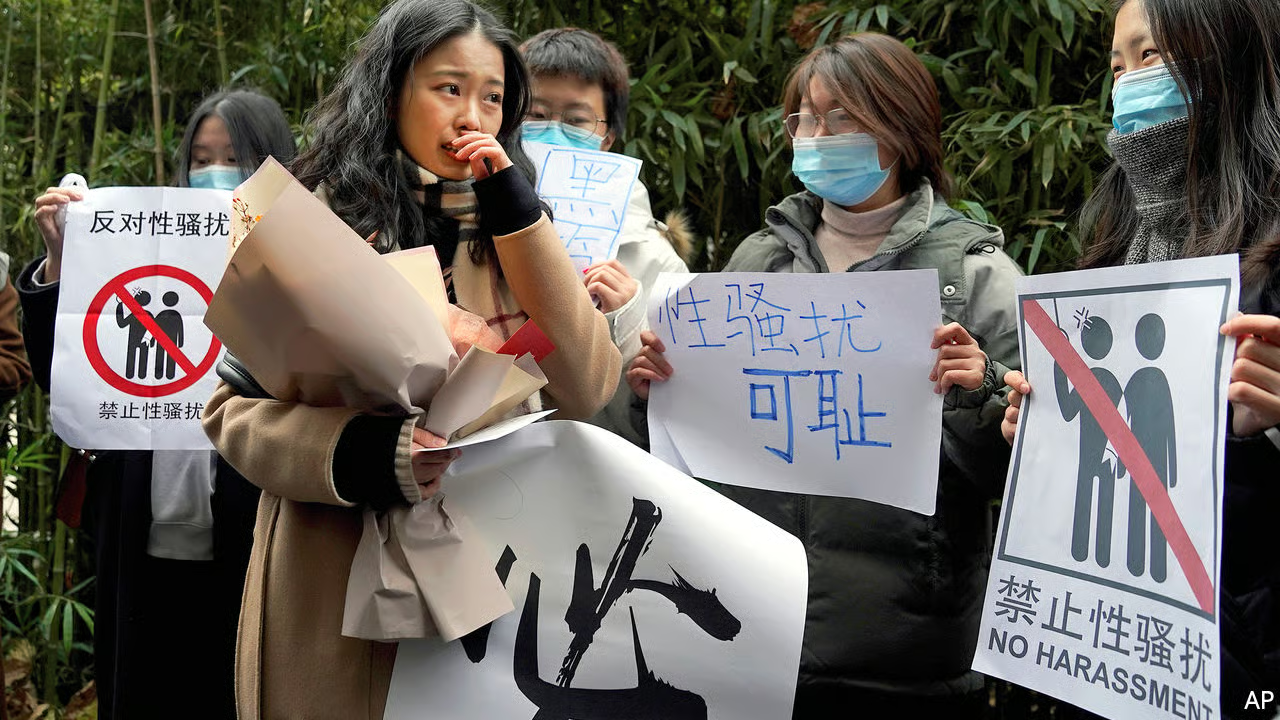
When Jasmine organises feminist activities in Beijing these days, she rarely describes them publicly as feminist events. Instead, gatherings may be presented as cultural or artistic activities, with details shared privately among trusted contacts rather than advertised openly on social media.
For activists who remember the early years of China’s MeToo movement, the change is striking. What was once an increasingly visible campaign in which survivors publicly shared experiences of sexual harassment and abuse has moved into a much more cautious and private phase.
The release of journalist and MeToo activist Sophia Huang Xueqin after five years in prison has brought renewed attention to how dramatically that environment has changed. Huang became one of the most prominent figures associated with China’s MeToo movement through her reporting on survivors and sexual harassment. She was detained in Guangzhou in September 2021, shortly before she was due to travel to Britain to begin postgraduate study.
Huang was convicted in 2024 alongside labour activist Wang Jianbing on a charge of “inciting subversion of state power”. Amnesty International has said Huang received a five-year prison sentence, while Wang was sentenced to three years and six months. Wang was released in March 2025, while Huang remained imprisoned until the completion of her sentence in September 2026.

Her release comes at a moment when the feminist movement she helped bring into public view has changed considerably. Activists and researchers describe a landscape in which open mobilisation has become substantially more difficult, while younger feminists are finding different ways to discuss gender, sexual harassment and women’s rights.
The original MeToo movement in China emerged as survivors increasingly used social media to tell their stories and draw attention to allegations of sexual harassment. Some cases generated national discussion and encouraged other women to speak publicly. The movement also reached universities and workplaces, where questions about harassment and institutional responsibility became harder to ignore.
But the space for such public campaigning has narrowed. Activists say hashtags associated with MeToo and related feminist campaigns have increasingly disappeared from Chinese social-media platforms, while discussions that might once have been conducted openly are now often moved into private networks.
Eva Liu, a researcher focusing on Chinese feminism and digital media, has described younger digital-native feminists as having less exposure to the movement’s earlier history because of the disappearance of previous online discussions. Activists now frequently experiment with alternative language to avoid automated censorship.
The process has been described as a continuing contest between those seeking to communicate and systems designed to identify and restrict sensitive content. Feminist groups have developed new expressions and indirect references, while researchers say censorship systems can quickly incorporate emerging terms into keyword lists.
For activists, this has changed not only how they communicate but also how they organise.
Jasmine says openly advertising an event about feminism or LGBT issues in Beijing can create a risk that authorities will shut it down. As a result, organisers sometimes use neutral descriptions that do not reveal the political or social themes that will be discussed once participants are together.
Such tactics reflect a broader transformation in Chinese civil society. Public mobilisation is more difficult, but activists have not necessarily disappeared. Instead, some have moved their activities into smaller communities where participants know one another and information can be shared with greater discretion.
The case of Huang illustrates the risks surrounding this environment. According to Amnesty International, she and Wang were arrested on 19 September 2021 and held for more than five months without normal access to the outside world. The organisation says their conviction followed allegations relating to private gatherings, online activities and material considered sensitive by Chinese authorities.
Human-rights organisations have criticised the prosecution and conviction. In a statement issued before Huang’s expected release, Amnesty International and other organisations called on Chinese authorities to ensure that she would be able to continue her journalism and human-rights work without surveillance, harassment or other restrictions. Amnesty also highlighted the additional four-year period of “deprivation of political rights” imposed on Huang.
The circumstances surrounding her release have therefore remained a concern for supporters. Activists have said they were uncertain about her situation and worried about the possibility of continued surveillance or restrictions after her imprisonment ended.
The Chinese government presents a different picture of women’s rights. Chinese authorities have said the country has made major progress in areas including women’s health, employment and participation in the economy, while also pledging stronger protection against sexual harassment and sexual violence.
The debate over China’s MeToo movement consequently involves both measurable changes and sharp disagreement about the political and social environment in which those changes have taken place.
For supporters of the movement, one of its most significant achievements was bringing sexual harassment into mainstream public discussion. Even where legal cases did not produce the outcomes activists sought, the willingness of women to discuss experiences of harassment changed the conversation around gender and personal rights.
Chinese feminist activist Lu Pin, who is based in New York, has argued that MeToo significantly increased awareness among women, particularly younger women, despite the difficult environment in which the movement operated.
One visible area of impact has been universities. Activists have pointed to institutional policy changes and increased awareness of sexual harassment, although they argue that progress has been more limited when cases move into the formal legal system.
The experience of Zhou Xiaoxuan became another important example of the challenges facing Chinese women who pursued sexual-harassment claims. Her case against a television presenter attracted considerable public attention, but she ultimately lost her legal action. Such cases contributed to an understanding among activists that public attention alone does not necessarily translate into legal accountability.
For the younger generation of feminists now entering the movement, the internet is also a different environment from the one that existed when MeToo first gained momentum.
Social media remains important for sharing information, documenting cases and connecting people, but activists have become more cautious about the permanence and visibility of online activity. Public posts can disappear, accounts can be restricted and keywords can become difficult to use.
That has encouraged a more fragmented form of activism. Instead of relying on a single national campaign or widely used hashtag, individuals and small networks may concentrate on supporting survivors, sharing legal information or organising discreet meetings.
The transformation does not necessarily mean that feminist activism has ended. Rather, its methods have changed in response to the conditions surrounding it.
In Beijing, Jasmine remains in contact with people who have experienced sexual harassment. She believes survivors can still receive assistance through publicity, legal support and personal networks, although those providing help must carefully consider how visible their activities should be.
The same caution can be seen in the language activists use. Terms that once openly identified feminist campaigns can be replaced by indirect expressions, cultural references or neutral descriptions. What appears to be an ordinary discussion or artistic gathering can sometimes provide a space for conversations that would be difficult to hold publicly under a more explicit label.
For observers of Chinese feminism, Huang’s release therefore represents more than the end of an individual prison sentence. It also provides an opportunity to assess how a movement that once relied heavily on public visibility has adapted to a much more restrictive digital and organisational environment.

The movement’s early activists had expected the internet to provide a powerful space for survivors to speak, connect and mobilise. Over time, many discovered that the same technology could also be closely monitored and controlled.
That lesson has shaped the new generation.
China’s MeToo movement today is less visible than it was during its most prominent period, but conversations about sexual harassment, women’s rights and gender inequality continue through smaller networks and less conspicuous forms of communication. The movement has lost some of its earlier public openness, yet the experiences and awareness generated during its rise remain part of China’s social debate.
Huang’s return comes against that complicated background. The journalist who once helped amplify survivors’ voices is now entering a feminist landscape that has been reshaped by censorship, legal pressure, changing technology and a generation of activists who have learned to operate with greater caution.
The central question is no longer simply whether women in China can speak about MeToo publicly. Increasingly, it is how those conversations can continue when the public spaces in which they once flourished have become far more difficult to navigate.
Related News:
 Undercover officer deceived women with ‘grotesque and cruel’ lies, spycops inquiry told
 Police Suspect Help in Missing Alice Springs Girl Case
 Florida Surgeon ‘Devastated’ Over Fatal Surgery Error
 Barrister Criticises Trial After Suicide Case Verdict
 Immigration Judges Fear Pressure in Trump Era
 Westminster Council Threatens Charing Cross Soup Kitchen
 BBC Warned About Missing Clothes of Murder Victim
 Cambridge Professor Jason Arday Found Dead at Home
 Five Years of Taliban Rule Leave Afghanistan in Crisis
 Internal Exclusions Surge in England’s Schools
 Nepal Flood Survivors Face Unimaginable Loss
 Nepal Tunnel Rescue Offers Hope Amid Flood Devastation
 Councils spend £125m on illegal children’s care
 Patriot Platform Raises Concern Across Britain
 Reform UK Receives Record £36m Donation From Crypto Billionaire
 Election Candidate Abuse Raises Alarm in England
 NHS Breast Care Review Finds Serious Patient Harm
 Prevent Failings Exposed After Southport Attack
 Ben Roberts-Smith Denies War Crime Allegations in First Statement
 Synagogue Arson Attempt Sparks Security Fears
 City & Guilds Sale Sparks Fees and Pay Uproar
 Walsall Rapist Jailed After Hate-Filled Online Trail
 Chornobyl Still at Risk 40 Years After Disaster
 Two Children Die in Wolverhampton House Fire Tragedy
 Judge Blocks Trump Bid for Arizona Voter Data
 Ukraine Urges UK to Seize Russian Oil Tankers
 Escobar’s Hippos May Be Moved to India Zoo
 US Court Weighs Fate of TPS for Migrants
 FBI Links Brown University Shooting to Long-Term Grievances
 Cartel crackdown raises fears of fresh violence
 US states redraw maps after voting rights ruling
 UK may ban protests amid rising antisemitism fears
 Greens Face Internal Row Over Antisemitism Claims
 China Fireworks Factory Blast Kills 21 in Hunan
 China mine blast death toll rises to 90
 Trump’s Revenge Drive Deepens GOP Divide
 Maldives Cave Diving Tragedy Raises Safety Alarm
 Victim says non-custodial rape sentence ‘rock in my face’
 Thailand Tightens Visa Rules to Curb Tourist Misbehavior
 Cornwall Van Dwellers Face Eviction in Housing Crisis
 Murder Probe Continues After Arrest Release
 New Footage Revives Peter Falconio Mystery
 Le Pen’s Popularity Holds Despite Conviction
 Teen Charged After Layla Jeffery Found Dead
 Trump Orders Signs Criticising Smithsonian Museum
 Pradhan Resigns Amid Protests
 Israeli Strike in Southern Lebanon Kills Seven
 Is America Ready for an AOC Presidential Run?
 RAF Barnham Protests Fuel Tensions in Norfolk Town
 Nepal-Tibet Flood Death Toll Rises as 2,478 Remain Missing
 British Museum Faces Questions Over Peter Thiel’s Private Bayeux Viewing
 Survivor Sues Musk’s xAI Over AI Abuse Images
 Argentina Orders Return of Nazi-Looted Painting
 Judge Allows Pentagon Firings at Stars and Stripes
 Armed Suspect Attacks Ohio Governor Candidate
 Typhoon Saudel Triggers Mass Evacuations in China
 British widow says deportation from Sweden feels like a death sentence
 New Mexico Takes Facebook to Trial Over Data Scandal
 Man Arrested in Mississippi Woman’s Death
 Israel Accused of Undermining Palestinian Life
 UK Retailers Accused of Breaking Refund Laws
 Piddington Votes for Symbolic Independence Over Asylum Plan
 Texas Charges Seven Noncitizens in Voting Crackdown
 Amnesty Finds Coordinated Abuses in Iran Protest Crackdown
 Turkey LGBTQ Crackdown Expands With New Arrests
 Fiji Declares National HIV Emergency as Cases Surge
 Yemen War Displaces 125,000 as Fighting Intensifies
 Iran School Strike Raises War Crimes Questions, UN Says
 Australia Post Worker Jailed Over Stolen Bank Cards
 Survivor Seeks Closure After Priest Dies in Prison
 Omar Proposes Bill to Redirect ICE Funding
 Gaza Strike Kills Child and Paramedic
 Texas Transfers Raise Fears for Migrant Children
 Memphis Questions National Guard Crime Surge
 Mahmood Warns Far Right Over Asylum Protests
 Disabled Travellers Seek Fairer UK Care Rules
 Saudi Pact Raises Risk of Pakistan Entering War
 Harrods Faces Dispute Over Fayed Abuse Compensation
 Lib Dems Prepare for Election Amid Reform Challenge
 Patrick Clancy speaks publicly about children’s deaths