Published: 05 October 2026. The English Chronicle Desk. The English Chronicle Online.
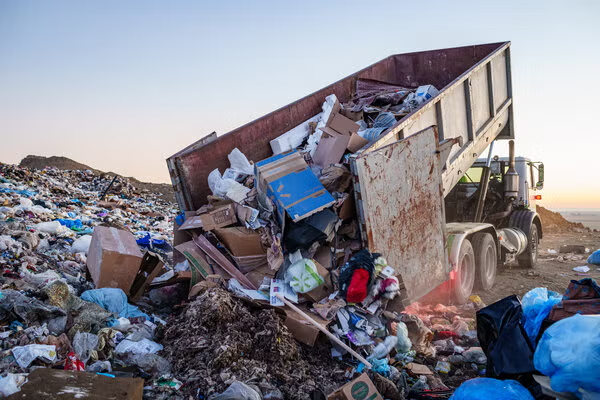
Residents living on the rural outskirts of Istanbul have spent years enduring an unpleasant smell that regularly descends over their villages, forcing families to close their windows even during the hottest nights of summer. The source, they say, is the enormous Silivri municipal landfill, where food and other organic waste decomposes and releases gases into the surrounding environment.
But investigations into the site have revealed that the problem extends far beyond an offensive odour. The landfill is releasing methane, one of the most powerful greenhouse gases, at a rate that places it among the most significant waste-sector methane sources identified anywhere in the world.
Satellite observations show that Silivri is Turkey’s largest identified methane super-emitting landfill. Researchers have estimated that the site releases an average of about 7.4 tonnes of methane every hour. The climate impact of such emissions is enormous, with the warming effect comparable to the emissions associated with roughly 1.5 million petrol-powered sport utility vehicles.

The findings have emerged at a politically sensitive moment for Turkey. The country is preparing to host the United Nations climate summit, Cop31, in Antalya in November. Methane reduction and zero-waste policies have been placed prominently on Turkey’s agenda for the international meeting, with officials presenting reductions in methane emissions as one of the fastest ways to slow near-term global warming.
For people living close to Silivri, however, the climate issue is inseparable from a more immediate quality-of-life problem.
Kemalettin Özenç, a resident of Yolçatı village, said the smell from the landfill can become overwhelming several nights a week. He described an odour so intense that residents sometimes have difficulty remaining outdoors and are forced to retreat inside their homes.
The communities surrounding the landfill have attempted to raise concerns about the problem, but many residents have been reluctant to challenge local authorities openly. Özenç said efforts to organise a petition encountered fear among residents who worried about possible consequences of publicly criticising government institutions.
The political atmosphere has added to those concerns. The Silivri area is located relatively close to a maximum-security prison where Istanbul mayor Ekrem İmamoğlu was detained after being accused of corruption in 2025. İmamoğlu and other former Istanbul municipal officials have denied wrongdoing and remain involved in legal proceedings.
Against this background, some residents have instead turned to online complaints and informal efforts to draw attention to the landfill’s impact.
Workers from İstaç, the waste management division responsible for the Istanbul metropolitan municipality’s facilities, appeared surprised when shown satellite images identifying a large methane plume close to the landfill. Because methane is invisible, the scale of the leak cannot be judged simply by looking at the site.
Fatih Arslan of İstaç acknowledged that emissions can occur from sections of the landfill that have not yet been covered with clay. He said the organisation’s priority was to cover exposed waste and capture the methane generated by decomposition.
The Silivri facility already operates a methane recovery system. According to İstaç, the landfill captures around 6,000 cubic metres of methane per hour and uses the gas to generate energy. From the company’s perspective, allowing methane to escape into the atmosphere represents not only an environmental problem but also a loss of potentially useful fuel.
Ebu Bekir Ikinci, who heads the facility, argued that waste management in Istanbul has improved dramatically compared with previous decades. He pointed to the city’s history of serious landfill problems, including a deadly methane explosion at a rubbish dump in 1993 that killed 39 people.
The disaster became part of a broader push to modernise waste management. Recep Tayyip Erdoğan, who became Istanbul’s mayor the following year, promoted improved waste collection and disposal as an important part of his administration.
İstaç officials therefore argue that the present system represents a substantial improvement over the uncontrolled dumping of earlier decades. Yet climate researchers say that comparison does not eliminate the need to address methane emissions that continue today.
Silivri is Turkey’s largest landfill, handling approximately 10,000 tonnes of waste every day. It is not, however, an isolated case.
Researchers from the University of California, Los Angeles, have identified multiple Turkish landfill sites producing exceptionally large methane emissions. Another major landfill near Şile, on the opposite side of Istanbul, has been estimated to release about four tonnes of methane an hour, equivalent in warming impact to hundreds of thousands of vehicles.
The analysis identified the 10 highest-emitting landfill sites in Turkey using satellite information. Researchers described several of the methane releases as exceptionally large even by international standards.
Cara Horowitz, who leads the UCLA Stop Methane project, said some of the Turkish sites rank among the largest individual human-made methane sources identified globally. The findings suggest that Turkey’s waste sector could represent a significant opportunity for rapid climate action.
Methane is particularly important because, although it remains in the atmosphere for far less time than carbon dioxide, it has a much stronger warming effect over the shorter term. Scientists estimate that methane contributes roughly a quarter of current global warming. Cutting methane emissions can therefore produce relatively rapid climate benefits.
That has made methane reduction a major focus of international climate policy. Turkey has promoted the waste sector as an area where immediate progress can be achieved, particularly through improved landfill management, methane capture and reductions in food waste.
Turkey’s environment minister and Cop31 president-designate Murat Kurum has emphasised the importance of reducing methane emissions, arguing that waste management provides an opportunity for countries to deliver rapid climate benefits.
Turkey’s first lady, Emine Erdoğan, has also made zero-waste policies a prominent part of her public environmental campaign. She has spoken internationally about the connection between discarded food, hunger and methane emissions and has promoted efforts to reduce waste.
Yet Turkey has not joined the Global Methane Pledge, an international initiative involving countries committed to reducing methane emissions substantially by 2030.
The country’s own greenhouse-gas reporting acknowledges that uncontrolled methane releases from landfills are a major source of emissions from the waste sector. However, questions remain about how effectively these emissions are monitored and regulated.
A Turkish emissions-trading framework introduced recently focuses primarily on carbon dioxide and does not cover certain facilities associated with biomass, including landfill operations. Environmental specialists say that methane requires dedicated monitoring because substantial releases can occur even where methane-capture infrastructure exists.
Tia Scarpelli, the waste-sector lead at Carbon Mapper, said the effectiveness of methane collection depends heavily on the design, maintenance and day-to-day operation of individual systems. Problems can arise when equipment is poorly maintained, when flares fail to operate properly or when collection systems capture only higher-quality gas while allowing other methane to escape.
Researchers say Turkey has several available options for addressing the problem. Better monitoring using satellites and ground-based systems could help authorities identify the largest leaks. Improved landfill engineering could increase methane capture, while stronger maintenance could prevent avoidable releases.
There is also a more fundamental solution: keeping organic waste out of landfills altogether.
When food and other biodegradable material is buried without sufficient oxygen, it decomposes and generates methane. Reducing the amount of organic material sent to landfill can therefore tackle the source of the emissions rather than attempting to capture the gas after it has already been produced.
Countries such as South Korea have made major progress in recycling and processing food waste, demonstrating that large-scale alternatives to landfill disposal are possible.
For Turkey, the challenge is not simply technological. Waste management has become intertwined with the country’s political divisions. Istanbul, Ankara, İzmir and several other major cities remain controlled by opposition administrations, while relations between the central government and opposition municipalities have become increasingly contentious.
That political environment could complicate efforts to determine responsibility for major methane sources and to coordinate national climate policy with municipal waste-management systems.
For residents such as Özenç, however, the debate is much more immediate. The methane detected by satellites may be invisible, but the consequences of living beside a poorly controlled landfill are not.

Communities around Silivri have spent years asking for relief from the smell and environmental impact. Residents say they want authorities to acknowledge the problem and take meaningful action rather than allowing complaints to disappear.
As Turkey prepares to welcome governments from around the world for Cop31, the country will face an uncomfortable test of its climate ambitions. Its landfill methane problem demonstrates both the scale of the challenge and the opportunity available through relatively straightforward waste-management improvements.
The same sites that are contributing significantly to climate change could also provide some of the quickest opportunities for reducing emissions. Capturing methane, improving landfill operations and diverting food waste could benefit both the global climate and the communities living closest to these facilities.
For the people of Yolçatı and neighbouring villages, such changes would bring another benefit that cannot be measured from space: the possibility of opening their windows without the smell that has troubled them for years.
Related News:
 Nepal seeks $20m climate compensation after deadly floods
 Nepal PM calls deadly flood a global climate warning
 Thai downpours shift north-westwards after Bangkok floods
 Bangkok Floods Push City to Breaking Point
 Scotland’s Climate Plans Face Scrutiny Over ‘Science Fiction’ Targets
 Ocean Warming Drives Massive Marine Life Loss, Study Warns
 Tropical Flowers Shift Blooming Due to Climate Crisis
 Evacuations Ordered as California Wildfires Spread Fast
 UK Records Earliest Spring as Nature Awakens Fast
 Queensland Braces for Potential Second Severe Cyclone Hit
 Cyclone Vaianu Forces Mass Evacuations in New Zealand
 Escobar’s Hippos May Be Moved to India Zoo
 Capitalism ‘Suicidal’, Warns Petro at Climate Summit
 Record May Heat to Cold Front in Eastern Australia
 UK Faces Mass Water Shortages by 2055, Lords Warn
 Hope for mountain bongos returns to Kenya
 UK Heatwaves Ignite Crisis of Sleep and Public Safety
 UK Seas Face Extreme Heatwave as Global Temperatures Surge
 Europe Scorched as Record Heatwaves Grip the Continent
 Venezuela Quake Death Toll Surpasses 4,000
 Three-Quarters of England’s Riverbanks Still Off Limits
 Powerful 7.7-Magnitude Earthquake Hits Eastern Indonesia
 Wildfires rage across Europe as hundreds arrested in France
 Battery Fires Cost UK Recycling Industry £1bn
 Nepal-Tibet Flood Death Toll Rises as 2,478 Remain Missing
 Nepal Rescuers Race to Save Hundreds Trapped Underground
 UN Warns Record El Niño Could Supercharge Global Heat
 Nepal Flood Survivors Face Unimaginable Loss
 Nepal Tunnel Rescue Offers Hope Amid Flood Devastation
 Typhoon Saudel Triggers Mass Evacuations in China
 Europe Faces Climate Reckoning After Extreme Summer
 Japan Braces for Dujuan as Storm Threat Grows
 Typhoon Dujuan Leaves Four Dead in Japan
 Super El Niño Threatens Hundreds of Thousands of Lives
 Chinese Hybrid Car Surge Raises EU Auto Industry Concerns
 Norfolk Broads Housing Levy Faces Environmental Criticism
 UN Warns of Narrowing Window to Restore Forests
 Swiss Glaciers Lose Nearly One-Fifth of Ice in Five Years
 Europe’s Record Heat Summer Signals Climate Risks
 Berlin App Helps Residents Protect City Trees
 Edinburgh Glasshouses Reopen After Major Restoration
 Polanski Says Leadership Not Tied to By-election Result
 ‘Extinct’ Antelope Returns to Sahara, Bringing Hope
 Polycrisis Anxiety Leaves Many Feeling Trapped in the Present
 Judi Dench Champions Fight to Save London’s Green Spaces
 Half the World’s Largest Cities Face Rising Water Stress
 Chikungunya Spread in Europe Climbs as Climate Warms
 Greenpeace $345m Ruling Sparks Appeal Battle
 Welsh Water Faces £44.7m Enforcement Over Sewage Breaches
 ‘Drinking from a Fetid Pond’: Superbug Genes in Lough Neagh
 UK Energy Reform Could Cut Bills by £200
 Extreme Weather: Europe Shivers as Cyclone Narelle Hits
 Middle East Deluge: Freak Storms Bangle Desert Nations
 Medellín’s Green Revolution: A Global Climate Blueprint
 Robots Outpace Humans in Beijing Half-Marathon
 Urban Flood Crisis: A Growing Threat to English Homes
 Coalition pushes fossil fuel phaseout plan
 EU Deal May Force UK Ban on Cancer-Linked Weedkiller
 Britain’s Quest to Crown Its Ultimate Butterfly Superstar
 Maldives Cave Diving Tragedy Raises Safety Alarm
 Pope Meets Families in Italy Toxic Waste Zone
 Discontent grows around Putin amid war strain
 US Courts Back Trump on Park Signage Removals
 Sydney Records Hottest June Since 1859 as Expert Warns New High a ‘Signature’ of Global Warming
 Southern Europe Reels as Wildfires Force Mass Evacuations
 Britain’s Mini Fan Craze Sparks Major Waste Crisis
 Colombia’s Fight Over Fossil Fuels
 US Chemical Accidents Rise as Protections Are Rolled Back
 UK Schools Struggle as Classrooms Top 40C
 Olympus Awaits Unesco Heritage Recognition
 Houthis Strike Saudi Arabia as Middle East Tensions Rise
 Burnham unveils £65m drought aid for farmers
 Swedish Mining Push Puts Sami Land Rights Under Pressure
 Heathrow Expansion Faces New Climate Conditions Over CO₂
 Tropics May Wait Longest for Net-Zero Climate Benefits
 Trump gives Xi red-carpet welcome as trade truce extends
 Xi urges Trump to avoid US-China military conflict
 US Sends Third Carrier to Middle East
 Yemen government launches offensive against Houthis