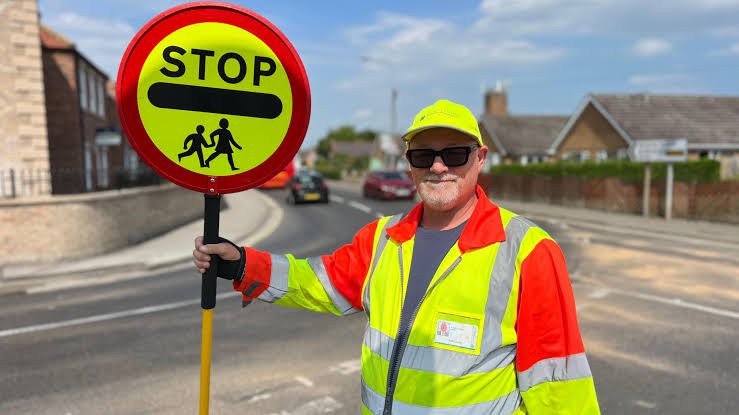
The future of Britain’s traditional school crossing patrol officers, widely known as lollipop people, is facing growing uncertainty as local councils struggle to recruit workers amid financial pressures, staffing shortages and rising vacancies. These familiar figures, who have helped generations of children cross busy roads safely, could gradually disappear from communities as authorities consider alternative arrangements to maintain road safety outside schools.
Recognisable by their bright yellow high-visibility uniforms and distinctive circular stop signs, school crossing patrol officers have long been an important part of everyday life in British towns and cities. Beyond helping children navigate traffic during busy school hours, they provide reassurance to parents, support local communities and often become familiar faces in the lives of pupils and their families. However, a combination of low pay, limited working hours and financial constraints affecting local authorities is threatening the future of the service.

The Recruitment and Employment Confederation (REC) has reported a significant increase in vacancies for school crossing patrol positions in recent weeks. The roles are among those experiencing some of the sharpest increases in recruitment difficulties, alongside sales positions and examination invigilator jobs. The growing number of vacancies has raised concerns about whether councils will be able to maintain adequate staffing levels at school crossings, particularly in areas where children regularly travel along busy roads.
One of the major difficulties is that local authorities are not legally required to maintain school crossing patrol services. This means councils facing financial difficulties can choose to leave positions unfilled, reduce the number of patrol locations or replace human patrol officers with permanent road infrastructure. Although such decisions may help reduce operating costs, they have also raised questions about the safety and wider community benefits associated with the traditional service.
The situation has become particularly noticeable in the East Riding of Yorkshire, where the local council recently revealed that approximately one-quarter of its school crossing patrol locations were unstaffed. Authorities acknowledged that the number of people applying for these positions had declined and said they were examining long-term alternatives at certain locations.
Among the options being considered are infrastructure improvements, including the installation of zebra crossings. Such facilities could provide a permanent arrangement for pedestrians without requiring councils to employ staff for daily patrol duties. However, the proposals have prompted concern among parents who believe that physical road markings alone may not offer the same level of protection as a trained individual actively supervising children crossing the road.
Parents and carers in Hessle have expressed concerns about the safety of children using crossings without dedicated patrol officers. They have argued that the absence of familiar crossing staff creates additional risks, particularly during busy school arrival and departure periods when traffic levels can be high.
The East Riding council explained that some vacancies had remained unfilled for extended periods because no suitable applicants had come forward, while other positions had become available following the retirement of existing employees. The authority acknowledged the recruitment challenges and suggested that the nature of the work might make the positions less attractive to potential candidates.
A council spokesperson explained that school crossing patrol officers are generally required to work relatively short shifts in the morning and afternoon, rather than completing a conventional full working day. The positions also offer comparatively low pay because the number of working hours is limited. In addition, employees must work outdoors in different weather conditions throughout the year.
These circumstances can make it difficult for people to combine the positions with other employment or personal responsibilities. Although the council continues to encourage residents to apply, the limited hours and financial rewards remain significant obstacles to attracting new workers.
Similar challenges have emerged in Redcar and Cleveland, where elected representatives have previously raised concerns about shortages in school crossing patrol services. During a council meeting in March, borough council leader Alec Brown acknowledged that maintaining a complete workforce was becoming increasingly difficult.
He explained that authorities could not simply rely on having a reserve group of trained workers ready to fill vacancies whenever positions became available. Recruiting suitable candidates and ensuring that they could undertake the responsibilities of the job required time and continued effort.
A spokesperson for Redcar and Cleveland Borough Council said vacancies were advertised through the authority’s recruitment channels and, where appropriate, directly through local schools. Although the council continued to receive a reasonable number of applications, the relatively low number of weekly working hours remained one of the biggest recruitment challenges.
The authority reported that three applicants were progressing through the recruitment process at the time and expected that appointing them would leave only one vacancy within the service. The development suggests that recruitment remains possible in some areas, although maintaining a consistent workforce continues to require considerable attention.
The debate has also attracted political attention. Tom Hayes, the Member of Parliament for Bournemouth East, has been campaigning to protect local school crossing patrol services and warned that the problem could eventually affect communities across the country.
Hayes believes the disappearance of lollipop people would represent more than the loss of a road safety service. In his view, these positions are among the everyday public services that help maintain relationships between residents and strengthen the sense of community in British neighbourhoods.
He has argued that many familiar community services are gradually disappearing as councils attempt to reduce spending or introduce more efficient alternatives. Libraries, children’s centres, playgrounds and other local facilities provide opportunities for people to meet, exchange experiences and develop relationships. Losing these everyday connections, he suggested, could contribute to greater social isolation.
The working conditions faced by school crossing patrol officers may also be becoming more difficult because of aggressive behaviour from some motorists. Reports of dangerous driving and road rage have raised concerns about the personal safety of workers who regularly stand in traffic to protect children.
Some local authorities have responded by providing crossing patrol officers with body cameras to help protect them and record incidents involving aggressive drivers. Such measures demonstrate that the responsibilities of the job extend beyond managing traffic and require employees to deal with potentially confrontational situations.
Despite these difficulties, some crossing patrol officers remain deeply committed to their work because of the relationships they develop with local families.
Ally Mitchell, who works as a school crossing patrol officer in Edinburgh, originally accepted the position after losing his job in the video games industry. He initially viewed the role as temporary employment while searching for a full-time opportunity. However, he enjoyed the experience so much that he continued working as a crossing patrol officer even after securing employment in the charity sector.
Mitchell explained that the additional income was important, but the strongest motivation for remaining in the position was the sense of belonging he developed within his local community. He valued the opportunity to help children, greet parents and make a positive contribution to people’s daily lives.
He believes school crossing patrol officers perform a role that extends beyond road safety. Their regular presence creates familiar human connections in neighbourhoods where people may otherwise have limited opportunities to interact.
According to Mitchell, a crossing patrol officer can become someone children recognise and trust, while parents often appreciate having a familiar person looking out for their children’s safety. Such relationships cannot necessarily be recreated through traffic signals, road markings or other infrastructure improvements.
Financial pressures have already resulted in some councils deciding to remove vacant crossing patrol positions. Durham County Council, controlled by Reform UK, decided last year to scrap unfilled crossing guard roles as part of a wider cost-saving programme. The authority reportedly argued that the positions had remained vacant for a prolonged period without any recorded incidents.
Data obtained by the GMB trade union through freedom of information requests also highlights the longer-term decline in the profession. The number of school crossing patrol officers across England, Scotland and Wales fell from 7,128 in the 2009-10 period to 5,047 in 2017-18. This represents a reduction of 2,081 officers over eight years and demonstrates the difficulties facing a service that has historically played an important role in protecting schoolchildren.
Elsewhere, Bournemouth, Christchurch and Poole Council postponed proposed reductions to its crossing patrol services earlier this year following a public campaign to protect the positions. The authority had previously moved towards upgrading certain school crossing locations with permanent pedestrian crossings in 2024.
A council spokesperson argued that permanent crossings provide a reliable facility that remains available throughout the day and night, benefiting schoolchildren and the wider community. However, the authority acknowledged that replacing a familiar crossing patrol officer also means losing an established presence that many local residents value.
For campaigners, the central issue is finding a balance between financial efficiency and the wider responsibilities of local government. Permanent crossings can provide important infrastructure, but they cannot necessarily offer the same reassurance, personal attention and community relationships created by an individual who regularly helps children cross the road.

As councils continue to face financial pressures, the future of school crossing patrol services will depend on their ability to attract new workers, maintain funding and identify appropriate alternatives where recruitment proves unsuccessful. Without effective action, more communities could lose a familiar part of their school routines.
The growing shortage therefore raises an important question about the value Britain places on its everyday public services. While technological and infrastructure improvements can make roads safer, the human relationships developed through familiar community roles remain difficult to replace. For many parents, children and residents, losing lollipop people would mean losing not only a trusted road safety presence but also one of the small everyday connections that help hold neighbourhoods together.
Related News:
 NHS Safety Fears as Nurses Cover Doctor Gaps
 Polanski Says Leadership Not Tied to By-election Result
 Milburn Proposes Pre-Apprenticeship Route for Young People
 UK Passport Rules Leave Family Facing Separation
 Up to 20 English Maternity Units Face Possible Closure
 UK Pledges Stronger Protections for Disabled Air Passengers
 Bradford Rail Hub Promises Faster Northern Connections
 Support for NHS Founding Principles Declines Across UK
 Older Worker Training Plan Faces Business Backlash
 Essex Volunteer Accuses Reform Councillor of Nazi Remark
 MPs Urge UK to Write Off Most British Council Debt
 UK Apologises to Ukrainian Refugees Over Russian GCSE
 UK Review Urges Jobs Revolution for Disabled Youth
 UK Employers to Be Forced to Publish Job Salaries
 TUC Chief Urges Major Investment to Tackle UK Youth Jobs Crisis
 Burnham Unveils Major Plan to Tackle Youth Unemployment
 England’s Special Needs Support Faces Breaking Point
 Student Loan Crisis Sparks Outrage Among Graduates in England
 Kezia Dugdale Warns of Possible Reversal of Equal Rights Gains
 John Terry Faces Backlash Over Political Posts
 Tractor Breakdown Tests Lincolnshire Farmers
 Farage and Reform UK Reshape British Politics
 Starmer Leadership Under Pressure After Setbacks
 UK Nations Brace for Potential Breakup Amid Reform Surge
 British Teens in EU Face Soaring UK University Fees
 UK Schools Struggle as Classrooms Top 40C
 London Tube Heat Reaches Dangerous Levels
 Three-Quarters of England’s Riverbanks Still Off Limits
 Burnham unveils £65m drought aid for farmers
 Queue row erupts on Wales’ highest mountain
 Ghent Professors Questioned Cofnas Appointment
 RAF Barnham Protests Fuel Tensions in Norfolk Town
 Internal Exclusions Surge in England’s Schools
 Councils spend £125m on illegal children’s care
 Mahmood Warns Far Right Over Asylum Protests
 Disabled Travellers Seek Fairer UK Care Rules
 Lib Dems Prepare for Election Amid Reform Challenge
 Headteachers Warn New Ofsted System Is Harming Wellbeing
 Labour Apprenticeship Scheme Faces Slow Start
 King Refers Jamaica Slavery Petition to Privy Council
 Roman Finds Reveal Bath’s Suburban Past
 Labour Urged to Rebuild Progressive Coalition
 Free Speech Emerges as Key UK Election Issue
 Avanti West Coast Set for Public Ownership in March
 French Student Protests Escalate Into Violent Clashes
 UK University Strikes Spread as Financial Pressure Grows
 Burnham Opens Door to Possible UK Return to EU
 Drumcree Talks Falter as Legal Challenge Deepens
 UK-France Returns Deal Faces Expiry as Talks Stall
 Green Party faces dispute over Zionism motion
 Badenoch Raises Prospect of 2027 UK Election
 French School Protests Escalate as 400 Schools Close
 Gosport Protesters Clash With Police Over Migrant Rescue
 Luton Residents Reject Claims of ‘No-Go Zones’
 Labour Wins Key London By-election as Greens Fall Short
 French Students Protest Poor Conditions in Paris Suburbs
 UK Greens Face Crisis Over Zionism and Extremism Row
 Greta Thunberg Backs French Students in School Protests
 Jenrick Defends Farage Amid Fresh Reform Racism Claims
 UK Plans Higher Training Costs for Older Apprentices
 Middleton Revitalisation Blueprint for UK Towns
 UK-EU Youth Mobility Scheme Delayed Over Fee Row
 Burnham Launches Crackdown on Transit Noise
 UK Land Registry Plan Faces Opposition From Landowners
 Yvette Cooper Reverses NHS Patient Watchdog Abolition Plan
 Spain Mourns 68 Dead After High-Speed Train Crash
 King Charles Faces Reparations Protests at Antigua Summit
 Avanti West Coast Faces £70m Refund Bill
 Australia Reviews UK Visa Rules Amid Worker Influx
 Exiled Journalists Defy Putin’s Growing Media Crackdown
 Early-Release Prisoners Face Rising Risk of Homelessness
 EU Citizens Sue Home Office Over UK Residency Rights
 Burnham’s Christmas Homelessness Pledge Faces Uncertainty
 EU Border System Errors Put Britons at Risk of Travel Bans
 Ilse Aigner Set to Make German History as First Female President
 Hackney Mayor Accuses Home Office of Free Speech Assault
 Burnham Weighs Tax Cuts to Boost Youth Employment
 London Car Use Set to Rise 10% Over Next Decade
 UK School Trust Pays Compensation Over Palestine Badges
 UK and EU Near Major Post-Brexit Reset Deal