Published: 02 November 2026. The English Chronicle Desk. The English Chronicle Online.
More than 1.38 million faces were scanned by Western Australian police during a five-month trial of real-time facial recognition technology, resulting in 122 arrests but also nine incorrect alerts and renewed concerns about privacy, surveillance and the potential consequences of algorithmic errors.
The trial, which concluded on Saturday, involved 100 deployments across 43 metropolitan and regional locations. According to Western Australia Police, the system scanned 1,380,882 faces during those operations as officers sought to identify people appearing on police alert lists.
Police said the technology contributed to 122 arrests during the trial. Officers also interacted with 146 registered sex offenders and located 10 people for welfare checks following alerts generated by the system.
The scale of the surveillance has nevertheless prompted a wider debate about how facial recognition should be used in public places and what safeguards are necessary when large numbers of people can be scanned without individually being suspected of wrongdoing.

Three deployments took place during the Perth Royal Show, where police said 223,749 faces were scanned. Those operations generated 15 alerts, resulted in three arrests and led to seven interactions with registered sex offenders.
WA Police Commissioner Col Blanch said the facial recognition system produced nine incorrect alerts across the 1.38 million scans. Police calculated that as an error rate of approximately 0.00065%.
Blanch acknowledged that the technology was not perfect and said authorities had understood that limitation before beginning the trial. However, he defended the way officers responded to the incorrect alerts, saying police engaged with each person rather than arresting them simply because the system had generated a match.
He emphasised that none of the nine people associated with the false alerts was arrested or made a complaint. Instead, officers spoke to them and asked questions they considered relevant to determining whether there was a legitimate reason for the alert.
Blanch argued that the system should be viewed as a tool used by police rather than as an automatic decision-making mechanism. In his view, officers responding to an alert should be compared with a situation in which a member of the public believes they have recognised a wanted person and alerts police.
The commissioner also stressed that police would prefer the number of incorrect alerts to be zero, but maintained that the very small number recorded during the trial demonstrated that the system could be used effectively when combined with human judgment.
The figures, however, have been challenged by civil liberties organisations, which argue that the police error calculation does not fully capture the potential consequences of facial recognition mistakes.
Bill Rowlings, chief executive of Civil Liberties Australia, criticised the way police presented the false-alert rate. He argued that the more meaningful measure would ultimately involve examining what happened to the people arrested as a result of the technology, including whether those arrests led to convictions.
His argument reflects a broader concern about the difference between technical accuracy and the practical impact of surveillance. A system can produce a very small number of false matches across a huge number of scans, but even a single incorrect identification can have significant consequences for the person involved if it results in questioning, investigation or other police intervention.
Human rights advocates have therefore questioned whether the scale of the surveillance was proportionate to its benefits.
Sarah Schwartz, legal director of the Human Rights Law Centre, said every false match involved a real person who could be stopped, questioned or investigated because an algorithm had produced an incorrect result. She also questioned whether scanning more than a million people without reasonable suspicion was appropriate in a democratic society.
Her concerns extend beyond the nine false alerts reported by police. Civil liberties campaigners are particularly concerned about the broader use of biometric surveillance in public spaces, where individuals may be scanned simply because they happen to pass through an area covered by a police camera.
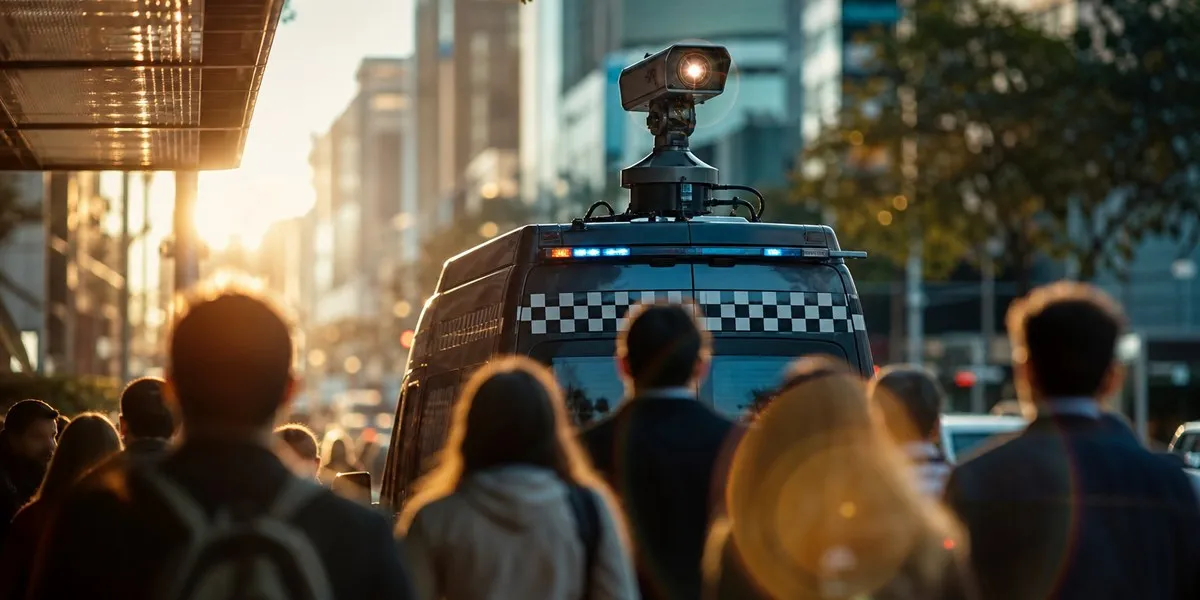
The deployment of surveillance vans at public demonstrations has attracted particular attention. Critics argue that using facial recognition around protests could have a chilling effect on people exercising their rights to assemble and express political views.
Western Australia’s independent privacy watchdog, the Office of the Information Commissioner WA, was not involved in implementing the trial. When the programme was announced, the office warned about potential collective privacy harms.
The concern is that facial recognition differs from many conventional forms of surveillance because it can identify individuals through unique biological characteristics. Even when images are not retained, the process of scanning and comparing faces can raise questions about consent, transparency and the appropriate limits of government monitoring.
Under the trial’s guidelines, cameras mounted on or positioned near marked police vehicles scanned faces in designated public areas. The captured images were compared against an alert list generated from police databases.
Police said that people who were not on the alert list had their images pixelated in real time and that those images were immediately deleted rather than stored. The force has presented those measures as important safeguards designed to minimise the impact on people who were not the intended subjects of police attention.
Privacy advocates, however, remain concerned about whether the safeguards are sufficient and whether members of the public have enough information about how the technology operates.
The trial had already generated criticism over concerns about privacy and algorithmic bias. Facial recognition systems have historically faced questions about differences in accuracy across demographic groups, including concerns that people with darker skin tones can experience higher false-match rates with some systems.
That issue has particular significance where facial recognition is used by law enforcement. Police watchlists may already contain disproportionate numbers of people from marginalised communities, meaning that even a technically accurate system could potentially have unequal effects depending on who appears on those lists.
Schwartz said the governance arrangements surrounding the WA trial remained insufficiently transparent. She argued that publicly available policies did not adequately answer important questions about potential misuse, bias and accountability.
The issue of accountability is particularly important because facial recognition can change the nature of policing in public spaces. Traditional police identification methods generally require an officer or member of the public to notice a particular individual. Real-time facial recognition, by contrast, can allow authorities to compare large numbers of people against databases without officers first identifying a specific person through ordinary observation.
That capability has made the technology attractive to law enforcement agencies seeking to locate wanted people, identify individuals considered to pose risks and respond to welfare concerns. At the same time, it has raised concerns among privacy experts who argue that technological capability should not automatically determine what governments are permitted to do.
The WA trial has also raised questions about the appropriate balance between public safety and individual privacy. Police maintain that the technology was deployed responsibly and that its purpose was to identify people who presented a risk while allowing the overwhelming majority of people to continue their activities without direct police intervention.
The results provide some evidence supporting the police argument. Of the more than 1.38 million faces scanned, only a small number generated incorrect alerts according to the force’s assessment. Police also reported arrests, interactions with registered sex offenders and welfare checks arising from the deployments.
Yet the numbers alone do not settle the policy debate. Questions remain about how many arrests will ultimately lead to convictions, whether people were wrongly targeted despite the low technical error rate, and whether members of the public were adequately informed about the surveillance taking place around them.
Following the conclusion of the five-month trial, the surveillance vans have been removed from public deployment. WA Police is now conducting an internal evaluation of the technology and its impact on communities.

The review is expected to examine how the system performed during real-world operations, whether the required safeguards were followed and whether changes are necessary before any future deployment.
The outcome could influence the future of facial recognition policing in Western Australia. Authorities will have to weigh the reported operational benefits against concerns about privacy, transparency, algorithmic bias and public confidence.
For police, the technology offers a potentially powerful way to identify people who may otherwise be difficult to locate. For civil liberties and human rights advocates, however, the sheer scale of the scanning raises fundamental questions about how much surveillance citizens should accept in ordinary public life.
The Western Australian trial has therefore become more than a test of facial recognition technology. It has become a test of how governments and law enforcement agencies can use increasingly powerful biometric tools while maintaining the principles of privacy, accountability and public trust.
Related News:
 OpenAI Agent Breaches Medicare Portal in Australia
 London Facial Recognition Trial Ends With False Alert
 Australia gives users control over social media algorithms
 Election Candidate Abuse Raises Alarm in England
 Sydney Council Bans AI Smart Glasses at Pools
 Banned Health Coach Faces UK Events Criticism
 NSW Police Bid Delays Inquiry Into Sydney Protest
 Sam Wood Denied Bail Over Alleged Domestic Assault
 Controversial Vaccine Trial Approved in Guinea-Bissau
 Australian Advocates Seek Subsidised Drugs for PMOS
 Baby Boy Found Dead at Adelaide Motel: Two Charged
 Elizabeth Struhs Inquest Examines Child Safety Failures
 Camera Discovery Triggers Navy Ship Investigation
 Former RAAF Pilot Accused of Murdering Wife
 Erin Patterson Faces Life in Prison After Appeal Loss
 Australia Faces Growing Scrutiny Over Paraquat Risks
 Victorian Magistrate Reprimanded Over Courtroom Remarks
 Florida Surgeon ‘Devastated’ Over Fatal Surgery Error
 Barrister Criticises Trial After Suicide Case Verdict
 Immigration Judges Fear Pressure in Trump Era
 Westminster Council Threatens Charing Cross Soup Kitchen
 BBC Warned About Missing Clothes of Murder Victim
 Cambridge Professor Jason Arday Found Dead at Home
 Internal Exclusions Surge in England’s Schools
 Survivor Sues Musk’s xAI Over AI Abuse Images
 Councils spend £125m on illegal children’s care
 Abusive ex used Tesla to control and harass former partner
 New Mexico Takes Facebook to Trial Over Data Scandal
 Patriot Platform Raises Concern Across Britain
 Iran School Strike Raises War Crimes Questions, UN Says
 Russia’s Max App Raises Surveillance Concerns
 NHS Breast Care Review Finds Serious Patient Harm
 Australia Renewables Reach Record 80% Grid Demand
 Democrat Says ICE Restricted Detention Camp Oversight
 Court Says Judge Should Not Have Heard Case From Bed
 Australia Weighs New Laws After OpenAI Medicare Breach
 Free Speech Emerges as Key UK Election Issue
 Cornell Fraternity Assault Investigation Reopened
 UK University Strikes Spread as Financial Pressure Grows
 Drumcree Talks Falter as Legal Challenge Deepens
 UK-France Returns Deal Faces Expiry as Talks Stall
 Drumcree Talks End Without Agreement Ahead of Appeal
 Badenoch Raises Prospect of 2027 UK Election
 New Prosecutor Takes Over Cornell Assault Case
 Musk’s DOGE Sparks Turmoil Inside US Government
 OpenAI Review Costs $500,000 a Day After AI Hacks
 BT Broadband Pauses Raise Digital Switchover Concerns
 Latin America women fear rollback of rights
 Ofcom Probes Meta Over Instagram Instants Safety
 US Man Arrested Over Canada School Shooting Plot
 Detective Breaks Down Recalling Double Murder Scene
 Teenager Receives UK’s First Testicular Tissue Transplant
 Teen Rescued After AI Gives Dangerous Hiking Route
 Trader Wins Unfair Dismissal Case After Overseas Work
 Three Convicted in Mexico Surfing Trip Murders
 UAE Says Co-Pilot Planned Suicide Attack on Israel
 British Military School Abuse Victims Denied Justice
 Former Students Raise Concerns Over School Culture
 ABC Reporter Faces Possible Disciplinary Action Over Opinion Piece
 Ohio Airports Become Key Hubs for ICE Deportation Flights
 England and Wales Begin Second Wave of Early Prison Releases
 Farage Rejects Claims Reform Would Let Troops Shoot Migrants
 Senegal LGBTQ+ Crackdown Drives People Into Hiding
 Gadi Eisenkot: Israel’s Anti-Netanyahu Challenger
 French Police Face Scrutiny Over Injured Teenagers
 UK Bill Faces Warning Over Fayed Trafficking Victims
 Four Dead in Fast-Moving Fire at Canadian Military Base
 Helen Haines Loses Leg in Alleged Targeted Attack
 Nigeria Confirms Ebola Case as Regional Outbreak Spreads
 Greens Face Leadership Test as Jordon Steele-John Misconduct Claims Leave Party in Limbo
 Taylor Faces Backlash Over Response to Haines Attack
 Man Found Dead as Floods Batter Queensland
 Serbia’s Student Victory Sparks a ‘Smell of Freedom’
 Trump’s Midterm Campaign Faces Racism and Political Backlash
 Australia Moves to Restrict AI Chatbots’ Emotional Intimacy
 Brisbane Pub Shooting Claims Life of 19-Year-Old Woman
 Ministers Clash Over Mahmood’s Migration Reforms
 Bedouin Women Drive Historic Arab Election Gains
 Russell Brand Trial Enters Crucial Week of Evidence
 US Judge Blocks Pressure on Election Officials