Published: 01 October 2026. The English Chronicle Desk. The English Chronicle Online
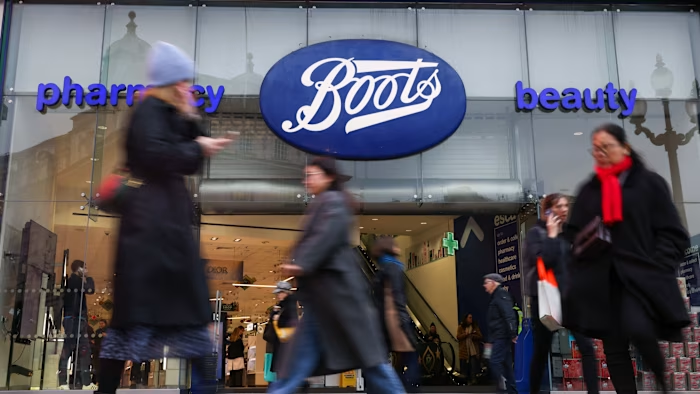
The private equity owner of Boots is reportedly moving closer to a potential sale of the UK pharmacy chain to the Canadian branch of the billionaire Weston family in a deal that could value the business at about $9bn, or roughly £7bn.
Sycamore Partners, which acquired Walgreens Boots Alliance for $23.7bn in 2025, is understood to be in advanced discussions with the Weston family over the future ownership of Boots. If negotiations conclude successfully, the transaction could be completed as early as next week, although the deal remains subject to final agreements and other conditions.
A sale would bring the Canadian branch of the Weston family back into Britain’s high street retail sector after it previously owned Selfridges, one of the country’s best-known department store groups. The family sold Selfridges as part of a deal worth about £4bn in 2022.
The possible acquisition would also place Boots under the ownership of a family with extensive experience in grocery, pharmacy and retail operations in Canada. The Canadian Weston interests include major supermarket and pharmacy businesses, giving the family a substantial presence across consumer retail and healthcare-related services.

The Weston family has also maintained a significant connection with the UK through its separate British business interests. The UK branch operates independently through its own investment structure and is associated with Associated British Foods, the company behind a range of major consumer brands and the majority owner of Primark.
For Boots, a change of ownership would represent another major stage in a long and complicated corporate history. The pharmacy chain has changed hands several times over the past two decades as international companies and private equity investors have sought to reshape the business.
Boots traces its origins back to Nottingham, where John Boot established the business in 1849. From its early beginnings as a pharmacy operation, it developed into one of Britain’s largest high street healthcare and beauty retailers.
The company expanded substantially over generations before undergoing a series of major corporate transactions in the 21st century. In 2006, Boots combined with Alliance UniChem to create Alliance Boots, bringing together two significant European healthcare and pharmacy businesses.
The combined company was subsequently acquired by private equity firm KKR in 2007. Walgreens, the major US pharmacy group, later purchased a 45% stake in Alliance Boots in 2012 before completing the full takeover in 2014.
That acquisition created Walgreens Boots Alliance, which became one of the world’s largest pharmacy-led retail groups. Boots remained one of its most recognisable businesses and continued to operate an extensive network of stores throughout Britain.
The latest potential transaction follows Sycamore Partners’ acquisition of Walgreens Boots Alliance last year. After taking control, the private equity firm began reorganising the wider group and separating its major businesses into individual companies.
The restructuring has fuelled expectations that Boots would eventually be sold as a standalone business. Sycamore has already explored a number of potential buyers as it considers the next stage of its investment strategy.
Earlier this year, Sycamore attempted to reach an agreement with Australia’s Sigma Healthcare. That proposed transaction was understood to have valued Boots at approximately $10bn, but the negotiations did not result in a completed sale.
The reported discussions with the Weston family therefore represent another attempt by Sycamore to find a new owner for the British pharmacy chain. A transaction at around $9bn would place a substantial value on the business, although the final price could change depending on the terms ultimately agreed.
Boots’ scale makes any change in ownership significant for Britain’s retail and healthcare sectors. The company operates around 1,800 stores across the UK and employs approximately 51,000 people.
Around 6,000 employees are based at its headquarters in Beeston, near Nottingham, making Boots an important employer in the region as well as a major national retailer.
Its stores provide pharmacy services alongside health, beauty and personal-care products, giving the company a distinctive position between traditional retail and healthcare. Its large physical network also gives it a presence in communities across the country where customers rely on local pharmacies for medicines and advice.
The business has also been attempting to benefit from changing consumer demand. In its most recent reported annual results, Boots recorded revenue of approximately £7.5bn for the year ending in August 2025, representing growth of 3.2%.
Pre-tax profit increased by about 25% to £337m during the same period. The company attributed part of the improvement to strong demand for weight-loss medicines and beauty products.
The performance provides important context for the reported sale discussions. Despite the structural changes affecting the wider Walgreens Boots Alliance group and the uncertainty surrounding its ownership, Boots has continued to generate substantial revenue from its combination of pharmacy, healthcare and retail activities.
Demand for weight-management treatments has become an increasingly important area for pharmacy businesses. At the same time, beauty products have remained a significant source of sales as retailers seek to expand beyond traditional pharmacy services.
For a prospective buyer, Boots’ established brand, nationwide store network and large customer base could therefore offer opportunities for further development. However, ownership of such a large business also comes with considerable operational responsibilities, particularly because pharmacy services operate within a closely regulated environment.
The potential involvement of the Weston family could also bring a different ownership model to Boots. Unlike a conventional corporate acquisition, a family-backed investment may place greater emphasis on long-term ownership and retail operations, although the eventual strategy would depend on the terms of any transaction and the family’s plans for the business.
The Westons have extensive experience in consumer-facing businesses. Their Canadian interests include Loblaws, one of the country’s largest grocery businesses, and Shoppers Drug Mart, a major pharmacy chain. Their previous ownership of Selfridges also gave the family direct experience of operating a major UK retail brand.
Selfridges was eventually sold in 2022 after the Weston family had owned the department store group for many years. A return to the UK through Boots would consequently mark a significant re-entry into the country’s high street retail market.
The reported negotiations also illustrate the continuing interest of private equity investors in large established consumer businesses. Sycamore’s acquisition of Walgreens Boots Alliance was followed by a process of separating the wider organisation into several standalone businesses, allowing individual assets to be evaluated and potentially sold independently.
Boots has become one of the most prominent assets within that restructuring. Its combination of physical stores, pharmacy services, healthcare products and beauty operations gives it a broad commercial base, but its size means that any ownership transition would attract close attention from employees, suppliers, regulators and customers.
For staff, a change of ownership could raise questions about the company’s future investment plans, store strategy and employment structure. However, there has been no confirmed indication that a potential Weston acquisition would result in specific changes to Boots’ workforce or store network.

Similarly, the reported $9bn valuation remains subject to negotiations. Until a formal transaction is announced, the final price, ownership structure and future strategy cannot be regarded as settled.
The possible sale nevertheless marks another significant chapter in the history of a business that has repeatedly changed ownership while remaining a familiar presence on Britain’s high streets.
If the Weston family completes the acquisition, Boots would return to an ownership structure with deep experience in pharmacy and retail and renew the family’s commercial presence in the UK. For Sycamore Partners, meanwhile, the transaction would represent another step in the process of reshaping the businesses acquired through Walgreens Boots Alliance.
The final outcome will depend on whether the parties can agree on the remaining commercial terms and complete the necessary stages of the transaction. Until then, Boots remains under Sycamore’s ownership, while the reported negotiations provide an indication of the direction in which the pharmacy chain’s corporate future may be heading.
Related News:
 Billionaire Chris Rokos poised to leave UK
 Oil nears $100 as Saudi attacks shake markets
 JPMorgan Boss Warns Against UK Bank Tax Rise
 Thames Water Revises Oxfordshire Mega-Reservoir Plan
 UK Trade Losses Grow Without EU Product Deal
 Poundland Rescue Bid Could Protect 11,000 Jobs
 EasyJet Takeover Sparks Fears Over Passengers’ Future
 Pubs and Hotels Face Business Rates Reform Review
 UK House Prices Fall as Mortgage Rates Rise
 John Lewis Losses Widen to £124m as Confidence Falls
 UK Retailers Accused of Breaking Refund Laws
 UK Productivity Improves as Bank Weighs Interest Rates
 UK Retail Sales Rebound as Consumers Spend More
 UK Borrowing Hits £18.3bn Ahead of Budget
 Thinktank Calls for Abolition of UK State Pension
 MPs Defend UK Economic Watchdog Against Critics
 Chinese Hybrid Car Surge Raises EU Auto Industry Concerns
 AO Acquires Jessops in Camera Retail Expansion
 TalkTalk Races to Sell Arms as Administration Looms
 Should Savers Lock Into 5.25% Fixed Rates?
 Beaverbrooks Boss Calls for Relief on Business Costs
 UK Diesel Prices Hit Record High Amid Iran Conflict
 Bank Chief Calls for Power to Intervene in AI
 UK house price growth slows as mortgage rates rise
 UK borrowing costs surge as global bond sell-off deepens
 UK Bookmakers Linked to Offshore Casino Deal
 Wealthy Britons Flee Gulf War but Avoid UK Taxes
 UK Wage Growth Slows as Jobs Market Holds Firm
 Oil and Gas Prices Surge Amid Iran-Israel Attacks on Gasfields
 Student Loan Interest May Rise Despite 6% Cap
 Europe EV Demand Surges as Fuel Prices Rise
 Carmakers Face £3bn Gap in UK Loan Payout Scandal
 BBC News Faces Deep Cuts in 2,000 Job Plan
 Spirit Airlines shuts down after 34 years amid crisis
 New UK advice scheme to boost savings and investing
 Reeves Fights to Keep Treasury Role Amid Labour Turmoil
 UK rejects EV charging VAT cut amid Treasury clash
 UK firms accused of ‘AI washing’ boom
 Severn Trent CEO Reward Package Doubled Despite Public Anger
 Weight-Loss Drugs Transform Fashion Shopping Habits
 Shein targets $27bn valuation in Hong Kong debut
 Firms on both sides fear damage from US-Canada trade war
 UK Risks Falling Behind in AI Race
 Europe Faces Winter Gas Supply Anxiety
 UK Households Could Save £173 on Fixed Energy Deals
 Burnham Faces Mounting Budget Challenges
 Dutch Bank Moves 86 Tonnes of Gold to London
 UK Subsidence Claims Surge After Record-Breaking Summer
 Reform Faces Fresh Financial Controversy
 Ukraine Moves to Seize Water Company
 UK Cost Squeeze Deepens as Mortgages and Gas Rise
 Spire Healthcare Agrees £1bn Takeover by Toscafund
 UK retailers plan 100,000 placements for young people
 McLaren to Create 1,000 UK Jobs in £450m Investment
 Nats Boss Summoned as UK Flight Chaos Continues
 Iceland to Open First UK High Street Store in Falklands
 Oil Prices Surge as Saudi Pipeline Closure Deepens Crisis
 Reform Faces Questions Over £72m Donations
 Farage Threatens Union Funding Ban Over Reform Donations
 UK State Pension Set to Rise 3.9% as Triple Lock Holds
 UK Parents Cut School Uniform Costs as Prices Rise
 UK Pay Growth Slows to 3.9% as Rate Decision Nears
 Bank Urged to Slow Bond Sales as UK Costs Rise
 JLR Eyes NATO Market With New Defender Military Vehicle
 UK Inflation Hits 3.1% as Household Pressure Grows
 Entain Plans 400 Job Cuts After Profit Update
 Next Raises Profit Forecast After Strong Summer Sales
 Barclays Staff Push Back Against Office Return Plan
 Japan Raises Rates to 31-Year High
 UK Rent Gap Puts Low-Income Families Under Pressure
 Reform UK Faces Internal Debate Over £72m Spending
 Calls Grow to Expand UK National Wealth Fund
 Tony Blair Calls for Britain to Rejoin EU Within a Decade
 Saudi intercepts Houthi missiles as oil fears grow
 Avanti West Coast Set for Public Ownership in March
 Why Americans Feel Ripped Off by Rising Prices
 New UK Homes in Flood Zones Face Insurance Risk
 Dale Vince Plans New London-Wide News Operation
 Ukraine Faces $45m Hourly Cost From Missile Alerts
 Healey urged to act as UK energy bills rise 4%