Published: 08 October 2026. The English Chronicle Desk. The English Chronicle Online.
Inside Juba military hospital, there is little certainty about what the next few hours may bring. A routine morning can quickly turn into a medical emergency when helicopters arrive carrying wounded people from conflict zones, or when a sudden outbreak of violence sends dozens of casualties towards the capital.
For surgeons and nurses working at the facility, the unpredictability has become part of everyday life. Renewed fighting across South Sudan is placing growing pressure on an already fragile healthcare system, with trauma services struggling to cope with an increasing number of people suffering gunshot wounds, blast injuries, fractures and other serious injuries.
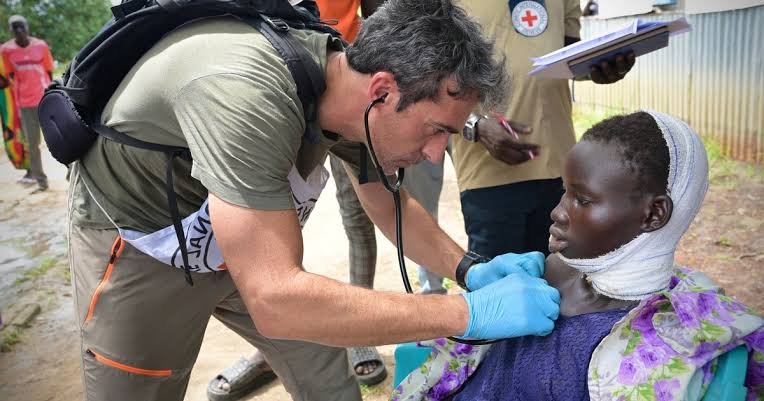
Dr Slobodan Mirosavljev, a surgeon supported by the International Committee of the Red Cross, had already treated two critically wounded patients by late morning during a recent shift. Yet the day was far from over. A patient with a bullet wound to the abdomen, chest or head could arrive at any moment, requiring immediate surgery and intensive care.

The hospital has become a vital centre for treating people injured in South Sudan’s renewed violence. The medical teams must remain prepared for mass casualty incidents even when the wards appear relatively calm.
Mirosavljev, who has worked at the hospital since August 2025, regularly operates on some of the most seriously injured patients and supervises surgical teams. His working day generally begins before 8am with a briefing, followed by ward rounds, consultations, emergency admissions and operations. On particularly difficult days, surgery continues well into the night.
The pressure has increased as political tensions and armed clashes have intensified across the country. Fighting between government forces and opposition-linked groups has been particularly severe in areas such as Jonglei state, while communal violence and disputes connected to cattle also contribute to the flow of injured people arriving for treatment.
South Sudan has struggled with instability since gaining independence from Sudan in 2011. President Salva Kiir and former vice-president Riek Machar, once partners in the independence struggle, became political rivals after Kiir dismissed Machar in 2013. The dispute developed into a devastating civil war that killed hundreds of thousands of people and displaced millions.
A peace agreement signed in 2018 brought Kiir and Machar together in a unity government, but implementation of the agreement has repeatedly stalled amid disagreements over power sharing and political authority.
The latest deterioration followed a deadly attack by the White Army, an armed group previously allied with Machar during the civil war, on a government position in Nasir county in March 2025. Machar was subsequently charged with serious offences including murder, treason and crimes against humanity in connection with the attack and was suspended from his government position.
Machar’s supporters have rejected the accusations as politically motivated, while observers have warned that the continuing confrontation could undermine the peace agreement and push the country towards another full-scale civil war. The political crisis is particularly concerning as South Sudan prepares for elections expected in December.
For hospitals, however, political developments are measured in lives saved and injuries treated.
During the first six months of this year, the ICRC evacuated 266 injured people from conflict-affected areas and brought them to the Juba facility. Most suffered gunshot wounds, while others arrived with stab wounds, broken bones and injuries caused by explosions.
Some patients have suffered devastating damage to vital organs. Mirosavljev estimates that around one in 10 cases involves serious head injuries, including wounds caused by bullets entering the skull.
For surgeons, these cases represent a race against blood loss, infection and organ damage. Some patients require several operations before their condition becomes stable. Every week, medical teams treat several particularly complex chest and abdominal injuries caused by bullets or blasts.
Those patients often need more than surgery. They may require large quantities of blood, intensive monitoring, medication and prolonged rehabilitation.
Blood supplies are among the most difficult resources to maintain. The hospital may have around 15 units available at a time, with stocks occasionally reaching 20. A single critically wounded patient can consume a substantial portion of that supply.
Medical staff and hospital administrators therefore have to continually search for donors. Relatives of patients may be called upon to donate, while the national blood bank in Juba is another important source. But maintaining a dependable supply remains a major challenge in a healthcare system already struggling with limited resources.
The situation becomes even more difficult when multiple casualties arrive simultaneously.
Rose Ochieng, the ICRC health coordinator in South Sudan, said the surgical department at Giada military hospital had recently operated at more than 160% of its bed capacity during a peak period. Overflow beds have been added and additional physiotherapy staff recruited, but the demand continues to rise faster than the system can expand.
The consequences are felt most directly by civilians caught in the fighting.
Emergency nurse Mubarak Jamal understands how quickly an ordinary shift can become overwhelming. The outpatient department normally receives around 30 patients a day, he said, with between seven and 10 suffering injuries connected to weapons.
But those figures can change dramatically when a mass casualty incident occurs. On one recent occasion, more than 93 patients arrived in a single day.
Jamal’s role includes ensuring that emergency staff are ready for such situations. Supplies must be restocked, staff schedules checked and arrangements made with surgical teams and other hospital departments. The goal is to ensure that when casualties arrive, medical workers can begin treatment without losing valuable time.
Yet the hospital’s work does not end when a patient survives surgery.
For physiotherapist Lotto Charles, recovery is ultimately measured by whether injured people can return home and regain enough independence to live their lives. Charles has worked at the hospital since 2016 and regularly treats people recovering from gunshot wounds, fractures, nerve injuries, collapsed lungs and extensive soft-tissue damage.
Some patients are unable to walk or even move independently after their injuries. Others require traction, casts or intensive physical therapy to restore movement and strength.
On one recent day, Charles treated several patients with different rehabilitation needs. One required a cast to be removed, modified and reapplied, while another needed exercises to restore movement in an injured knee. A bedridden patient was helped out of bed for the first time.
For medical workers, these small steps can carry enormous significance.
A patient who arrives at the hospital on a stretcher may eventually walk out through the same doors. For Charles, seeing that transformation provides a powerful sense of purpose.
His work reflects the wider challenge facing South Sudan’s healthcare system. The country is not simply dealing with the immediate consequences of armed violence but also with the long-term physical and emotional effects carried by survivors.
Every serious injury can create months or years of medical needs. A gunshot wound may require repeated operations, blood transfusions, physiotherapy and continued care. For people living far from major hospitals, completing that recovery can be extremely difficult.
The renewed violence is therefore placing pressure on every stage of the healthcare system, from emergency transport and surgery to blood supplies and rehabilitation.
For surgeons such as Mirosavljev, the workload can be exhausting and unpredictable. Yet the moment a critically injured patient survives and eventually walks out of the hospital offers a powerful reminder of why the medical teams continue.
As fighting continues to threaten civilians across South Sudan, the pressure on hospitals is unlikely to disappear quickly. Medical workers can prepare for the next emergency, but they cannot predict when it will arrive or how many people it will bring.

In Juba, that uncertainty has become part of daily life. Behind the hospital doors, doctors, nurses and rehabilitation workers continue to treat the consequences of a conflict that has already taken an enormous toll on the country.
Their immediate mission is simple but demanding: keep patients alive, restore their mobility and help them return home. But as demand continues to outpace capacity, the survival of South Sudan’s most vulnerable civilians increasingly depends not only on ending the violence, but also on strengthening the healthcare system left to deal with its consequences.
Related News:
 Ebola outbreak in DRC overwhelms health system as cases surge
 South Africa’s Femicide Crisis Deepens
 Dreyfus Statue Finally Gets Permanent Paris Home
 Gaza Strike Kills Child and Paramedic
 King Refers Jamaica Slavery Petition to Privy Council
 Fayed Survivors Demand Inquiry Into Medical Regulator
 Latin America women fear rollback of rights
 Kenya Confirms First Ebola Case as Patient Dies
 WHO Says Russia Plague Epidemic Risk Remains Low
 NHS Safety Fears as Nurses Cover Doctor Gaps
 Two Dead in Adelaide Airport Plane Crash Fire
 Police Suspect Help in Missing Alice Springs Girl Case
 China Fireworks Factory Blast Kills 21 in Hunan
 Barrister Criticises Trial After Suicide Case Verdict
 China mine blast death toll rises to 90
 Pope Meets Families in Italy Toxic Waste Zone
 Victim says non-custodial rape sentence ‘rock in my face’
 Unflinching Witness: Doctors Document Gaza’s Medical Crisis
 New Footage Revives Peter Falconio Mystery
 Ukraine Creates Long-Range Strike Command
 Teen Charged After Layla Jeffery Found Dead
 Israeli Strike in Southern Lebanon Kills Seven
 Five Years of Taliban Rule Leave Afghanistan in Crisis
 Ukraine Villagers Demand Answers After Deadly Arms Depot Strike
 Daughter Finds Bones in Parents’ Burned-Out Car
 Argentina Orders Return of Nazi-Looted Painting
 Masked Protesters Bring Dover Port Traffic to Standstill
 UN expert urges UK to rethink Israel policy
 Family of British man found dead in Grenada urges UK-Grenada police cooperation
 Miliband Rejects Chief Rabbi’s West Bank Warning
 Royal Crown Branded Enslaved Africans in Britain’s Slave Trade
 Israel Accused of Undermining Palestinian Life
 Yemen War Displaces 125,000 as Fighting Intensifies
 Texas Transfers Raise Fears for Migrant Children
 Patrick Clancy speaks publicly about children’s deaths
 Clancy Defense Seeks Inquiry Into Lone Juror
 Briton Faces Cyprus Court Over Son’s Fatal Fall
 Tropics May Wait Longest for Net-Zero Climate Benefits
 Japan PM Backs International Criminal Court
 Paris child pickpocketing gang leader jailed for eight years
 Ukraine and Russia Escalate Long-Range Drone War
 Yemen fighting forces children out of school and into work
 Three Die in Channel Crossing Attempt Near France
 Tennessee Set to Execute Woman After Clemency Denied
 Pelicot Trial Play Comes to London for One Night
 French Student Protests Escalate Into Violent Clashes
 Israel-bound Plane Lands in Saudi Arabia After Cockpit Fight
 Almost Half of Fayed Accusers May Be Trafficking Victims
 Pilot Recalls Fight to Save Flydubai Passengers
 French School Protests Escalate as 400 Schools Close
 Tigray rebels accused of recruiting boys as war returns
 Cancer rises faster among younger adults, study finds
 Iran Nobel Laureate Reveals Prison Torture and Fears
 Police accused of failing abuse victims
 Christa Pike Wakes After Failed Tennessee Execution
 WHO Seeks Russia Answers Over Suspected Plague Death
 Greene Pushes Epstein Files Amid Trump Fallout
 Deadly Russian Strikes Hit Western Ukraine, 20 Killed in Ternopil
 Two National Guard Soldiers Critically Injured Near White House
 American Mother Extradited From UK to U.S. on Murder Charges
 SA Police Intensify Search in Gus Lamont Case
 El Mencho Killed as Mexico Faces Violence
 Kelly Wilkinson Inquest Reveals Bail Failure
 M&S Demands Urgent Action on Rising Violent Retail Crime
 Ben Roberts-Smith Denies War Crime Allegations in First Statement
 Trump Announces 3-Day Russia–Ukraine Ceasefire Deal
 Cruisers Face Perth Quarantine After Hantavirus Outbreak
 Maldives Cave Diving Tragedy Raises Safety Alarm
 Farage and Reform UK Reshape British Politics
 England and Norway Fans Turn Miami Into World Cup Carnival
 UK Schools Struggle as Classrooms Top 40C
 Olympus Awaits Unesco Heritage Recognition
 Abusive ex used Tesla to control and harass former partner
 Man Arrested in Mississippi Woman’s Death
 British Columbia Sues OpenAI Over School Shooting
 Democrat Says ICE Restricted Detention Camp Oversight
 Madrid Tent Camp Grows as Spain Housing Crisis Deepens
 London Facial Recognition Trial Ends With False Alert
 Gosport Protesters Clash With Police Over Migrant Rescue