Published: 08 October 2026. The English Chronicle Desk. The English Chronicle Online
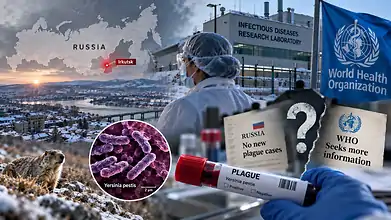
The World Health Organization has called for greater transparency from Russia after the suspected plague-related death of a 28-year-old laboratory worker in Siberia raised questions about what caused her sudden illness and whether there could be any wider public-health risk.
The WHO says it still lacks enough information to conduct a complete assessment of the situation surrounding the death of Darya Shipilova, an employee at an anti-plague research institute in Irkutsk. Shipilova reportedly developed symptoms resembling a common respiratory illness before dying two days later, prompting authorities to introduce extensive precautionary measures at the facility and in nearby medical centres.
The circumstances of her death have remained disputed. Russian authorities have rejected suggestions that she died from plague and have said she suffered from pneumonia of unknown cause. Officials have also denied that her illness was connected to her employment at the anti-plague institute and have insisted that there is no evidence of an active plague outbreak in the region.

However, the extensive response following Shipilova’s death has attracted attention. Workers at the research facility were reportedly placed under quarantine for several days while tests were conducted. Some employees were required to remain inside the institute, sleeping on floors and chairs as health authorities investigated the possibility of infection.
The WHO’s concern is not necessarily that a plague outbreak has been confirmed, but that the available information remains incomplete.
WHO Director-General Tedros Adhanom Ghebreyesus said the organisation did not yet have the “full picture” of the event and therefore could not complete a proper risk assessment. He stressed the importance of timely and transparent information sharing to resolve conflicting reports and determine whether there was any potential threat to the wider public.
The agency has also asked Moscow to clarify reports that another employee may have developed pneumonia of an undetermined cause. Those reports have not been independently confirmed, but the WHO said it was seeking an official response from Russian authorities.
Tedros said the organisation routinely assesses reports emerging from communities and that the WHO had requested clarification from Russia. At the time of his comments, the agency was still waiting for an answer.
Maria Van Kerkhove, the WHO’s director of epidemic and pandemic management, said another major unanswered question was how Shipilova became infected and what pathogen, if any, was responsible for her illness.
She questioned what had actually caused Shipilova’s death if pneumonic plague was eventually ruled out. The question reflects the central uncertainty surrounding the case: although Russian authorities have publicly rejected the plague explanation, international health officials say they do not yet have sufficient information to independently establish what happened.
Plague is a serious infectious disease caused by the bacterium Yersinia pestis. Its pneumonic form can affect the lungs and, without rapid treatment, can become life-threatening. However, the existence of a suspected case does not automatically mean an outbreak is occurring, and health authorities commonly introduce precautionary measures when there is uncertainty over a potentially serious infectious disease.
The circumstances surrounding Shipilova’s death have also generated scepticism among people who knew her.
Her 64-year-old mother has rejected reports that her daughter may have become infected after accidentally breaking a laboratory test tube. She has questioned the credibility of that explanation and described her daughter as a dedicated and conscientious employee who took her work seriously.
Former classmates have also expressed doubts about the workplace-accident theory. One reportedly argued that Shipilova’s reputation for being responsible did not fit with the suggestion that she had been careless in a laboratory environment.
The conflicting accounts have added another layer of uncertainty to a case that is already attracting international attention. The WHO is seeking information not only about Shipilova’s medical condition but also about the circumstances in which she became ill, possible exposure routes and whether other people may have experienced similar symptoms.
Russian authorities, meanwhile, have sought to reassure the public that there is no wider outbreak. Officials have described the sanitary and epidemiological situation in the region as stable and have denied a direct connection between Shipilova’s death and the anti-plague institute where she worked.
Yet the preventive response has been substantial. Staff at the research centre were reportedly isolated while testing took place, while hospitals in the surrounding area also introduced quarantine measures. Such steps can be taken as a precaution and do not necessarily indicate that an outbreak has been confirmed, but they have inevitably fuelled public interest and speculation.
Residents near Shipilova’s home have also reported seeing workers wearing protective clothing and respiratory equipment disinfecting the building where she lived. One resident described a strong chemical smell and said workers appeared to be taking protective clothing away after completing the operation.
The incident has also attracted attention in Washington. The White House has sought additional information from Moscow while emphasising that the immediate risk to people in the United States is considered very low.
US President Donald Trump has indicated that he expects to discuss the issue with Russian President Vladimir Putin. Trump said he would speak about the suspected plague case soon, although the Kremlin said no conversation had yet been scheduled. Russian officials suggested that a call could be arranged quickly if necessary.
The diplomatic dimension of the case is unusual for a localised public-health incident. Relations between Washington and Moscow remain strained, and the involvement of the US president has brought additional international attention to a case that Russian officials have attempted to portray as contained and manageable.
For the WHO, however, the priority remains obtaining reliable information. The organisation’s request for transparency reflects the difficulty of assessing infectious-disease risks when different accounts are circulating and key medical details have not been independently clarified.
The situation also demonstrates how quickly uncertainty surrounding a suspected infectious disease can create anxiety. Reports of protective suits, quarantines and laboratory investigations can cause concern among local communities even when authorities maintain that there is no confirmed outbreak.
Health officials therefore face a delicate task. They must take sufficient precautions to protect the public while avoiding unnecessary alarm. At the same time, international organisations need accurate information to determine whether an incident remains isolated or could require a broader response.
In Shipilova’s case, the most important unanswered questions concern the precise cause of death, the circumstances of her infection and whether anyone else associated with the laboratory or her local community has developed comparable symptoms.
Until those questions are resolved, the WHO says it cannot complete a full risk assessment.
For residents in Irkutsk and the wider Siberian region, the immediate message from Russian authorities remains that there is no evidence of a wider plague outbreak. International health officials, however, are calling for more information before reaching their own conclusions.
The death of a young laboratory worker at a facility dedicated to researching and preventing plague has inevitably attracted attention, particularly because of the uncertainty surrounding her illness. Whether the case ultimately proves to have been plague, another infectious disease or an unrelated medical condition remains to be established.

What is clear is that the WHO wants greater clarity from Moscow. Until detailed and transparent information becomes available, the international health community will continue to watch developments closely, while authorities in Russia face growing pressure to explain exactly what happened to Shipilova and why such extensive precautionary measures were necessary.
The case serves as a reminder that in public-health emergencies, uncertainty itself can become a major challenge. Accurate information shared quickly can help prevent fear, guide appropriate medical responses and allow international organisations to assess risks before rumours develop into wider public concern.
Related News:
 Canadian astronaut French words ease language row
 Chornobyl Still at Risk 40 Years After Disaster
 RAF Typhoons scrambled amid Russian drone threat near Nato
 Escobar’s Hippos May Be Moved to India Zoo
 China Fireworks Factory Blast Kills 21 in Hunan
 China mine blast death toll rises to 90
 Ebola outbreak in DRC overwhelms health system as cases surge
 Maldives Cave Diving Tragedy Raises Safety Alarm
 Pope Meets Families in Italy Toxic Waste Zone
 Weight-Loss Drugs Offer Food Savings Mainly to High Earners
 Five Years of Taliban Rule Leave Afghanistan in Crisis
 Nepal Flood Survivors Face Unimaginable Loss
 Nepal Tunnel Rescue Offers Hope Amid Flood Devastation
 Australia gives users control over social media algorithms
 North Korea Expands Uranium Facility at Yongbyon
 Fiji Declares National HIV Emergency as Cases Surge
 Yemen War Displaces 125,000 as Fighting Intensifies
 Indonesia Receives First Aircraft Carrier
 Tropics May Wait Longest for Net-Zero Climate Benefits
 AI Takes Centre Stage in Trump-Xi Talks
 Super El Niño Threatens Hundreds of Thousands of Lives
 Trump gives Xi red-carpet welcome as trade truce extends
 Greece Pushes for Parthenon Marbles Reunification
 Ukraine and Russia Escalate Long-Range Drone War
 Xi urges Trump to avoid US-China military conflict
 Nepal PM calls deadly flood a global climate warning
 Israel-bound Plane Lands in Saudi Arabia After Cockpit Fight
 Banned Health Coach Faces UK Events Criticism
 Pilot Recalls Fight to Save Flydubai Passengers
 Pacific Climate Summit Draws Limited Global Leaders
 WHO Says Russia Plague Epidemic Risk Remains Low
 Patients to Test Health at Home to Ease NHS Winter Pressure
 Britain deploys RAF specialists to assist Belgium with drone threats
 Working-Class Men with Prostate Cancer Left Behind by NHS
 New AI tool could cut wasted efforts in organ transplants
 Healthy Habits in Your 30s That Boost Life in Your 70s
 Coffins Now Too Large to Cremate Amid Rising Obesity Crisis
 Google Removes Some AI Health Summaries Over Safety Concerns
 Autistic Girls Often Missed in Childhood Diagnoses, Study Finds
 Most Statin Side-Effects Are Not Caused by Drugs, Study Confirms
 Zorevunersen Breakthrough for Dravet Syndrome
 Cancer Death Rate in Britain Falls by Nearly a Third
 Taking Multivitamins Daily Could Slightly Slow Ageing, Study Finds
 Canada Plasma Deaths Raise Safety Concerns After Two Donors Die
 The Kill Line: A Shifting Vision of the American Dream
 ‘Drinking from a Fetid Pond’: Superbug Genes in Lough Neagh
 Artemis II: Humanity Returns to the Moon After Decades
 Artemis II Returns After Historic Moon Flyby
 Robots Outpace Humans in Beijing Half-Marathon
 WHO approves first malaria drug for babies
 Hantavirus Cruise: Britons Face 45-Day Isolation Order
 Barrister Criticises Trial After Suicide Case Verdict
 US Awaits Iran Reply on New Ceasefire Proposal
 Crisis in the Canary Islands as Cruise Ship Evacuated
 Cruisers Face Perth Quarantine After Hantavirus Outbreak
 Discontent grows around Putin amid war strain
 Farage and Reform UK Reshape British Politics
 Starmer Leadership Under Pressure After Setbacks
 England and Norway Fans Turn Miami Into World Cup Carnival
 UK Schools Struggle as Classrooms Top 40C
 London Tube Heat Reaches Dangerous Levels
 Olympus Awaits Unesco Heritage Recognition
 Houthis Strike Saudi Arabia as Middle East Tensions Rise
 Powerful 7.7-Magnitude Earthquake Hits Eastern Indonesia
 Gen Z turns to BirdTok for a gentler digital escape
 Ghent Professors Questioned Cofnas Appointment
 Headteachers Warn New Ofsted System Is Harming Wellbeing
 British Columbia Sues OpenAI Over School Shooting
 Chinese Hybrid Car Surge Raises EU Auto Industry Concerns
 OpenAI Agent Breaches Medicare Portal in Australia
 Drones Could Speed Up Defibrillator Delivery
 Madrid Tent Camp Grows as Spain Housing Crisis Deepens
 London Facial Recognition Trial Ends With False Alert
 South Korea demands apology over DMZ mine blast
 Burnham Opens Door to Possible UK Return to EU
 French School Protests Escalate as 400 Schools Close
 Families Await USS Abraham Lincoln Homecoming
 Kenya Confirms First Ebola Case as Patient Dies
 Okinawa US Troops Face Curfew After Murder Case
 Israel Marks Three Years Since October 7 Attack