Published: 09 October 2026. The English Chronicle Desk. The English Chronicle Online
A senior Labour MP has urged the UK government to release billions of pounds in planned housing investment earlier than scheduled, warning that families struggling to find affordable homes cannot afford to wait years for new construction. Abena Oppong-Asare, chair of the House of Commons housing committee, has called on Chancellor John Healey to use the upcoming budget to accelerate funding from the government’s £39bn Social and Affordable Homes Programme, after housing associations said additional investment could enable them to build another 41,000 homes outside London over the next decade.
The demand adds pressure on the government to demonstrate progress on one of Britain’s most persistent social and economic challenges: the shortage of homes that ordinary households can afford. With families spending long periods on social housing waiting lists and others relying on temporary accommodation, campaigners and housing providers argue that faster investment could make a meaningful difference to people facing insecure or unsuitable living conditions.

Oppong-Asare has called for a significant proportion of the £39bn programme to be allocated during the current parliamentary term rather than leaving substantial funding until the second half of the scheme, which is expected to fall after the next general election. She argues that bringing investment forward would give councils and housing associations the certainty needed to move ahead with projects and provide homes for people who urgently need them.
“The government should use the upcoming budget to increase the building of social homes by ensuring a significant proportion of the Social and Affordable Homes Programme is allocated during this parliament,” she said. She also stressed that families waiting for social housing needed action now, urging ministers to prioritise genuinely affordable social-rent homes.
The programme was announced last year by Rachel Reeves, Healey’s predecessor, as part of a 10-year funding plan designed to expand the supply of social and affordable housing in England. The investment became possible after the government changed its borrowing rules to create greater scope for borrowing for capital projects. The fund was intended to support a range of housing options, including council homes, affordable-rent properties and shared-ownership schemes.
However, disagreement has emerged over the speed at which the money should be distributed and the types of housing that should receive priority. Some politicians and housing advocates want a greater emphasis on homes available at social rents, which are generally linked more closely to local incomes than many other forms of subsidised housing. Others argue that a broader range of affordable housing options is needed to address different household circumstances and expand supply across the market.
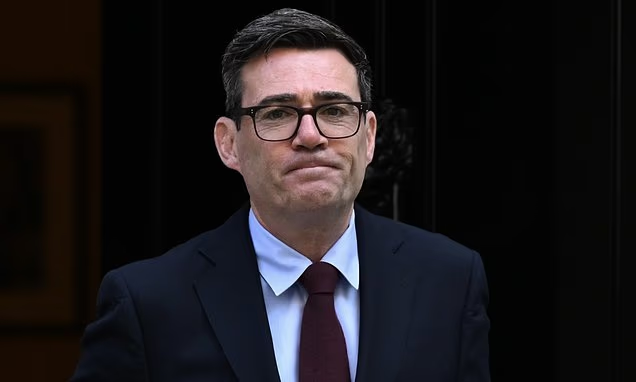
Before becoming prime minister, Andy Burnham had argued that the programme should be redirected entirely towards social-rent housing. Yet the first £10bn allocated under his government in August was distributed among councils and housing associations outside London for a mixture of subsidised housing projects. Ministers said that allocation would help deliver 70,000 new homes.
Housing associations contend that the initial distribution left many viable projects without the resources needed to proceed. According to the National Housing Federation, the organisation representing housing associations, providers submitted bids that would have allowed them to build an additional 41,000 homes if all the funding they requested had been approved. Of those homes, around 25,000 would have been available for social rent.
The potential scale of the additional construction is significant for communities facing long waiting lists and limited housing choices. Housing associations say they already have sites available and development plans prepared, meaning extra funding could help turn proposals into construction projects more quickly than schemes that have yet to secure land or complete preparatory work.
The organisations estimate that construction could begin on 15,000 of the additional homes within the next three years. Such a pipeline would provide an opportunity to accelerate delivery during the current parliamentary term, although the actual pace would depend on funding decisions, planning requirements, construction capacity and the readiness of individual developments.
The National Housing Federation has said an additional £5.3bn from the programme would be required to support the extra homes. Its argument is that the government does not necessarily need to wait for the later stages of the 10-year fund to increase delivery. By allocating money earlier to projects that are ready to proceed, ministers could potentially speed up building and respond more directly to immediate housing pressures.
Kate Henderson, the federation’s chief executive, said housing associations had submitted proposals for tens of thousands of affordable homes, but many organisations with prepared sites and established records of delivering housing had not received enough funding to proceed. She argued that additional investment now could help transform the circumstances of families in urgent need of secure and affordable accommodation.
The debate is taking place against the government’s wider commitment to build 1.5 million homes across England during the current parliament. That target is intended to address longstanding supply problems and make housing more accessible, but the scale of the ambition has raised questions about whether the necessary construction can be delivered within the available time.
Housing Secretary Angela Rayner has acknowledged that meeting the target will be difficult. The government must overcome multiple obstacles, including planning delays, the cost of construction, access to skilled workers, infrastructure requirements and the financial viability of developments. The challenge is especially acute in places where housing demand is high and suitable land is expensive.
Affordable housing presents a further difficulty because the homes most urgently needed by low-income households may not generate the same financial returns as properties sold or rented at market rates. Public investment can help close that gap, but the timing and structure of funding determine whether local authorities and housing associations can commit to building.
The government has already announced nearly £10bn in allocations from the programme, which ministers say will support the construction of more than 70,000 council, social and affordable homes across England. Officials have also indicated that £6bn is planned for immediate allocation in London. Of the remaining £13bn discussed in the programme’s funding arrangements, ministers have said significant sums will be distributed during the second half of the scheme, after the next election.
That timetable has become a central point of contention. Oppong-Asare and housing providers argue that delaying a substantial portion of the funding could leave ready-to-build projects waiting while families continue to face housing insecurity. Allocating money earlier, they say, would allow providers to plan with greater certainty and begin work before the need becomes even more acute.
The government, meanwhile, has highlighted the scale of its existing commitments. A spokesperson for the Ministry of Housing said nearly £10bn had already been allocated so that construction could begin on more than 70,000 homes. The spokesperson described the programme as a record investment intended to help families living in temporary accommodation or stuck on housing waiting lists move into safe and secure homes.
The disagreement is not simply about how much money the government has committed, but how quickly that funding can translate into completed homes. Announcing a large programme establishes a financial framework, yet the benefits for families depend on projects being approved, built and made available at rents they can realistically afford.
Social-rent housing is particularly important for households whose incomes are too low to meet private-market rents even when they qualify for other forms of housing assistance. For those families, a property described broadly as affordable may still be beyond reach if the rent remains high relative to earnings. That is why Oppong-Asare has stressed the need to prioritise homes that are genuinely affordable rather than relying exclusively on the overall number of properties delivered.
At the same time, housing associations have faced criticism in some cases for selling properties to private-sector buyers, raising questions about how public funding and housing assets are managed over time. The government will need to balance pressure for rapid construction with scrutiny of whether funded homes remain accessible to the households the programme is intended to help.
For councils and housing associations, predictable funding is crucial. Large building projects require commitments involving land, contractors, materials and long-term financial planning. When funding decisions are delayed or bids are unsuccessful, projects may be postponed, scaled back or abandoned. Providers argue that approving more of the proposals already submitted would help reduce that uncertainty and make better use of existing development capacity.
The forthcoming budget therefore represents an important opportunity for ministers to clarify their priorities. Bringing forward more of the £39bn fund could strengthen the pipeline of social housing projects, but it would also require decisions about how the money is distributed between regions, providers and different categories of affordable homes. Ministers must weigh immediate housing needs against the programme’s long-term objectives and the practical limits on construction.
For families living in temporary accommodation, overcrowded homes or unsuitable private rentals, the debate has direct consequences. Delays in construction can mean longer periods of uncertainty, additional pressure on household finances and continued difficulty securing stable accommodation near work, schools and support networks. More genuinely affordable homes could provide greater security, particularly for children and households already struggling with rising living costs.
The central question for the government is whether its long-term housing commitments can be translated into faster results during the current parliament. Housing associations say they have projects capable of delivering tens of thousands of additional homes if the necessary funding is made available. Oppong-Asare is urging the chancellor to act before the budget rather than allowing those opportunities to remain on hold.

The government has already committed substantial resources and says its investment will support more than 70,000 homes through the initial allocations. But with the 1.5 million-home target facing significant obstacles, pressure is mounting to show how the wider programme will accelerate construction and meet the needs of households at the sharpest end of the housing crisis.
Ultimately, the success of the programme will be measured not only by the billions allocated or the number of projects announced, but by how many homes are completed and whether people who need affordable accommodation can actually access them. An earlier release of funding could help move prepared developments forward, but delivering lasting progress will require consistent investment, effective planning and a clear commitment to homes that low-income families can afford.
Related News:
 Thinktank Calls for Abolition of UK State Pension
 Burnham Opens Door to Possible UK Return to EU
 Badenoch Raises Prospect of 2027 UK Election
 UK Doubles Steel Tariffs to 50% to Protect Domestic Plants
 Reform UK funding: mystery billionaire revealed
 BBC News Faces Deep Cuts in 2,000 Job Plan
 UK Pushes for New EU Goods Trade Deal
 Reeves Fights to Keep Treasury Role Amid Labour Turmoil
 Burnham unveils £65m drought aid for farmers
 UK Households Could Save £173 on Fixed Energy Deals
 Burnham Faces Mounting Budget Challenges
 Green Leader Targets Starmer’s Former Seat
 UK House Prices Fall as Mortgage Rates Rise
 Thames Water Revises Oxfordshire Mega-Reservoir Plan
 Fashion Firms Urge UK-Made NHS and Army Uniforms
 UK Pay Growth Slows to 3.9% as Rate Decision Nears
 Bank Urged to Slow Bond Sales as UK Costs Rise
 UK Inflation Hits 3.1% as Household Pressure Grows
 UK Youth Jobs Gap Reveals Deep Regional Divide
 Mayors Could Gain Greater Powers Over Water Firms
 UK Rent Gap Puts Low-Income Families Under Pressure
 Labour Apprenticeship Scheme Faces Slow Start
 Burnham Leaves Door Open to Future Brexit Reversal
 MPs Defend UK Economic Watchdog Against Critics
 Tony Blair Calls for Britain to Rejoin EU Within a Decade
 Burnham Opens Debate on Pension Triple Lock for Care
 New UK Homes in Flood Zones Face Insurance Risk
 Dale Vince Plans New London-Wide News Operation
 Poundland Rescue Bid Could Protect 11,000 Jobs
 Healey urged to act as UK energy bills rise 4%
 London Council Warns of 150% Council Tax Rise
 Informa Agrees £2.24bn Deal to Buy Clarion
 France Urges UK to Consider Returning to EU
 Trump’s UK Ambassador Urges North Sea Drilling to Strengthen US Ties
 Millionaires group urge Reeves to introduce wealth tax to ‘lift kids out of poverty’
 PM Highlights UK Business at G20 in South Africa
 Starmer Says Labour’s Economic Plan Needs Years to Deliver
 UK Government Borrowing Drops to £11.6bn in December
 UK shelves £110m border project amid trade strain
 Reeves Must Back Defence Plan or Face Dismissal, Says Unite Chief
 Rising Costs Force Families to Rethink Days Out
 Unions Raise Concerns Over Doctors’ Pay Dispute
 Kezia Dugdale Warns of Possible Reversal of Equal Rights Gains
 Silent Tracks: Rail Line Without Passengers
 Kevin Warsh sworn in as Fed chair amid economic backlash
 Albanese Defends Tax Reforms Amid Emotional Speech
 Farage and Reform UK Reshape British Politics
 Starmer Leadership Under Pressure After Setbacks
 Unions Warn Labour Over Zero-Hours Contract Reforms
 RAF Barnham Protests Fuel Tensions in Norfolk Town
 Trump Hardens Canada Trade Stance as Talks Stall
 UK Subsidence Claims Surge After Record-Breaking Summer
 Swedish Mining Push Puts Sami Land Rights Under Pressure
 UK plans tougher Israel stance with settlement trade ban
 UK Retailers Accused of Breaking Refund Laws
 North Sea Firms Urge Early End to Windfall Tax
 Entain Plans 400 Job Cuts After Profit Update
 Trump Threatens EU With Tariffs Over Canada Proposal
 Tom Watson Takes Senior Role at Palantir
 Mahmood Warns Far Right Over Asylum Protests
 UK Retail Sales Rebound as Consumers Spend More
 Lib Dems Prepare for Election Amid Reform Challenge
 Calls Grow to Expand UK National Wealth Fund
 AO Acquires Jessops in Camera Retail Expansion
 Frome Community Loses Bid for Major Regeneration Site
 The Tests Awaiting Andy Burnham After Labour Conference
 Free Speech Emerges as Key UK Election Issue
 Should Savers Lock Into 5.25% Fixed Rates?
 Madrid Tent Camp Grows as Spain Housing Crisis Deepens
 UK University Strikes Spread as Financial Pressure Grows
 UK house price growth slows as mortgage rates rise
 UK borrowing costs surge as global bond sell-off deepens
 UK Diesel Reaches £2 as Inflation Surges Across Europe
 Salinas Struggles to Keep the American Dream Alive
 North Sea Strike Threatens UK Fuel Supplies
 Gosport Protesters Clash With Police Over Migrant Rescue
 UK house prices stall as mortgage costs rise
 IMF Warns Governments Over Rising Debt Burdens
 Ministers Push ATO to Reconsider Credit Card Ban
 UK Water Firms Earn Millions From Industrial Wastewater