Published: 14 October 2026. The English Chronicle Desk. The English Chronicle Online
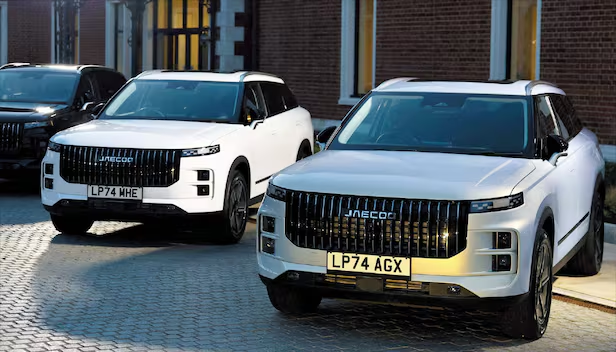
The United Kingdom has pushed back against growing European Union pressure to impose tariffs on Chinese vehicle imports, insisting that British trade policy will be determined by national economic interests rather than demands from Brussels. The position highlights continuing differences between London and European capitals as the UK seeks closer economic cooperation with the bloc while protecting its automotive industry, international trading relationships and industrial competitiveness.
Business Secretary Jonathan Reynolds made the government’s position clear during a trade visit to India, rejecting suggestions that Britain should introduce import duties on Chinese electric vehicles simply to align itself with European policy. His comments come at a sensitive moment in UK-EU relations, with negotiations over future economic cooperation gaining momentum ahead of a planned summit in Brussels on 20 November.

The dispute reflects a broader question confronting British policymakers: how can the UK strengthen its relationship with the European single market without surrendering control over its trade decisions or exposing domestic businesses to retaliatory measures from major trading partners?
Reynolds said decisions on trade-defence tariffs would be made according to the UK’s requirements, rather than in response to pressure from other governments. He maintained that British authorities had already examined the question of Chinese electric vehicle imports in 2024 and would continue reviewing the issue as industrial conditions evolved.
The business secretary emphasised that the structure of Britain’s automotive industry was central to the government’s calculations. Unlike a market focused primarily on domestic consumption, the UK automotive sector depends heavily on exports, making access to international markets and the stability of trading relationships particularly important.
Introducing tariffs on Chinese vehicles could provide some protection against lower-priced imports, but it could also create complications for British manufacturers operating across international supply chains. Any assessment, Reynolds indicated, must therefore consider the potential consequences for production, exports, employment and investment.
His position does not amount to a permanent rejection of tariffs. The government retains the option of considering trade restrictions in the future if changing circumstances and the needs of British industry justify such action. However, Reynolds made clear that any decision would require an independent assessment of Britain’s interests.
This distinction is important because the European Union has increasingly sought coordinated measures to address competition from Chinese manufacturers. Britain’s refusal to automatically follow the European approach demonstrates that closer diplomatic relations will not necessarily produce identical trade policies.
The European Union introduced additional tariffs on Chinese electric vehicles in 2024, arguing that government subsidies and other competitive advantages could undermine European manufacturers. European policymakers have expressed concern that a sustained influx of cheaper imported vehicles could weaken domestic production, threaten industrial employment and accelerate the decline of established automotive manufacturing centres.
The debate has intensified as Chinese companies expand internationally, offering electric and hybrid vehicles that compete aggressively on price, technology and features. Their growing presence has placed pressure on European manufacturers already facing the costly transition from traditional combustion engines to electric mobility.
Last Friday, the EU also agreed to a quota limiting Chinese hybrid car imports to 350,000 vehicles annually, according to the report. The measure reflects continuing efforts to manage competition while protecting European industrial capacity.
Britain has taken a different approach. Although British policymakers recognise the challenges facing domestic manufacturers, they have been reluctant to introduce tariffs that could raise costs for consumers or provoke retaliation against UK exports.
One concern is that China could respond to British restrictions by imposing duties on British products. Reynolds has previously highlighted the potential consequences for companies such as Jaguar Land Rover, whose international business depends on access to major overseas markets.
For the UK, the challenge is to protect industrial interests without creating additional barriers for businesses that depend on global trade. That calculation becomes more complicated when the country’s largest nearby economic market adopts a different strategy.
European officials have expressed concern that the UK’s refusal to impose comparable tariffs could create an alternative entry point for Chinese automotive companies seeking access to the European market.
The concern centres on the possibility that Chinese manufacturers could establish production operations in Britain and subsequently export vehicles into the EU. If those vehicles qualified for preferential treatment under applicable trade arrangements, European policymakers fear that differences between British and European tariff policies could weaken the effectiveness of their restrictions.
The potential involvement of Chinese manufacturers in British production has made the issue more sensitive. Nissan, for example, has agreed to examine the possibility of building vehicles in northern England for China’s Chery, a development that illustrates the changing structure of international automotive partnerships.
Reynolds rejected the suggestion that Britain was already functioning as a back door for Chinese vehicle exports into Europe. He argued that the UK did not currently have a major Chinese automotive manufacturer established in the sector producing vehicles for onward shipment into the European single market.
His response underlines the government’s argument that fears about future industrial arrangements should not dictate current trade policy without considering the actual structure of British production.
Nevertheless, the issue could become more significant as Chinese companies explore manufacturing partnerships, investment opportunities and distribution networks across Europe. The expansion of such arrangements may force Britain and the EU to clarify how their respective trade rules interact.
For British manufacturers, uncertainty over future regulations could also influence decisions about where to source components, establish production facilities and invest in new technologies.
The disagreement comes ahead of the planned UK-EU summit in Brussels on 20 November, which is expected to provide an important opportunity to discuss the future of economic relations between the two sides.
Prime Minister Andy Burnham has indicated that the government wants a more constructive relationship with Europe. Speaking in the House of Commons, he called for a serious dialogue about Britain’s position on the continent, presenting the forthcoming discussions as an opportunity to explore closer cooperation.
The summit is not expected to place the dispute over Chinese vehicle tariffs formally on its agenda. However, British officials hope to influence European legislation affecting manufacturers and supply chains, including the proposed Made in Europe rules.
These rules are intended to strengthen European industrial capacity and protect businesses against competition from subsidised imports. British manufacturers are concerned that restrictive eligibility requirements could exclude UK-based companies from important supply chains, even when their operations are closely integrated with European production networks.
The disagreement therefore extends beyond tariffs. It raises questions about whether British businesses will receive favourable treatment under future European industrial policies and what the UK might need to offer in return.
Some officials in Brussels have argued that Britain’s willingness to align more closely with European trade policy could influence the bloc’s readiness to consider wider arrangements. These could include improved access to the single market, a new customs union or, potentially, a renewed discussion about EU membership.
Reynolds, however, insisted that excluding Britain from emerging European arrangements would also carry economic costs for the EU. He pointed to the closely connected nature of British and European supply chains, arguing that restrictions could create difficulties for businesses on both sides of the Channel.
The central challenge for negotiators will be finding arrangements that protect European industrial objectives without unnecessarily disrupting established commercial relationships.
Reynolds made his remarks while leading a two-day British trade delegation to Delhi and Mumbai, where officials announced a series of UK-India investment initiatives expected to be worth more than £1 billion to Britain over the next 15 years.
The visit demonstrates that London is pursuing economic opportunities beyond Europe while continuing discussions about closer relations with the EU. The government’s strategy involves maintaining independent trade partnerships, attracting investment and expanding access to international markets.
Britain and India agreed a landmark free trade agreement in 2025 after several years of negotiations. The agreement has already begun reducing tariffs on selected products, including Scotch whisky, for which Indian import duties fell from 150 per cent to 75 per cent under the arrangement.
British officials hope to broaden the benefits of the agreement by expanding trade in services alongside goods. One area under consideration is the mutual recognition of professional qualifications, particularly for legal practitioners seeking to work across the two countries.
Reynolds expressed confidence that cooperation in these areas could improve over the medium to long term, although he acknowledged that progress would require continued negotiations.
The possibility of Britain rejoining the European Union would have implications for its separate trade agreements. Reynolds recognised that membership of the EU would involve collective trade arrangements, potentially replacing some of the independent agreements Britain has negotiated since leaving the bloc.
His comments illustrate the difficult balance facing the government as it considers the benefits of closer European integration alongside the advantages of maintaining independent international partnerships.
The tariff dispute exposes the competing priorities shaping Britain’s economic policy. Closer cooperation with the EU could improve market access, reduce regulatory friction and strengthen supply chains. However, adopting European restrictions without considering their consequences for British businesses could increase costs and expose exporters to retaliatory measures.
At the same time, allowing substantial differences between British and European trade rules could complicate negotiations over future access to the single market and create uncertainty for manufacturers operating across both markets.
Chinese automotive investment adds another layer of complexity. While new manufacturing partnerships could support British jobs, industrial capacity and technological development, they may also raise questions about market access, domestic production requirements and the treatment of goods traded between the UK and EU.
The November summit will provide an early indication of whether both sides can reconcile these competing interests. Progress on electricity, emissions and food and drink trade arrangements could deliver practical benefits even if wider disagreements remain unresolved.

For now, the British government is maintaining its position that national economic interests must guide decisions on tariffs. Reynolds has left open the possibility of future restrictions but rejected the idea that Britain should impose them simply to satisfy European demands.
Whether that approach can coexist with the government’s ambition for a meaningful reset in relations with Brussels remains uncertain. The outcome will depend on the ability of both sides to recognise their economic interdependence while accommodating differences in industrial strategy and international trade policy.
As negotiations continue, the question will not simply be whether Britain follows Europe’s approach to China. It will be whether London and Brussels can develop a framework that protects their respective industries without undermining the commercial links that connect them.
Related News:
 UK Pushes for New EU Goods Trade Deal
 Reeves Fights to Keep Treasury Role Amid Labour Turmoil
 Green Leader Targets Starmer’s Former Seat
 Ukraine Moves to Seize Water Company
 Swedish Mining Push Puts Sami Land Rights Under Pressure
 Argentina to file criminal charges over Falklands oil drilling
 UK plans tougher Israel stance with settlement trade ban
 Oil nears $100 as Saudi attacks shake markets
 Iceland to Open First UK High Street Store in Falklands
 JLR Eyes NATO Market With New Defender Military Vehicle
 Burnham Leaves Door Open to Future Brexit Reversal
 Tony Blair Calls for Britain to Rejoin EU Within a Decade
 Avanti West Coast Set for Public Ownership in March
 Dale Vince Plans New London-Wide News Operation
 Burnham Opens Door to Possible UK Return to EU
 Royal Nursing Union Ends Partnership With Teva UK
 Palantir Lobbyist Had Role in Burnham Campaign
 UK Diesel Reaches £2 as Inflation Surges Across Europe
 Minister Rejects Fears of UK Diesel Shortage
 Informa Agrees £2.24bn Deal to Buy Clarion
 EU-China Talks Target Surge in Hybrid Car Imports
 Report Urges UK to Rethink Overseas Military Spending
 France Urges UK to Consider Returning to EU
 UK Urges Interpol to Reject Argentina’s Falklands Arrest Requests
 Trump’s UK Ambassador Urges North Sea Drilling to Strengthen US Ties
 Millionaires group urge Reeves to introduce wealth tax to ‘lift kids out of poverty’
 Canada Passes Carney’s First Budget in Tight Parliamentary Vote
 PM Highlights UK Business at G20 in South Africa
 India’s Labour Law Overhaul Sparks Fierce Debate
 Starmer Says Labour’s Economic Plan Needs Years to Deliver
 UK Government Borrowing Drops to £11.6bn in December
 Starmer Condemns ‘Depraved’ Russian Strikes on Ukraine
 UK shelves £110m border project amid trade strain
 Trump Tariffs Threat Spark UK and EU Alarm
 Reeves Must Back Defence Plan or Face Dismissal, Says Unite Chief
 Gordon Brown urges court for crimes against children
 Trump to Deploy “God Squad” Over Gulf Wildlife Protections
 Army Probes Apache Flyover at Kid Rock’s Nashville Estate
 Relationship with Trump may be beyond repair, Starmer warned
 UK Stands Firm on Falklands Amid US Rift
 Oil Prices Surge Above $120 Amid Iran Blockade Fears
 Silent Tracks: Rail Line Without Passengers
 Trump approval plunges amid Iran war fears
 US Awaits Iran Reply on New Ceasefire Proposal
 Farage and Reform UK Reshape British Politics
 Starmer Leadership Under Pressure After Setbacks
 New South Wales Premier Chris Minns Signals Tough Road Ahead for Labor
 Ukraine Creates Long-Range Strike Command
 Burnham unveils £65m drought aid for farmers
 Unions Warn Labour Over Zero-Hours Contract Reforms
 Former Diplomats Urge UK and France to Act on Palestine
 Trump Hardens Canada Trade Stance as Talks Stall
 Bayeux Tapestry Revives Franco-British Ties
 Trump Calls Iran War ‘Small Potatoes’ Despite US Deaths
 Billionaire Chris Rokos poised to leave UK
 Europe’s democracies face a growing far-right threat
 JPMorgan Boss Warns Against UK Bank Tax Rise
 UK Retailers Accused of Breaking Refund Laws
 Farage Threatens Union Funding Ban Over Reform Donations
 Mayors Could Gain Greater Powers Over Water Firms
 Trump Threatens EU With Tariffs Over Canada Proposal
 US Sanctions Open New Battle for Cuba Assets
 Tom Watson Takes Senior Role at Palantir
 Lib Dems Prepare for Election Amid Reform Challenge
 MPs Defend UK Economic Watchdog Against Critics
 AO Acquires Jessops in Camera Retail Expansion
 Xi urges Trump to avoid US-China military conflict
 Lula accuses Trump of seeking control over Brazil
 The Tests Awaiting Andy Burnham After Labour Conference
 Poundland Rescue Bid Could Protect 11,000 Jobs
 Badenoch Raises Prospect of 2027 UK Election
 Royal Mail Plans Up to 2,500 Job Cuts
 South Korea Probes Fuel Shipments to Russia
 UK Mission in East Jerusalem to Remain Open
 Ministers Push ATO to Reconsider Credit Card Ban
 Houthi Missile Claim Sparks Riyadh Airport Disruption
 UK Water Firms Earn Millions From Industrial Wastewater
 UK Pharmacy Body Drops Teva After Ethical Concerns
 Trump’s Russian Diesel Deal Sparks Ukraine Fury
 Brazil Court Scandal Threatens Lula as Bolsonaros Rise