Published: 24 September 2026. The English Chronicle Desk. The English Chronicle Online.
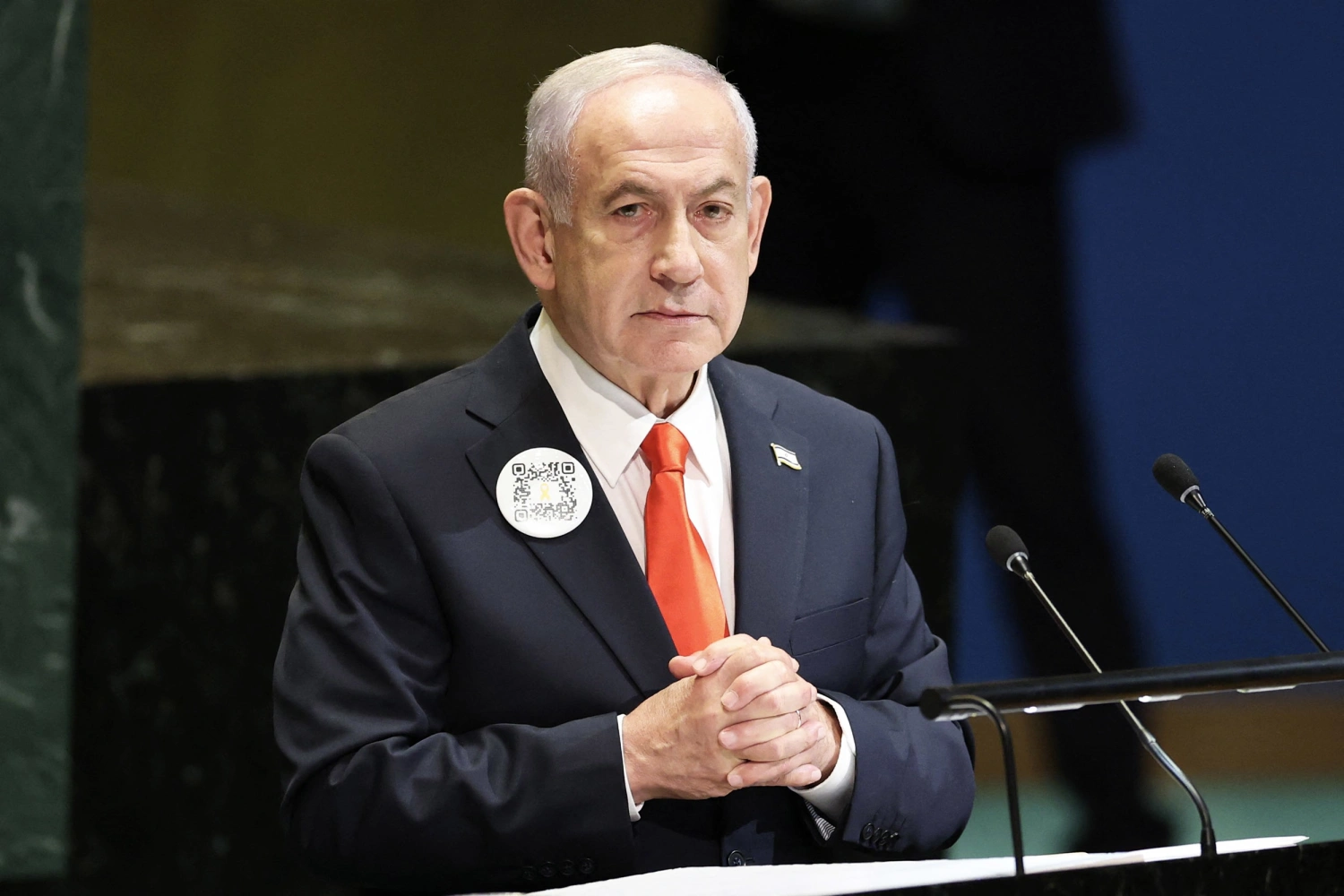
Israeli Prime Minister Benjamin Netanyahu is set to address the United Nations General Assembly in New York on Thursday as protests, diplomatic criticism and political pressure surround his government at home and abroad. His appearance comes at a particularly sensitive point, with Israel involved in conflicts involving Gaza, Lebanon and Iran, continuing international criticism over its policies in the occupied West Bank, and a forthcoming election campaign in which Netanyahu is seeking to maintain his political position.
The speech is expected to combine a defence of Israel’s military record with a broader attempt to challenge international criticism of the country. Israeli Ambassador to the United Nations Danny Danon has said Netanyahu intends to highlight what the government considers its achievements while also discussing what remains to be accomplished and how Israel can ensure that the objectives of its military campaign are achieved.
Netanyahu’s visit to New York is unusually short. He is expected to arrive for the UN appearance and return to Israel shortly afterwards, limiting the opportunity for the kind of extensive diplomatic meetings that have often accompanied visits by Israeli prime ministers to the United States. There is no scheduled meeting with US President Donald Trump, who is expected to remain in Washington while preparing to host Chinese President Xi Jinping.
The absence of a meeting with Trump is notable because the relationship between the two leaders has been an important element of Israeli-American diplomacy and Netanyahu’s political messaging. A Trump administration official said Netanyahu’s delegation had sought a high-level meeting, but none had been arranged. Israeli officials have also indicated that there are no planned meetings with congressional leaders during the brief visit.

Instead, the central event of Netanyahu’s trip will be his appearance before the UN General Assembly, where he will face an international audience deeply divided over Israel’s military actions and policies. The Israeli government argues that its military operations are necessary for national security and the defeat of armed groups threatening Israel. Critics, including governments, international organisations and advocacy groups, have raised concerns over civilian casualties, humanitarian conditions and the continuing consequences of the conflict in Gaza.
The political circumstances surrounding Netanyahu have added another dimension to the speech. Israel is approaching an election campaign, and the prime minister is expected to address not only international leaders but also voters at home. His presentation of Israel’s military achievements, security challenges and relations with its allies could therefore have implications beyond the UN chamber.
Netanyahu has spent decades building his political identity around national security, Iran and Israel’s relationship with the United States. His government now faces a complicated environment in which military developments abroad are closely linked to domestic political debates. The conflicts in Gaza, Lebanon and Iran have placed security at the centre of Israeli politics, while questions about the government’s conduct and the country’s international standing remain prominent.
International pressure has also increased. The United Kingdom, France and Canada have been preparing measures targeting Israeli settlements in the West Bank. British Foreign Secretary Ed Miliband has accused Israeli settlers of carrying out ethnic cleansing against Palestinian communities, an allegation strongly disputed by Israel and its supporters.
The West Bank is expected to be another important issue surrounding Netanyahu’s appearance. Israel has faced criticism over plans for settlement expansion, including development associated with the E1 area. Critics argue that construction there could further divide Palestinian communities and complicate the prospects for a future Palestinian state. Israeli officials, however, have indicated that international criticism will not determine their policy.
Danon has defended Israel’s position and argued that much of the criticism directed at the country has been driven by what he describes as misinformation and political bias. He has said Israel recognises the difficult international environment but remains proud of what its government and military have achieved during the past several years.
The Israeli government’s position is being challenged by groups organising demonstrations in New York. Protests are expected around the UN headquarters and elsewhere in the city, with activists planning marches and demonstrations opposing Netanyahu’s policies and Israel’s conduct in Gaza and the West Bank.
Palestinian representatives have also encouraged diplomatic missions to participate in a planned walkout during Netanyahu’s speech. The proposed action is intended to demonstrate opposition to Israeli policies and to draw attention to allegations concerning the conduct of the war, the occupation and the humanitarian situation affecting Palestinians.
The protests reflect the increasingly polarised debate surrounding Israel in the United States. Demonstrations have involved Palestinian-rights activists, Jewish organisations critical of Netanyahu’s government and other groups opposed to Israeli military policies. At the same time, supporters of Israel have defended Netanyahu and are expected to mobilise in response.
New York Mayor Zohran Mamdani has also become part of the political controversy surrounding Netanyahu’s visit. Mamdani has previously described Netanyahu in highly critical terms and has spoken about the International Criminal Court’s warrant against the Israeli prime minister. Netanyahu has responded by accusing Mamdani of hostility towards Israel and of supporting positions associated with Hamas.
The dispute between the two politicians has given Netanyahu an additional domestic and international political issue to address. Reuters reported that Netanyahu was expected to confront Mamdani in his UN address, turning the speech partly into a response to criticism from the New York mayor.
For Netanyahu, the exchange offers an opportunity to address an American political audience as well as the international community. His supporters can interpret criticism from Mamdani and other opponents as evidence of hostility towards Israel, while Netanyahu’s critics argue that the confrontation diverts attention from the government’s policies and the humanitarian consequences of the conflicts.
The broader American political environment is also changing. Debate over US support for Israel has become more visible across both major political parties, with disagreements emerging over military assistance, settlement policy and the Gaza war. Some Republican and Democratic politicians have expressed positions that differ from the traditionally broad bipartisan support for Israeli government policy.
Public opinion has also become an important part of the discussion. A Pew Research Center survey cited in reporting on Netanyahu’s visit found that 62% of respondents in July held a negative view of the Israeli government under Netanyahu. Another poll cited by the same reporting indicated that 60% of American Jewish respondents wanted Netanyahu to leave office in Israel’s October election. These measurements reflect specific survey populations and dates and should not be treated as a prediction of electoral outcomes.
The political debate extends into the future of US-Israeli security relations. Israel continues to emphasise the strategic importance of its partnership with Washington, while disagreements over Gaza, Iran and settlement policy have created new points of tension.
Danon has maintained that Israel and the United States continue to share fundamental values and that the security relationship remains strong. The Israeli government has also continued to argue that cooperation with Washington remains essential to confronting threats from Iran and armed groups in the region.
The Gaza conflict remains one of the most difficult issues confronting Netanyahu internationally. Humanitarian conditions, reconstruction, military operations and the future role of Hamas are all central to discussions about what happens next. Israeli officials have indicated that they would prefer Hamas to disarm without another major Israeli military intervention, but they have also warned that Israel could act if that does not happen.
The possibility of further military action has raised concern internationally, particularly in light of a reported $2.8bn US arms package. Israeli officials have not ruled out future military operations if their security objectives are not achieved, while supporters of the government argue that Israel cannot leave unresolved security threats in place indefinitely.
The situation in the West Bank adds another layer of pressure. Settlement expansion has become a major source of disagreement between Israel and several Western governments. The US political debate over sanctions against individuals or organisations facilitating settlement activity demonstrates that the issue is no longer confined to European criticism.
At the same time, Netanyahu’s government faces pressure from within Israel over the handling of the conflicts and the country’s security priorities. The upcoming election means that every major international appearance can also function as a domestic political message. Netanyahu’s emphasis on military achievements and his willingness to confront international critics are likely to be closely watched by Israeli voters.
His brief New York visit therefore carries significance well beyond a standard diplomatic appearance. The UN provides Netanyahu with a global platform at a time when Israel is facing intense scrutiny. The streets surrounding the UN are expected to host competing demonstrations, while inside the General Assembly the Israeli prime minister will confront governments that hold sharply different views of his policies.
The speech is also likely to reflect the competing pressures facing Israel’s government. Netanyahu needs to reassure supporters that the country’s military campaigns have strengthened Israel’s security, while addressing international criticism that has become increasingly prominent. He also needs to maintain close relations with Washington while navigating disagreements with American politicians and public opinion.
For the United Nations, Netanyahu’s appearance comes during one of the most contentious periods in recent Middle Eastern diplomacy. Conflicts involving Israel, Hamas, Hezbollah and Iran have created overlapping security and humanitarian crises, while disagreements over Palestinian statehood and Israeli settlements continue to dominate international discussions.

Netanyahu’s message is expected to focus on Israel’s security, its military achievements and its argument that international criticism often fails to recognise the threats facing the country. His opponents are preparing to use the same occasion to draw attention to Palestinian suffering, settlement expansion and allegations concerning Israel’s conduct.
The contrasting messages will make the speech a closely watched moment in the continuing international debate over Israel and the wider Middle East. Netanyahu will seek to present his government as determined and resilient, while protesters and critics will use his presence in New York to highlight the policies they oppose.
Whatever the immediate reaction to the address, the issues surrounding it will not be resolved by a single speech. The conflicts in Gaza, Lebanon and Iran, the future of the West Bank, the US-Israel relationship and Israel’s domestic political contest will continue to shape the country’s position long after Netanyahu leaves New York.
His appearance at the UN therefore represents both a diplomatic event and a political moment. For Netanyahu, it is an opportunity to defend his government’s record before the international community and communicate directly with voters at home. For his critics, it is an opportunity to challenge those claims publicly. The competing demonstrations, diplomatic disagreements and domestic political pressures surrounding the visit demonstrate how closely Israel’s foreign policy is now intertwined with its internal political future.
Related News:
 Houthis Strike Saudi Arabia as Middle East Tensions Rise
 Trump Calls Strait of Hormuz ‘American Territory’
 Trump Faces Iran War Crisis Before Midterm Vote
 UK Prepares Aircraft Carrier for Middle East Crisis
 Middle East Crisis Escalates as Oil Routes Shake Markets
 Tensions Emerge in Netanyahu-Trump Alliance
 Former ICC prosecutor condemns US sanctions
 Trump Receives Machado’s Nobel Medal in White House Meeting
 Thousands Protest ICE Operations in Nationwide US Day of Action
 Epstein Files Reveal Trump Officials’ Emails with Financier
 Thousands Protest ICE in New York Against Trump Deportation Campaign
 Thousands Protest Iran Strikes Outside US Embassy London
 US Bombers Arrive at RAF Base Amid Rising Iran Tensions
 Ukraine war briefing: Zelenskyy offers help to Saudi Crown prince on combatting Iranian drones
 Trump orders US troop pullout from Germany
 Activists allege abuse after Gaza flotilla seizure
 Trump likens US Navy actions to ‘pirates’
 Global order shifts amid Trump-era turmoil
 Indiana Republicans Defy Trump in Key Vote Test
 Putin Declares Russia Victory at Scaled Victory Day Parade
 Hunger increasingly weaponised in global conflicts
 Trump Claims Iran Peace Deal Near Completion
 Millions Gather for Khamenei’s Six-Day State Funeral
 Taliban global ties grow as rights fears mount
 Trump dismisses concerns over 250-day carrier deployment
 Russian Missiles Intensify Pressure on Kyiv
 Former Diplomats Urge UK and France to Act on Palestine
 Trump announces major US oil deal with Venezuela
 Trump Hardens Canada Trade Stance as Talks Stall
 Trump Calls Iran War ‘Small Potatoes’ Despite US Deaths
 UN expert urges UK to rethink Israel policy
 Nearly 50,000 Flee as Houthis Advance in Yemen
 Saudi Pact Raises Risk of Pakistan Entering War
 Trump Escalates Minnesota Immigration Surge Amid Rising Tensions
 Greenland Faces Pivotal Summit Over Arctic Power Struggle
 Iran unrest slows under brutal crackdown and global tensions
 Clinton Testimony Erupts in Fiery Exchange
 Mojtaba Khamenei Chosen as Iran’s New Supreme Leader
 Tehran Oil Depot Strikes Darken City With Toxic Smoke
 Mojtaba Khamenei Supporters Rally as Iranians Fear Repression
 Iran Defiance Grows Amid US-Israel War Pressure
 Hormuz Crisis Sparks Global Oil Market Fears
 Injured Mojtaba Khamenei Elevated as Iran Leader
 Yvette Cooper: UK Must Follow Principles, Not US Pressure
 Trump Iran War Stance Hardens as Conflict Widens
 MAGA Anxiety and the Iran War: A Movement Divided at CPAC
 Iran Crisis Tests Trump’s Global Leadership
 Trump Signals Hope for New Iran Talks as Ceasefire Fades
 Trump Faces Crisis as Iran Reopens Hormuz Tensions
 GOP Senator Criticizes Trump’s Feud With Pope Leo XIV
 UK Stands Firm on Falklands Amid US Rift
 Investigation Into Anti-Trump Motives After Gala Shooting
 Ukraine Urges UK to Seize Russian Oil Tankers
 US Calls Australia Media Law “Foreign Extortion”
 Oil Prices Surge Above $120 Amid Iran Blockade Fears
 Judge halts deportation of Yemeni refugees in US
 Trump approval plunges amid Iran war fears
 Ohio’s Battle for Trust: Democrats Vying to Flip the Buckeye State
 Trump Threatens UN Budget Cuts as US Pushes ‘Trade Over Aid’ Agenda
 Trump warns Iran as Middle East tensions surge again
 Australia pushes Pacific security pact amid China tension
 US ‘Narco Boat’ Strikes Draw Global Outcry
 Ohio Primaries Set Stage for Crucial Midterms
 Afghan Families Left in Limbo Face Risk of Deportation
 Trump Announces 3-Day Russia–Ukraine Ceasefire Deal
 US Awaits Iran Reply on New Ceasefire Proposal
 Fear and Betrayal: The Chilling Case of Kouri Richins
 Tulsi Gabbard exits after turbulent intelligence tenure
 Hormuz Talks Near Critical Stage
 Discontent grows around Putin amid war strain
 House Curbs Trump’s War Powers in Rare Rebellion
 Grief and Devotion Amidst the Rubble of Nabatieh
 Iran Prepares for Massive Six-Day Funeral for Khamenei
 Trump’s Mount Rushmore Speech: A Divisive Anniversary
 Iran Mourns: Millions at Khamenei’s Final Procession
 Israeli Strike in Southern Lebanon Kills Seven
 Saudi Arabia Shuts Oil Pipeline After Drone Attack
 Israel Accused of Undermining Palestinian Life
 US Networks Suspend Trump White House Pool Coverage
 Trump Eyes Major Belarus Fertiliser Deal Amid Canada Trade Dispute