Published: 03 October 2026. The English Chronicle Desk. The English Chronicle Online
Bangkok is facing one of its most severe flooding crises in years after relentless rainfall transformed large parts of Thailand’s capital into vast stretches of stagnant water, overwhelming drainage systems, disrupting transport and forcing thousands of residents into emergency shelters.
Around 40 people have died in flood-related incidents, according to the Thai government, with drowning and accidental electrocution among the reported causes. Authorities have also declared a flood disaster across Bangkok’s 50 districts as emergency services struggle to drain water from residential neighbourhoods, roads and commercial areas.
The crisis has exposed the vulnerability of a city that has long lived with seasonal flooding but is increasingly confronting rainfall events that overwhelm infrastructure designed for more moderate storms. In some parts of Bangkok, nearly 300mm of rain fell over roughly two days, creating conditions that residents said were dramatically different from the short, intense downpours they have become accustomed to during the rainy season.

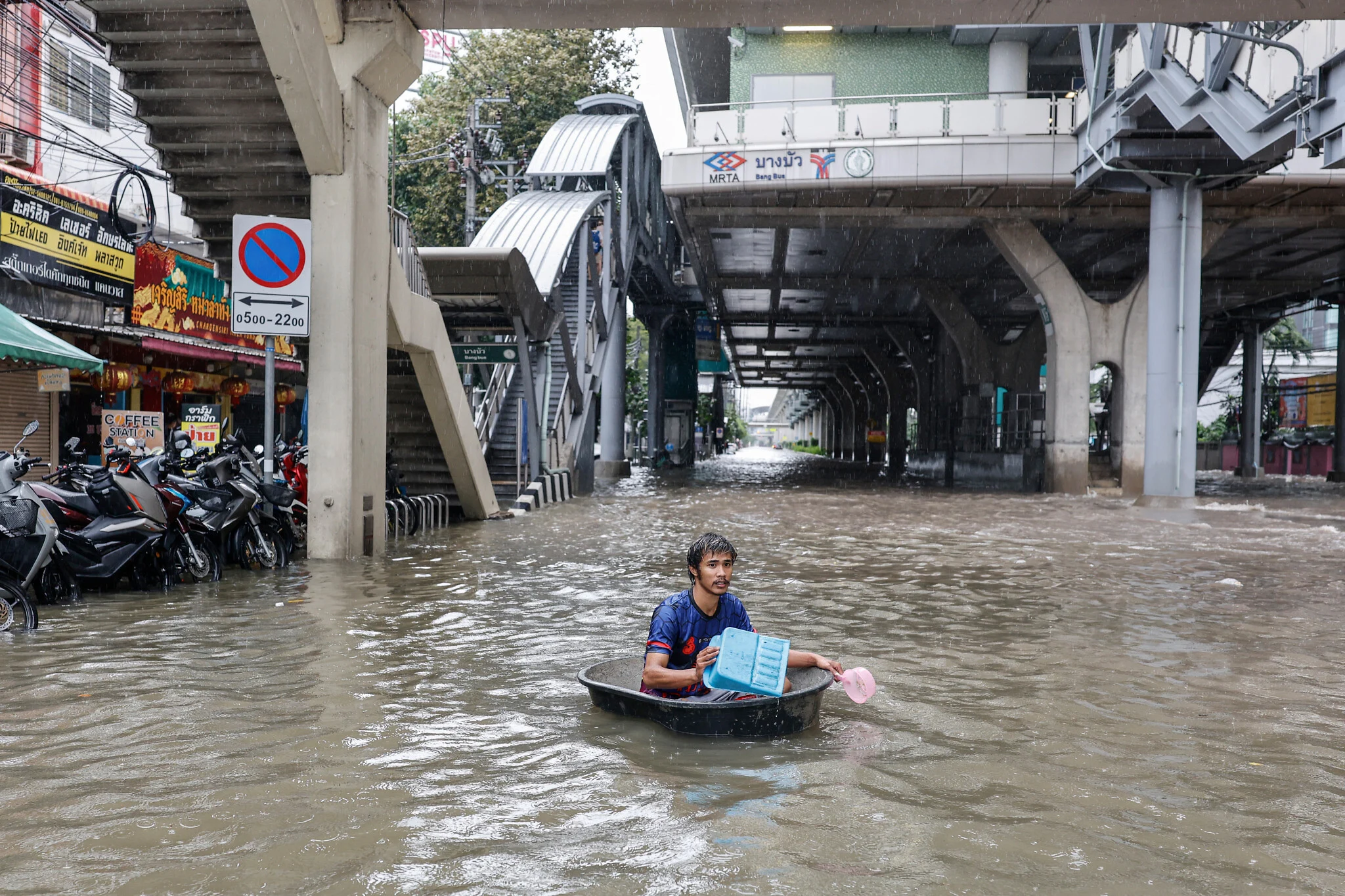
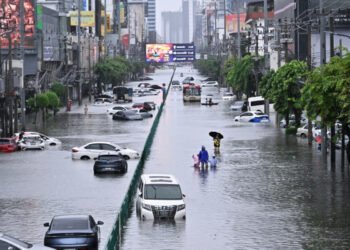
For many residents, the difference has been measured not only in water levels but in how long the water has remained. Streets that normally drain within hours have become stagnant pools filled with rubbish, debris and polluted runoff. Cars have disappeared beneath the brown water, while residents have been forced to find unusual ways of reaching their homes.
At the Khlong Chan apartment compound in north-east Bangkok, 73-year-old resident Suleemas Kurangkul watched water rise around the 1970s-era buildings. The ground-floor stairs remained submerged while residents on higher floors waited for the water to recede.
Suleemas said the rainfall was unlike the typical evening storms experienced in Bangkok. Instead of arriving for a short period and then disappearing, the rain continued through the day and night, allowing water levels to rise steadily.
By the time residents received warnings on their mobile phones, the flooding had already become severe. Water on the surrounding streets reached waist height, making movement difficult and leaving many residents dependent on neighbours and emergency responders.
The apartment compound became one of the most recognisable images of the flooding, with photographs showing buildings rising above muddy water while only the roofs of parked vehicles remained visible. Although pumping and drainage operations reduced some of the water later in the week, residents continued to face the consequences of prolonged inundation.
As the rain briefly eased, Suleemas said residents were relieved to see sunlight again. But the improvement brought another problem into view. With water receding slowly, rubbish and other debris were left behind, while the smell of stagnant water became increasingly difficult to ignore.
Bangkok’s geographical position helps explain why the city is particularly vulnerable. Built across the broad floodplain of the Chao Phraya River, the capital is low-lying and depends on canals, pumping stations, drainage networks and flood barriers to move excess water away from populated areas.
Over decades, however, rapid urban development and extensive concrete construction have altered the natural landscape. Parts of the traditional canal network have disappeared or become less effective, while paved surfaces leave less opportunity for rainfall to be absorbed naturally into the ground.
The latest flooding has demonstrated how quickly those systems can become overwhelmed when exceptionally heavy rain continues for an extended period.
In several neighbourhoods, residents have improvised to cope with the water. Inflatable paddling pools have been used to transport people, while one resident reportedly used a floating refrigerator as an improvised boat. Another man was arrested after riding a jet ski along a flooded main road.
The disruption has extended far beyond residential communities. Bangkok’s roads have experienced widespread congestion, with flooded routes becoming difficult or impossible for vehicles to use. Schools have closed in affected areas, while residents in less severely flooded parts of the capital have also struggled to travel because of gridlock.
The crisis has also affected Suvarnabhumi Airport, one of Thailand’s most important transport hubs. At one point, a significant proportion of Thai Airways employees were unable to reach their workplaces, contributing to operational disruption, luggage accumulation and flight cancellations.
For a city that functions as Thailand’s economic and transport centre, the disruption has created consequences extending well beyond the neighbourhoods directly under water. Businesses have faced difficulties reopening, employees have struggled to reach workplaces and supply chains have been affected by road conditions.
Prime Minister Anutin Charnvirakul said Bangkok’s metropolitan area remained at risk from water moving south from northern parts of the country. Authorities established an emergency monitoring operation to track developments, while weather officials warned that additional heavy rainfall could arrive.
The possibility of further rain has added to residents’ concerns because the problem is no longer simply how much water has fallen but how much capacity remains in the drainage system.
Experts say Bangkok’s infrastructure has limits. Drainage canals can process substantial volumes of water, but intense localised rainfall can exceed those limits, particularly when heavy rain arrives repeatedly without enough time for the system to recover.
Naim Laeni, a consultant and university lecturer who has studied Bangkok’s flood resilience, said the duration and intensity of the rainfall had created conditions that were difficult for the existing system to manage. The challenge, he said, was compounded because the city normally experiences heavy rainfall for a few hours rather than continuously for several days.
The flooding has also intensified discussion about the relationship between extreme rainfall and climate change. Scientists caution that it is too early to attribute this specific event directly to climate change without a detailed scientific assessment. The immediate weather pattern involved a low-pressure system that moved from an unusually warm South China Sea across Cambodia and Vietnam before becoming concentrated over Bangkok.
However, scientists say there is increasing evidence that a warmer atmosphere can produce more intense rainfall. Warmer air is capable of holding more moisture, while warmer seas can contribute additional evaporation. When atmospheric conditions trigger heavy precipitation, the result can be more powerful and prolonged downpours.
Nikolaos Skliris, an ocean scientist at the University of Southampton, has identified a significant long-term trend towards more extreme rainfall in central Thailand. Climate models indicate that this pattern could become more pronounced as global temperatures rise.
The wider region is experiencing similar pressures. Myanmar has also been affected by the same weather system, with flash floods, blocked roads and landslides complicating rescue operations. In southern Myanmar, rescuers have been recovering bodies following a landslide that devastated a village, while other people remained missing beneath mud in a separate area.
Information from Myanmar has been difficult to obtain because of the country’s ongoing conflict and restrictions affecting media organisations and humanitarian groups.
For Bangkok, meanwhile, the immediate priority remains removing the water and helping residents whose homes and livelihoods have been disrupted. Pumping stations have been operating at high capacity, but authorities have warned that some areas may take days to return to normal.
The disaster has also highlighted the importance of community support. In flooded neighbourhoods, residents have helped elderly people move to safer areas, shared food and water and assisted those unable to leave their homes.

For Suleemas and her neighbours, remaining together has become an important source of strength. Despite the damage, uncertainty and uncomfortable conditions, they have continued supporting one another while waiting for the water to disappear.
Bangkok has survived severe floods before, but the latest crisis has renewed questions about whether the city’s infrastructure can keep pace with increasingly intense weather events and continued urban growth. For residents watching water slowly drain from their streets, the immediate concern is returning to normal life. For planners and scientists, however, the flooding offers a much broader warning about the challenges facing rapidly growing cities across south-east Asia.
The water may eventually disappear from Bangkok’s streets, but the questions raised by the disaster are likely to remain. As extreme rainfall becomes a growing concern across the region, the ability of cities to absorb, redirect and recover from enormous volumes of water will become increasingly important to the safety and resilience of millions of people.
Related News:
 Nepal seeks $20m climate compensation after deadly floods
 Wildfires rage across Europe as hundreds arrested in France
 Nepal PM calls deadly flood a global climate warning
 Thai downpours shift north-westwards after Bangkok floods
 Venezuela Quake Death Toll Surpasses 4,000
 Powerful 7.7-Magnitude Earthquake Hits Eastern Indonesia
 Nepal Flood Death Toll Tops 300 as Second Flood Feared
 Nepal-Tibet Flood Death Toll Rises as 2,478 Remain Missing
 Nepal Rescuers Race to Save Hundreds Trapped Underground
 UN Warns Record El Niño Could Supercharge Global Heat
 Nepal Flood Survivors Face Unimaginable Loss
 Nepal Tunnel Rescue Offers Hope Amid Flood Devastation
 Japan Braces for Dujuan as Storm Threat Grows
 Typhoon Dujuan Leaves Four Dead in Japan
 Super El Niño Threatens Hundreds of Thousands of Lives
 UN Warns of Narrowing Window to Restore Forests
 Swiss Glaciers Lose Nearly One-Fifth of Ice in Five Years
 Evacuations Ordered as California Wildfires Spread Fast
 Queensland Braces for Potential Second Severe Cyclone Hit
 Cyclone Vaianu Forces Mass Evacuations in New Zealand
 Escobar’s Hippos May Be Moved to India Zoo
 Capitalism ‘Suicidal’, Warns Petro at Climate Summit
 Wildfires Force Mass Evacuations in France And Spain
 Heavy Casualties Feared as Flash Flood Sweeps Nepal-Tibet Border
 Australia Races to Find Tourists Missing in Nepal
 Typhoon Saudel Triggers Mass Evacuations in China

 Europe Faces Climate Reckoning After Extreme Summer
 ‘Extinct’ Antelope Returns to Sahara, Bringing Hope
 Half the World’s Largest Cities Face Rising Water Stress
 Storm Leonardo Triggers Election Delay Calls in Iberia
 Ocean Warming Drives Massive Marine Life Loss, Study Warns
 Greenpeace $345m Ruling Sparks Appeal Battle
 The Truth Behind Rising Energy Costs and Fossil Fuel Myths
 North Korea Fires Missiles Amid US-South Korea Drills
 Extreme Weather: Europe Shivers as Cyclone Narelle Hits
 Trump to Deploy “God Squad” Over Gulf Wildlife Protections
 Southeast Asia Turns to Russia Amid Energy Crisis
 Coalition pushes fossil fuel phaseout plan
 Ukraine strikes Tuapse as oil disaster worsens
 China Fireworks Factory Blast Kills 21 in Hunan
 Australia pushes Pacific security pact amid China tension
 US Awaits Iran Reply on New Ceasefire Proposal
 UK Faces Mass Water Shortages by 2055, Lords Warn
 Hormuz Talks Near Critical Stage
 Maldives Cave Diving Tragedy Raises Safety Alarm
 Pope Meets Families in Italy Toxic Waste Zone
 Discontent grows around Putin amid war strain
 Man killed in shark attack on Great Barrier Reef
 Hope for mountain bongos returns to Kenya
 Germany Summons Chinese Envoy Over Russian Troop Training
 Sydney Records Hottest June Since 1859 as Expert Warns New High a ‘Signature’ of Global Warming
 Millions Gather for Khamenei’s Six-Day State Funeral
 UK Heatwaves Ignite Crisis of Sleep and Public Safety
 Olympus Awaits Unesco Heritage Recognition
 Houthis Strike Saudi Arabia as Middle East Tensions Rise
 Three-Quarters of England’s Riverbanks Still Off Limits
 Israeli Strike in Southern Lebanon Kills Seven
 Nepal-Tibet Flood Leaves 270 Dead and 1,400 Missing
 Families Fly to Nepal in Search of 33 Missing Britons
 Swedish Mining Push Puts Sami Land Rights Under Pressure
 Saudi Arabia Shuts Oil Pipeline After Drone Attack
 Indonesia Receives First Aircraft Carrier
 Saudi Pact Raises Risk of Pakistan Entering War
 Tropics May Wait Longest for Net-Zero Climate Benefits
 Japan PM Backs International Criminal Court
 Iran Rejects Claims of Shift in US Talks
 Trump gives Xi red-carpet welcome as trade truce extends
 Chinese Hybrid Car Surge Raises EU Auto Industry Concerns
 Greece Pushes for Parthenon Marbles Reunification
 Ukraine and Russia Escalate Long-Range Drone War
 Xi urges Trump to avoid US-China military conflict
 Saudi intercepts Houthi missiles as oil fears grow
 South Korea-Ukraine Row Erupts Over North Korean POWs
 South Korea demands apology over DMZ mine blast
 New Maps Reveal Gaza’s Vast Destruction
 Europe’s Record Heat Summer Signals Climate Risks
 Berlin App Helps Residents Protect City Trees
 Pilot Recalls Fight to Save Flydubai Passengers
 Polanski Says Leadership Not Tied to By-election Result