Published: 16 October 2026. The English Chronicle Desk. The English Chronicle Online
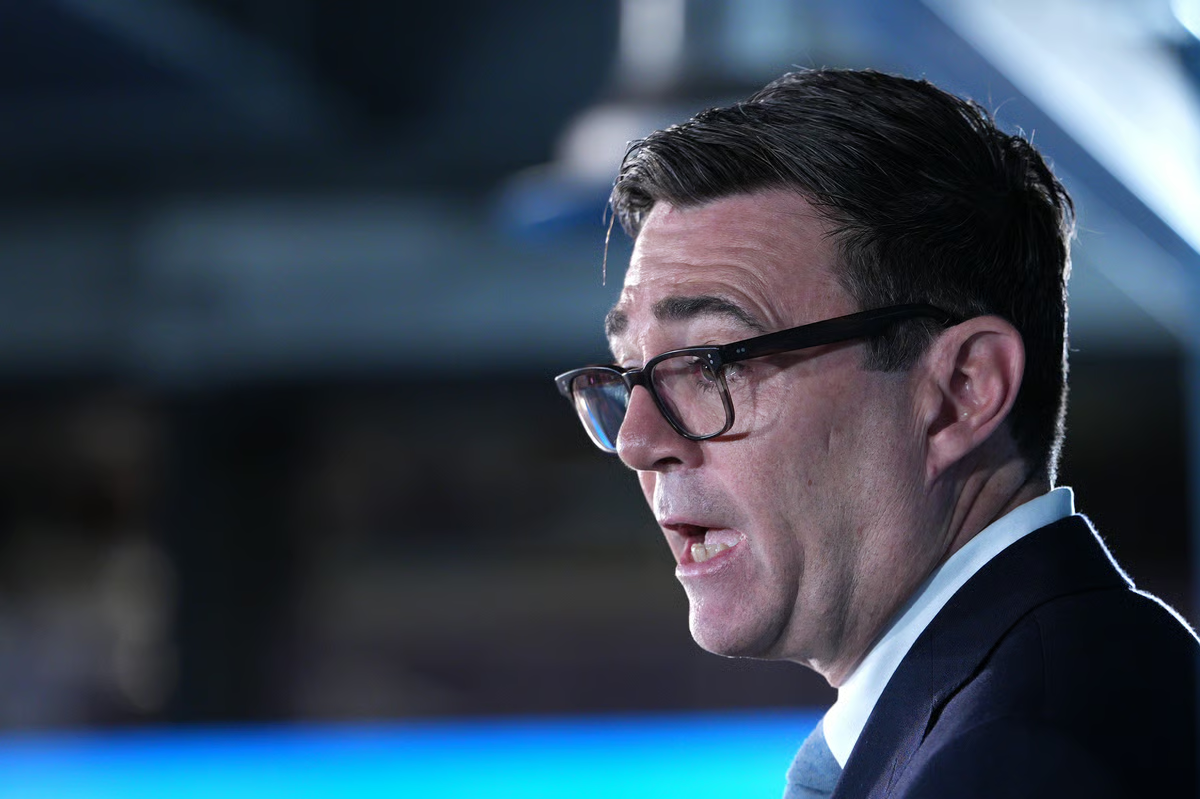
Repairing the economic damage caused by Brexit should be one of Prime Minister Andy Burnham’s highest priorities as the government considers a closer relationship with the European Union, according to the head of one of Britain’s leading business organisations. Shevaun Haviland, director general of the British Chambers of Commerce, has argued that the UK’s current trading relationship with the EU continues to create significant difficulties for businesses and that the government should be prepared to reconsider its approach.
Haviland said she welcomed Burnham’s decision to reopen the debate over Britain’s long-term relationship with the European Union, even though such a move could generate political uncertainty. In her view, the economic consequences of the current arrangement have become increasingly difficult for companies to ignore, with many businesses continuing to struggle with additional rules, costs and administrative requirements introduced after Britain left the bloc.
The intervention comes as the government faces renewed pressure to address the consequences of Brexit while also dealing with wider economic challenges. Energy costs remain a concern for companies, while geopolitical instability and the war in the Middle East have added further uncertainty to the business environment. At the same time, the government is preparing for a closely watched budget in which ministers are expected to balance support for economic growth against pressure on public finances.

Haviland said evidence gathered from businesses suggested that the post-Brexit trading arrangement had not delivered the improvements many companies had hoped would emerge after the initial adjustment period. More than half of the business leaders surveyed by the British Chambers of Commerce believe the agreement negotiated by Boris Johnson’s government and implemented in 2021 has not been beneficial to their businesses.
She said companies had initially expected the difficulties associated with the new trading rules to ease as businesses became familiar with the system. Instead, many of the problems have persisted, leaving companies facing continuing complications when trading with European markets.
The scale of the economic consequences remains a subject of debate among economists, but several estimates indicate that the UK has experienced a substantial loss in economic output compared with a scenario in which the country had remained within the European Union. Some estimates have placed the cumulative cost to the British economy in the hundreds of billions of pounds, while calculations of income per person have suggested a significant gap compared with the projected path without Brexit.
The Office for Budget Responsibility has also estimated that Brexit could have a long-term impact on the size of the British economy, reinforcing concerns among economists and business organisations about the consequences of reduced trade integration with the UK’s largest neighbouring economic bloc.
Burnham has increasingly moved toward a more critical assessment of Brexit. At the Labour conference in Liverpool last month, he said Brexit had done more harm than good and promised to reassess Britain’s relationship with the EU. His comments represented a significant shift in the political debate because he opened the possibility of Britain eventually pursuing a much closer relationship with the bloc, including the prospect of rejoining the European Union in the longer term.
This week, Burnham went further by arguing that failing to seek a better relationship with Europe would represent a major failure of political responsibility. His position has intensified debate within Labour and across Westminster about how far the government should go in attempting to repair the economic relationship without immediately reopening the wider political divisions created by the 2016 referendum.
For the British Chambers of Commerce, however, the issue is primarily economic rather than ideological. Haviland stressed that her organisation was politically neutral and said businesses were interested in practical outcomes rather than arguments over the language traditionally associated with Brexit.
She said the BCC intends to consult its approximately 50,000 members, representing businesses that collectively employ more than six million people across the UK. The consultation will consider a range of possible relationships between Britain and the EU, potentially including options as far-reaching as rejoining the bloc.
Haviland argued that the political vocabulary surrounding Brexit should now evolve. A decade after the referendum, she said businesses were increasingly focused on the practical difference between the trading environment they previously operated in and the system they currently face.
That distinction could prove increasingly important as the government attempts to develop a new economic relationship with Europe. Rather than revisiting the referendum itself, businesses appear more interested in reducing barriers to trade, improving access to European markets and making cross-border operations easier.
Nova Fairbanks, chief executive of the Norfolk Chambers of Commerce, also suggested that attitudes among businesses that supported Brexit may have changed. She said it would be interesting to assess how many companies that strongly backed leaving the EU still held the same position after experiencing the practical consequences of the new trading system.
Fairbanks said she had encountered continuing support among businesses that had opposed Brexit for closer ties with Europe. Her comments reflected a wider concern that the economic realities of Brexit may have altered the debate among companies even where political arguments remain deeply divided.
The renewed discussion over Brexit is unfolding alongside immediate concerns about the cost of doing business in Britain. Haviland said companies were facing pressure from higher energy prices and the wider consequences of instability in the Middle East. She urged the government to use the forthcoming budget to provide meaningful support rather than simply maintaining the existing economic course.
She rejected suggestions that the government should pursue a cautious budget designed primarily to avoid disturbing financial markets. In her view, businesses need measures capable of reducing costs and stimulating investment, rather than a package that merely maintains the status quo.
Haviland specifically highlighted energy bills, business rates and employment-related taxes as areas where government action could make a difference. She argued that the tax component of energy bills represents a substantial burden for companies and suggested that ministers could reduce some of those costs.
Her comments come as the government faces difficult choices over borrowing, spending and investment. Financial markets have been closely watching the government’s fiscal position, while ministers are under pressure to demonstrate control over public finances. Business groups, however, are warning that excessive caution could weaken investment and economic growth.
Haviland argued that the government should combine fiscal discipline with measures that encourage private-sector expansion. She suggested that spending reductions could be accompanied by policies designed to unlock business investment, allowing companies to contribute more strongly to employment and economic growth.
The business leader also linked the cost of employment to the government’s efforts to create opportunities for younger workers. She called for changes that would make it easier for companies to recruit young people, arguing that employment costs remain a barrier for businesses attempting to expand their workforce.
For Burnham, the challenge is therefore broader than simply deciding whether Britain should move closer to the EU. Any attempt to reshape the relationship must be considered alongside the domestic pressures facing businesses, including energy costs, taxation, investment and labour-market conditions.
The renewed Brexit debate could nevertheless become a defining economic issue for the government. Ten years after the referendum, businesses are still adjusting to the consequences of Britain’s departure from the EU, while political leaders are increasingly debating whether the existing relationship is sustainable.
Haviland’s intervention gives Burnham an important signal from the business community that closer European ties could receive support if they lead to tangible improvements for companies. The BCC’s planned consultation could provide further evidence about how businesses view the available options and whether attitudes have shifted since the referendum.

The political difficulty will be managing that economic argument without reopening the deep divisions that Brexit created across British society. For many businesses, however, the priority is increasingly practical: reducing costs, simplifying trade and improving access to European markets.
As the government approaches the budget and continues to consider its European strategy, pressure is likely to grow for ministers to demonstrate how they intend to improve Britain’s economic performance. For the business community, repairing the weaknesses of the current EU trading relationship may be one of the clearest opportunities to support growth.
Haviland’s message is ultimately that Britain cannot afford to treat the economic consequences of Brexit as a settled issue. If businesses continue to face higher costs and greater barriers to European trade, she argues, the government must be willing to consider meaningful changes. For Burnham, that could make repairing Britain’s economic relationship with Europe one of the most consequential challenges of his premiership.
Related News:
 Thinktank Calls for Abolition of UK State Pension
 MPs Defend UK Economic Watchdog Against Critics
 Informa Agrees £2.24bn Deal to Buy Clarion
 IFS Warns UK Budget Faces £35bn Spending Gap
IMF Raises UK Growth Forecast Ahead of Healey’s Budget
IFS Warns UK Budget Faces £35bn Spending Gap
IMF Raises UK Growth Forecast Ahead of Healey’s Budget
 BBC News Faces Deep Cuts in 2,000 Job Plan
 Reeves Fights to Keep Treasury Role Amid Labour Turmoil
 Burnham Faces Mounting Budget Challenges
 UK House Prices Fall as Mortgage Rates Rise
 Oil nears $100 as Saudi attacks shake markets
 Thames Water Revises Oxfordshire Mega-Reservoir Plan
 UK Pay Growth Slows to 3.9% as Rate Decision Nears
 Bank Urged to Slow Bond Sales as UK Costs Rise
 UK Inflation Hits 3.1% as Household Pressure Grows
 UK Retail Sales Rebound as Consumers Spend More
 UK Borrowing Hits £18.3bn Ahead of Budget
 Tony Blair Calls for Britain to Rejoin EU Within a Decade
 UK Trade Losses Grow Without EU Product Deal
 Saudi intercepts Houthi missiles as oil fears grow
 Should Savers Lock Into 5.25% Fixed Rates?
 UK Diesel Prices Hit Record High Amid Iran Conflict
 Poundland Rescue Bid Could Protect 11,000 Jobs
 UK house price growth slows as mortgage rates rise
 UK borrowing costs surge as global bond sell-off deepens
 UK Assures Public Over Diesel Supply
 UK Diesel Reaches £2 as Inflation Surges Across Europe
 Minister Rejects Fears of UK Diesel Shortage
 London Council Warns of 150% Council Tax Rise
 EU-China Talks Target Surge in Hybrid Car Imports
 IMF Warns Governments Over Rising Debt Burdens
 Google Maps Brings Live Fuel Prices to UK Drivers
 Ministers Push ATO to Reconsider Credit Card Ban
 Australia Delays Tax Credit Card Payment Ban After Backlash
 France Faces Debt Crisis as Protests and Markets Clash
 Labour Fears Budget Will Fail to Lift Living Standards
 UK Van Drivers Face £2.5bn Diesel Cost Surge
 IMF Warns Global Economy Is Nearing Its Limits
 Healey Plans £1bn Online Marketplace Tax Crackdown
 UK Doubles Steel Tariffs to 50% to Protect Domestic Plants
 UK Pushes for New EU Goods Trade Deal
 UK rejects EV charging VAT cut amid Treasury clash
 Labour MPs Urge Burnham to Revive UK Aid Target
 EasyJet Takeover Sparks Fears Over Passengers’ Future
 Europe Faces Winter Gas Supply Anxiety
 UK Households Could Save £173 on Fixed Energy Deals
 Trump Hardens Canada Trade Stance as Talks Stall
 Reform Faces Fresh Financial Controversy
 UK Cost Squeeze Deepens as Mortgages and Gas Rise
 Billionaire Chris Rokos poised to leave UK
 JPMorgan Boss Warns Against UK Bank Tax Rise
 John Lewis Losses Widen to £124m as Confidence Falls
 UK State Pension Set to Rise 3.9% as Triple Lock Holds
 North Sea Firms Urge Early End to Windfall Tax
 Trump Threatens EU With Tariffs Over Canada Proposal
 UK Productivity Improves as Bank Weighs Interest Rates
 Trump Threatens EU Over Canada Partnership Proposal
 Japan Raises Rates to 31-Year High
 UK Rent Gap Puts Low-Income Families Under Pressure
 Reform UK Faces Internal Debate Over £72m Spending
 Calls Grow to Expand UK National Wealth Fund
 Trump Eyes Major Belarus Fertiliser Deal Amid Canada Trade Dispute
 Iran Rejects Claims of Shift in US Talks
 Chinese Hybrid Car Surge Raises EU Auto Industry Concerns
 AO Acquires Jessops in Camera Retail Expansion
 Beaverbrooks Boss Calls for Relief on Business Costs
 Burnham Opens Door to Possible UK Return to EU
 Healey urged to act as UK energy bills rise 4%
 Boots Sale Nears as Weston Family Eyes $9bn Deal
 French Debt Fears Put Euro Markets Under Pressure
 Badenoch Raises Prospect of 2027 UK Election
 UK Faces Calls to Review Bank Failure Bets
 North Sea Strike Threatens UK Fuel Supplies
 UK Weighs Chinese Car Tariffs Amid EU Trade Push
 BT Agrees £400m TalkTalk Rescue Deal
 UK house prices stall as mortgage costs rise
 Tesco Raises Profit Forecast as Consumer Confidence Holds
 France Urges UK to Consider Returning to EU
 Oil Shock Sends Markets Lower as Middle East Risks Grow
 UK Savers Face Uncertainty as Rates Rise Above 5%
 Hall and Woodford Win Nobel Economics Prize