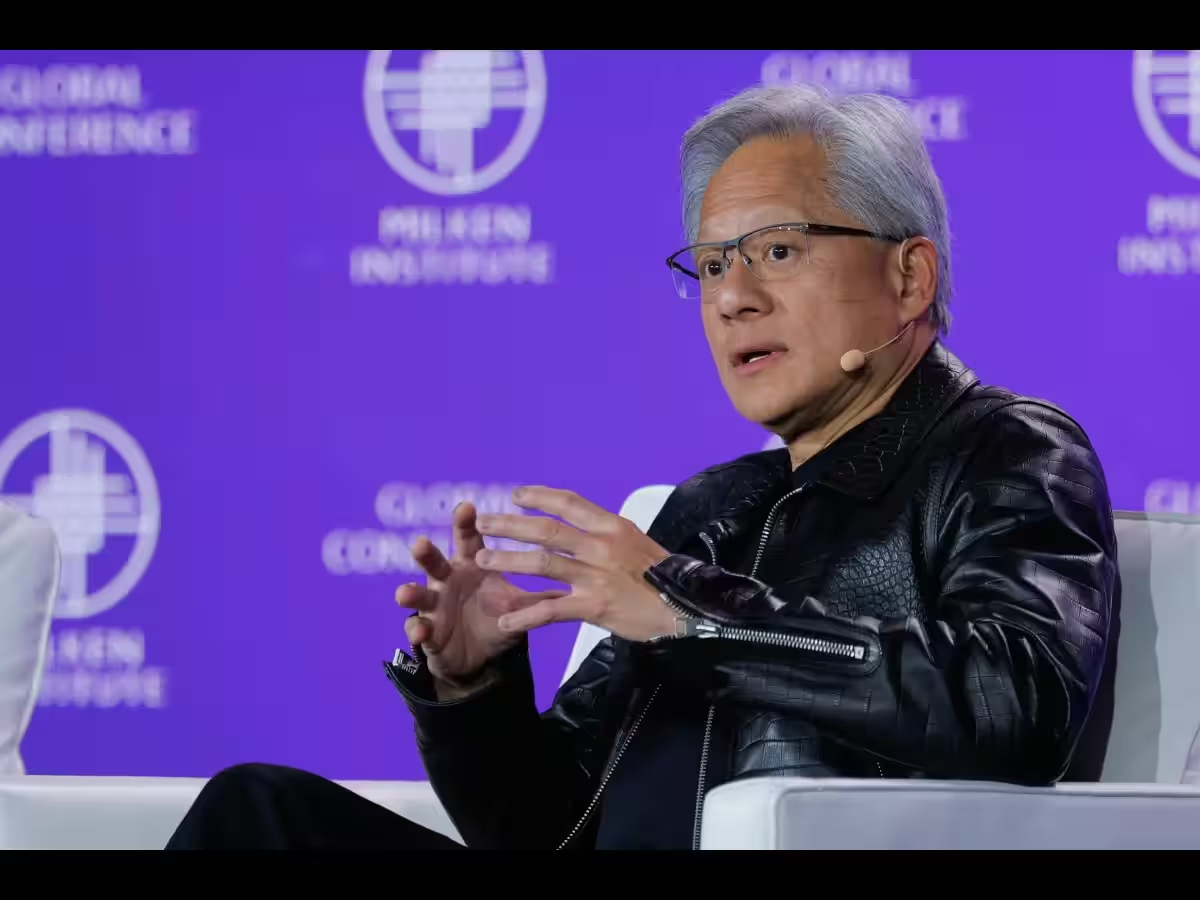
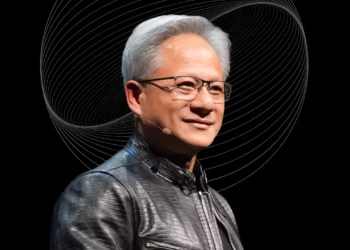
Nvidia shares came under renewed pressure in premarket trading on Tuesday as the controversial return of Jensen Huang to the leadership of the world’s most valuable semiconductor company triggered political criticism in the United States and raised fresh questions about corporate governance, national security and the future of artificial intelligence investment. The development followed an extraordinary rally in global technology stocks after Huang was reinstated as chief executive, with investors initially welcoming the prospect of renewed stability at the company. However, the celebrations were quickly overshadowed by concerns about the circumstances surrounding his return and the reported involvement of US President Donald Trump.
Nvidia shares fell approximately 4.1 per cent in premarket trading, reaching $158.26, after gaining more than 30 per cent during the previous session. The company’s stock had closed at $165.05 on Monday, compared with $125.53 at the end of the previous Friday’s trading. The dramatic recovery had added approximately $950 billion to Nvidia’s market value, demonstrating the enormous influence the company continues to exercise over global financial markets and the artificial intelligence industry.

The initial enthusiasm also spread across Asian financial markets. Taiwan’s TW50 index surged by approximately 9.5 per cent, while South Korea’s Kospi climbed 6.5 per cent, supported by strong performances from major semiconductor manufacturers SK Hynix and Samsung Electronics. Japan’s Nikkei gained nearly 4 per cent, while Australia’s S&P/ASX 200 advanced 1.8 per cent. These gains reflected renewed investor confidence that Nvidia’s leadership uncertainty would no longer threaten the broader artificial intelligence supply chain.
However, the positive momentum proved less consistent elsewhere. Hong Kong’s Hang Seng index declined by 0.73 per cent, while European markets also experienced losses during Tuesday’s early trading. The pan-European Stoxx 600 fell 0.25 per cent, with Germany, Italy and Spain recording declines. London’s FTSE 100 slipped approximately 0.05 per cent to 10,475 points after rising 1.3 per cent during the previous session.
US markets also appeared set to surrender part of their recent gains. The S&P 500 declined almost 0.4 per cent in premarket trading, while the technology-focused Nasdaq was heading towards a larger fall of approximately 0.9 per cent. Investors were reassessing the implications of Huang’s reinstatement, particularly as political objections and concerns about the sustainability of artificial intelligence investment continued to influence market sentiment.
The controversy centres on the extraordinary circumstances surrounding Huang’s departure and subsequent return. His reinstatement followed reports of a relationship with Alice Huang, a Chinese businesswoman associated with Megaspeed International who has been alleged to have links to Chinese intelligence. The allegations have generated concerns about potential national security implications, although the claims remain disputed and China has described accusations surrounding the businesswoman as groundless.
The situation became particularly controversial after Trump reportedly intervened in Nvidia’s internal leadership discussions. According to reports, the US president joined the company’s board meeting by telephone on Sunday and argued in favour of Huang’s return. Trump subsequently acknowledged speaking directly and indirectly with board members, saying he had convinced them to reinstate the executive.
Reports also indicated that Trump asked Vice-President JD Vance to work with Nvidia’s board to reassure its members that Huang did not represent a national security threat. The intervention reportedly took place despite the company’s chairman previously indicating that Huang would not be reinstated because his personal conduct was inconsistent with Nvidia’s code of conduct, standards and cultural expectations.
The decision has prompted criticism from lawmakers belonging to both major US political parties. Democratic Senator Elizabeth Warren described Huang’s restoration as reckless and questioned the extent of government involvement in the company’s internal decision-making. She also warned that the Senate Banking Committee, which she is expected to lead next year, would examine whether Nvidia had complied with US export controls.
Warren argued that the Trump administration must explain what influence senior government officials exercised to support Huang’s reinstatement. Her intervention suggests that the controversy could become part of a wider congressional examination of the relationship between government authorities and major technology corporations.
Republican lawmakers have also expressed dissatisfaction with the decision. Senator Pete Ricketts of Nebraska criticised Nvidia’s board, arguing that Huang’s reported behaviour did not justify reinstatement. His comments highlighted the unusual political situation in which criticism of Trump’s intervention has emerged from members of his own party as well as Democratic opponents.
Robert Garcia, the leading Democrat on the House Oversight Committee, also called for an investigation. He raised concerns about possible national security and corruption issues, arguing that a president should not influence the leadership decisions of a private company in which he has financial interests.
The financial implications have added another dimension to the controversy. Trump’s holdings in Nvidia reportedly increased in value by as much as $15 million following Monday’s share-price rally. Financial disclosures reviewed by news organisations indicate that the president held Nvidia shares valued between $11 million and $55 million, based on his 2025 annual financial disclosure and subsequent 2026 trading disclosures.
The reported increase in the value of those holdings has intensified questions about potential conflicts of interest. Critics argue that presidential involvement in a corporate decision that could substantially affect the value of personal investments requires greater transparency. The White House’s role in the reinstatement could therefore attract further congressional scrutiny.
Meanwhile, international concerns are emerging over the implications for US-China technology relations. China’s state-controlled Global Times newspaper warned that Huang’s return would not automatically ease tensions between Beijing and Washington. Its commentary urged China to remain vigilant against potential restrictions and political pressure affecting the semiconductor industry.
Those concerns have become more significant following the US Commerce Department’s decision to add Megaspeed International to its trade blacklist. The designation means the company will require approval from American authorities before obtaining US exports, including advanced technologies subject to export controls. The move reinforces Washington’s determination to restrict access to sensitive artificial intelligence technology where national security concerns arise.
For Nvidia, the political controversy comes at a critical time. The company occupies a central position in the global artificial intelligence industry because its advanced processors are widely used to develop and operate sophisticated AI systems. Major technology companies depend on Nvidia’s chips to build data centres and expand their computing capabilities.
Huang’s return was initially welcomed by investors because it appeared to restore strategic continuity and reduce uncertainty surrounding the company’s leadership. Charu Chanana, chief investment strategist at Saxo in Singapore, said the development reduced the immediate risk of disruptions to Nvidia’s supply chain and technology roadmap.
Nevertheless, analysts have cautioned that the immediate market rally does not resolve the industry’s deeper financial challenges. Technology companies are spending enormous amounts on data centres, advanced processors and other artificial intelligence infrastructure. Investors increasingly want evidence that these investments will generate sustainable revenues and profits.
Christian Stocker, an equity strategist at UniCredit in Munich, suggested that the market recovery reflected relief that the artificial intelligence investment cycle was unlikely to face an abrupt disruption. However, questions surrounding financing, profitability and the eventual returns from AI spending remain unresolved.
There are also concerns about the wider economic consequences of renewed confidence in artificial intelligence investment. Deutsche Bank analysts indicated that easing fears of an AI slowdown could influence expectations for US Federal Reserve interest-rate decisions. If economic activity and investment remain stronger than expected, policymakers could face greater pressure to maintain restrictive monetary conditions or consider further increases.
This creates a complicated outlook for investors. Stronger technology investment may support economic growth, but higher borrowing costs could make it more expensive for businesses to finance infrastructure projects and expand their operations.

The political response to Huang’s return could prove equally important. If congressional investigations result in tighter scrutiny of Nvidia’s export arrangements or additional restrictions on advanced chip sales, the company could face new regulatory challenges. Its relationships with international customers, particularly in China, will remain sensitive to changes in US foreign policy.
For now, Nvidia’s dramatic share-price movements demonstrate how closely financial markets are tied to the fortunes of major artificial intelligence companies and their leadership. Huang’s reinstatement has restored confidence in one important aspect of the industry, but it has also opened a new debate about corporate independence, political influence and national security.
As investors reassess their positions, Nvidia must navigate a difficult combination of market expectations, regulatory pressure and political controversy. The coming weeks could reveal whether Huang’s return provides lasting stability or whether the circumstances surrounding his reinstatement create another period of uncertainty for the global technology sector.
Related News:
 Firmus Abandons Major ASX Listing Amid Investor Doubts
 EU Caps Chinese Hybrid Car Imports at 350,000
 Global Tech Sell-Off Deepens on Inflation and AI Debt Fears
 China’s AI Ambitions Hit $2.4 Trillion Market Setback
 Anthropic IPO Reveals AI Boom’s Huge Costs and Risks
 M&S Profits Rebound to £355m After Cyber-Attack
 Billionaire Chris Rokos poised to leave UK
 Oil nears $100 as Saudi attacks shake markets
 JPMorgan Boss Warns Against UK Bank Tax Rise
 Thames Water Revises Oxfordshire Mega-Reservoir Plan
 Chinese Hybrid Car Surge Raises EU Auto Industry Concerns
 UK Trade Losses Grow Without EU Product Deal
 Why Americans Feel Ripped Off by Rising Prices
 Poundland Rescue Bid Could Protect 11,000 Jobs
 Bank Chief Calls for Power to Intervene in AI
 Boots Sale Nears as Weston Family Eyes $9bn Deal
 UK Diesel Reaches £2 as Inflation Surges Across Europe
 Minister Rejects Fears of UK Diesel Shortage
 UK Faces Calls to Review Bank Failure Bets
 Informa Agrees £2.24bn Deal to Buy Clarion
 Asos Investigates Hack Claims After Customer Alerts
 EU-China Talks Target Surge in Hybrid Car Imports
 IMF Warns Governments Over Rising Debt Burdens
 Tesco Raises Profit Forecast as Consumer Confidence Holds
 Ministers Push ATO to Reconsider Credit Card Ban
 Australia Delays Tax Credit Card Payment Ban After Backlash
 Healey Plans £1bn Online Marketplace Tax Crackdown
 North Korea Linked to Record $6.3bn Binance Crypto Heist
 BP Profits Surge as Middle East Conflict Lifts Margins
 Australia Faces Deeper Economic Slowdown
 Ryanair Weighs Pay Freezes as Fuel Costs Surge
 David Jones Faces Administration After Talks Collapse
 UK House Prices Suffer Sharpest Fall in Three Years
 Nationwide Launches Exclusive Savings Deal Paying 5.3%
 Nvidia and Jensen Huang Face Shareholder Lawsuit
 Microsoft Outage Sparks Billion-Dollar Fears in Australia
 UK Retail Sales Surge as Families Stockpile Emergency Supplies
 Global Markets Plunge as AI Sell-Off Intensifies
 Trump Hosts Third Crypto Gala Amid Corruption Allegations
 Capita CEO Quits as Shares Plunge 67% Over Pension Crisis
 Trump, Nvidia and the Fight Against Tech Oligarchs
 UK Risks Falling Behind in AI Race
 Trump Hardens Canada Trade Stance as Talks Stall
 John Lewis Losses Widen to £124m as Confidence Falls
 AI CEOs Call for Slower Development
 UK Retailers Accused of Breaking Refund Laws
 UK Productivity Improves as Bank Weighs Interest Rates
 UK Retail Sales Rebound as Consumers Spend More
 MPs Defend UK Economic Watchdog Against Critics
 Trump gives Xi red-carpet welcome as trade truce extends
 AO Acquires Jessops in Camera Retail Expansion
 TalkTalk Races to Sell Arms as Administration Looms
 Should Savers Lock Into 5.25% Fixed Rates?
 UK house price growth slows as mortgage rates rise
 UK borrowing costs surge as global bond sell-off deepens
 French Debt Fears Put Euro Markets Under Pressure
 UK Assures Public Over Diesel Supply
 UK Weighs Chinese Car Tariffs Amid EU Trade Push
 Japan Beer Giants Face Cartel Probe
 Hall and Woodford Win Nobel Economics Prize
 IMF Warns Global Economy Is Nearing Its Limits
 UK Unemployment Falls to 4.7% as Vacancies Decline
 UK Borrowing Hits £24.5bn Ahead of Healey’s Budget
 Sainsbury’s Warns of Tough Christmas Ahead
 Labour MPs Urge Burnham to Lead UK Reindustrialisation
 US Bans BYD Vehicles at Japan Military Base
 UK Chancellor Moves to Scrap Gas Standing Charges
 Healey Set to Scrap Planned Cut to Cash ISA Allowance
 Fed Expected to Hold Rates Steady Ahead of US Midterms
 London Luxury Homes Face Deeper Price Declines
 UK Mortgage Holders Face Fresh Payment Shock
 Australia Raises Interest Rates to 18-Year High
 Elon Musk’s $446m Midterm Gamble Ends in Defeat
 Poundland Remains Vulnerable as Rescue Talks Continue
 Starbucks to Create 7,500 UK Jobs in Major Expansion
 Australian Mortgage Confidence Hits 32-Year Low
 Australian Property Investor Lending Suffers Record Fall
 Bank of England Faces £160m Renovation Challenge
 EDF Expands UK Market With 1.3m Utilita Accounts
 UK Borrowing Beats Forecast in Boost for Healey