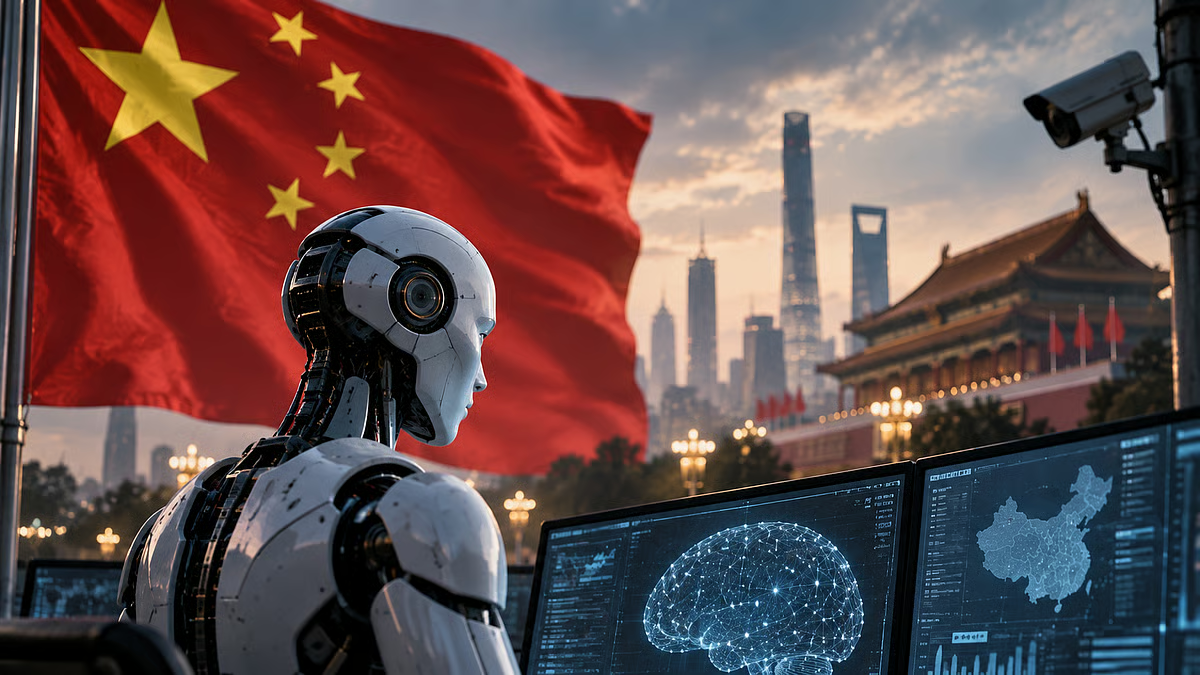
The downturn has erased approximately $2.4 trillion in market value from Chinese equities since May, according to Bloomberg, highlighting the growing gap between Beijing’s technological ambitions and the ability of its technology companies to generate sustainable profits. The latest market turmoil has also raised questions about whether government-backed investment alone can support the rapid expansion of China’s artificial intelligence industry.
The Shanghai Stock Exchange’s STAR 50 Index, which tracks technology and innovation-focused companies, has fallen by around 40 per cent since June. Other major Chinese stock market indices have declined by approximately 20 per cent over the same period, reflecting a broader deterioration in investor confidence.

The scale of the losses is particularly significant because artificial intelligence-related stocks account for more than 40 per cent of the combined stock market value of mainland China and Hong Kong, according to Goldman Sachs figures cited in the original report. A sharp correction in this sector can therefore affect the wider financial market, weaken investor sentiment and complicate Beijing’s efforts to encourage domestic savings to flow into equities.
The sell-off comes at a critical moment for China, which has placed technological self-reliance and AI development at the centre of its economic strategy.
For much of the recent technology rally, investors were willing to pay premium prices for companies expected to benefit from the rapid adoption of artificial intelligence. Businesses developing advanced AI models, semiconductor technologies, data infrastructure and robotics attracted substantial interest as investors anticipated that these industries would transform manufacturing, services and everyday life.
However, expectations are now being tested against commercial realities.
Developing advanced AI systems requires substantial spending on computing infrastructure, specialised chips, research, energy and skilled personnel. Companies must continue investing to remain competitive, even when their products and services are not generating enough revenue to cover those costs.
The result is a growing concern that some businesses may struggle to convert technological progress into lasting profitability. Investors who previously focused on future growth are increasingly examining earnings, operating costs and the strength of actual customer demand.
Dan Wang, China director at Eurasia Group, identified disappointing profit margins, rising US interest rates and weak domestic demand as important sources of anxiety among Chinese technology companies.
The problem extends beyond the technology industry. Chinese consumers have remained cautious about spending across several parts of the economy, limiting opportunities for companies seeking to expand their customer base. Expensive AI-powered devices and advanced robotic products may attract considerable attention at exhibitions and demonstrations, but that interest does not necessarily translate into widespread commercial sales.
For investors, the distinction is crucial. A company may possess impressive technology and enjoy strong government support while still struggling to generate sufficient cash flow. If valuations rise faster than revenues and profits, even a modest change in expectations can trigger a substantial correction.
China’s government has not abandoned its ambition to become a global AI powerhouse. Instead, it is increasing financial support for domestic developers and encouraging wider adoption of artificial intelligence across manufacturing and consumer industries.
A key initiative is the state-backed national AI industry investment fund, worth 60 billion yuan, or approximately $9 billion. According to Caixin Global’s 20 October report, the fund has begun directing capital towards leading domestic developers of large AI models. The initiative forms part of Beijing’s broader effort to strengthen local technological capabilities and reduce dependence on foreign suppliers.
Government funding can help businesses finance research, develop products and expand computing capacity. It can also support promising companies during the expensive early stages of technological development.
Nevertheless, public investment cannot guarantee commercial success. Companies must still persuade customers to purchase their products, demonstrate that their services provide measurable benefits and establish business models capable of delivering sustainable returns.
This creates a difficult policy challenge for Beijing. Authorities want domestic firms to compete with American technology leaders, but excessive dependence on state funding could leave companies vulnerable if public investment fails to produce stronger consumer demand or commercial earnings.
The current market downturn therefore represents more than a temporary financial setback. It is also a test of whether China’s state-supported technology strategy can deliver competitive businesses rather than simply rapid technological expansion.
Geopolitical tensions are another major source of uncertainty for Chinese technology companies. Washington has increasingly treated advanced technology, robotics and AI infrastructure as matters of national security, introducing restrictions that could limit the access of Chinese manufacturers to the American market.
In July 2026, the US Federal Communications Commission introduced restrictions targeting newly released foreign-made humanoid and quadruped robots, alongside connected power inverters used in energy systems and data centre infrastructure. The measures were justified on national security grounds, including concerns about potential cyberattacks, surveillance and the security of critical supply chains. Their practical impact is particularly significant for Chinese manufacturers seeking access to American customers.
Further restrictions on Chinese components used in data centres have also been discussed, although any additional measures would depend on subsequent government decisions.
For China, the commercial consequences could be considerable. Export-oriented manufacturers need access to large markets to achieve economies of scale, recover research expenses and remain competitive on price. If access to the United States becomes more difficult, companies may have to redirect exports towards other regions while competing more aggressively for customers at home.
That challenge becomes more serious when domestic demand is already weak. Manufacturers facing reduced access to overseas buyers cannot easily compensate if local consumers and businesses are unwilling or unable to purchase their products.
The restrictions also illustrate how the US-China technology competition increasingly extends beyond AI software. Robotics, semiconductors, computing equipment and the infrastructure needed to operate advanced AI systems are all becoming strategically important industries.
Robotics has emerged as one of the most prominent elements of China’s AI ambitions. Beijing sees embodied AI, which enables intelligent systems to interact with and perform tasks in the physical world, as a potential driver of industrial productivity and a response to the country’s ageing population and shrinking workforce.
Humanoid robots could eventually assist in factories, warehouses, healthcare facilities and households. Robotic dogs and other autonomous machines have also attracted attention through public demonstrations and entertainment events.
Yet the transition from impressive demonstrations to widespread everyday use remains difficult.
Advanced robots are still expensive, and their ability to perform complex tasks reliably in unpredictable environments remains limited. Household customers may find it difficult to justify the cost when the machines cannot yet perform enough practical tasks to replace existing products or services.
As a result, demand is being driven largely by government agencies, research institutions and industrial organisations rather than ordinary consumers.
China’s leading robot manufacturer, Unitree, has become a prominent example of the uncertainty surrounding the sector. Its shares have reportedly fallen by around half from their earlier trading levels, reflecting concerns about the sustainability of valuations and the prospects for mass-market demand.
The company’s experience does not establish that robotics will fail as an industry. Instead, it highlights the uncertainty surrounding the speed at which technological innovation can become a profitable commercial business.
For manufacturers, the challenge is to reduce production costs, improve reliability and identify applications where customers can clearly measure the economic benefits of using robots.
Beijing also wants domestic investors to direct more of their savings into Chinese financial markets rather than overseas assets. Restrictions on certain forms of overseas investment have been introduced, with additional regulations scheduled to take effect from 1 December.
However, limiting investment abroad does not automatically make domestic equities more attractive. Investors also need confidence in corporate earnings, economic growth and the reliability of future returns.
The latest losses suggest that policy measures encouraging domestic investment have not been sufficient to overcome concerns about valuations and profitability.
There are still areas of China’s technology sector that may attract long-term support. AI research remains strategically important, while satellite technologies have potential commercial and military applications. Their links to national priorities could help sustain investment even during periods of weaker market sentiment.
Nevertheless, these prospects do not eliminate the financial risks facing companies whose valuations depend heavily on expectations of rapid future growth.
Developments in the United States provide another point of comparison. Anthropic, the company behind the Claude AI chatbot, filed paperwork on 26 October ahead of a planned initial public offering that could become one of the largest stock market debuts in history.
Reports suggest the company could seek to raise as much as $100 billion, although the final size and terms of any offering remain uncertain. The potential listing underscores the scale of investor interest in leading American AI businesses, even as questions about the long-term economics of the industry remain unresolved.
The contrast with China is significant. While American AI companies are attracting attention for potentially record-breaking public offerings, the Chinese market is struggling with falling valuations and uncertainty about the commercial returns from its own technology boom.
However, fundraising ambitions should not be confused with guaranteed profitability. Large capital raises can provide companies with resources to expand, but they also create expectations that future revenues and business performance will justify their valuations.
The broader AI industry, on both sides of the Pacific, must ultimately demonstrate that its technological achievements can support durable commercial returns.
China’s policymakers face additional constraints as senior Communist Party officials gather for the fifth plenum, a significant meeting shaping the country’s future policy direction ahead of the 21st Party Congress.
With leadership and economic priorities under discussion, officials may be reluctant to introduce large, potentially destabilising stimulus measures before the political process advances.
Any intervention would involve difficult choices. Additional financial support could strengthen investment and encourage economic activity, but it could also direct more capital towards businesses that have yet to establish sustainable demand. If a major stimulus programme failed to achieve its objectives, policymakers could face criticism over the allocation of public resources.

The challenge is therefore to support innovation without encouraging excessive speculation or creating an expectation that the government will continually protect technology valuations from market corrections.
China’s AI ambitions remain substantial, and the current downturn does not mean the country has lost its capacity to develop competitive technology. Its manufacturing base, research capabilities and large industrial economy continue to provide important advantages.
But the latest market losses expose a central question facing Beijing: can technological leadership be translated into profitable businesses that attract customers at home and remain competitive internationally?
The answer will depend not only on how much money China invests in artificial intelligence, but also on whether its companies can turn research into useful products, expand their customer base and generate reliable earnings.
For investors, the message is increasingly clear. Government backing and technological ambition may help build an industry, but they cannot substitute indefinitely for commercial success.
Related News:
 Chinese Hybrid Car Surge Raises EU Auto Industry Concerns
 EU Caps Chinese Hybrid Car Imports at 350,000
 Oil nears $100 as Saudi attacks shake markets
 Trump gives Xi red-carpet welcome as trade truce extends
 Saudi intercepts Houthi missiles as oil fears grow
 UK Diesel Reaches £2 as Inflation Surges Across Europe
 Minister Rejects Fears of UK Diesel Shortage
 EU-China Talks Target Surge in Hybrid Car Imports
 Firmus Abandons Major ASX Listing Amid Investor Doubts
 Hall and Woodford Win Nobel Economics Prize
 Global Tech Sell-Off Deepens on Inflation and AI Debt Fears
 Shein targets $27bn valuation in Hong Kong debut
 Firms on both sides fear damage from US-Canada trade war
 Dutch Bank Moves 86 Tonnes of Gold to London
 Oil Prices Surge as Saudi Pipeline Closure Deepens Crisis
 Thames Water Revises Oxfordshire Mega-Reservoir Plan
 UK Productivity Improves as Bank Weighs Interest Rates
 Japan Raises Rates to 31-Year High
 AI Takes Centre Stage in Trump-Xi Talks
 Iran Rejects Claims of Shift in US Talks
 UK Trade Losses Grow Without EU Product Deal
 Xi urges Trump to avoid US-China military conflict
 Why Americans Feel Ripped Off by Rising Prices
 Ukraine Faces $45m Hourly Cost From Missile Alerts
 Poundland Rescue Bid Could Protect 11,000 Jobs
 Bank Chief Calls for Power to Intervene in AI
 French Debt Fears Put Euro Markets Under Pressure
 Informa Agrees £2.24bn Deal to Buy Clarion
 Asos Investigates Hack Claims After Customer Alerts
 IMF Warns Governments Over Rising Debt Burdens
 Japan Beer Giants Face Cartel Probe
 Tesco Raises Profit Forecast as Consumer Confidence Holds
 Ministers Push ATO to Reconsider Credit Card Ban
 Oil Shock Sends Markets Lower as Middle East Risks Grow
 Australia Delays Tax Credit Card Payment Ban After Backlash
 France Faces Debt Crisis as Protests and Markets Clash
 IMF Warns Global Economy Is Nearing Its Limits
 Healey Plans £1bn Online Marketplace Tax Crackdown
 US Awaits Iran Reply on New Ceasefire Proposal
 UK rejects EV charging VAT cut amid Treasury clash
 Canada to Match Trump’s 50% Tariffs Dollar for Dollar
 UK Risks Falling Behind in AI Race
 Europe Faces Winter Gas Supply Anxiety
 Trump Hardens Canada Trade Stance as Talks Stall
 Swedish Mining Push Puts Sami Land Rights Under Pressure
 UK House Prices Fall as Mortgage Rates Rise
 Billionaire Chris Rokos poised to leave UK
 JPMorgan Boss Warns Against UK Bank Tax Rise
 John Lewis Losses Widen to £124m as Confidence Falls
 Saudi Arabia Shuts Oil Pipeline After Drone Attack
 AI CEOs Call for Slower Development
 Anthropic Backs $31.9bn Queensland Data Centre
 Trump Threatens EU Over Canada Partnership Proposal
 Indonesia Receives First Aircraft Carrier
 UK Retail Sales Rebound as Consumers Spend More
 Trump Eyes Major Belarus Fertiliser Deal Amid Canada Trade Dispute
 MPs Defend UK Economic Watchdog Against Critics
 Ukraine and Russia Escalate Long-Range Drone War
 Tony Blair Calls for Britain to Rejoin EU Within a Decade
 AO Acquires Jessops in Camera Retail Expansion
 TalkTalk Races to Sell Arms as Administration Looms
 Should Savers Lock Into 5.25% Fixed Rates?
 Beaverbrooks Boss Calls for Relief on Business Costs
 Trump backs voluntary AI safety pact with tech giants
 UK house price growth slows as mortgage rates rise
 UK borrowing costs surge as global bond sell-off deepens
 Boots Sale Nears as Weston Family Eyes $9bn Deal
 UK Assures Public Over Diesel Supply
 UK Weighs Chinese Car Tariffs Amid EU Trade Push
 BT Agrees £400m TalkTalk Rescue Deal
 Shell Refineries Set for Record Refining Profits
 South Korea Probes Fuel Shipments to Russia
 IFS Warns UK Budget Faces £35bn Spending Gap
 UK Could Rejoin EU Through a Switzerland Plus Deal
 UK Unemployment Falls to 4.7% as Vacancies Decline
 UK Inflation Hits 3.5% as Middle East War Drives Fuel Costs
UK Borrowing Hits £24.5bn Ahead of Healey’s Budget
 Meta Reaches Deal to Keep Zuckerberg in California
 Sainsbury’s Warns of Tough Christmas Ahead
 Labour MPs Urge Burnham to Lead UK Reindustrialisation