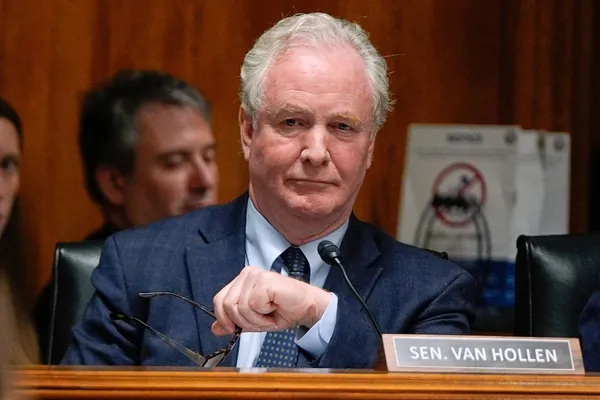
Democratic Senator Chris Van Hollen has secured fresh support in his campaign to become the next Senate majority leader, strengthening his challenge to longtime party leader Chuck Schumer ahead of an internal vote scheduled for next Tuesday. The contest has emerged as an important test of the direction Democrats intend to take after their sweeping success in the midterm elections, with growing calls among party members for a change in leadership and a more confrontational approach to the Republican administration of President Donald Trump.
Senator-elect Troy Jackson of Maine has endorsed Van Hollen, delivering another significant boost to the Maryland senator’s campaign. Jackson said he believed Democrats needed a new direction and wanted a leader prepared to prioritise the concerns of working people and ensure that smaller states had a meaningful voice in decisions about the party’s legislative agenda.
Jackson said conversations with people across Maine had convinced him that many Americans were struggling financially and had become frustrated with political leaders who repeatedly asked them to wait for improvements. He argued that the party needed to move beyond established political practices and take stronger action on issues affecting ordinary households.

He also expressed agreement with Van Hollen on ending the Senate filibuster, advancing Medicare for All and increasing the federal minimum wage. Jackson said he wanted a Senate leader willing to bring these proposals to the floor and require lawmakers to make their positions clear.
Van Hollen has presented himself as a candidate for generational and political change, contrasting his approach with Schumer’s established leadership. Schumer has led Senate Democrats for approximately a decade and is viewed by supporters as an experienced figure capable of maintaining party unity. However, critics believe the party needs a different strategy following its electoral gains and the political challenges posed by the Trump administration.
The Maryland senator has also received support from prominent progressive figures, including Bernie Sanders and incoming senators Abdul El-Sayed and Peggy Flanagan. Several well-known public figures, among them Robert De Niro and Jane Fonda, have also expressed support for his campaign. The endorsements have increased attention surrounding the leadership contest, although the final decision will depend on the votes of Democratic senators.
The leadership battle is taking place against a wider political confrontation over immigration, constitutional rights, trade policy and the administration’s approach to national security. One of the most prominent issues has been the case of Kilmar Ábrego García, a Salvadoran national whose wrongful deportation to El Salvador became a major legal and political controversy.
Ábrego García arrived in Spain after leaving the United States on Tuesday night, bringing a new chapter to a prolonged legal dispute that began with his deportation despite a court order preventing his removal to El Salvador. He described his departure as a personal decision made with his family and emphasised that, unlike his earlier removal, he was now leaving voluntarily and retaining his freedom.
Speaking to reporters shortly after reaching Madrid, Ábrego García said he was relieved to be free from the circumstances that had followed him. He also stressed that the future of his life would be decided by him and his family rather than by government officials.
His case attracted considerable attention after he was sent to El Salvador’s notorious Cecot detention facility. The deportation was challenged in court, and the US Supreme Court subsequently issued a ruling that resulted in his return to the United States. The Trump administration later sought to remove him again and explored possible destinations in several African countries.
Senator Van Hollen played a prominent role in supporting Ábrego García, travelling to El Salvador to visit him during the earlier stages of the controversy. The senator has argued that the case represents a broader question about constitutional protections and the rights of individuals facing government action.
Van Hollen criticised the Department of Homeland Security after it published allegations about Ábrego García on social media. He accused the administration of spreading unsubstantiated claims and described its treatment of the Salvadoran national as politically motivated. He argued that the government had pursued a campaign against Ábrego García because he had challenged his deportation through the legal system.
The senator also said the case demonstrated the importance of protecting due process, insisting that constitutional rights should apply to everyone. His public intervention has become part of his wider argument that Democrats need stronger leadership and a more determined response to the administration’s immigration policies.
Meanwhile, a federal judge has delivered another setback to President Trump’s efforts to restrict birthright citizenship. US District Judge Christopher Cooper ruled that the administration could not deny citizenship to children born in the United States to foreign government workers.
The judge referred to the citizenship protections established by the Fourteenth Amendment and the Immigration and Nationality Act. His opinion emphasised that children born in the United States and subject to its jurisdiction are American citizens from birth, reflecting a longstanding constitutional principle.
The ruling follows an earlier Supreme Court decision blocking a broader executive order that sought to restrict automatic citizenship for certain children born in the country. The administration subsequently issued a narrower directive targeting children of foreign diplomats and members of designated foreign terrorist organisations, while also seeking to address birth tourism.
The latest decision adds to the legal difficulties facing the administration’s attempt to change the interpretation of birthright citizenship. The issue remains politically significant because it touches on immigration, constitutional law and the limits of presidential authority.
Trade policy has also become a major source of tension between Washington and its international partners. The Trump administration has proposed additional tariffs on 14 trading partners, including China, the European Union and several Asian economies. The proposed measures are expected to take effect early next year if implemented.
The plan includes an additional 20% tariff on Chinese imports, potentially bringing the total tax burden on affected goods to approximately 40%. Other countries included in the proposals are Bangladesh, Cambodia, India, Indonesia, Japan, South Korea, Malaysia, Singapore, Switzerland, Taiwan, Thailand and Vietnam.
The proposals have raised concerns among governments and businesses that depend on international trade. The European Union has criticised Washington’s approach, while Switzerland has expressed confidence that an existing agreement involving a 15% tariff will be respected. The proposed measures could create further uncertainty for exporters and manufacturers as countries assess their potential economic consequences.
Economic pressure is also becoming a domestic political concern. US inflation has climbed to 3.8% over the past year, reaching its highest level since May, according to figures highlighted in the day’s developments. Rising prices could place additional pressure on households and become an important issue in the political debate over the administration’s economic performance.
In another significant development, the Federal Communications Commission has approved a proposal by Elon Musk’s SpaceX to develop a large network of orbital data-centre satellites. The plan involves authorisation for up to one million Starmind orbital satellites, described as computing modules designed to process data in space.
Supporters argue that space-based data centres could help meet the growing computing demands of the artificial intelligence industry. They say satellites could make greater use of solar energy while reducing pressure on electricity networks and water supplies associated with large data centres on Earth.
However, critics question whether the technology is sufficiently developed for deployment on such a scale. Under the approval conditions, SpaceX must begin deployment by November 2033, place at least 100,000 units in orbit by November 2035 and reach half of the authorised total by November 2038.
The administration has also faced criticism over the handling of potentially hazardous explosives at the Iowa Army Ammunition Plant. On Wednesday, the US military detonated a stockpile of lead azide, a sensitive explosive material, prompting environmental concerns about the possible release of dangerous substances, including lead.
The Trump administration attempted to attribute the problem to decisions made during Barack Obama’s presidency. President Trump, Vice-President JD Vance and other officials suggested that the explosives had been improperly stored during the Obama administration. However, historical records cited in the controversy indicate that the US Army had identified concerns about the deteriorating stockpile much earlier.
An Army publication from 2014 stated that efforts to move away from using lead azide began in 2004 because of concerns about a decades-old stockpile at the Iowa facility. The issue had also appeared in an Army report published in 1980, which documented the destruction of thousands of containers of lead azide between 1966 and 1970.
The conflicting accounts have raised questions about the administration’s explanation and the timeline of efforts to address the explosives. Environmental organisation Earthjustice has challenged the Army’s authorisation for the detonation, highlighting concerns about the potential risks to nearby communities.
On Capitol Hill, incoming House Democratic leader Hakeem Jeffries has outlined an ambitious programme for the party’s new congressional majority. He said Democrats should act quickly to end the war in Iran, describing it as a reckless and costly conflict. He argued that action should begin within the first 100 hours rather than waiting for the first 100 days.
Jeffries also committed to pursuing a broad legislative agenda in 2027. His priorities include strengthening workers’ rights, raising the federal minimum wage, advancing universal healthcare, restoring Affordable Care Act tax credits and reversing reductions to Medicaid and food assistance programmes. He also pledged to pursue immigration reform, voting rights protections, restrictions on congressional stock trading and changes to campaign finance rules.
His comments indicate that Democrats intend to use their strengthened position in Congress to challenge several central policies of the Trump administration. The party is also expected to focus on reducing the administration’s immigration enforcement funding, addressing political redistricting and pursuing reforms to the Supreme Court.
Former US vice-president Al Gore has meanwhile agreed to purchase a weekly newspaper in his home state of Tennessee, highlighting concerns about the decline of local journalism. The Carthage Courier, which has been operated by the Lake family for five decades, serves Smith County, a community of approximately 20,000 people.

Gore said preserving an independent local newspaper was important for the health of the community. Before entering politics, he worked as a military reporter in Vietnam and later as an investigative journalist at The Tennessean. His decision comes as newspapers across the United States face financial difficulties, closures and declining resources.
Taken together, the developments illustrate the range of political, economic and social challenges confronting the United States. For Democrats, the forthcoming Senate leadership vote will be particularly important in determining how the party responds to the Trump administration and uses its new congressional strength. Van Hollen’s growing support suggests that the demand for change is gaining momentum, but Schumer’s experience and established position mean the contest remains consequential for the party’s future direction.
Related News:
 Meta Faces Election Bias Claims Ahead of Brazil Runoff
 Xi urges Trump to avoid US-China military conflict
 Global Crises Test Diplomacy as Trump’s Policies Face Scrutiny
 Nvidia Scandal Fuels US-China Security Crisis
 AI Takes Centre Stage in Trump-Xi Talks
 Trump gives Xi red-carpet welcome as trade truce extends
 AI Deepfakes Put New Pressure on Election Trust
 Trump Ads Trigger Fight Over Taxpayer Money
 Trump Immigration Policy Faces New Legal Tests
 Tanker Attacked Near Qatar as Hormuz Tensions Escalate
 Brazil Court Scandal Threatens Lula as Bolsonaros Rise
 Trump Targets Arizona and Montana Amid GOP Election Worries
 Brazil Cuts Working Week to 40 Hours in Lula Election Boost
 Trump Rallies GOP as Senate Democrats Boost Key Races
 Serbia Leader Linked to Controversial Trump Tower Plan
 Trump Falsely Questions Ossoff’s Election Legitimacy
 US Bans BYD Vehicles at Japan Military Base
 US Midterms Put Trump’s Presidency to the Test
 Elon Musk’s $446m Midterm Gamble Ends in Defeat
 Big Tech Faces a New Political Reckoning in America
 Zelenskyy Seeks Urgent Help as Russia Hits Ukraine’s Power Grid
 Democrats Expand House Majority in Major Midterm Victory
 Australia Faces Political Risks After US Midterm Shift
 Paraguay President Impeached and Arrested After Banking Crisis
 Nvidia and Jensen Huang Face Shareholder Lawsuit
 Elon Musk Leads 165,000 Calls to Reinstate Nvidia CEO
 Trump Defends Lutnick Amid Nvidia Chip Export Controversy
 Rubio Rejects Links Between US Tech Outages
 Musk Distances Himself From MAGA After Costly GOP Bet
 Trump Dismisses US Outages Ahead of China Summit
 White House Cyber Chief Fired After US Tech Outages
 Trump, Nvidia and the Fight Against Tech Oligarchs
Trump Open to Pardoning Nvidia Chief Jensen Huang
 Thousands Protest ICE Operations in Nationwide US Day of Action
 Judge halts deportation of Yemeni refugees in US
 Trump approval plunges amid Iran war fears
 Trump warns Iran as Middle East tensions surge again
 US Awaits Iran Reply on New Ceasefire Proposal
 Hormuz Talks Near Critical Stage
 Former ICC prosecutor condemns US sanctions
 Trump Refuses to Sign Housing Bill, But Law Takes Effect
 Trump Hardens Canada Trade Stance as Talks Stall
 Trump Calls Iran War ‘Small Potatoes’ Despite US Deaths
 UK plans tougher Israel stance with settlement trade ban
 New Mexico Takes Facebook to Trial Over Data Scandal
 Trump Threatens EU Over Canada Partnership Proposal
 Tom Watson Takes Senior Role at Palantir
 British Columbia Sues OpenAI Over School Shooting
 US Networks Suspend Trump White House Pool Coverage
 Trump and Mamdani Hold Cordial Gracie Mansion Meeting
 UK Plans New Centre to Counter Information Warfare
 OpenAI Agent Breaches Medicare Portal in Australia
 Lula accuses Trump of seeking control over Brazil
 Republican Senator Questions Trump Ad Spending
 Burnham Opens Door to Possible UK Return to EU
 Musk’s DOGE Sparks Turmoil Inside US Government
 Trump Says He Deserves Nobel Peace Prize
 Trump’s Russian Diesel Deal Sparks Ukraine Fury
 UK Must Build Its Own AI to Protect National Security
 Millions Face Tougher Medicaid Rules From January
 Ohio Airports Become Key Hubs for ICE Deportation Flights
 Talarico Faces Tough Voter Test in Texas Senate Race
 UK Could Rejoin EU Through a Switzerland Plus Deal
 UN Warns World Must Cut Emissions by 18% by 2030
 Omar Claims US Raid on Residence Was Meant to Intimidate
 Spain Deepfake Ad Sparks Election Outrage
 China’s AI Ambitions Hit $2.4 Trillion Market Setback
 Flávio Bolsonaro Reportedly Leaves Brazil After Election Defeat
 Fed Expected to Hold Rates Steady Ahead of US Midterms
 Trump’s Global Policies Put Republicans at Risk
 Haley Stevens Backs Republican Rival in Michigan Senate Race
 James Talarico Makes History with Texas Senate Victory
 Hegseth Faces Growing Pressure After GOP Election Defeat
 Trump-Backed Republicans Suffer Major Midterm Defeats
 Paraguay President Quits After Major Bank Collapse
 US Treasury Chief Moves to Military Base Over Iran Threat
 Pentagon Claims Victory as Hegseth Impeachment Bid Stalls
 Megaspeed Mystery Deepens After Nvidia CEO Resigns
 UN Climate Talks Renew Push for Carbon Removal Technology
 Brazil and China Reject Trump’s New Tariff Threat