A major political controversy has erupted within Michigan’s Democratic Party after Congresswoman Haley Stevens publicly endorsed Republican Senate candidate Mike Rogers, despite previously competing against Democratic nominee Abdul El-Sayed in the party’s Senate primary. The unexpected move has triggered widespread criticism from Democratic leaders, progressive politicians and former members of Stevens’s campaign team, raising fresh concerns about party unity ahead of the November midterm elections.
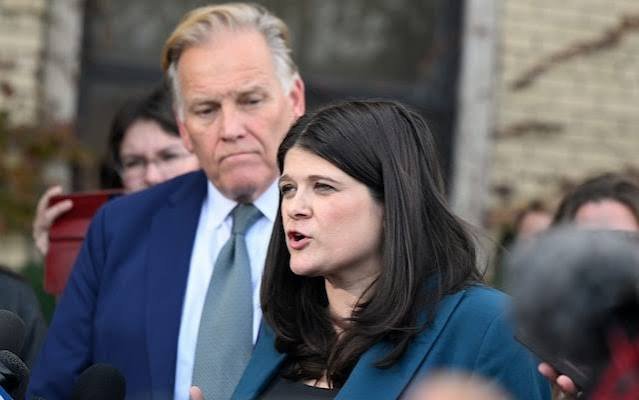
Stevens announced her decision in a video shared on social media platform X on Sunday, following her appearance alongside Rogers at an event held at Perfecting Church in Detroit. Her endorsement represents a dramatic political shift, particularly because she had spent much of her political career identifying herself with positions opposed to several policies associated with former President Donald Trump and the Republican Party.
The development has intensified an already difficult election campaign in Michigan, where the Senate contest has attracted considerable national attention. The disagreement between Stevens and El-Sayed has developed into a wider political dispute involving competing views on foreign policy, economic priorities, party loyalty and the future direction of the Democratic Party.

The immediate reaction from Democratic officials was strongly critical. Michigan Democratic Party chair Curtis Hertel accused Stevens of abandoning the interests and principles she had previously claimed to support. He argued that Rogers had repeatedly failed to defend working-class interests and had supported policies that Democrats consider harmful to reproductive rights.
Hertel also raised concerns about Rogers’s political alignment with Trump, particularly his willingness to support the former president’s legislative agenda. According to Hertel, Stevens’s decision risked creating unnecessary divisions within the Democratic Party at a crucial moment in the election campaign.
The party leadership maintained that Democrats needed to concentrate on defeating their Republican opponent rather than allowing internal disagreements to weaken their electoral prospects. Hertel indicated that the party would not permit last-minute political disputes to undermine its campaign momentum.
The controversy also had immediate consequences for Stevens’s political organisation. Several members of her former campaign team reportedly decided to leave following her endorsement of Rogers. Among those who departed were Justin German, who had served as her chief of staff for eight years, and communications director Logan Basch.
German subsequently issued a statement expressing support for El-Sayed and criticising Stevens’s decision. Speaking on behalf of members of the former campaign team, he described the Democratic Senate election as too important for political divisions or indecision. He also expressed disappointment over the congresswoman’s decision to support the Republican candidate after losing the Democratic primary.
The departure of experienced campaign officials represents another setback for Stevens, whose endorsement has placed her at odds with many of the political figures who previously supported her. Their reaction suggests that the dispute is not simply a disagreement between two politicians but has also created significant tensions among people who worked closely with Stevens throughout her political career.
Progressive leaders have also rallied behind El-Sayed. Independent Senator Bernie Sanders was among the most prominent figures to criticise Stevens, arguing that her decision demonstrated a failure to recognise the broader political consequences of the Michigan Senate contest.
Sanders supported the decision of Stevens’s former staff members to resign, suggesting that their reaction reflected their commitment to defeating the Republican candidate. He urged Democratic voters and political activists to unite behind El-Sayed, warning that internal disputes could strengthen Republican efforts to maintain control of the Senate.
Sanders’s intervention is particularly significant because he has considerable influence among progressive voters and political organisations across the United States. His support provides El-Sayed with an important political endorsement at a time when the Democratic nominee is attempting to consolidate support within different sections of the party.
New York City Mayor Zohran Mamdani also criticised Stevens, accusing her of betraying working-class Americans by endorsing the Republican candidate she had previously opposed. His comments reflected broader concerns among progressive Democrats that political disagreements should not result in support for candidates whose policies differ substantially from the party’s stated priorities.
El-Sayed, meanwhile, attempted to shift attention away from the controversy and towards the policy issues facing Michigan residents. Speaking to reporters outside a campaign rally on Sunday, he indicated that he was not interested in allowing Stevens’s decision to dominate his campaign.
He emphasised that his primary concern was addressing the issues affecting ordinary people rather than becoming involved in prolonged political arguments. His response appeared designed to present himself as focused on public policy and the interests of voters rather than personal disagreements with his former primary opponent.
El-Sayed also questioned whether voters concerned about discrimination, political hostility and the direction of the Republican Party could comfortably support Rogers and his association with Trump and Vice-President JD Vance. His remarks highlighted the broader political differences between the Democratic and Republican candidates.
The dispute has also attracted attention because Stevens had previously maintained a strongly critical position towards several Trump administration policies. Her official political messaging had included extensive criticism of the former president’s approach to national governance. Consequently, her endorsement of Rogers has created questions about the consistency of her political positions.
Trump himself welcomed Stevens’s decision. Speaking at a campaign rally in Iowa, he praised her for turning against El-Sayed and suggested that she could eventually join the Republican Party. His comments added another dimension to the controversy, particularly because Stevens had previously criticised his political agenda.
The Republican leader described her endorsement as an extraordinary development and openly expressed interest in welcoming her into the GOP. Although Stevens has not announced any intention to change her party affiliation, Trump’s comments have fuelled speculation about the political implications of her decision.
The conflict between Stevens and El-Sayed had been developing for months. Stevens narrowly lost the Democratic Senate primary earlier this year but did not immediately become an active campaign supporter of the eventual nominee. Another former primary contender, Mallory McMorrow, also did not initially offer the level of public campaigning that party leaders had hoped to see.
Senior Democrats had subsequently attempted to establish a working arrangement between Stevens and El-Sayed to prevent the primary contest from damaging the party’s chances in the general election. Although Stevens eventually offered El-Sayed a relatively cautious endorsement, the relationship remained strained.
The latest confrontation has been closely connected to disagreements over Israel, an issue that became one of the most divisive subjects during the Democratic primary campaign. Stevens has consistently maintained strong support for Israel, while disagreements over American policy towards the country have become increasingly prominent among progressive Democratic voters.
The tension escalated after Stevens indicated that she would only appear alongside El-Sayed at a campaign event if he publicly condemned an advertisement produced by an outside political group. The advertisement had linked American support for Israel to increasing living costs in the United States.
El-Sayed rejected Stevens’s demand, arguing that the issue had already been debated during the primary campaign and that reopening the disagreement would serve little purpose. The disagreement eventually disrupted plans for the two politicians to appear together at a predominantly Black church in Detroit’s North End.
The situation became even more complicated after reports emerged concerning Stevens’s fiancé, Jason Turkish. Turkish has publicly criticised El-Sayed while expressing support for Rogers. Although he has previously made substantial political donations to Democratic candidates, his recent financial support for Republican politicians, including Susan Collins, has attracted attention.
California Governor Gavin Newsom also questioned the timing and circumstances surrounding Stevens’s political shift. Speaking on the political programme 2WAY, Newsom suggested that the rapid change in her position raised questions about what had happened behind the scenes. He also acknowledged that the controversy had distracted attention from the broader electoral contest.
Senate Democratic leader Chuck Schumer joined other senior party figures in condemning Stevens’s endorsement. A statement issued through Schumer’s campaign account described her decision as a serious betrayal, while reaffirming the party’s support for El-Sayed.
The statement also defended El-Sayed against what Democrats described as racist and Islamophobic attacks from Republican figures. Democratic leaders argued that such rhetoric demonstrated the growing political divisions surrounding the election and urged voters to focus on economic challenges facing working families.

With the midterm elections approaching, Michigan has become an important political battleground for both major parties. Stevens’s decision has exposed significant disagreements within the Democratic organisation at a moment when party leaders are attempting to maintain unity and protect their position in the Senate.
The ultimate impact of her endorsement remains uncertain. While Rogers could benefit from divisions among Democratic supporters, El-Sayed continues to receive backing from prominent progressive figures and senior Democratic politicians.
For Michigan voters, the controversy presents a broader choice between competing political priorities, including economic security, reproductive rights, foreign policy and the future direction of national leadership. The coming days will indicate whether Stevens’s intervention significantly changes the dynamics of the Senate race or whether Democratic leaders can successfully contain the internal dispute.
What began as a disagreement between two former primary rivals has now developed into a national political controversy, placing questions of loyalty, ideological differences and party unity at the centre of Michigan’s closely watched Senate election.
Related News:
 Trump approval plunges amid Iran war fears
 Trump Threatens UN Budget Cuts as US Pushes ‘Trade Over Aid’ Agenda
 US Awaits Iran Reply on New Ceasefire Proposal
 Hormuz Talks Near Critical Stage
 Trump announces major US oil deal with Venezuela
 Trump Hardens Canada Trade Stance as Talks Stall
 Trump Calls Iran War ‘Small Potatoes’ Despite US Deaths
 Trump Pledges $5,000 if Republicans Win Midterms
 Macron and Carney deepen France-Canada ties
 Trump Eyes Major Belarus Fertiliser Deal Amid Canada Trade Dispute
 Xi urges Trump to avoid US-China military conflict
 Lula accuses Trump of seeking control over Brazil
 Trump Ads Trigger Fight Over Taxpayer Money
 Tanker Attacked Near Qatar as Hormuz Tensions Escalate
 Trump’s Russian Diesel Deal Sparks Ukraine Fury
 Brazil Court Scandal Threatens Lula as Bolsonaros Rise
 Millions Face Tougher Medicaid Rules From January
 Trump Targets Arizona and Montana Amid GOP Election Worries
 Brazil Cuts Working Week to 40 Hours in Lula Election Boost
 Trump Rallies GOP as Senate Democrats Boost Key Races
 Serbia Leader Linked to Controversial Trump Tower Plan
 Trump Halts New Russia Sanctions Amid Ukraine Rift
Trump Falsely Questions Ossoff’s Election Legitimacy
 Trump Fears Shock Democratic Senate Win in Kansas
 Meta Faces Election Bias Claims Ahead of Brazil Runoff
 Fed Expected to Hold Rates Steady Ahead of US Midterms
 Trump’s Global Policies Put Republicans at Risk
 Global Crises Test Diplomacy as Trump’s Policies Face Scrutiny
 G20 Photo Cancelled as Russia Deepens Western Rift
 Canada Passes Carney’s First Budget in Tight Parliamentary Vote
 India’s Labour Law Overhaul Sparks Fierce Debate
 Government Unveils Northern Powerhouse Rail Plans
 Trump Fed bid heads to Supreme Court
 Thousands Protest ICE Operations in Nationwide US Day of Action
 Epstein Files Reveal Trump Officials’ Emails with Financier
 Trump to Deploy “God Squad” Over Gulf Wildlife Protections
 UK Stands Firm on Falklands Amid US Rift
 Capitalism ‘Suicidal’, Warns Petro at Climate Summit
 Oil Prices Surge Above $120 Amid Iran Blockade Fears
 Trump orders US troop pullout from Germany
 Judge halts deportation of Yemeni refugees in US
 Ohio’s Battle for Trust: Democrats Vying to Flip the Buckeye State
 US ‘Narco Boat’ Strikes Draw Global Outcry
 Afghan Families Left in Limbo Face Risk of Deportation
 Kevin Warsh sworn in as Fed chair amid economic backlash
 House Curbs Trump’s War Powers in Rare Rebellion
 Ukraine Creates Long-Range Strike Command
 Trump Refuses to Sign Housing Bill, But Law Takes Effect
 Houthis Strike Saudi Arabia as Middle East Tensions Rise
 Swedish Mining Push Puts Sami Land Rights Under Pressure
 UK plans tougher Israel stance with settlement trade ban
 Saudi Arabia Shuts Oil Pipeline After Drone Attack
 US Networks Suspend Trump White House Pool Coverage
 Trump gives Xi red-carpet welcome as trade truce extends
 Republican Senator Questions Trump Ad Spending
 Economic growth and political strain reshape Benin
 Burnham Opens Door to Possible UK Return to EU
 Brazil Election Draws Religion Into Final Campaign
 Lula Warns of Bolsonaro Family Return as Brazil Votes
 Families Await USS Abraham Lincoln Homecoming
 Quebec separatists return to power without majority
 Canadian Veterans Condemn Trump Allies’ Military Remarks
 Argentina Protesters Resist Milei’s Land Sale Drive
 Vance Demands Iran Cut Nuclear Enrichment
 South Korea Probes Fuel Shipments to Russia
 Trump Says He Deserves Nobel Peace Prize
 USS Lincoln Ends Record 265-Day Deployment
 Houthi Missile Claim Sparks Riyadh Airport Disruption
 Trump Rules Out Iran Attack Before US Elections
 Australia Rejects Russian Fuel as Trump Strikes Deal
 Trump Names Katie Zachariah as Next White House Press Secretary
 UK Could Rejoin EU Through a Switzerland Plus Deal
 Brexit Debate Returns as UK Voters Reconsider EU Exit
 Japan’s Takaichi Faces a Crucial Second Year in Power
 Omar Claims US Raid on Residence Was Meant to Intimidate
 Lula Supporters Make Final Push Ahead of Brazil Runoff
 Rubio Urges Cubans to Seize Moment for Change
 US Bans BYD Vehicles at Japan Military Base
 Flávio Bolsonaro Reportedly Leaves Brazil After Election Defeat
 Gulf States Push Multi-Part Deal to Avert US-Iran War