Published: 10 October 2026. The English Chronicle Desk. The English Chronicle Online.
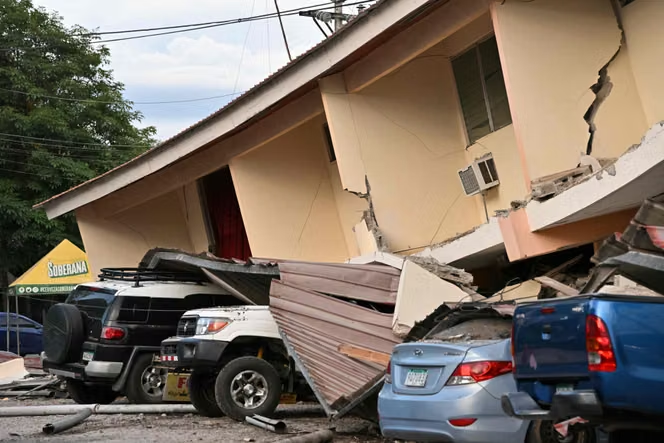
A powerful 7.7-magnitude earthquake struck southern Panama on Friday, sending thousands of frightened residents into the streets, damaging buildings and roads and triggering widespread concern across the country. Although the initial scenes were dramatic and several structures suffered serious damage, Panama appeared to avoid the scale of widespread destruction and loss of life that can follow an earthquake of such strength.
The United States Geological Survey estimated that the earthquake occurred at a depth of about 12.6 kilometres, with its epicentre located in a relatively sparsely populated area roughly 200 kilometres from Panama City. The shaking lasted for a prolonged period, with residents in different parts of the country reporting intense vibrations lasting close to a minute.
In Panama City, the earthquake produced scenes of confusion and panic as residents and office workers rushed out of high-rise buildings. Some people gathered in streets and open spaces, unsure whether further tremors would follow. The sudden evacuation of large numbers of buildings also created major traffic problems in the capital, complicating efforts by workers trying to return home.

For many residents, the experience was unlike anything they had previously encountered. Salomon Andion, a 46-year-old resident who evacuated his 15-storey building, described the shaking as extremely strong and prolonged. Heavy furniture, beds and kitchen items moved violently during the earthquake, leaving residents frightened about the possibility of structural collapse.
The strongest human impact was reported in communities closer to the earthquake’s epicentre. In Penonome, in central Cocle province, residents described scenes of fear and confusion as buildings were evacuated and families tried to locate relatives.
Juana Alveo, a 38-year-old cashier in Penonome, said the earthquake was unlike anything she had experienced before. Her daughter was at school when the shaking began, leaving her deeply worried about her safety.
The country’s president, Jose Raul Mulino, warned that Panama was dealing with a major emergency. He said some roads had completely collapsed, highlighting concerns about the condition of transport infrastructure in affected areas and the possibility that damaged routes could complicate emergency response operations.
Among the most visible structural damage was reported in Penonome, where a cathedral and a governor’s office building were damaged or collapsed. The destruction raised concerns about the vulnerability of older buildings, particularly in communities where structures may not have been designed to withstand an earthquake of this magnitude.
Social media videos captured the intensity of the shaking. One widely circulated video showed water spilling from a rooftop swimming pool of a high-rise building as the structure moved. Another showed a bridge spanning the Panama Canal shaking dramatically while vehicles continued to cross it.
Despite the alarming images, the bridge remained standing and critical national infrastructure appeared to continue functioning. The Panama Canal reported normal operations following the earthquake, an important development for Panama and the global shipping industry because the canal is one of the world’s most important maritime trade routes.
The Cobre Panama copper mine also reported normal operations, while Tocumen International Airport resumed flights after a temporary suspension. The continued operation of these major facilities helped reduce fears that the earthquake could immediately cause a broader economic disruption.
More than 40 aftershocks were reported in the hours following the main earthquake. The continuing tremors kept residents on edge, particularly those who had already evacuated buildings. Authorities faced the difficult task of assessing structures and infrastructure while knowing that further shaking could potentially cause additional damage.
In Panama City, Nestor Luque, director of the national geosciences institute, said the vibrations were felt for around 40 seconds in the capital. Residents in other parts of the country reported that the shaking appeared to last even longer.
The earthquake was particularly frightening because powerful earthquakes are relatively uncommon in Panama. For older residents, the sudden and prolonged movement of buildings and objects was an unfamiliar experience. Some elderly people were seen crying as they left buildings and gathered in the streets.
The earthquake also disrupted normal electricity supplies. Power provider Naturgy reported outages across six provinces, creating additional challenges for residents and emergency services. Electricity interruptions can become particularly serious after a major earthquake because they affect communication, transportation, medical facilities and access to essential services.
Hospitals and medical facilities also took precautionary measures. At Hospital Aquilino Tejeira in Penonome, medical staff worked outside the facility following an evacuation. Such measures are common after major earthquakes because authorities must ensure that patients and staff are protected from potential structural damage or further tremors.
The US Geological Survey estimated that around 43,000 Panamanians lived in areas exposed to severe shaking from the earthquake. It also warned that the economic consequences could be substantial, with potential losses estimated at between 1% and 10% of Panama’s gross domestic product.
Such a range reflects the uncertainty that follows a major natural disaster. The final economic impact depends not only on visible structural damage but also on the condition of roads, electricity networks, businesses, homes and other essential infrastructure. Interruptions to commercial activity can also increase losses even when major facilities remain operational.
For Panama, the earthquake came at an unfortunate moment because the country was already preparing for a national evacuation drill scheduled for the following Monday. The exercise was intended to test the country’s emergency preparedness and response capabilities. The real earthquake has now provided authorities with an unexpected and immediate test of those systems.
The disaster also attracted attention from the United States. US Secretary of State Marco Rubio said Washington was closely monitoring reports from Panama and indicated that the United States was prepared to provide assistance if necessary.
The response from authorities and the relatively limited number of reported casualties initially provided some reassurance, but officials still faced a long process of inspection and recovery. Aftershocks can continue for hours or days following a major earthquake, and structures weakened by the initial shock may become more vulnerable during subsequent tremors.
Residents meanwhile faced the difficult task of deciding when it was safe to return to their homes and workplaces. The evacuation of office towers in Panama City left thousands outside, while severe traffic congestion made the journey home difficult for many workers.
For people living in affected communities, the earthquake was a reminder of how quickly normal life can be disrupted by a natural disaster. Families were separated during evacuations, schools were affected, buildings were emptied and businesses temporarily closed as people sought safety.
The relatively strong performance of key national infrastructure, particularly the Panama Canal and international airport, offered an important measure of relief. Had those facilities suffered major damage, the consequences could have extended well beyond Panama, potentially affecting international shipping, trade and regional transportation.
Authorities are now expected to focus on detailed inspections of buildings, roads, bridges and public infrastructure while continuing to monitor aftershocks. Emergency teams must also determine whether apparently minor structural damage could pose risks to residents returning to affected buildings.
The earthquake has demonstrated both the destructive power of natural disasters and the importance of preparedness in a country where such severe seismic events are relatively unusual. Panama’s planned evacuation exercise, scheduled just days after the earthquake, now carries an added significance as authorities assess what worked during the emergency and where improvements may be necessary.

Although the initial disaster appeared to spare Panama from widespread fatalities, the full consequences may take time to become clear. Structural inspections, economic assessments and continued monitoring of aftershocks will determine the true scale of the damage.
For thousands of Panamanians who stood in the streets as buildings shook around them, however, the earthquake was already a deeply unsettling experience. The suddenness and intensity of the 7.7-magnitude event transformed an ordinary Friday into a national emergency and left communities across the country waiting anxiously for the ground to finally become still.
Related News:
 Wildfires rage across Europe as hundreds arrested in France
 Nepal Flood Survivors Face Unimaginable Loss
 Nepal Tunnel Rescue Offers Hope Amid Flood Devastation
 Nepal seeks $20m climate compensation after deadly floods
 Nepal PM calls deadly flood a global climate warning
 Bangkok Floods Push City to Breaking Point
 Argentina Protesters Resist Milei’s Land Sale Drive
 Evacuations Ordered as California Wildfires Spread Fast
 Chornobyl Still at Risk 40 Years After Disaster
 Escobar’s Hippos May Be Moved to India Zoo
 Capitalism ‘Suicidal’, Warns Petro at Climate Summit
 Trump’s Revenge Drive Deepens GOP Divide
 Pope Meets Families in Italy Toxic Waste Zone
 Venezuela Quake Death Toll Surpasses 4,000
 Olympus Awaits Unesco Heritage Recognition
 Wildfires Force Mass Evacuations in France And Spain
 Three-Quarters of England’s Riverbanks Still Off Limits
 Powerful 7.7-Magnitude Earthquake Hits Eastern Indonesia
 Is America Ready for an AOC Presidential Run?
 Nepal Flood Death Toll Tops 300 as Second Flood Feared
 Nepal-Tibet Flood Death Toll Rises as 2,478 Remain Missing
 UN Warns Record El Niño Could Supercharge Global Heat
 Typhoon Saudel Triggers Mass Evacuations in China
 Europe Faces Climate Reckoning After Extreme Summer
 Tropics May Wait Longest for Net-Zero Climate Benefits
 Super El Niño Threatens Hundreds of Thousands of Lives
 Thai downpours shift north-westwards after Bangkok floods
 UN Warns of Narrowing Window to Restore Forests
 Swiss Glaciers Lose Nearly One-Fifth of Ice in Five Years
 Edinburgh Glasshouses Reopen After Major Restoration
 Polanski Says Leadership Not Tied to By-election Result
 Families Await USS Abraham Lincoln Homecoming
 Latin America women fear rollback of rights
 Pacific Climate Summit Draws Limited Global Leaders
 New Zealand Faces Rising Climate Threats as Glaciers Shrink
 Britons Demand Greater Honesty on Climate Crisis
 USS Lincoln Ends Record 265-Day Deployment
 Bolsonaro Gains Key Endorsement Ahead of Brazil Runoff
 Hurricane Isaias Puts FEMA Under New Pressure
 Two National Guard Soldiers Critically Injured Near White House
 ‘Extinct’ Antelope Returns to Sahara, Bringing Hope
 American Mother Extradited From UK to U.S. on Murder Charges
 Half the World’s Largest Cities Face Rising Water Stress
 Thousands Protest ICE Operations in Nationwide US Day of Action
 Ocean Warming Drives Massive Marine Life Loss, Study Warns
 Greenpeace $345m Ruling Sparks Appeal Battle
 Extreme Weather: Europe Shivers as Cyclone Narelle Hits
 UK Stands Firm on Falklands Amid US Rift
 Coalition pushes fossil fuel phaseout plan
 Trump orders US troop pullout from Germany
 Trump approval plunges amid Iran war fears
 Fear and Betrayal: The Chilling Case of Kouri Richins
 UK Faces Mass Water Shortages by 2055, Lords Warn
 Farage and Reform UK Reshape British Politics
 US Courts Back Trump on Park Signage Removals
 Trump’s Mount Rushmore Speech: A Divisive Anniversary
 England and Norway Fans Turn Miami Into World Cup Carnival
 UK Schools Struggle as Classrooms Top 40C
 Houthis Strike Saudi Arabia as Middle East Tensions Rise
 Burnham unveils £65m drought aid for farmers
 Trump Calls Iran War ‘Small Potatoes’ Despite US Deaths
 Swedish Mining Push Puts Sami Land Rights Under Pressure
 Man Arrested in Mississippi Woman’s Death
 US Networks Suspend Trump White House Pool Coverage
 Democrat Says ICE Restricted Detention Camp Oversight
 Trump gives Xi red-carpet welcome as trade truce extends
 Xi urges Trump to avoid US-China military conflict
 Republican Senator Questions Trump Ad Spending
 Madrid Tent Camp Grows as Spain Housing Crisis Deepens
 Burnham Opens Door to Possible UK Return to EU
 Europe’s Record Heat Summer Signals Climate Risks
 French School Protests Escalate as 400 Schools Close
 Lula Warns of Bolsonaro Family Return as Brazil Votes
 Salinas Struggles to Keep the American Dream Alive
 Quebec separatists return to power without majority
 Okinawa US Troops Face Curfew After Murder Case
 Trump Says He Deserves Nobel Peace Prize
 UK Water Firms Earn Millions From Industrial Wastewater
 Trump Rules Out Iran Attack Before US Elections
 Trump’s Russian Diesel Deal Sparks Ukraine Fury