Published: 13 October 2026. The English Chronicle Desk. The English Chronicle Online
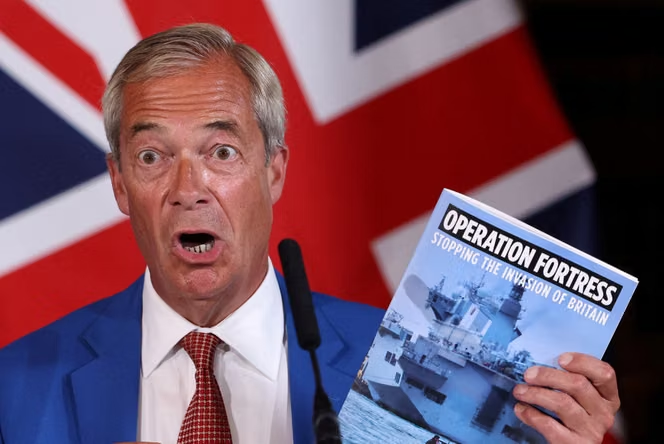
Nigel Farage has rejected suggestions that a Reform UK government would authorise British troops to use lethal force against migrant boats crossing the English Channel, seeking to clarify his party’s position after controversial remarks by one of its MPs triggered a political backlash.
The dispute erupted after Robert Jenrick, a former Conservative politician who has joined Reform UK, said the party would deploy the Royal Marines to intercept migrant boats and allow them to use lethal force if necessary. His comments raised questions about how far a future Reform government would go to enforce its proposed policy of returning people crossing the Channel to France.
Farage subsequently insisted that Jenrick’s remarks had been misconstrued. Speaking to LBC, the Reform UK leader said he would not authorise the routine use of force against migrants and argued that military personnel would only respond with force if they came under attack.

The exchange has intensified an already heated debate over irregular migration, border enforcement and the potential role of the British armed forces in operations involving civilian migrants. It has also highlighted the political and legal challenges facing any proposal to use military personnel to intercept boats carrying people attempting to reach the United Kingdom.
Jenrick had told TalkTV that Reform UK would send the Royal Marines into the Channel to take migrant boats back to France. He presented the proposal as a decisive response to crossings that have remained a major issue in British politics.
“What we are going to do, and we’re the only political party that has the courage to say this, is deploy the Royal Marines into the Channel. If they need to use lethal force, then they’ll be able to do so,” Jenrick said.
Although he acknowledged that the use of force was not the desired outcome, his remarks suggested that military personnel could be authorised to employ potentially deadly measures during an operation to return boats across the Channel.
Jenrick argued that the prospect of such a response could bring crossings to an end within days. He maintained that the preferred approach would be to intercept people in a controlled and reasonable manner before taking them back to France, but his reference to lethal force quickly became the focus of the controversy.
Farage sought to draw a distinction between authorising military personnel to shoot at migrant boats and allowing soldiers to defend themselves if they were attacked. He said British service members who came under fire had the right to respond, presenting Jenrick’s comments as a reference to that principle rather than a plan to use lethal force against migrants as a matter of policy.
“Anybody wearing British military uniform who gets fired at has the right to respond. That’s what he was saying,” Farage said.
The Reform leader also referred to violence in migrant camps and alleged that serious international criminal organisations were involved in the Channel crossings. He argued that the situation required a tougher response and reiterated his intention to return people arriving in small boats to France if his party won the next general election.
Farage suggested that the initial implementation of such a policy could encounter resistance. He warned that if attempts to return boats were met with force, his government would respond accordingly. He also predicted that the crossings would stop within two weeks of the policy being introduced.
That timetable was more cautious than Jenrick’s claim that the issue could be resolved within a few days, although both men presented the prospect of tougher enforcement as a deterrent.
The comments have drawn criticism from the government, with Defence Minister Luke Pollard condemning Jenrick’s remarks as both unacceptable and unlawful. Pollard emphasised that members of the armed forces could not be expected to carry out illegal orders, regardless of the political circumstances in which they were issued.
Speaking to Times Radio, Pollard rejected the suggestion that British troops should use military force against unarmed civilians. He argued that the proposal conflicted with the standards expected of the armed forces and the principles underpinning British military conduct.
Pollard described the remarks as an attempt to attract attention and divert scrutiny from problems within Reform UK. He said the party’s language was incompatible with military and national values and warned against treating the proposal as a credible or responsible solution to irregular migration.
His intervention placed the dispute beyond the question of political rhetoric, raising concerns about the responsibilities of military commanders and the limits of government authority when armed forces are deployed in situations involving civilians.
Any future policy involving the Royal Marines in Channel interceptions would face complex operational and legal questions. Military personnel would have to operate in a busy maritime environment where boats may be overcrowded, passengers may include children and vulnerable people, and sudden manoeuvres could create serious risks to life.
The distinction between self-defence and the deliberate use of lethal force is particularly significant. A service member responding to an immediate threat is in a different situation from one instructed to use deadly force to compel a civilian boat to change direction. Farage’s explanation sought to establish that distinction, although questions remain over how a policy of returning boats to France would work in practice.
The Channel is also an international waterway with significant implications for relations between the United Kingdom and France. Returning intercepted boats would require workable arrangements with French authorities, while the use of military personnel would raise questions about jurisdiction, safety procedures and the treatment of those on board.
The political dispute therefore centres not only on whether Reform UK could reduce the number of crossings but also on the methods it would use, the risks those methods might create and the legal safeguards that would govern any operation.
Small-boat crossings have become one of the most contentious issues in British public life, placing successive governments under pressure to demonstrate control over the country’s borders. Supporters of tougher enforcement argue that a credible deterrent is needed to undermine smuggling networks and prevent dangerous journeys. Critics, however, warn that aggressive interception strategies could place lives at risk and fail to address the conditions that drive people to attempt the crossing.
The involvement of the Royal Marines would represent a particularly significant shift in the approach to border enforcement. The armed forces have specialist training and capabilities, but their deployment in a politically sensitive operation involving civilian passengers would require clear rules, carefully defined responsibilities and robust safeguards.
Farage’s remarks also expose a challenge for Reform UK as it seeks to present itself as a government-in-waiting. A forceful message on immigration may appeal to voters demanding a reduction in crossings, but proposals involving lethal force can create questions about practicality, legality and the consequences of implementation.
The disagreement between Farage and Jenrick leaves uncertainty over the precise boundaries of the party’s proposed policy. Jenrick presented lethal force as an option available to troops if necessary, while Farage insisted that the reference concerned the right of soldiers to respond if fired upon. Neither formulation, on its own, establishes the detailed rules that would govern a real operation.
The government’s criticism indicates that the proposal is likely to remain a point of political confrontation. Pollard’s warning that troops must not be given illegal orders reflects the fundamental requirement that military action must operate within the law, even when governments face intense pressure to deliver rapid results.
For people attempting to cross the Channel, the debate carries immediate human implications. Those travelling in small boats may be fleeing conflict, persecution or severe hardship, while criminal smuggling networks can expose passengers to dangerous conditions. Any enforcement policy would need to account for the safety of those on board as well as the security concerns raised by the government.
Reform UK has framed its proposed returns policy as a way to discourage future crossings, with Farage predicting that the flow of boats would quickly diminish. Whether such a policy could be implemented at the scale envisaged, and whether France would cooperate with the necessary arrangements, remains a separate question from the party’s political assurances.

The row has ultimately exposed the tension between a promise of decisive action and the practical limits of military intervention. Farage has attempted to reassure critics that his party would not direct troops to use lethal force routinely against migrants, but Jenrick’s original comments have ensured that the role of the armed forces remains central to the debate.
As the next general election approaches, the episode is likely to fuel further scrutiny of Reform UK’s immigration proposals. Voters will be asked to assess not only the party’s pledge to stop small-boat crossings but also the legality, feasibility and human consequences of the measures it proposes to achieve that objective.
Related News:
 Drumcree Talks Falter as Legal Challenge Deepens
 UK-France Returns Deal Faces Expiry as Talks Stall
 Patriot Platform Raises Concern Across Britain
 Reform UK Receives Record £36m Donation From Crypto Billionaire
 Election Candidate Abuse Raises Alarm in England
 Lib Dems Prepare for Election Amid Reform Challenge
 King Refers Jamaica Slavery Petition to Privy Council
 UK Pauses Chagos Deal Amid US Opposition
 Elif Eralp Emerges as Berlin’s Next Political Force
 Free Speech Emerges as Key UK Election Issue
 Burnham Opens Door to Possible UK Return to EU
 Green Party faces dispute over Zionism motion
 Hundreds of UK prisoners released early amid overcrowding
 Drumcree Talks End Without Agreement Ahead of Appeal
 Badenoch Raises Prospect of 2027 UK Election
 Latin America women fear rollback of rights
 Controversial Vaccine Trial Approved in Guinea-Bissau
 Trump Attacks Norway After Nobel Peace Prize Snub
 Delhi Braces for Youth Protests Over Voter Roll Dispute
 UK Gaza Refugee Route Criticised Over False Hope Claims
 UK Greens Face Crisis Over Zionism and Extremism Row
 Ohio Airports Become Key Hubs for ICE Deportation Flights
 England and Wales Begin Second Wave of Early Prison Releases
 UK and EU Signal Fresh Push for Defence Cooperation Talks
 Cartel crackdown raises fears of fresh violence
 US states redraw maps after voting rights ruling
 Barrister Criticises Trial After Suicide Case Verdict
 Immigration Judges Fear Pressure in Trump Era
 Farage and Reform UK Reshape British Politics
 Starmer Leadership Under Pressure After Setbacks
 Le Pen’s Popularity Holds Despite Conviction
 Westminster Council Threatens Charing Cross Soup Kitchen
 BBC Warned About Missing Clothes of Murder Victim
 Is America Ready for an AOC Presidential Run?
 Cambridge Professor Jason Arday Found Dead at Home
 Ghent Professors Questioned Cofnas Appointment
 RAF Barnham Protests Fuel Tensions in Norfolk Town
 Internal Exclusions Surge in England’s Schools
 Green Leader Targets Starmer’s Former Seat
 Masked Protesters Bring Dover Port Traffic to Standstill
 UN expert urges UK to rethink Israel policy
 UK plans tougher Israel stance with settlement trade ban
 Councils spend £125m on illegal children’s care
 Europe’s democracies face a growing far-right threat
 Pavlohrad Strike Kills Five, Injures 67
 Israel Accused of Undermining Palestinian Life
 Piddington Votes for Symbolic Independence Over Asylum Plan
 Amnesty Finds Coordinated Abuses in Iran Protest Crackdown
 Turkey LGBTQ Crackdown Expands With New Arrests
 Iran School Strike Raises War Crimes Questions, UN Says
 Mahmood Warns Far Right Over Asylum Protests
 Disabled Travellers Seek Fairer UK Care Rules
 NHS Breast Care Review Finds Serious Patient Harm
 US Networks Suspend Trump White House Pool Coverage
 Briton Faces Cyprus Court Over Son’s Fatal Fall
 Democrat Says ICE Restricted Detention Camp Oversight
 UK Plans New Centre to Counter Information Warfare
 Republican Senator Questions Trump Ad Spending
 Three Die in Channel Crossing Attempt Near France
 London Facial Recognition Trial Ends With False Alert
 French Student Protests Escalate Into Violent Clashes
 UK University Strikes Spread as Financial Pressure Grows
 French School Protests Escalate as 400 Schools Close
 Gosport Protesters Clash With Police Over Migrant Rescue
 UK Mission in East Jerusalem to Remain Open
 Royal Navy Sailor Charged With Alleged Spying
 Luton Residents Reject Claims of ‘No-Go Zones’
 Trump Says He Deserves Nobel Peace Prize
 Labour Wins Key London By-election as Greens Fall Short
 India’s Youth Movement Alleges Mass Detentions Before Protest
 Gaza War Deepens India’s Strategic Ties With Israel
 Bolsonaro Gains Key Endorsement Ahead of Brazil Runoff
 Burnham Rises as Farage and Polanski Face Setbacks
 UAE Says Co-Pilot Planned Suicide Attack on Israel
 Delhi Detains Protest Leaders as Youth Rally Escalates
 British Military School Abuse Victims Denied Justice
 French Students Protest Poor Conditions in Paris Suburbs
 Brazil Court Scandal Threatens Lula as Bolsonaros Rise
 Greta Thunberg Backs French Students in School Protests
 Millions Face Tougher Medicaid Rules From January