Published: 03 October 2026. The English Chronicle Desk. The English Chronicle Online
Kyiv is facing growing disruption after repeated Russian strikes hit bridges and other infrastructure across the Ukrainian capital, causing major traffic problems and forcing authorities to suspend or restrict movement across several key crossings over the Dnipro River.
Russian forces struck a bridge connecting the two sides of Kyiv for a second consecutive day, Ukrainian officials said, as a renewed wave of attacks intensified pressure on a city already preparing for another difficult winter. The latest strike targeted the Southern Bridge, which had already been closed, while air attacks also affected two other major crossings.
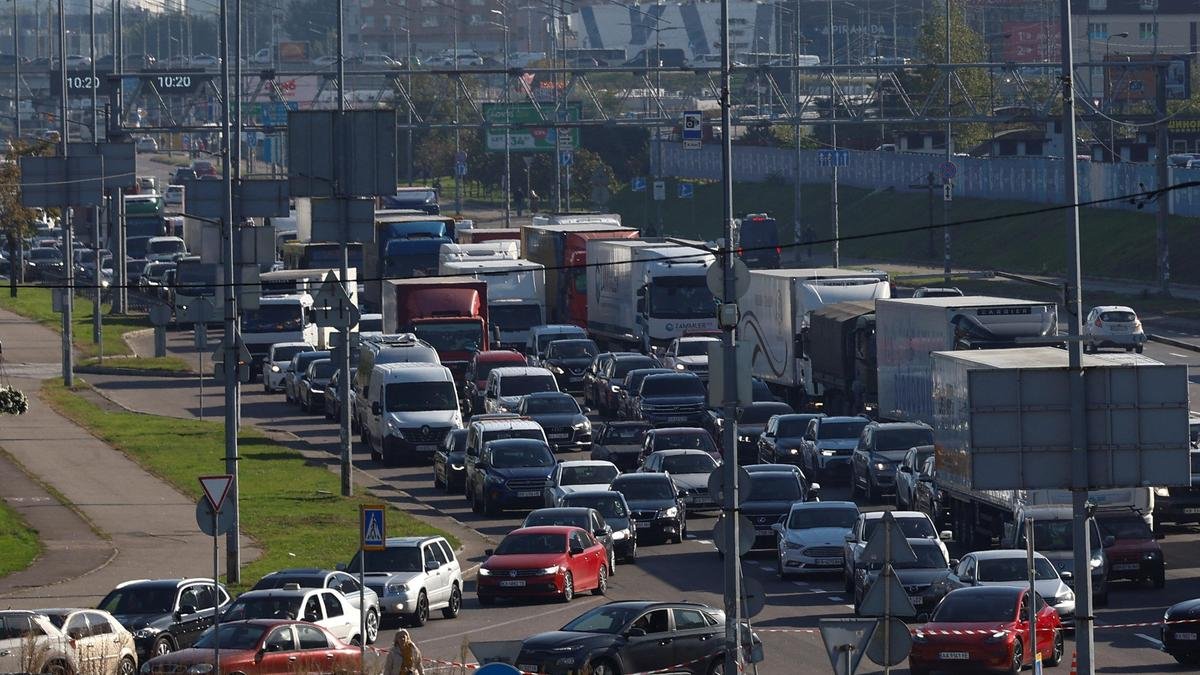
The attacks have created lengthy traffic queues during the morning and evening rush hours, disrupting one of the most important transport networks in the capital. With Kyiv divided by the Dnipro River, the bridges are essential for workers, students, emergency services and businesses moving between the eastern and western sides of the city.

The scale of the disruption has raised concerns about how long Kyiv can maintain normal daily activity if attacks on critical infrastructure continue. An economic analyst estimated that about 500,000 people normally travel from the left bank of the Dnipro to the right bank every day, highlighting the importance of the crossings to the capital’s economy and daily life.
Kyiv Mayor Vitali Klitschko convened a city security council meeting before the latest attack and described the situation in the capital as extremely serious. Officials have been attempting to manage traffic and maintain essential services while dealing with continuing air-raid threats.
The latest strikes came after a series of attacks that have increasingly targeted infrastructure and sensitive facilities in Kyiv. Ukrainian officials have linked the escalation to an order reportedly issued by Russian President Vladimir Putin in September to remove previous constraints on Russia’s air campaign. The claim reflects Ukraine’s assessment of the changing military strategy, while the wider consequences have been increasingly visible in civilian life.
For residents of Kyiv, the latest escalation has added another layer of uncertainty to an already difficult period. For weeks, much of the public discussion had focused on the approaching winter and the possibility of renewed attacks on Ukraine’s energy infrastructure. The recent intensification of Russian strikes, however, has made some of those anticipated difficulties an immediate reality.
The capital has experienced repeated attacks since Russia launched its full-scale invasion of Ukraine, but the latest campaign has affected transportation as well as residential areas and other infrastructure. The disruption to bridge traffic demonstrates how attacks on relatively small numbers of strategic locations can have consequences across an entire city.
The human cost has also continued to mount elsewhere in Ukraine.
Earlier on Friday, a Russian drone strike caused a fire on the upper floors of an apartment building in Kyiv, killing one person and injuring two others, according to Ukrainian officials. The incident added to the pressure on emergency services already dealing with repeated air attacks.
In Kharkiv, Ukraine’s second-largest city in the north-east, a guided bomb strike killed two people and injured 32 others, according to the regional governor. Kharkiv has remained one of Ukraine’s most exposed major cities because of its proximity to the Russian border and has repeatedly come under missile, drone and guided-bomb attacks.
The latest violence comes as Ukrainian authorities continue efforts to protect critical infrastructure and maintain essential services. The repeated attacks have forced residents to adapt their routines around air-raid warnings, damaged infrastructure and the possibility of sudden transport restrictions.
At the same time, Ukraine is continuing to pursue international financial and reconstruction support.
A joint US-Ukrainian reconstruction investment fund has announced its first critical minerals agreement as part of a wider group of new projects. The fund, established under a minerals agreement signed by Washington and Kyiv in April 2025, is designed to support investment in several strategically important sectors, including minerals, defence, energy and infrastructure.
The projects announced so far are valued at roughly $70m, according to Conor Coleman, head of investments at the US International Development Finance Corporation. The first minerals investment is expected to provide about $30m for a joint investment platform involving BGV Group, a Ukrainian company founded by businessman Hennadii Butkevych.
The investment initiative reflects Ukraine’s broader effort to strengthen its economic foundations while the war continues. Critical minerals, energy infrastructure and defence-related industries have become increasingly important to discussions about the country’s reconstruction and long-term economic security.
Yet for civilians in areas directly affected by the conflict, immediate humanitarian concerns remain severe.
European Commissioner for Equality and Crisis Management Hadja Lahbib has called on Russia to provide humanitarian assistance to civilians in the Russian-occupied Ukrainian town of Oleshky, describing conditions there as extremely serious. She said civilians were facing shortages of food, medicine, clean water and basic services.
Accounts from former residents have described increasingly desperate conditions. One former resident told international media that flour had become unavailable and that people had resorted to eating pigeons during the early stages of the crisis. Such reports underline the humanitarian consequences of prolonged occupation and restricted access to essential supplies.
The situation in Oleshky is difficult to independently assess because access to Russian-occupied territories remains severely restricted. Humanitarian organisations and international authorities have repeatedly raised concerns about the ability of civilians in occupied areas to obtain basic necessities.
The war is also continuing to shape political developments elsewhere in Europe.
Latvia is holding a parliamentary election as voters choose representatives amid continuing concerns about regional security and Russia’s war against Ukraine. The country has been one of Ukraine’s strong supporters since the beginning of the full-scale invasion and has maintained a firm position on European security.
Political fragmentation could make the formation of a government difficult after the election. Polling conducted before voting placed the centrist United List among the leading parties, while the Sovereign Power party was also competing strongly. The election is taking place against the broader backdrop of heightened security concerns across the Baltic region.
For Kyiv, however, the immediate challenge remains much closer to home.
The repeated attacks on bridges have demonstrated how vulnerable essential transport links can become during sustained military pressure. Every suspension of traffic forces residents to search for alternative routes, adding congestion to other crossings and increasing the burden on public transport.
The disruption also affects emergency response. In a city under frequent air-raid alerts, keeping roads and bridges accessible is essential for ambulances, firefighters and other emergency services. Prolonged traffic congestion can make it more difficult for responders to reach affected neighbourhoods quickly.
As autumn progresses, Kyiv is therefore entering a period in which infrastructure, transportation and energy security are closely connected. Damage to one part of the urban system can quickly create problems elsewhere, particularly when residents are already coping with repeated attacks.

The latest strikes have not brought Kyiv’s daily life to a halt, but they have made ordinary activities more difficult. Commuters face longer journeys, businesses must account for unpredictable disruptions and residents continue to live with the possibility of another air attack.
Ukraine’s authorities are attempting to keep the capital functioning while seeking international assistance for both immediate defence and long-term reconstruction. The coming months are likely to test the resilience of Kyiv’s infrastructure and its ability to maintain essential services under sustained military pressure.
For millions of Ukrainians, the war remains a daily reality measured not only by explosions and casualties but also by traffic jams, closed bridges, disrupted services and difficult journeys across cities. In Kyiv, the latest attacks on the Dnipro crossings have provided another stark reminder that the conflict continues to shape even the most routine aspects of civilian life.
Related News:
 Putin Declares Russia Victory at Scaled Victory Day Parade
 Russian Missiles Intensify Pressure on Kyiv
 South Korea demands apology over DMZ mine blast
 Ukraine’s New FP-7 Missile Makes Combat Debut
 Ukraine strikes Tuapse as oil disaster worsens
 Zelenskyy warns over Oreshnik threat as Kyiv hit
 Discontent grows around Putin amid war strain
 Houthis Strike Saudi Arabia as Middle East Tensions Rise
 Taliban global ties grow as rights fears mount
 Trump Asked Xi About Buying US Weapons
 Putin Orders Russian Army Expansion as War Intensifies
 South Korea-Ukraine Row Erupts Over North Korean POWs
 UK Prepares Aircraft Carrier for Middle East Crisis
 North Korea Fires Missiles Amid US-South Korea Drills
 ‘The frontline is like Terminator’: Ukraine’s fighting robots
 Ukraine Urges UK to Seize Russian Oil Tankers
 Trump orders US troop pullout from Germany
 Activists allege abuse after Gaza flotilla seizure
 Global order shifts amid Trump-era turmoil
 Australia pushes Pacific security pact amid China tension
 Ceasefire Standoff Deepens in Ukraine War
 Middle East Crisis Escalates as Oil Routes Shake Markets
 Hunger increasingly weaponised in global conflicts
 Former ICC prosecutor condemns US sanctions
 Millions Gather for Khamenei’s Six-Day State Funeral
 Seoul proposes historic peace talks to replace Korean War armistice
 Israeli Strike in Southern Lebanon Kills Seven
 Trump dismisses concerns over 250-day carrier deployment
 Trump Calls Strait of Hormuz ‘American Territory’
 Trump Faces Iran War Crisis Before Midterm Vote
 UN expert urges UK to rethink Israel policy
 North Korea Expands Uranium Facility at Yongbyon
 Nearly 50,000 Flee as Houthis Advance in Yemen
 Saudi Pact Raises Risk of Pakistan Entering War
 US Greenland Security Deal Reshapes Arctic Ties
 Netanyahu faces protests and pressure at UN
 Greece Pushes for Parthenon Marbles Reunification
 Iran Awaits Trump Response on Seven-Day Hormuz Plan
 Russia Targets Ukraine’s Digital Economy With Strikes
 Russia Escalates Ukraine Energy Attacks as Winter Nears
 New Maps Reveal Gaza’s Vast Destruction
 US Sends Third Carrier to Middle East
 Thousands Protest ICE Operations in Nationwide US Day of Action
 Italian Town Buys Mussolini Villa to Keep Away Fascist Fans
 Trump and Tehran Find Common Ground in Landmark Ceasefire
 Reeves Slams Trump Over Iran War Lack Of Exit Plan
 Oil Prices Surge Above $120 Amid Iran Blockade Fears
 Japan Protests Erupt Over Plans to Revise Constitution
 FIFA Confirms Global Ban for Benfica Star Prestianni
 Trump Announces 3-Day Russia–Ukraine Ceasefire Deal
 US Awaits Iran Reply on New Ceasefire Proposal
 US and Mexico Face Heatwave as Floods Batter South Africa
 Putin Signals War End as Russian Momentum Stalls
 Fear and Betrayal: The Chilling Case of Kouri Richins
 Romania’s Judicial Crisis: A System Under Siege
 Scepticism and tight security as Beijing braces for Trump
 Philippine Senator Flees After Days Under Senate Siege
 Fragile Truce Shattered as Violence Escapes Diplomatic Control
 Maldives Cave Diving Tragedy Raises Safety Alarm
 Pope Meets Families in Italy Toxic Waste Zone
 Cannes filmmakers split over AI’s role in cinema
 EU Leadership Gathers in Tivat to Renew Balkan Ties
 Papal Visit Offers Political Lifeline to Spanish Premier
 Aukus Deal Facing Fierce Backing and Historic Criticism
 Thai Princess Bajrakitiyabha Passes Away at 47
 Grief and Devotion Amidst the Rubble of Nabatieh
 Canada Secure Historic Last 16 Spot with Late Goal
 Keiko Fujimori Claims Dramatic Victory in Peru Runoff
 England and Norway Fans Turn Miami Into World Cup Carnival
 A New Era Begins: Spain and Gibraltar Border Fence Falls
 Powerful 7.7-Magnitude Earthquake Hits Eastern Indonesia
 Former Diplomats Urge UK and France to Act on Palestine
 Ukraine Villagers Demand Answers After Deadly Arms Depot Strike
 Bayeux Tapestry Revives Franco-British Ties
 Trump gives Xi red-carpet welcome as trade truce extends
 Xi urges Trump to avoid US-China military conflict
 Madrid Tent Camp Grows as Spain Housing Crisis Deepens
 Pilot and Passengers Help Save Flydubai Flight
 French Debt Fears Put Euro Markets Under Pressure
 French School Protests Escalate as 400 Schools Close