Published: 19 October 2026. The English Chronicle Desk. The English Chronicle Online
French President Emmanuel Macron has condemned what he described as “unbridled violence” after a wave of unrest swept across France, leaving public buildings damaged by fire, shops looted, streets barricaded and nearly 2,400 people arrested. The violence, which erupted alongside demonstrations over the cost of living and deteriorating public services, has triggered a political crisis, intensified scrutiny of the government’s security response and raised serious questions about the state’s ability to maintain public order.
The unrest reached a particularly alarming level on Saturday, when violence broke out in several major cities, including Paris, Bordeaux, Marseille, Nice and Limoges. Buildings were stormed, vehicles and rubbish bins were set alight, and commercial premises were attacked by groups of masked individuals. Police officers and gendarmes also suffered widespread injuries as security forces struggled to contain the disorder.
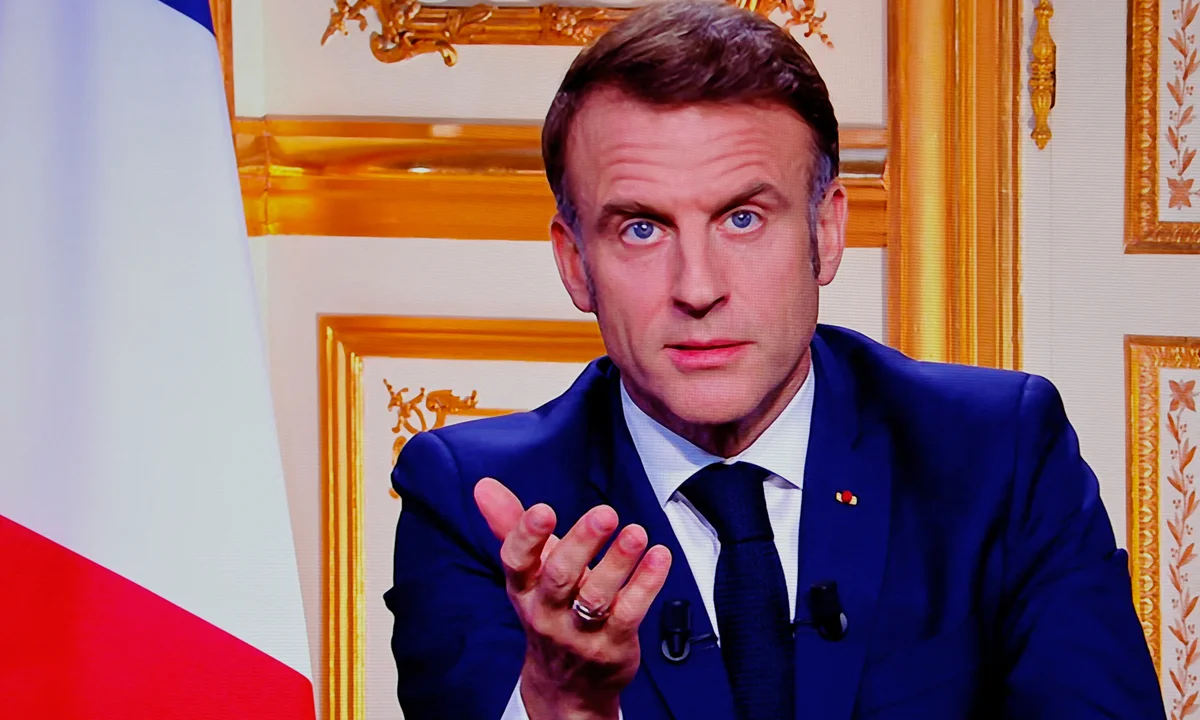
Addressing the nation in a televised statement, Macron expressed shock at the destruction and questioned how French citizens could inflict such damage on their own country. He insisted that violence could not be justified under any circumstances, while acknowledging the need to distinguish between peaceful demonstrators raising legitimate concerns and individuals involved in rioting, vandalism and theft.

The president criticised groups he described as belonging to the ultra-left, alongside criminal elements that he accused of exploiting the unrest. He also indicated that local state representatives could prohibit certain street gatherings when authorities considered such measures necessary to prevent further violence.
However, the government’s handling of the crisis has come under growing criticism from politicians across the political spectrum. Opposition figures have questioned whether security agencies adequately assessed the threat before Saturday’s demonstrations and whether police forces received sufficient intelligence, personnel and equipment to respond effectively.
The controversy deepened on Sunday when Interior Minister Laurent Nuñez reportedly submitted his resignation to Macron. The president rejected it, with the Élysée Palace explaining that continuity in the leadership of law enforcement was essential during the emergency.
Macron nevertheless instructed Nuñez to take the necessary steps to establish transparency surrounding the failures in planning and intelligence that contributed to the violence. He also called for new operational methods to help security forces manage similar incidents more effectively in the future.
The decision to retain the interior minister has not ended the political debate. Instead, it has intensified demands for a comprehensive examination of how the authorities prepared for the demonstrations and why multiple cities experienced simultaneous outbreaks of serious disorder.
Paris recorded particularly severe violence. Police said a record 855 people had been arrested in the capital, where damaged shopfronts, burned-out vehicles and the remains of barricades remained visible on Sunday. Some barricades had been constructed using electric bicycles, rubbish bins and other materials, while several streets were left littered with debris.
Clashes continued around Place de la République, one of the capital’s prominent public gathering places. Protesters threw bottles and stones, fires burned in the streets, and thick smoke rose above the surrounding buildings. Police responded with tear gas and stun grenades as they attempted to disperse crowds and regain control of affected areas.
Lamia El Aaraje, a Socialist deputy mayor of Paris, described the violence as unprecedented in her experience. The destruction has also raised concerns among residents and business owners, many of whom were left facing damaged property, disrupted trading and uncertainty about when normal conditions would return.
Yet the events of Saturday were not limited to a single type of demonstration. Tens of thousands of people had participated in peaceful marches across major French cities to demand improvements in education, better school facilities and stronger public services. Parents, teachers, grandparents, students and workers joined the gatherings, reflecting concerns that extend beyond individual political parties.
Demonstrators have been protesting for weeks over overcrowded or deteriorating schools, insufficient teaching resources and the rising cost of living. Their banners accused the government of ignoring public concerns and demanded greater investment in essential services.
The distinction between those peaceful marches and the subsequent violence has become central to the political debate. Organisers and local officials have warned that the actions of rioters and looters risk undermining the demands of people who gathered peacefully to seek changes through public demonstrations.
In Limoges, central France, the 19th-century town hall was burned down after rioters stormed the building. Mayor Guillaume Guérin said those responsible were not ordinary demonstrators pursuing political or social causes but organised individuals intent on violence.
According to Guérin, the attackers threatened a caretaker with death and warned elected officials that they would burn the building. He also raised serious concerns about the capacity of local police to respond as the situation deteriorated.
The mayor said municipal police officers, despite being present in significant numbers, eventually found themselves unable to confront the rioters because they had run out of ammunition. He described the episode as a “colossal failure of the state”, a statement that has added to demands for an investigation into the operational difficulties faced by local security services.
Marseille also experienced serious disorder. Masked groups reportedly stormed the city hall and a police station, prompting condemnation from Socialist mayor Benoît Payan. He said the attacks appeared to have no genuine political demands and instead threatened to discredit people who had participated in legitimate demonstrations.
Payan called for questions to be asked about policing tactics and the authorities’ preparations. Buildings in other cities, including Lille, were also targeted, highlighting the geographical scale of the unrest and the difficulties of protecting public institutions during widespread disturbances.
In Lyon, Green mayor Grégory Doucet said he was stunned by the violence, including the burning of the city’s historic tourism office. He described an atmosphere of fear and anger among residents and said shopkeepers felt abandoned as their businesses came under attack.
Doucet urged the national government to respond carefully rather than relying on broad political labels. He argued that the authorities needed to examine the underlying causes of the violence while also responding to the long-standing social and economic concerns raised by peaceful protesters.
The damage to commercial property has been substantial. Traders’ organisations reported that more than 1,500 shops and businesses had been ransacked, with losses estimated at tens of millions of euros. Retailers described organised groups smashing windows, entering premises and carrying away merchandise.
One Paris shopkeeper said the looting had little connection with the peaceful demonstrations and expressed concern about the scale of destruction. For many small businesses, the immediate consequences include repair costs, lost stock, interrupted operations and uncertainty about future security.
The human cost has also been significant. France’s Interior Ministry reported nearly 2,400 arrests and almost 1,000 injured police officers and gendarmes during Saturday’s unrest, including seven officers who were seriously injured.
Among the most disturbing incidents, a 17-year-old boy lost his right hand after a crowd-control grenade exploded in Saint-Étienne, in east-central France. A 17-year-old girl lost an eye in Mulhouse, prompting a police investigation into the circumstances surrounding her injury. The incidents have raised further concerns about the dangers faced by demonstrators, bystanders and law enforcement personnel during confrontations.
The political response has exposed divisions over responsibility for the crisis. Macron’s centrist government and Marine Le Pen, the far-right presidential frontrunner, have both blamed groups they identify as ultra-left for the violence. Prime Minister Sébastien Lecornu has insisted that the government will not be intimidated by rioters and has attributed the disorder to extremist groups and criminals.
Jean-Luc Mélenchon, the radical-left presidential candidate who attended a peaceful demonstration in Paris on Saturday, has instead accused the government of organisational failures that allowed the situation to descend into chaos. Lecornu rejected the criticism, arguing that placing responsibility for the violence on police leadership was a dangerous reversal of accountability.
The unrest has also attracted attention beyond France, with protests reported in Spain, Italy and Portugal. Although the circumstances and demands associated with demonstrations in those countries may differ, the developments have highlighted wider European concerns about economic pressures, public services and political dissatisfaction.
For Macron’s government, the immediate challenge is to restore public order while demonstrating that legitimate grievances will not be dismissed simply because violence has occurred alongside peaceful protests. Authorities must also determine whether failures in intelligence, planning, policing resources or operational coordination contributed to the scale of the destruction.

The coming days are likely to bring renewed scrutiny of the interior ministry, local police forces and the government’s broader approach to public demonstrations. Investigations into injuries, property damage and alleged criminal activity will be important in establishing individual responsibility, while an examination of the security response may help identify shortcomings that require urgent correction.
France now faces a difficult balancing act. Protecting public buildings, businesses and residents is an immediate priority, but the government must also address the social and economic concerns that brought thousands of people onto the streets peacefully. Treating every demonstrator as responsible for the actions of violent groups could deepen mistrust, while failing to confront organised looting and attacks on public institutions could further undermine confidence in the state.
Macron’s condemnation has made the government’s position clear: violence will not be accepted as a means of political expression. Whether that message is followed by effective security reforms, transparent investigations and a credible response to public grievances will help determine how quickly France can recover from one of its most serious episodes of unrest in recent years.
Related News:
 French Student Protests Escalate Into Violent Clashes
 French School Protests Escalate as 400 Schools Close
 Irish Gangland Figure Fails in Dublin Election Bid
 King Refers Jamaica Slavery Petition to Privy Council
 Latin America women fear rollback of rights
 France Promises 3,000 Teachers as Student Protests Grow
 EU Divisions Deepen Over Israel Policy
 Navi Pillay Wins Nobel Peace Prize for Justice
 French Police Face Scrutiny Over Injured Teenagers
 Hungary election: Orbán faces biggest test amid scandal
 Cartel crackdown raises fears of fresh violence
 France Faces Record Presidential Crowded Race Amid Far-Right Surge
 Trump’s Revenge Drive Deepens GOP Divide
 Former ICC prosecutor condemns US sanctions
 Gunman Killed After White House Security Shootout
 Le Pen’s Popularity Holds Despite Conviction
 Dreyfus Statue Finally Gets Permanent Paris Home
 Teen Charged After Layla Jeffery Found Dead
 Ukraine Villagers Demand Answers After Deadly Arms Depot Strike
 Masked Protesters Bring Dover Port Traffic to Standstill
 UN expert urges UK to rethink Israel policy
 Armed Suspect Attacks Ohio Governor Candidate
 Miliband Rejects Chief Rabbi’s West Bank Warning
 Patriot Platform Raises Concern Across Britain
 Israel Accused of Undermining Palestinian Life
 Iran School Strike Raises War Crimes Questions, UN Says
 Texas Transfers Raise Fears for Migrant Children
 Mahmood Warns Far Right Over Asylum Protests
 Briton Faces Cyprus Court Over Son’s Fatal Fall
 UK Reviews Hague Child Abduction Cases Involving Abuse
 Democrat Says ICE Restricted Detention Camp Oversight
 Japan PM Backs International Criminal Court
 Paris child pickpocketing gang leader jailed for eight years
 Elif Eralp Emerges as Berlin’s Next Political Force
 Far-Right Activist Arrested After Channel Dinghy Incident
 Portadown protest ends after tense Orange Order standoff
 Three Die in Channel Crossing Attempt Near France
 Madrid Tent Camp Grows as Spain Housing Crisis Deepens
 Israel-bound Plane Lands in Saudi Arabia After Cockpit Fight
 Burnham Opens Door to Possible UK Return to EU
 Drumcree Talks Falter as Legal Challenge Deepens
 UK-France Returns Deal Faces Expiry as Talks Stall
 Hundreds of UK prisoners released early amid overcrowding
 Drumcree Talks End Without Agreement Ahead of Appeal
 Bosnia’s Young People Look Beyond Election Hope
 Spain Sets Snap Election as Housing Crisis Deepens
 Gosport Protesters Clash With Police Over Migrant Rescue
 Lithuania Offers to Fund Permanent US Military Base
 Former German Intelligence Chief Arrested Over Espionage
 France Suspends Stun Grenades After Student Injury
 Botstein Quits Bard Amid Epstein Investigation Calls
 NSW Police Bid Delays Inquiry Into Sydney Protest
 French Student Protests Grow Despite Government Pledge
 ICE Agent Shoots Man in New York as Child Escapes Harm
 South Africa Withdraws Directive on Asylum Applications
 US Execution Livestream Plan Sparks Global Outrage
 Three Convicted in Mexico Surfing Trip Murders
 UAE Says Co-Pilot Planned Suicide Attack on Israel
 Controversial Vaccine Trial Approved in Guinea-Bissau
 France Faces Debt Crisis as Protests and Markets Clash
 Trump Attacks Norway After Nobel Peace Prize Snub
 Delhi Braces for Youth Protests Over Voter Roll Dispute
 Delhi Detains Protest Leaders as Youth Rally Escalates
 Recruitment Boss Accused of Leading Doxxing Campaign
 French Students Protest Poor Conditions in Paris Suburbs
 Ten US Midterm Races That Could Defy Expectations
 Greta Thunberg Backs French Students in School Protests
 Ohio Airports Become Key Hubs for ICE Deportation Flights
 England and Wales Begin Second Wave of Early Prison Releases
 Farage Rejects Claims Reform Would Let Troops Shoot Migrants
 Ukrainian Soldier Faces Trial Over Nord Stream Blast
 Camera Discovery Triggers Navy Ship Investigation
 Brazil Cuts Working Week to 40 Hours in Lula Election Boost
 Gadi Eisenkot: Israel’s Anti-Netanyahu Challenger
 Talarico Faces Tough Voter Test in Texas Senate Race
 Albania’s Rama Defies Calls to Quit Amid Student Protests
 Trump Slams Ukraine Strikes as Russia Ceasefire Collapses
 One Nation Pledges $2,000 Baby Subsidy in Victoria
 Mexican Court Sentences Three Men to 158 Years Each
 Trump Administration Threatens California Election Officials