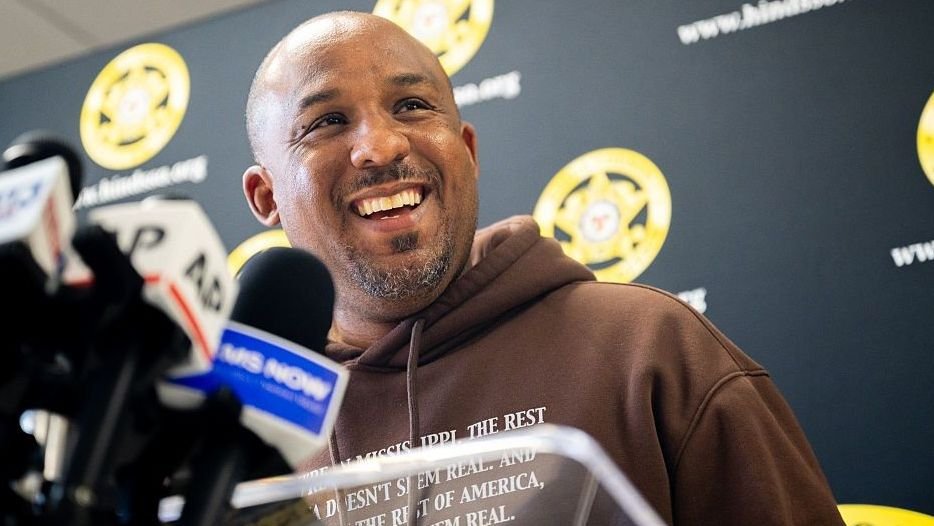
An emotional celebration unfolded at Tougaloo College in Jackson, Mississippi, as Scott Colom’s election victory brought together generations of supporters who viewed his success as a historic political breakthrough for the state. Families, students, civil rights veterans and community leaders gathered to celebrate a result that ended decades without a Democratic US senator elected from Mississippi and marked a significant milestone in the state’s history of Black political representation.
Approximately 1,000 people assembled on the lawn of Woodworth Chapel at the historically Black college. Music filled the evening air as a DJ played classic Southern line-dance tracks, prompting many in the crowd to dance while waiting for Colom to arrive. The atmosphere resembled a family reunion, with people of different ages and backgrounds sharing a moment of collective pride.

Members of all nine organisations represented by the National Pan-Hellenic Council, commonly known as the Divine Nine, attended the gathering. Their members wore clothing displaying the letters and symbols of their historically Black fraternities and sororities. Students and alumni also arrived wearing the colours and merchandise of universities across Mississippi, including Tougaloo College, Alcorn State University, Jackson State University, Mississippi State University and Millsaps College.
The gathering brought together young children, university students, working families and older residents who had witnessed some of the most difficult periods in the state’s civil rights history. Babies and toddlers sat in strollers or were carried by their parents, while elderly attendees reflected on the struggles that had shaped their communities and the long campaign to secure voting rights.
For many, Colom’s victory represented more than a change in political representation. It was a moment connected to generations of activism, sacrifice and determination to make Mississippi’s political institutions more representative of its population.
After more than a week of processing affidavit ballots and completing the vote count, Colom was officially confirmed as Mississippi’s senator-elect. His victory followed an extended period of uncertainty as election officials worked through the remaining ballots before the result could be finalised.
Rev. Maxine Bolden, a Tougaloo graduate, described attending the celebration as an experience of enormous personal and historical importance. Her parents had participated in the civil rights movement but were no longer alive to witness the result. She said she felt proud to see the efforts of earlier generations reflected in the participation of young voters and the eventual outcome.
For Bolden, the victory connected the past with the future. She said she was celebrating not only for herself and her children and grandchildren but also in memory of her parents and others who had worked for greater political equality.
Colom’s campaign had also been closely connected to his family. His wife, Nadia, and their daughters, Lucy and Maddie, appeared in campaign advertisements and took visible roles throughout the election effort. At the victory gathering, the daughters led the audience in the pledge of allegiance, while Nadia addressed supporters.
When Colom finally arrived, he walked onto the stage to the sound of T.I.’s song Let ‘Em Know. Despite having waited for hours, the crowd responded with loud cheers and renewed excitement. The reception reflected the significance supporters attached to his achievement and the expectations they placed on his future role in Washington.
The election carries particular historical weight because Mississippi has not elected a Democrat to the US Senate since 1982. Colom’s victory therefore ends a 44-year gap in Democratic Senate representation chosen by voters in the state.
The result also marks a major moment in the history of Black political representation. Mississippi had not sent a Black senator to Washington since the 19th century. Hiram Revels became the first Black man to serve in the US Senate, representing Mississippi during the Reconstruction era. Blanche K Bruce, who was born into slavery, later served a single term that ended in 1881.
The period following Reconstruction brought increasingly severe restrictions on Black political participation across the American South. The rise of segregationist policies and the Jim Crow system weakened the political rights of Black communities and limited their ability to influence state and national institutions.
Mississippi’s last Democratic senator elected before Colom was John C Stennis, a prominent segregationist who won a seventh term in 1982. The contrast between that political history and the celebration of Colom’s victory was not lost on many people attending the gathering.
Dr Charles Holmes, a longtime educator, said the full historical significance of the election might not be immediately understood by everyone. He argued that Colom’s success was connected to the wider history of Reconstruction, racial segregation and the continuing struggle for political representation. Even those who simply attended the celebration, he suggested, had become part of an important moment in the state’s history.
Colom addressed supporters from behind a campaign sign reading “Picked Another Senator”, a reference to an advertisement that had attracted widespread attention during his campaign. His speech focused on Mississippi’s history, the importance of believing in the state and the possibility of achieving political change.
He told the audience that he had needed the courage to imagine such a night and to believe that Mississippi could demonstrate its importance to the rest of the country. He also paid tribute to prominent figures from the state’s civil rights movement, including Medgar Evers, Fannie Lou Hamer and Frank Figgers.
Colom asked supporters to recognise the veterans of the civil rights struggle who were present. His acknowledgement connected the campaign’s electoral success with the work of activists who had fought for voting rights and political equality over many decades.
One of the people who helped build early support for Colom was Bennie Thompson, a fellow Tougaloo graduate and a longstanding Democratic representative from Mississippi. Thompson had been among the campaign’s early supporters, alongside civil rights activist Frank Figgers and Derrick Johnson, president of the National Association for the Advancement of Colored People.
For decades, Thompson had been Mississippi’s only Black and only Democratic representative in Congress. Colom’s election changes that political landscape by giving Thompson a Democratic colleague in the Senate who also understands the state’s challenges.
Speaking at the celebration, Thompson said he now had a partner in Washington. He highlighted healthcare, education, housing and the effects of tariffs on Mississippi as issues that required serious attention. He praised Colom for understanding the concerns of ordinary residents and for being willing to listen to them.
Thompson’s remarks reflected the hopes of supporters who believe Colom’s presence in the Senate could strengthen Mississippi’s voice in national discussions about public services and economic policy.
Young voters also played an important role in the campaign’s wider mobilisation efforts. Aznii Welchlin, president of Tougaloo College’s student government association, was involved in efforts to encourage participation during the months leading up to the election. She helped organise a student march to voting locations and later assisted with the process of resolving affidavit ballots.
The campaign unfolded against a wider debate over voting rights following the US Supreme Court’s decision in Louisiana v Callais, which weakened an important part of the Voting Rights Act. The ruling had raised concerns among voting rights advocates about the future of electoral representation and the ability of minority communities to elect candidates of their choice.
Welchlin spoke with Walker Lake, president of Mississippi State University’s College Democrats, during the celebration. Referring to Sam Cooke’s civil rights-era song A Change Is Gonna Come, she told the audience that meaningful change had taken a long time but was finally becoming visible.
Her message reflected the determination of younger activists who had invested time and energy in encouraging voters to participate. Their work continued beyond election day, particularly through efforts to ensure that affidavit ballots were properly processed and counted.
Colom concluded his remarks by making a personal commitment to the people of Mississippi. He promised to treat other people’s children with the same care and respect he would want for his own daughters, and to show the same consideration towards older residents that he would expect for his parents. He also pledged to work for a future in which the interests of all Mississippians would receive attention.
His words offered a message of public responsibility at a moment when supporters were celebrating a significant political achievement. The expectations surrounding his election will now shift from campaigning to the practical responsibilities of representing the state in the US Senate.

For those gathered at Tougaloo College, however, the evening was first and foremost a celebration of history, community and political participation. The presence of civil rights veterans alongside students and young families gave the gathering a significance that extended beyond the result itself.
Colom’s victory does not erase Mississippi’s complicated political past or the challenges facing its communities. Yet the election has created a new chapter in the state’s representation in Washington. For supporters who spent years working towards greater participation and political change, the celebration was a powerful reminder that generations of effort can eventually produce a historic result.
Related News:
 Immigration Judges Fear Pressure in Trump Era
 Is America Ready for an AOC Presidential Run?
 Democrat Says ICE Restricted Detention Camp Oversight
 Senators warn US childcare policies could raise costs
 Latin America women fear rollback of rights
 ICE Agent Shoots Man in New York as Child Escapes Harm
 Bolsonaro Gains Key Endorsement Ahead of Brazil Runoff
 Trump Attacks Norway After Nobel Peace Prize Snub
 Trump Names Katie Zacharia as Next White House Spokesperson
 Millions Face Tougher Medicaid Rules From January
 Ohio Airports Become Key Hubs for ICE Deportation Flights
 Trump’s Midterm Campaign Faces Racism and Political Backlash
 Obama Mocks Trump at Georgia Rally for Democrats
 Ramaswamy Drops Controversial Attack Ad in Ohio Race
 US Judge Blocks Pressure on Election Officials
 Stephen Miller’s Rise Puts Hardline Views at Centre of Power
 Melania Trump Epstein remarks spark survivor backlash
 US Court Weighs Fate of TPS for Migrants
 US ‘Narco Boat’ Strikes Draw Global Outcry
 Florida Surgeon ‘Devastated’ Over Fatal Surgery Error
 Trump’s Mount Rushmore Speech: A Divisive Anniversary
 Trump Orders Signs Criticising Smithsonian Museum
 RAF Barnham Protests Fuel Tensions in Norfolk Town
 Trump Calls Iran War ‘Small Potatoes’ Despite US Deaths
 New Mexico Takes Facebook to Trial Over Data Scandal
 Man Arrested in Mississippi Woman’s Death
 Trump’s Washington Projects Face Architectural Criticism
 Texas Charges Seven Noncitizens in Voting Crackdown
 Omar Proposes Bill to Redirect ICE Funding
 Lib Dems Prepare for Election Amid Reform Challenge
 US Networks Suspend Trump White House Pool Coverage
 Trump and Mamdani Hold Cordial Gracie Mansion Meeting
 Elif Eralp Emerges as Berlin’s Next Political Force
 Lula accuses Trump of seeking control over Brazil
 Republican Senator Questions Trump Ad Spending
 Free Speech Emerges as Key UK Election Issue
 Cornell Fraternity Assault Investigation Reopened
 Drumcree Talks Falter as Legal Challenge Deepens
 UK-France Returns Deal Faces Expiry as Talks Stall
 Green Party faces dispute over Zionism motion
 Badenoch Raises Prospect of 2027 UK Election
 New Prosecutor Takes Over Cornell Assault Case
 Musk’s DOGE Sparks Turmoil Inside US Government
 Families Await USS Abraham Lincoln Homecoming
 US bombers leave RAF Fairford after terror threat
 Botstein Quits Bard Amid Epstein Investigation Calls
 Luton Residents Reject Claims of ‘No-Go Zones’
 Trump Says He Deserves Nobel Peace Prize
 USS Lincoln Ends Record 265-Day Deployment
 India’s Youth Movement Alleges Mass Detentions Before Protest
 Gaza War Deepens India’s Strategic Ties With Israel
 Hurricane Isaias Puts FEMA Under New Pressure
 US Execution Livestream Plan Sparks Global Outrage
 Controversial Vaccine Trial Approved in Guinea-Bissau
 Trump Names Katie Zachariah as Next White House Press Secretary
 French Students Protest Poor Conditions in Paris Suburbs
 UK Greens Face Crisis Over Zionism and Extremism Row
 Brazil Court Scandal Threatens Lula as Bolsonaros Rise
 Greta Thunberg Backs French Students in School Protests
 England and Wales Begin Second Wave of Early Prison Releases
 Judge Blocks Trump White House Media Ban
 Gadi Eisenkot: Israel’s Anti-Netanyahu Challenger
 Talarico Faces Tough Voter Test in Texas Senate Race
 Serbia Leader Linked to Controversial Trump Tower Plan
 Jenrick Defends Farage Amid Fresh Reform Racism Claims
 Lula Supporters Make Final Push Ahead of Brazil Runoff
 Rubio Urges Cubans to Seize Moment for Change
Ramaswamy Under Fire Over Controversial Ohio Ad
 Taylor Faces Backlash Over Response to Haines Attack
 Serbia’s Student Victory Sparks a ‘Smell of Freedom’
 Spain Mourns 68 Dead After High-Speed Train Crash
 Trump Again Demands Peltola Prosecution as Alaska Race Escalates
 Trump’s Global Policies Put Republicans at Risk
 Novaya Gazeta to Close After Russian Government Pressure
 Bedouin Women Drive Historic Arab Election Gains
 ANC Faces Voter Backlash in South African Elections
 Exiled Journalists Defy Putin’s Growing Media Crackdown
 Judge Blocks Trump’s $100m Washington Arch Project
 Paraguay President Impeached and Arrested After Banking Crisis
 One Nation Candidate Apologises for Offensive Posts